PUBLISHER: Mordor Intelligence | PRODUCT CODE: 2185146

PUBLISHER: Mordor Intelligence | PRODUCT CODE: 2185146
Dedicated Contract Carriage - Market Share Analysis, Industry Trends & Statistics, Growth Forecasts (2026 - 2031)
According to Mordor Intelligence, the dedicated contract carriage market size was valued at USD 97.55 billion in 2025, and is estimated to grow from USD 102.42 billion in 2026 to reach USD 138.62 billion by 2031 at a CAGR of 6.24% from 2026 to 2031.
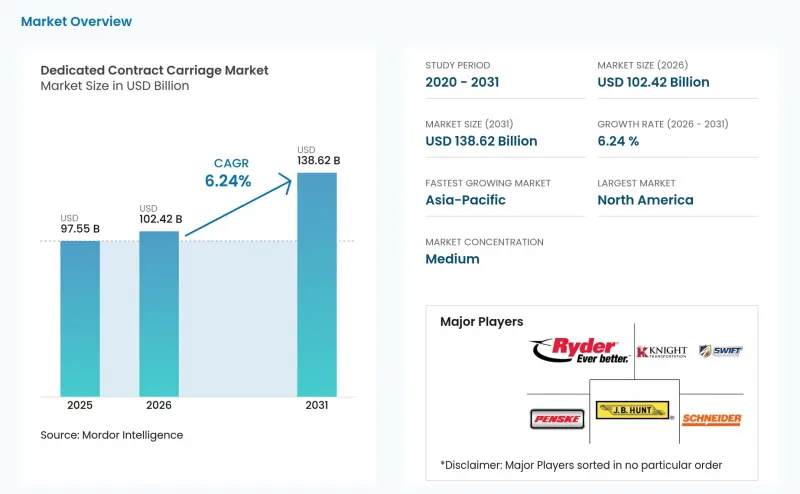
The dedicated contract carriage market is growing as shippers move driver management, equipment financing, and compliance responsibilities to specialized providers. This report is Segmented by Vehicle Type (Dry Van, Refrigerated, Flatbed, Tanker, Specialized), by Contract Duration (Short-Term, Medium-Term, Long-Term), by Customer Size (Large, Mid-Sized, Smes), by End-Use Industry (Automotive, Manufacturing, Life Sciences, and More), and by Geography (North America, South America, Europe, Asia-Pacific, MEA). The Market Forecasts are Provided in Value (USD).
Global Dedicated Contract Carriage Market Trends and Insights
E-commerce and Omnichannel Delivery Complexity
E-commerce has increased the frequency, speed, and dispersion of freight movements in the dedicated contract carriage market. Retailers use guaranteed-volume arrangements on city-to-city and ZIP-code lanes to manage delivery commitments across the year. These arrangements support networks that connect distribution centers, cross-docks, and urban micro-hubs in structured circuits. Dedicated providers can design those circuits around repeat freight flows, while ad hoc carrier capacity is less suited to recurring delivery schedules.This operating environment supports the dedicated contract carriage market, where omnichannel fulfillment needs reliable equipment and controlled delivery windows for customers.
Outsourcing Private Fleets to Release Capital and Transfer Risk
The dedicated contract carriage market offers a route for shippers to move fleet ownership responsibilities to a transportation provider. ATRI reported an operating-cost benchmark of USD 2.336 per mile in 2025, with labor, insurance, and maintenance contributing to fleet costs. Dedicated arrangements can transfer residual-value risk, liability exposure, equipment management, and driver administration to the provider. Such agreements can also include volume commitments, cost pass-through terms, and multi-year durations that give both parties a clearer operating framework. Food and beverage shippers face additional documentation and temperature-control responsibilities under the FDA sanitary transportation rule. These compliance demands make the dedicated contract carriage market relevant for companies that lack in-house cold-chain expertise.
Multi-year Contract Inflexibility Under Volume Volatility
The dedicated contract carriage market can create challenges when actual freight volumes fall below the fleet size in a multi-year agreement. A 3-to-5-year arrangement priced on projected truckload counts leaves both parties exposed when production, replenishment, or import patterns change. Manufacturing output declines and disruptions in trade patterns can make fixed capacity harder to use fully. Providers are responding with flex-fleet provisions and volume-band pricing in new agreements. These options improve operating flexibility but can reduce the cost certainty that attracted the shipper to outsourcing. Customer concentration adds another concern because a single contract change can alter a provider's fixed-cost base and affect its ability to grow.
Other drivers and restraints analyzed in the detailed report include:
- Capacity Assurance Amid Driver Shortages and Carrier Exits
- Fleet Electrification and Low-Emission Equipment as a Managed-Service Decision
- Driver Recruitment, Retention, and Wage Pressure
For complete list of drivers and restraints, kindly check the Table Of Contents.
Segment Analysis
Dry van held 37.63% of the share of the dedicated contract carriage market in 2025. Its position reflects wide compatibility with general merchandise freight for retail, manufacturing, and consumer goods customers. Fixed-lane dedicated networks can use dry van equipment efficiently where freight volumes are regular. Refrigerated and frozen equipment supports temperature-controlled food and grocery movements that are subject to the FDA sanitary transportation rule. This equipment is relevant for operators who need continuous temperature documentation and do not have in-house cold-chain capabilities.
Specialized and heavy-haul equipment registered at an 8.19% CAGR through 2031 within the dedicated contract carriage market. Renewable-energy infrastructure, semiconductor fabrication construction, and defense-related freight require engineered haul plans and permit coordination. These requirements favor contract capacity because specialized equipment is not consistently available in the spot market. Flatbed and step-deck equipment serve construction materials and oversized industrial loads when project delivery schedules are fixed. Tanker and bulk operations support energy, chemical, and agricultural freight, and their safety certifications make provider changes costly. State routing rules, escort requirements, and oversize permits add another reason for shippers to use experienced dedicated providers.
Long-term contracts exceeding 3 years commanded 48.38% of the dedicated contract carriage market size in 2025. Their role expanded during the freight downturn because customers value forward rate and capacity arrangements when spot rates rise. This recorded a 21% increase in dry van spot rates from March 2025 through mid-2026. Long-term arrangements also require providers to assess shipper credit quality, lane stability, and projected freight density. This due diligence helps providers allocate drivers and equipment to accounts with recurring demand.
Medium-term contracts are forecast to expand at an 7.89% CAGR through 2031. They offer an intermediate choice for organizations that are reducing their dependence on spot capacity before committing to longer agreements. Medium-term arrangements also allow a provider and customer to test operating fit before allocating more capital to the account. Short-term contracts of up to 1 year remain useful for seasonal operations and the 90-to-120-day implementation period for a new dedicated solution. However, these contracts offer less security for a carrier deciding whether to assign equipment to a customer. This contract mix keeps the dedicated contract carriage market responsive to both stable and changing shipper requirements.
Complete Report Scope:
- By Vehicle Type
- Dry Van
- Refrigerated and Frozen
- Flatbed and Step-deck
- Tanker and Bulk
- Specialized and Heavy-haul Equipment
- By Contract Duration
- Short-term Contracts, Up to 1 Year
- Medium-term Contracts, 1 to 3 Years
- Long-term Contracts, More Than 3 Years
- By Customer Size
- Large Enterprises
- Mid-sized Enterprises
- Small and Medium-sized Enterprises
- By End-use Industry
- Automotive
- Energy and Utilities
- Manufacturing
- Life Sciences and Healthcare
- Technology and Electronics
- Retail and E-commerce
- Consumer Goods and FMCG
- Food and Beverages
- Others
- By Geography
- North America
- United States
- Canada
- Mexico
- South America
- Brazil
- Argentina
- Peru
- Chile
- Rest of South America
- Europe
- Germany
- United Kingdom
- France
- Italy
- Spain
- Russia
- Nordics (Denmark, Finland, Iceland, Norway, and Sweden)
- Rest of Europe
- Asia-Pacific
- China
- India
- Japan
- South Korea
- Australia
- Southeast Asia (ASEAN)
- Rest of Asia-Pacific
- Middle East and Africa
- Saudi Arabia
- United Arab Emirates
- Qatar
- South Africa
- Nigeria
- Egypt
- Rest of Middle East and Africa
- North America
Geography Analysis
North America accounted for 31.29% of the share of the dedicated contract carriage market in 2025. The United States has a mature contractual trucking culture and substantial demand from e-commerce and manufacturing freight. Federal compliance requirements, state emissions rules, and liability exposure encourage large shippers to use professionally managed fleets. Canada adds national dedicated capacity through carriers, including Day & Ross and Canada Cartage. Mexico is gaining cross-border dedicated freight as nearshoring supports automotive and electronics production in Nuevo Leon, Coahuila, and Jalisco.
Asia-Pacific registered at an 8.10% CAGR through 2031 in the dedicated contract carriage market. China's policy objective to lower total social logistics costs to 13.5% of GDP by 2027 supports outsourcing to operators that can improve network efficiency. China Economic Net reported that total social logistics volume rose 4.9% year-over-year in the first 8 months of 2026. India's third-party logistics sector is supported by freight-corridor investment and production-led expansion in Maharashtra, Gujarat, and Tamil Nadu. Japan, South Korea, and Southeast Asian countries add demand from automotive, electronics, and cross-border e-commerce activity.
Europe is a mature road-freight region with a dedicated and contract logistics sector shaped by post-consolidation changes. The IRTU recorded rising contract rates in the first quarter of 2026. South America is emerging through manufacturing expansion in Brazil and Argentina. The Middle East and Africa show demand concentrated in the UAE, Saudi Arabia, and South Africa, where diversification programs support logistics infrastructure. These regional conditions broaden the addressable base for the dedicated contract carriage market.
- J.B. Hunt Transport Services, Inc.
- Ryder System, Inc.
- Schneider National, Inc.
- Penske Corporation
- Knight-Swift Transportation Holdings Inc.
- Werner Enterprises, Inc.
- NFI Industries
- Ruan Transportation Management Systems
- Lazer Logistics, Inc.
- C.R. England, Inc.
- Day & Ross Inc.
- Canada Cartage System LP
- CRST The Transportation Solution, Inc.
- CMA CGM Group
- TCI Transportation
- Covenant Logistics Group, Inc.
- DHL Group
- Universal Logistics Holdings, Inc.
- Marten Transport, Ltd.
- Venture Transport Logistics
- TA Dedicated
- Averitt Express, Inc.
- Hub Group, Inc.
- AIM Integrated Logistics
- Lineage, Inc.
- United Parcel Service, Inc.
- FedEx Corporation
- GEODIS
- DSV A/S
Additional Benefits:
- The market estimate (ME) sheet in Excel format
- 3 months of analyst support
TABLE OF CONTENTS
1 INTRODUCTION
- 1.1 Study Assumptions and Market Definition
- 1.2 Scope of the Study
2 RESEARCH METHODOLOGY
3 EXECUTIVE SUMMARY
4 MARKET LANDSCAPE
- 4.1 Market Overview
- 4.2 Market Drivers
- 4.2.1 E-commerce and Omnichannel Delivery Complexity
- 4.2.2 Outsourcing of Private Fleets to Release Capital and Transfer Risk
- 4.2.3 Capacity Assurance Amid Driver Shortages and Carrier Exits
- 4.2.4 Compliance-Cost Transfer Through Professionally Managed Fleets
- 4.2.5 Fleet Electrification and Low-Emission Equipment as a Managed-Service Decision
- 4.2.6 Account-Level Data Visibility and Route Optimization
- 4.3 Market Restraints
- 4.3.1 Multi-year Contract Inflexibility Under Volume Volatility
- 4.3.2 Driver Recruitment, Retention, and Wage Pressure
- 4.3.3 Equipment Availability, Financing Costs, and Charging Infrastructure Constraints
- 4.3.4 Customer Concentration and Account-Transition Risk
- 4.4 Value / Supply-Chain Analysis
- 4.5 Regulatory Landscape
- 4.6 Technological Outlook
- 4.7 Porter's Five Forces Analysis
- 4.7.1 Threat of New Entrants
- 4.7.2 Bargaining Power of Suppliers
- 4.7.3 Bargaining Power of Buyers
- 4.7.4 Threat of Substitutes
- 4.7.5 Competitive Rivalry
- 4.8 Impact of Geopolitical Events on the Market
5 Market Size & Growth Forecasts (Value in USD)
- 5.1 By Vehicle Type
- 5.1.1 Dry Van
- 5.1.2 Refrigerated and Frozen
- 5.1.3 Flatbed and Step-deck
- 5.1.4 Tanker and Bulk
- 5.1.5 Specialized and Heavy-haul Equipment
- 5.2 By Contract Duration
- 5.2.1 Short-term Contracts, Up to 1 Year
- 5.2.2 Medium-term Contracts, 1 to 3 Years
- 5.2.3 Long-term Contracts, More Than 3 Years
- 5.3 By Customer Size
- 5.3.1 Large Enterprises
- 5.3.2 Mid-sized Enterprises
- 5.3.3 Small and Medium-sized Enterprises
- 5.4 By End-use Industry
- 5.4.1 Automotive
- 5.4.2 Energy and Utilities
- 5.4.3 Manufacturing
- 5.4.4 Life Sciences and Healthcare
- 5.4.5 Technology and Electronics
- 5.4.6 Retail and E-commerce
- 5.4.7 Consumer Goods and FMCG
- 5.4.8 Food and Beverages
- 5.4.9 Others
- 5.5 By Geography
- 5.5.1 North America
- 5.5.1.1 United States
- 5.5.1.2 Canada
- 5.5.1.3 Mexico
- 5.5.2 South America
- 5.5.2.1 Brazil
- 5.5.2.2 Argentina
- 5.5.2.3 Peru
- 5.5.2.4 Chile
- 5.5.2.5 Rest of South America
- 5.5.3 Europe
- 5.5.3.1 Germany
- 5.5.3.2 United Kingdom
- 5.5.3.3 France
- 5.5.3.4 Italy
- 5.5.3.5 Spain
- 5.5.3.6 Russia
- 5.5.3.7 Nordics (Denmark, Finland, Iceland, Norway, and Sweden)
- 5.5.3.8 Rest of Europe
- 5.5.4 Asia-Pacific
- 5.5.4.1 China
- 5.5.4.2 India
- 5.5.4.3 Japan
- 5.5.4.4 South Korea
- 5.5.4.5 Australia
- 5.5.4.6 Southeast Asia (ASEAN)
- 5.5.4.7 Rest of Asia-Pacific
- 5.5.5 Middle East and Africa
- 5.5.5.1 Saudi Arabia
- 5.5.5.2 United Arab Emirates
- 5.5.5.3 Qatar
- 5.5.5.4 South Africa
- 5.5.5.5 Nigeria
- 5.5.5.6 Egypt
- 5.5.5.7 Rest of Middle East and Africa
- 5.5.1 North America
6 Competitive Landscape
- 6.1 Market Concentration
- 6.2 Key Strategic Moves in the Market
- 6.3 Market Share Analysis
- 6.4 Company Profiles (includes Global Level Overview, Market Level Overview, Core Segments, Financials as available, Strategic Information, Geographic/Network Coverage, Products and Services, Recent Developments)
- 6.4.1 J.B. Hunt Transport Services, Inc.
- 6.4.2 Ryder System, Inc.
- 6.4.3 Schneider National, Inc.
- 6.4.4 Penske Corporation
- 6.4.5 Knight-Swift Transportation Holdings Inc.
- 6.4.6 Werner Enterprises, Inc.
- 6.4.7 NFI Industries
- 6.4.8 Ruan Transportation Management Systems
- 6.4.9 Lazer Logistics, Inc.
- 6.4.10 C.R. England, Inc.
- 6.4.11 Day & Ross Inc.
- 6.4.12 Canada Cartage System LP
- 6.4.13 CRST The Transportation Solution, Inc.
- 6.4.14 CMA CGM Group
- 6.4.15 TCI Transportation
- 6.4.16 Covenant Logistics Group, Inc.
- 6.4.17 DHL Group
- 6.4.18 Universal Logistics Holdings, Inc.
- 6.4.19 Marten Transport, Ltd.
- 6.4.20 Venture Transport Logistics
- 6.4.21 TA Dedicated
- 6.4.22 Averitt Express, Inc.
- 6.4.23 Hub Group, Inc.
- 6.4.24 AIM Integrated Logistics
- 6.4.25 Lineage, Inc.
- 6.4.26 United Parcel Service, Inc.
- 6.4.27 FedEx Corporation
- 6.4.28 GEODIS
- 6.4.29 DSV A/S
7 MARKET OPPORTUNITIES AND FUTURE OUTLOOK
- 7.1 White-Space and Unmet-Need Assessment

