PUBLISHER: Mordor Intelligence | PRODUCT CODE: 2125693

PUBLISHER: Mordor Intelligence | PRODUCT CODE: 2125693
India Contract Logistics - Market Share Analysis, Industry Trends & Statistics, Growth Forecasts (2026 - 2031)
According to Mordor Intelligence, the India contract logistics market size was valued at USD 20.78 billion in 2025 and estimated to grow from USD 22.28 billion in 2026 to reach USD 31.58 billion by 2031, at a CAGR of 7.22% during the forecast period (2026-2031).
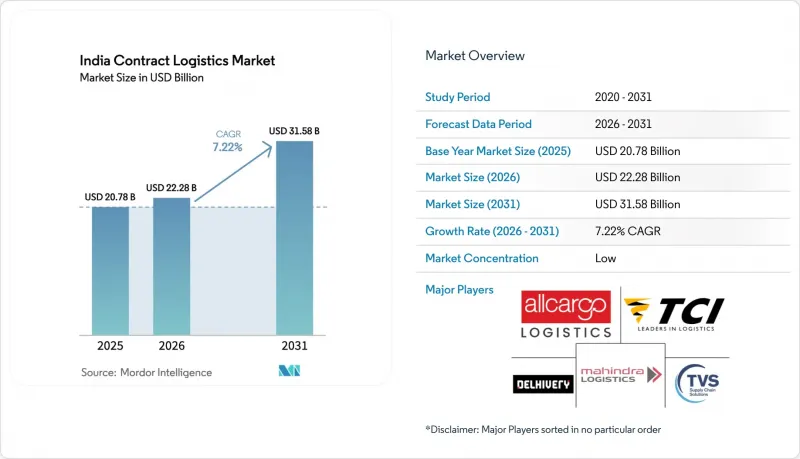
This report is Segmented by Service Type (Transportation, Warehousing & Distribution, and Value-Added Services), Contract Duration (1-3 Years and Above 3 Years), End-User Industry (Manufacturing & Automotive, Food & Beverage, Retail & E-Commerce, Healthcare & Pharmaceuticals, Chemicals, and Other Industries). The Market Forecasts are Provided in Terms of Value (USD).
India Contract Logistics Market Trends and Insights
Surge in e-commerce & omni-channel retail
E-commerce volumes continue to double-digit climb, with online grocery alone tracking toward INR 2.1 lakh crore (USD 24.6 billion) by 2027. More than 4,000 dark stores now dot major metros, and network densification is migrating into tier-II and III clusters where last-mile costs remain elevated. Retailers adopting omni-channel models require synchronized inventory and reverse-logistics flows, prompting 3PLs to deploy micro-fulfillment sites within 2-3 km of customers. The India contract logistics market thus pivots toward dynamic routing software and on-demand capacity to uphold sub-30-minute delivery promises. As organized retail penetration is expected to reach 60% by 2028, integrated service providers that combine B2B replenishment with direct-to-consumer fulfillment gain a competitive edge.
Government infrastructure push (NLP, Gati-Shakti)
The PM Gati Shakti platform has onboarded 44 central ministries, mapping 200+ projects to a single GIS interface to accelerate multimodal corridor execution. Expressway mileage, dedicated freight corridors, and logistics parks receive synchronized clearances, shrinking cross-state transit at erstwhile choke points. The Unified Logistics Interface Platform unifies shipment visibility across ports, railways, and road transport, trimming documentation time that earlier inflated travel duration by 60%. While land acquisition delays persist, standardized asset specifications and digital permits are steadily lifting asset utilization rates for fleet owners and warehouse operators within the India contract logistics market.
Skilled warehouse & SCM labour shortage
Only 5% of India's 150 million blue-collar workforce is formally trained, resulting in chronic shortages for forklift operators, inventory analysts, and robotics technicians. Employers in manufacturing hubs extend overtime and boost wages to secure talent, inflating operating costs for the India contract logistics market. Automation alleviates repetitive tasks yet raises demand for specialized maintenance roles, reinforcing the training imperative.
Other drivers and restraints analyzed in the detailed report include:
- Rising 3PL outsourcing by manufacturers
- Post-GST network consolidation benefits
- High CAPEX for Grade-A automation
For complete list of drivers and restraints, kindly check the Table Of Contents.
Segment Analysis
Transportation services stood at 61.34% of the India contract logistics market in 2025, with road fleets carrying the bulk of e-commerce and FMCG loads despite rail corridor gains. Value-added services represent the swiftest trajectory, registering a 6.18% CAGR through 2031. The segment benefits from manufacturers outsourcing kitting and labeling to 3PLs equipped with handheld scanners and AI slotting engines. Blue Dart's Delhi hub, capable of processing 550,000 parcels daily via automated sorters, typifies the shift toward high-throughput nodes.
Warehousing and distribution thrive on GST-driven depot consolidation, lifting large-box Grade-A stock across Mumbai, NCR, and Bengaluru. Modal mix diversification progresses as dedicated freight corridors attract bulk cargo, yet road retains primacy for last-mile flexibility. Tech adoption across service types accelerates; Allcargo Gati introduced machine-learning-guided handheld printers to shave mis-sort errors and boost on-time performance within the India contract logistics market.
Complete Report Scope:
- By Service Type
- Transportation
- Road
- Rail
- Air
- Sea
- Warehousing & Distribution
- Value-added Services (Assembly, Labelling, Kitting)
- Transportation
- By Contract Duration
- 1 - 3 Years
- Above 3 years
- By End-user Industry
- Manufacturing & Automotive
- Food & Beverage
- Retail & E-commerce
- Healthcare & Pharmaceuticals
- Chemicals
- Other Industries
List of Companies Covered in this Report:
- Allcargo Logistics Ltd
- TVS Supply Chain Solutions
- Transport Corporation of India (TCI)
- Mahindra Logistics Ltd
- Delhivery Ltd
- Blue Dart Express Ltd
- Safexpress Pvt Ltd
- Adani Logistics Ltd
- Yusen Logistics
- VRL Logistics
- Deutsche Post DHL Group
- Kuehne + Nagel Pvt Ltd
- CEVA Logistics
- DSV
- FedEx Corp.
- Nippon Express
- CH Robinson
- Hellmann Worldwide Logistics
- Holisol Logistics
- Varuna Group
Additional Benefits:
- The market estimate (ME) sheet in Excel format
- 3 months of analyst support
TABLE OF CONTENTS
1 Introduction
- 1.1 Study Assumptions & Market Definition
- 1.2 Scope of the Study
2 Research Methodology
3 Executive Summary
4 Market Landscape
- 4.1 Market Overview
- 4.2 Market Drivers
- 4.2.1 Surge in e-commerce & omni-channel retail
- 4.2.2 Government infrastructure push (NLP, Gati-Shakti)
- 4.2.3 Rising 3PL outsourcing by manufacturers
- 4.2.4 Post-GST network consolidation benefits
- 4.2.5 Tier-II/III hyper-local dark-store boom
- 4.2.6 CLaaS demand from D2C & quick-commerce brands
- 4.3 Market Restraints
- 4.3.1 Skilled warehouse & SCM labour shortage
- 4.3.2 High CAPEX for Grade-A automation
- 4.3.3 Inter-state compliance frictions post-GST
- 4.3.4 Cyber-security risks to digital control towers
- 4.4 Value / Supply-Chain Analysis
- 4.5 Regulatory Landscape
- 4.6 Technological Outlook
- 4.7 Insights on E-Commerce Landscape
- 4.8 Insights on Reverse Logistics
- 4.9 Impact Analysis - Implementation of GST
- 4.10 Key Special Economic Zones (SEZs) & Manufacturing Hubs
- 4.11 Impact of Geopolitics & Pandemic Events
- 4.12 Porter's Five Forces
- 4.12.1 Bargaining Power of Suppliers
- 4.12.2 Bargaining Power of Buyers
- 4.12.3 Threat of New Entrants
- 4.12.4 Threat of Substitutes
- 4.12.5 Intensity of Competitive Rivalry
5 Market Size & Growth Forecasts
- 5.1 By Service Type
- 5.1.1 Transportation
- 5.1.1.1 Road
- 5.1.1.2 Rail
- 5.1.1.3 Air
- 5.1.1.4 Sea
- 5.1.2 Warehousing & Distribution
- 5.1.3 Value-added Services (Assembly, Labelling, Kitting)
- 5.1.1 Transportation
- 5.2 By Contract Duration
- 5.2.1 1 - 3 Years
- 5.2.2 Above 3 years
- 5.3 By End-user Industry
- 5.3.1 Manufacturing & Automotive
- 5.3.2 Food & Beverage
- 5.3.3 Retail & E-commerce
- 5.3.4 Healthcare & Pharmaceuticals
- 5.3.5 Chemicals
- 5.3.6 Other Industries
6 Competitive Landscape
- 6.1 Market Concentration
- 6.2 Strategic Moves (M&A, JV, Fund-Raising, Tech Partnerships)
- 6.3 Market Share Analysis
- 6.4 Company Profiles (includes Global level Overview, Market level overview, Core Segments, Financials as available, Strategic Information, Market Rank/Share for key companies, Products & Services, and Recent Developments)
- 6.4.1 Allcargo Logistics Ltd
- 6.4.2 TVS Supply Chain Solutions
- 6.4.3 Transport Corporation of India (TCI)
- 6.4.4 Mahindra Logistics Ltd
- 6.4.5 Delhivery Ltd
- 6.4.6 Blue Dart Express Ltd
- 6.4.7 Safexpress Pvt Ltd
- 6.4.8 Adani Logistics Ltd
- 6.4.9 Yusen Logistics
- 6.4.10 VRL Logistics
- 6.4.11 Deutsche Post DHL Group
- 6.4.12 Kuehne + Nagel Pvt Ltd
- 6.4.13 CEVA Logistics
- 6.4.14 DSV
- 6.4.15 FedEx Corp.
- 6.4.16 Nippon Express
- 6.4.17 CH Robinson
- 6.4.18 Hellmann Worldwide Logistics
- 6.4.19 Holisol Logistics
- 6.4.20 Varuna Group
7 Market Opportunities & Future Outlook
- 7.1 White-space & Unmet-need Assessment

