PUBLISHER: Mordor Intelligence | PRODUCT CODE: 2124011

PUBLISHER: Mordor Intelligence | PRODUCT CODE: 2124011
United States Contract Logistics - Market Share Analysis, Industry Trends & Statistics, Growth Forecasts (2026 - 2031)
According to Mordor Intelligence, the United States contract logistics market size was valued at USD 62.37 billion in 2025 and estimated to grow from USD 64.74 billion in 2026 to reach USD 78.01 billion by 2031, at a CAGR of 3.80% during the forecast period (2026-2031).
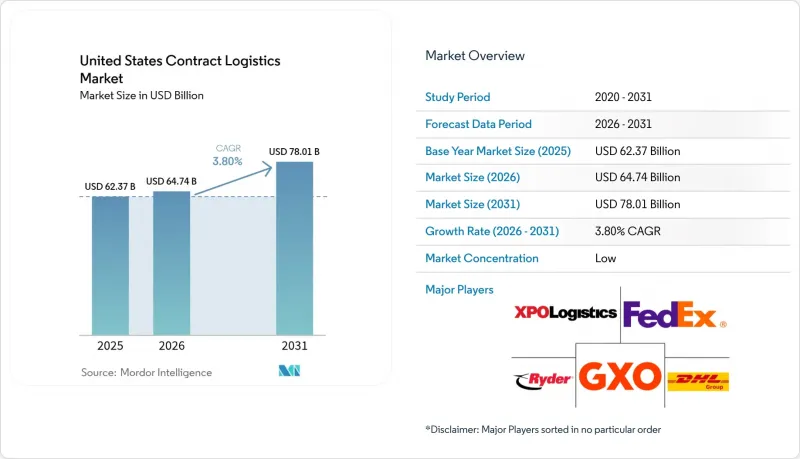
This report is Segmented by Service Type (Transportation, Warehousing & Distribution, and Value-Added Services), Contract Duration (1-3 Years and Above 3 Years), End-User Industry (Manufacturing & Automotive, Food & Beverage, Retail & E-Commerce, Healthcare & Pharmaceuticals, Chemicals, and Other Industries). The Market Forecasts are Provided in Terms of Value (USD).
United States Contract Logistics Market Trends and Insights
Explosive e-commerce fulfillment demand
Persistent online shopping makes inventory velocity a year-round constraint. Amazon delivered more than 9 billion items via same-day and next-day services in 2024, a 30% year-over-year jump. Rural penetration covering 4,000+ small towns reshapes network topology, compelling contractors to craft micro-fulfillment and flexible capacity models. Walmart's closure of a legacy fulfillment site while opening automated centers that cut 12 process steps to 5 shows how speed trumps footprint. DOT hours-of-service regulations further dictate route planning, forcing compliance-aligned shifts in facility location. The United States contract logistics market continues to funnel capital into real-time visibility and short-haul transport solutions that shrink order-to-delivery windows.
Surge in cold-chain & healthcare logistics
DHL's USD 1.1 billion North American outlay illustrates how temperature-controlled know-how has evolved into an entry barrier. Acquisitions such as Cryopdp, which handles 600,000 clinical-trial moves yearly, exemplify the push toward white-glove services for cell-and-gene therapies requiring sub-zero maintenance. The FDA Good Distribution Practice mandates now attach steep penalties to temperature excursions, compelling providers to deploy IoT sensors and redundant power. The United States contract logistics market, therefore, prizes GDP-certified space and trained personnel, with cold-chain square footage like Cold Zone's 170,000-sq-ft Springfield site signaling further expansion.
Acute warehouse & driver labor shortages
FMCSA English-proficiency rules, effective June 2025, risk sidelining 10% of drivers, lifting tender rejections, and tightening capacity. Transportation and warehousing hiring added 14,000 positions in July 2024, yet 51% driver turnover undermined headcount stability. Wage inflation persists as Amazon's rural delivery wages far exceed federal minimums. Shortfalls are profound in CDL-A and hazmat-certified positions, directly constraining healthcare and chemical freight lanes within the United States contract logistics market.
Other drivers and restraints analyzed in the detailed report include:
- Automation-first warehouses & AI orchestration
- Near-shoring to Mexico boosting cross-border flows
- Fuel-price and freight-rate volatility
For complete list of drivers and restraints, kindly check the Table Of Contents.
Segment Analysis
Transportation claims 64.35% of the United States contract logistics market share in 2025, buoyed by road carriers that moved 72.2% of U.S.-Mexico freight. Yet, warehousing & distribution is growing faster at 3.12% CAGR as e-commerce demands distributed inventory that elevates storage-and-pick services. Rail's single-line Canada-to-Mexico network following the CP-KC merger improves intermodal reliability, although market power concentration may raise rates. Air lifts time-sensitive cargo but remains vulnerable to fuel swings. Sea lanes gain from port upgrades but confront labor-automation gridlock.
Warehouse square footage receives disproportionate capital as automation boosts pick rates and slot-density. Amazon's shift from March Air Reserve Base to San Bernardino proves network fluidity. Veritiv's USD 60 million AmeriPac buy points to a strong appetite for value-added kitting, assembly, and postponement processes that lock in customers during seasonal bursts. These services carry higher margins than pure transport and reduce revenue volatility across the United States contract logistics market.
Complete Report Scope:
- By Service Type
- Transportation
- Road
- Rail
- Air
- Sea
- Warehousing & Distribution
- Value-added Services (Assembly, Labelling, Kitting)
- Transportation
- By Contract Duration
- 1 - 3 Years
- Above 3 years
- By End-user Industry
- Manufacturing & Automotive
- Food & Beverage
- Retail & E-commerce
- Healthcare & Pharmaceuticals
- Chemicals
- Other Industries
List of Companies Covered in this Report:
- DHL Supply Chain
- XPO Logistics
- GXO Logistics
- Ryder Supply Chain Solutions
- FedEx Logistics
- UPS Supply Chain Solutions
- C.H. Robinson
- Penske Logistics
- Buske Logistics
- DSV
- GEODIS
- Kuehne + Nagel
- Ceva Logistics
- Werner Enterprises
- Burris Logistics
- Hub Group
- Penske Logistics
- J.B. Hunt
- Saddle Creek Logistics
- Capstone Logistics
Additional Benefits:
- The market estimate (ME) sheet in Excel format
- 3 months of analyst support
TABLE OF CONTENTS
1 Introduction
- 1.1 Study Assumptions & Market Definition
- 1.2 Scope of the Study
2 Research Methodology
3 Executive Summary
4 Market Landscape
- 4.1 Market Overview
- 4.2 Market Drivers
- 4.2.1 Explosive e-commerce fulfilment demand
- 4.2.2 Surge in cold-chain & healthcare logistics
- 4.2.3 Automation-first warehouses & AI orchestration
- 4.2.4 Near-shoring to Mexico boosting cross-border flows
- 4.2.5 OEM shift to Build-to-Order logistics models
- 4.2.6 Exploding reverse-logistics volumes from returns & recommerce
- 4.3 Market Restraints
- 4.3.1 Acute warehouse & driver labour shortages
- 4.3.2 Fuel-price and freight-rate volatility
- 4.3.3 Coastal port realignments creating network risk
- 4.3.4 Rising cybersecurity & data-privacy compliance costs
- 4.4 Value / Supply-Chain Analysis
- 4.5 Regulatory Landscape
- 4.6 Technological Outlook
- 4.7 Porter's Five Forces
- 4.7.1 Threat of New Entrants
- 4.7.2 Bargaining Power of Buyers
- 4.7.3 Bargaining Power of Suppliers
- 4.7.4 Threat of Substitutes
- 4.7.5 Competitive Rivalry
5 Market Size & Growth Forecasts
- 5.1 By Service Type
- 5.1.1 Transportation
- 5.1.1.1 Road
- 5.1.1.2 Rail
- 5.1.1.3 Air
- 5.1.1.4 Sea
- 5.1.2 Warehousing & Distribution
- 5.1.3 Value-added Services (Assembly, Labelling, Kitting)
- 5.1.1 Transportation
- 5.2 By Contract Duration
- 5.2.1 1 - 3 Years
- 5.2.2 Above 3 years
- 5.3 By End-user Industry
- 5.3.1 Manufacturing & Automotive
- 5.3.2 Food & Beverage
- 5.3.3 Retail & E-commerce
- 5.3.4 Healthcare & Pharmaceuticals
- 5.3.5 Chemicals
- 5.3.6 Other Industries
6 Competitive Landscape
- 6.1 Market Concentration
- 6.2 Strategic Moves
- 6.3 Market Share Analysis
- 6.4 Company Profiles
- 6.4.1 DHL Supply Chain
- 6.4.2 XPO Logistics
- 6.4.3 GXO Logistics
- 6.4.4 Ryder Supply Chain Solutions
- 6.4.5 FedEx Logistics
- 6.4.6 UPS Supply Chain Solutions
- 6.4.7 C.H. Robinson
- 6.4.8 Penske Logistics
- 6.4.9 Buske Logistics
- 6.4.10 DSV
- 6.4.11 GEODIS
- 6.4.12 Kuehne + Nagel
- 6.4.13 Ceva Logistics
- 6.4.14 Werner Enterprises
- 6.4.15 Burris Logistics
- 6.4.16 Hub Group
- 6.4.17 Penske Logistics
- 6.4.18 J.B. Hunt
- 6.4.19 Saddle Creek Logistics
- 6.4.20 Capstone Logistics
7 Market Opportunities & Future Outlook
- 7.1 White-space & Unmet-need Assessment

