PUBLISHER: Mordor Intelligence | PRODUCT CODE: 2124026

PUBLISHER: Mordor Intelligence | PRODUCT CODE: 2124026
Screen Print Label - Market Share Analysis, Industry Trends & Statistics, Growth Forecasts (2026 - 2031)
According to Mordor Intelligence, screen print label market size in 2026 is estimated at USD 2.51 billion, growing from 2025 value of USD 2.44 billion with 2031 projections showing USD 2.83 billion, growing at 2.53% CAGR over 2026-2031.
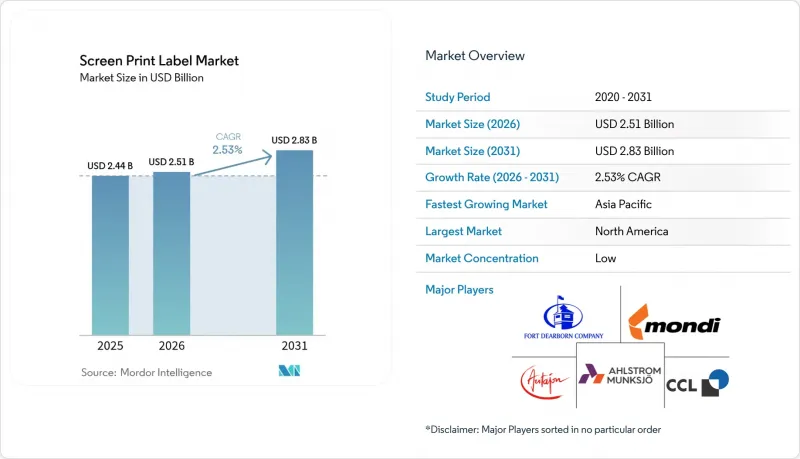
This report is Segmented by Type (Shrink Sleeves Label, Linerless Label, and More), End User (Fashion and Apparels, Food, Beverages, and More), Printing Ink Type (Solvent-Based, Water-Based, UV-Curable, and More), Substrate Material (Paper, Plastic Films, Glass, Metal, and More), and Geography. The Market Forecasts are Provided in Terms of Value (USD).
Global Screen Print Label Market Trends and Insights
Durable Branding for Fast-Moving Consumer Goods
Brand owners mandate labels that survive xenon-arc exposure, repeated abrasion, and refill-pack cycles. Unilever requires color stability within Delta E 2.0 after 2,000 hours of light aging, which water-based screen inks achieve through high titanium dioxide loading. Procter and Gamble's 50-double-rub threshold under ASTM D5264 keeps solvent-based digital inks off qualified lists. As Europe shifts to refillable packs, labels must also withstand 15-20 hot-wash cycles without delaminating.
Robust Labels for E-Commerce Fulfillment
Amazon's 2024 packaging rules require labels that remain intact after 48 hours of water immersion, directing fulfillment centers toward polyester screen constructions with acrylic adhesives. ISTA 3L drop tests add 40-60 G shock loads, so converters raise adhesive coverage to 85% of the footprint. FedEx specifies a minimum peel adhesion of 16 oz/in after 72 hours, which solvent-acrylic screen inks exceed by up to 35%.
High Cost of Multicolor Screen-Printing Setups
Rotary equipment needs USD 800,000-1.2 million upfront, four to five times the ticket price of an entry-level digital press. Make-ready still takes 45-90 minutes, delaying short runs and increasing scrap. Emerging-market converters, therefore, delay capacity additions until interest rates ease or orders shift to longer repeats.
Other drivers and restraints analyzed in the detailed report include:
- Advancements in UV-LED Screen Printing Equipment
- Smart-Label Integration with RFID and QR Codes
- Competition from Digital Inkjet Label Printing
For complete list of drivers and restraints, kindly check the Table Of Contents.
Segment Analysis
Shrink sleeves accounted for 38.12% of 2025 revenue and are expected to advance at a 3.38% CAGR, helping the screen print label market outpace commodity pressure-sensitive formats. The segment benefits from 360-degree graphic coverage, steam tunnel shrinkage of up to 78%, and compatibility with irregular container designs. Energy-efficient films such as Pentalabel Boost cut steam use by 30%, shaving USD 0.008-0.012 per container. Linerless solutions lag in share but appeal to logistics customers seeking waste-free workflows. Wet-glued labels cling to legacy glass-bottle lines in beer, yet this niche is shrinking as cans gain traction. Heat-transfer decals for apparel and in-mold options for durable goods complete the mix, each serving specialized requirements that sustain price premiums.
Sustainability and authentication extend the growth runway. Screen-printed holographic foils deter counterfeiters in the spirits and cosmetics industries, while washable inks enable the use of returnable packaging loops. Craft beverage brands exploit raised varnish and tactile effects that digital cannot replicate at production speed. Although shrink-film recycling remains a hurdle, mono-material polyethylene sleeves and delaminating adhesives promise end-of-life gains that align with retailer targets.
Food brands held 28.10% of 2025 sales as allergen and tamper-evidence rules kept volumes high, but cosmetics and personal care is set for the fastest 4.38% CAGR. Prestige lines demand metallic inks, soft-touch varnish, and chemical endurance that only UV-screen builds provide. L'Oreal now specifies ink cross-link density above 85% to survive 30-day immersion in oily formulations. Upcoming FDA healthy-claim labels add more variable data, a task that hybrid screen-digital workflows solve without color drift.
Beverage applications enjoy mid-teens share as craft breweries order textured labels that reinforce artisanal cues. Pharmaceutical serialization utilizes two-dimensional codes at 600 dpi, whereas industrial applications require labels that withstand exposure to mineral spirits. Fashion labels grow modestly as fast-fashion brands adopt direct-to-garment printing; yet, luxury houses still favor woven satin with screen-printed logos for their brand heritage.
Complete Report Scope:
- By Type
- Shrink Sleeves Label
- Linerless Label
- Wet-Glued Label
- Other Types
- By End User
- Fashion and Apparels
- Food
- Beverages
- Cosmetics and Personal Care
- Other End Users
- By Printing Ink Type
- Solvent-Based
- Water-Based
- UV-Curable
- Silicone Ink
- Other Printing Ink Types
- By Substrate Material
- Paper
- Plastic Films
- Glass
- Metal
- Fabric
- Other Substrates
- By Geography
- North America
- United States
- Canada
- Mexico
- South America
- Brazil
- Argentina
- Rest of South America
- Europe
- Germany
- United Kingdom
- France
- Italy
- Spain
- Rest of Europe
- Asia Pacific
- China
- Japan
- India
- South Korea
- Australia and New Zealand
- Rest of Asia Pacific
- Middle East and Africa
- Middle East
- Saudi Arabia
- United Arab Emirates
- Turkey
- Rest of Middle East
- Africa
- South Africa
- Egypt
- Nigeria
- Rest of Africa
- Middle East
- North America
Geography Analysis
North America accounted for 39.70% of 2025 revenue, driven by the Drug Supply Chain Security Act serialization, which spurred double-digit reprint demand. United States converters invested up to USD 220 million in UV-LED capacity, winning craft beverage and specialty food contracts that crave metallic inks and tactile finishes. Canada's bilingual label law increased information density, a benefit for opaque screen inks. Mexico's electronics maquiladoras specified polyimide labels rated for 260 °C reflow, reinforcing regional demand.
Europe accounted for roughly one-quarter of sales. The Packaging and Packaging Waste Regulation mandates 65% recycled content in labels by 2030, prompting converters to shift toward mono-material builds. Germany's VerpackG fees on non-recyclables and the United Kingdom's UKCA symbol changeover fueled short-run orders that favored screen printing. Security holograms for authenticating the origin of olive oil and wine remain a resilient niche.
The Asia-Pacific region is expected to post a 4.98% CAGR through 2031 due to China's late-2025 QR-code deadline, which will affect billions of packaged food units. India's IS 17142:2024 adhesion rule accelerates the adoption of wet glue in humid coastal corridors. Japanese tax credits for solvent-free presses, South Korean deposit fees on label waste, and Australian ISO 22000 export standards further expand regional uptake. Middle East and African growth hovers near mid-single digits, with Saudi localization rules and South African local-content thresholds prompting domestic press installations.
- 3M Company
- Ahlstrom-Munksjo Oyj
- Autajon Group
- Avery Dennison Corporation
- Brady Corporation
- CCL Industries Inc.
- Constantia Flexibles Group GmbH
- Coveris Group
- Fort Dearborn Company
- Fuji Seal International Inc.
- Gallus Ferd. Ruesch AG
- Huhtamaki Oyj
- Inland Label and Marketing Services LLC
- Lintec Corporation
- Mondi plc
- Multi-Color Corporation
- R.R. Donnelley and Sons Company
- SATO Holdings Corporation
- TSC Auto ID Technology Co. Ltd.
- UPM Raflatac (UPM-Kymmene Corporation)
- Xeikon (Flint Group)
Additional Benefits:
- The market estimate (ME) sheet in Excel format
- 3 months of analyst support
TABLE OF CONTENTS
1 INTRODUCTION
- 1.1 Study Assumptions and Market Definition
- 1.2 Scope of the Study
2 RESEARCH METHODOLOGY
3 EXECUTIVE SUMMARY
4 MARKET LANDSCAPE
- 4.1 Market Overview
- 4.2 Market Drivers
- 4.2.1 Rising Demand for Durable Branding Solutions in Fast-Moving Consumer Goods
- 4.2.2 Growth of E-Commerce Requiring Robust Packaging Labels
- 4.2.3 Advancements in UV-LED Screen Printing Equipment
- 4.2.4 Proliferation of Smart Label Features Integrating RFID and QR Codes
- 4.2.5 Sustainability Push Toward Solvent-Free Screen Printing Inks
- 4.2.6 Increasing Adoption of Heat-Resistant Labels in Electric Vehicle Batteries
- 4.3 Market Restraints
- 4.3.1 High Cost of Multicolor Screen Printing Setups
- 4.3.2 Competition from Digital Inkjet Label Printing
- 4.3.3 Volatility in Petrochemical Raw Material Prices for Inks
- 4.3.4 Stringent Environmental Regulations on Volatile Organic Compound Emissions
- 4.4 Industry Value Chain Analysis
- 4.5 Impact of Macroeconomic Factors on the Market
- 4.6 Regulatory Landscape
- 4.7 Technological Outlook
- 4.8 Porter's Five Forces Analysis
- 4.8.1 Threat of New Entrants
- 4.8.2 Bargaining Power of Buyers or Consumers
- 4.8.3 Bargaining Power of Suppliers
- 4.8.4 Threat of Substitute Products
- 4.8.5 Intensity of Competitive Rivalry
5 MARKET SIZE AND GROWTH FORECASTS (VALUE)
- 5.1 By Type
- 5.1.1 Shrink Sleeves Label
- 5.1.2 Linerless Label
- 5.1.3 Wet-Glued Label
- 5.1.4 Other Types
- 5.2 By End User
- 5.2.1 Fashion and Apparels
- 5.2.2 Food
- 5.2.3 Beverages
- 5.2.4 Cosmetics and Personal Care
- 5.2.5 Other End Users
- 5.3 By Printing Ink Type
- 5.3.1 Solvent-Based
- 5.3.2 Water-Based
- 5.3.3 UV-Curable
- 5.3.4 Silicone Ink
- 5.3.5 Other Printing Ink Types
- 5.4 By Substrate Material
- 5.4.1 Paper
- 5.4.2 Plastic Films
- 5.4.3 Glass
- 5.4.4 Metal
- 5.4.5 Fabric
- 5.4.6 Other Substrates
- 5.5 By Geography
- 5.5.1 North America
- 5.5.1.1 United States
- 5.5.1.2 Canada
- 5.5.1.3 Mexico
- 5.5.2 South America
- 5.5.2.1 Brazil
- 5.5.2.2 Argentina
- 5.5.2.3 Rest of South America
- 5.5.3 Europe
- 5.5.3.1 Germany
- 5.5.3.2 United Kingdom
- 5.5.3.3 France
- 5.5.3.4 Italy
- 5.5.3.5 Spain
- 5.5.3.6 Rest of Europe
- 5.5.4 Asia Pacific
- 5.5.4.1 China
- 5.5.4.2 Japan
- 5.5.4.3 India
- 5.5.4.4 South Korea
- 5.5.4.5 Australia and New Zealand
- 5.5.4.6 Rest of Asia Pacific
- 5.5.5 Middle East and Africa
- 5.5.5.1 Middle East
- 5.5.5.1.1 Saudi Arabia
- 5.5.5.1.2 United Arab Emirates
- 5.5.5.1.3 Turkey
- 5.5.5.1.4 Rest of Middle East
- 5.5.5.2 Africa
- 5.5.5.2.1 South Africa
- 5.5.5.2.2 Egypt
- 5.5.5.2.3 Nigeria
- 5.5.5.2.4 Rest of Africa
- 5.5.5.1 Middle East
- 5.5.1 North America
6 COMPETITIVE LANDSCAPE
- 6.1 Market Concentration
- 6.2 Strategic Moves
- 6.3 Market Share Analysis
- 6.4 Company Profiles (includes Global Level Overview, Market Level Overview, Core Segments, Financials as Available, Strategic Information, Market Rank or Share for Key Companies, Products and Services, and Recent Developments)
- 6.4.1 3M Company
- 6.4.2 Ahlstrom-Munksjo Oyj
- 6.4.3 Autajon Group
- 6.4.4 Avery Dennison Corporation
- 6.4.5 Brady Corporation
- 6.4.6 CCL Industries Inc.
- 6.4.7 Constantia Flexibles Group GmbH
- 6.4.8 Coveris Group
- 6.4.9 Fort Dearborn Company
- 6.4.10 Fuji Seal International Inc.
- 6.4.11 Gallus Ferd. Ruesch AG
- 6.4.12 Huhtamaki Oyj
- 6.4.13 Inland Label and Marketing Services LLC
- 6.4.14 Lintec Corporation
- 6.4.15 Mondi plc
- 6.4.16 Multi-Color Corporation
- 6.4.17 R.R. Donnelley and Sons Company
- 6.4.18 SATO Holdings Corporation
- 6.4.19 TSC Auto ID Technology Co. Ltd.
- 6.4.20 UPM Raflatac (UPM-Kymmene Corporation)
- 6.4.21 Xeikon (Flint Group)
7 MARKET OPPORTUNITIES AND FUTURE OUTLOOK
- 7.1 White-Space and Unmet-Need Assessment

