PUBLISHER: Mordor Intelligence | PRODUCT CODE: 2124677

PUBLISHER: Mordor Intelligence | PRODUCT CODE: 2124677
United States Print Label - Market Share Analysis, Industry Trends & Statistics, Growth Forecasts (2026 - 2031)
According to Mordor Intelligence, the United States print label market size is projected to expand from USD 9.15 billion in 2025 and USD 9.33 billion in 2026 to USD 10.77 billion by 2031, registering a CAGR of 2.92% between 2026 to 2031.
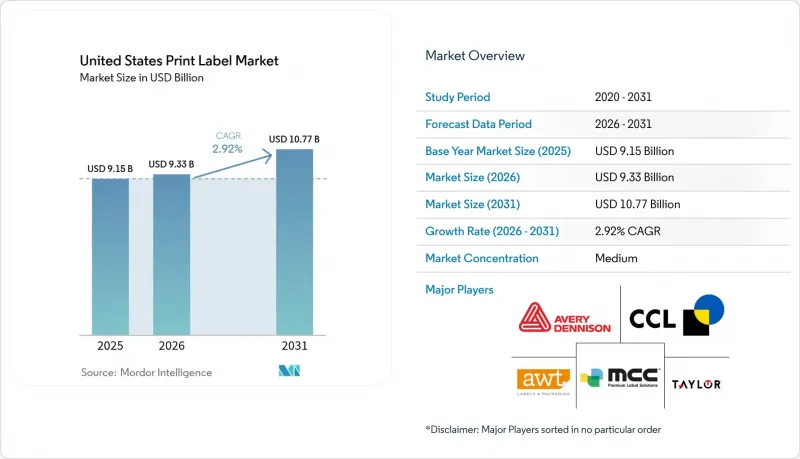
This report is Segmented by Substrate Material (Paper and Paperboard, PET, PVC, Biobased and Compostable Films, and More), Print Technology (Offset, Flexography, Screen, Digital Printing, and More), Label Type (Wet-Glued, Pressure-Sensitive, Liner-Less, In-Mold, Shrink Sleeve, and More), End-User Industry (Food, Beverage, Industrial, and More). Market Forecasts are Provided in Terms of Value (USD).
United States Print Label Market Trends and Insights
Digital Print Technology Penetration
Digital printing already accounts for roughly one-fifth of United States print label market value even though it represents less than one-tenth of unit volume. Converters report that most digital orders run below 5,000 pieces and ship within 48 hours, metrics unattainable for plate-based flexography, so brand owners pay a premium for rapid SKU proliferation and late-stage customization. Hybrid presses that combine flexographic white or spot colors with digital overprints allow converters to amortize their existing narrow-web infrastructure while capturing high-margin short runs. Inline finishing die-cutting, lamination, and foil stamping eliminates secondary steps, slashing makeready waste and supporting sustainability scorecards. Equipment vendors are responding with wider-web digital units, which should lower the cost per square meter and lift digital's share of the United States print label market over the medium term.
Healthcare and Cosmetics Label Uptake
Serialization deadlines under the Drug Supply Chain Security Act forced pharmaceutical plants to encode National Drug Code, lot, and expiration data on every saleable unit by November 2024, providing a durable tailwind for pressure-sensitive and booklet labels that can carry significant variable information. Parallel FDA enforcement of Unique Device Identification for Class II and III medical devices expanded demand for durable labels resistant to autoclave and gamma-sterilization environments. Cosmetics brands faced new ingredient-disclosure rules under the Modernization of Cosmetics Regulation Act and California's Right to Know statute, triggering SKU revisions and smaller-batch production. The biological therapeutics pipeline also calls for cryogenic adhesives and tamper-evident seals, lifting the value density of each label sold into this channel. Collectively these factors support the fastest end-user CAGR inside the United States print label market.
Volatile Paper and Resin Input Costs
Bleached-kraft pulp prices peaked in mid-2024 and were still 18% above 2023 averages in early 2025, while acrylic and hot-melt resin indices held 12% higher than pre-spike levels, compressing converter margins on fixed-price contracts. Smaller converters without hedging programs endure working-capital swings when specialty film lead times triple and post-consumer recycled PET trades at premiums of USD 200-400 per metric ton. Inventory buffers tie up cash, limit capital upgrades, and slow the shift to sustainable materials, shaving 0.3 percentage points off the forecast CAGR for the United States print label market.
Other drivers and restraints analyzed in the detailed report include:
- E-commerce and Logistics Label Volumes
- EPR-Driven Shift to Linerless and Recyclable Labels
- Skilled Narrow-Web Labor Shortages
For complete list of drivers and restraints, kindly check the Table Of Contents.
Segment Analysis
Polyethylene terephthalate sustained a 37.83% market share in 2025, making it the anchor substrate for beverage, personal-care, and pharmaceutical applications that value clarity and recyclability. That prominence keeps PET as the single largest slice of the United States print label market size at both dollar and volume levels. Yet EPR fee structures and retailer scorecards are steering incremental growth toward polylactic-acid and cellulose-based films that meet ASTM D6400 compostability criteria. Biobased offerings are set to grow 3.57% per year to 2031, outpacing every legacy polymer. The premium they command, often 40%-60% higher than standard PET, encourages converters to carve out specialized production cells rather than cannibalize mainstream lines. Over the medium term, broader municipal composting infrastructure will determine how fast these new materials convert trial orders into baseline specifications in the United States print label market.
Investments in recyclable label technologies are picking up. Clean-flake adhesive systems now allow pressure-sensitive labels to float off during caustic washing, unlocking equivalent resin quality to virgin PET for bottle-to-bottle loops. Such innovations not only reinforce PET leadership but also protect its share against polypropylene, which suffers from lower curbside recovery rates. Looking ahead, federal recycled-content mandates, if enacted, could reprice virgin inputs and accelerate brand migration toward both post-consumer recycled PET and bio-based substitutes, reshaping the material hierarchy inside the United States print label market.
Flexography generated 45.63% of market share in 2025 because converters retain decades of investment in narrow-web presses, anilox inventories, and inline finishing assets. These sunk costs keep cost-per-thousand labels low on jobs beyond 10,000 units, anchoring flexo's role in high-volume food and beverage programs that dominate the United States print label market share figure. However, digital printing's 3.21% forecast CAGR demonstrates a clear pivot toward short runs and variable data requirements. Hybrid presses now marry flexo for solid backgrounds and white underprints with digital heads for versioning, effectively blurring the boundary between the two technologies.
The economic breakeven between flexo and digital continues to creep upward as inkjet manufacturers release wider-web models and raise maximum linear speed. Concurrently, LED-curable inks improve energy efficiency on newer flexo units, narrowing the total-cost gap. Converters that invest today in workflow automation and color-management software will capture margin from both halves of the technology split, but laggards risk ceding premium work to digitally native entrants as the United States print label market evolves.
Complete Report Scope:
- By Substrate Material
- Paper and Paperboard
- Polyethylene Terephthalate (PET)
- Polypropylene (PP and BOPP)
- Polyvinyl Chloride (PVC)
- Biobased and Compostable Films
- Other Substrate Materials
- By Print Technology
- Offset
- Flexography
- Screen
- Digital Printing
- Other Print Technologies
- By Label Type
- Wet-glued Labels
- Pressure-Sensitive Labels
- Liner-less Labels
- In-mold Labels
- Shrink Sleeve Labels
- Other Label Types
- By End-user Industry
- Food
- Beverage
- Healthcare and Pharmaceutical
- Cosmetics and Personal Care
- Industrial
- Other End-user Industries
List of Companies Covered in this Report:
- Avery Dennison Corporation
- Multi-Color Corporation
- Fort Dearborn Company LLC
- AWT Labels and Packaging
- Brady Corporation
- RR Donnelley and Sons Company
- Taylor Corporation
- Weber Packaging Solutions
- Grand Rapids Label
- DRG Technologies Inc.
- CCL Industries Inc.
- Constantia Flexibles Group GmbH
- Label Masters LLC
- 3M Company
- Resource Label Group LLC
- Fortis Solutions Group LLC
- Brook and Whittle Holdings Corp.
- Inland Label and Marketing Services LLC
Additional Benefits:
- The market estimate (ME) sheet in Excel format
- 3 months of analyst support
TABLE OF CONTENTS
1 INTRODUCTION
- 1.1 Study Assumptions and Market Definition
- 1.2 Scope of the Study
2 RESEARCH METHODOLOGY
3 EXECUTIVE SUMMARY
4 MARKET LANDSCAPE
- 4.1 Market Overview
- 4.2 Market Drivers
- 4.2.1 Digital Print Technology Penetration
- 4.2.2 Healthcare and Cosmetics Label Uptake
- 4.2.3 E-commerce and Logistics Label Volumes
- 4.2.4 EPR-Driven Shift to Linerless and Recyclable Labels
- 4.2.5 Smart and IoT Labels for Supply-Chain Traceability
- 4.2.6 Near-Shoring Driving Short-Run Variable-Data Print
- 4.3 Market Restraints
- 4.3.1 Durability Limits in Harsh Conditions
- 4.3.2 Volatile Paper and Resin Input Costs
- 4.3.3 Skilled Narrow-Web Labor Shortages
- 4.3.4 Recycling-Stream Fragmentation
- 4.4 Industry Value Chain Analysis
- 4.5 Regulatory Landscape
- 4.6 Technological Outlook
- 4.7 Porter's Five Forces Analysis
- 4.7.1 Threat of New Entrants
- 4.7.2 Bargaining Power of Buyers
- 4.7.3 Bargaining Power of Suppliers
- 4.7.4 Threat of Substitute Products
- 4.7.5 Intensity of Competitive Rivalry
- 4.8 Impact of Macroeconomic Factors on the Market
5 MARKET SIZE AND GROWTH FORECASTS (VALUE)
- 5.1 By Substrate Material
- 5.1.1 Paper and Paperboard
- 5.1.2 Polyethylene Terephthalate (PET)
- 5.1.3 Polypropylene (PP and BOPP)
- 5.1.4 Polyvinyl Chloride (PVC)
- 5.1.5 Biobased and Compostable Films
- 5.1.6 Other Substrate Materials
- 5.2 By Print Technology
- 5.2.1 Offset
- 5.2.2 Flexography
- 5.2.3 Screen
- 5.2.4 Digital Printing
- 5.2.5 Other Print Technologies
- 5.3 By Label Type
- 5.3.1 Wet-glued Labels
- 5.3.2 Pressure-Sensitive Labels
- 5.3.3 Liner-less Labels
- 5.3.4 In-mold Labels
- 5.3.5 Shrink Sleeve Labels
- 5.3.6 Other Label Types
- 5.4 By End-user Industry
- 5.4.1 Food
- 5.4.2 Beverage
- 5.4.3 Healthcare and Pharmaceutical
- 5.4.4 Cosmetics and Personal Care
- 5.4.5 Industrial
- 5.4.6 Other End-user Industries
6 COMPETITIVE LANDSCAPE
- 6.1 Market Concentration
- 6.2 Strategic Moves
- 6.3 Market Share Analysis
- 6.4 Company Profiles (Includes Global Level Overview, Market Level Overview, Core Segments, Financials as Available, Strategic Information, Market Rank/Share, Products and Services, and Recent Developments)
- 6.4.1 Avery Dennison Corporation
- 6.4.2 Multi-Color Corporation
- 6.4.3 Fort Dearborn Company LLC
- 6.4.4 AWT Labels and Packaging
- 6.4.5 Brady Corporation
- 6.4.6 RR Donnelley and Sons Company
- 6.4.7 Taylor Corporation
- 6.4.8 Weber Packaging Solutions
- 6.4.9 Grand Rapids Label
- 6.4.10 DRG Technologies Inc.
- 6.4.11 CCL Industries Inc.
- 6.4.12 Constantia Flexibles Group GmbH
- 6.4.13 Label Masters LLC
- 6.4.14 3M Company
- 6.4.15 Resource Label Group LLC
- 6.4.16 Fortis Solutions Group LLC
- 6.4.17 Brook and Whittle Holdings Corp.
- 6.4.18 Inland Label and Marketing Services LLC
7 MARKET OPPORTUNITIES AND FUTURE OUTLOOK
- 7.1 White-Space and Unmet-Need Assessment

