PUBLISHER: Mordor Intelligence | PRODUCT CODE: 2124537

PUBLISHER: Mordor Intelligence | PRODUCT CODE: 2124537
North America Print Label - Market Share Analysis, Industry Trends & Statistics, Growth Forecasts (2026 - 2031)
According to Mordor Intelligence, the North America print label market size is expected to increase from USD 12.18 billion in 2025 to USD 12.49 billion in 2026 and reach USD 14.49 billion by 2031, growing at a CAGR of 3.02% over 2026-2031.
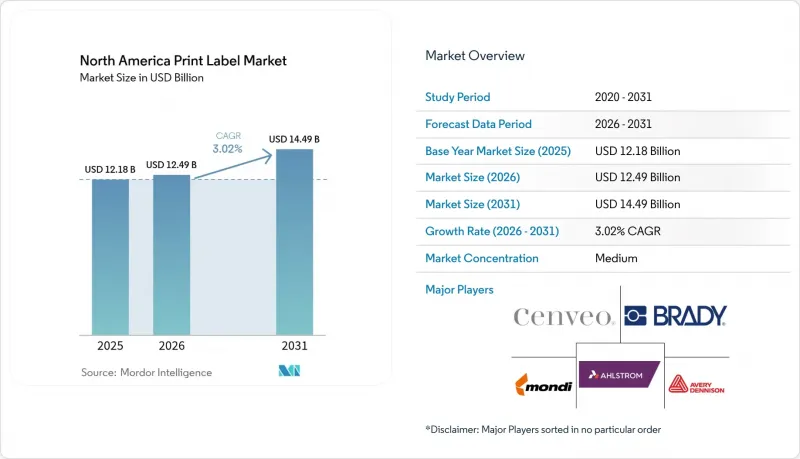
This report is Segmented by Substrate Material (Paper and Paperboard, Polyethylene Terephthalate, and More), Print Technology (Flexography, Screen, and More), Label Type (Wet-Glued Labels, Pressure-Sensitive Labels, Liner-Less Labels, and More), End-User Industry (Food, Beverage, Healthcare and Pharmaceutical, and More), and Country. The Market Forecasts are Provided in Terms of Value (USD).
North America Print Label Market Trends and Insights
Growing Demand for Digital Print Technologies
Digital presses are changing the economics of the North America print label market by making runs under 5 000 linear feet financially viable. RR Donnelley installed an HP Indigo 120K press in June 2025, pairing it with robotic material handling to streamline short-run production. Cimpress committed in May 2025 to add up to 20 more HP Indigo units across its network, signaling confidence in personalized packaging demand through 2027. Taylor Corporation's in-house data pegs the digital break-even point versus flexography at roughly 3 000 feet, down from 8 000 feet five years ago. These economics allow smaller converters to compete on 48-hour turnaround times that national retailers increasingly expect. The flexibility of digital platforms also supports serialization, unique QR codes, and augmented-reality triggers that are impractical on analog lines.
Surge in Variable Data Printing for E-commerce Logistics
Rapid expansion of online retail has multiplied the number of shipping labels that require unique barcodes, return data, and branded messaging. Major U.S. third-party logistics operators now specify radio-frequency identification (RFID)- enabled labels to automate pallet sortation, a requirement accelerated by Amazon's mandate that inbound pallets carry RFID tags from 2025. Avery Dennison's APR-recognized mono-material RFID label, introduced in June 2025, demonstrates how converters are merging sustainability with smart-label functionality. The boom in serialized labels obliges converters to deploy digital front-end software capable of ingesting high-volume data streams directly from customer enterprise systems. In parallel, fulfillment centers prefer liner-less formats that reduce waste on high-speed applicators, reinforcing volume growth for direct-wound constructions.
Inadequate Durability in Extreme Cold-Chain Applications
Messenger RNA vaccines and cell therapies shipped at ultra-low temperatures have exposed adhesive and facestock failures within the North America print label market. RxSource identified delamination and barcode fading during freeze-thaw cycles and recommends acrylic systems with sub-40 °C glass-transition points plus polypropylene facestocks that resist embrittlement. FDA good manufacturing practice rules obligate labels to remain legible throughout shelf life, elevating converters' liability when materials fail. Biogen validates labels through 10 accelerated freeze-thaw tests at -80 °C, a protocol spreading across biotech customers. Reformulating adhesives increases material cost by up to 25%, squeezing margins on contracts already tendered at tight pricing. Niche converters able to certify cryogenic constructions capture a share in this specialized pocket of demand.
Other drivers and restraints analyzed in the detailed report include:
- Sustainability-Driven Switch to Liner-Less and Shrink-Sleeve Formats
- Healthcare UDI-Labeling Mandates
- Supply Volatility of Specialty Label-Stock Papers
For complete list of drivers and restraints, kindly check the Table Of Contents.
Segment Analysis
Polyethylene terephthalate maintained a 36.98% share of the North America print label market in 2025, supported by its toughness, transparency, and suitability for high-speed bottling. Brand owners pursuing circular-economy goals are adding biobased and compostable films that are advancing at a 4.56% CAGR, though current cost premiums confine adoption to premium organic and wellness lines. Paper retains relevance for wine and artisanal food where a natural look matters, while polypropylene dominates squeezable packaging that demands conformability. Polyvinyl chloride continues to retreat under environmental scrutiny, yet it persists in industrial chemicals where its solvent resistance remains unmatched. Association of Plastic Recyclers design protocols now influence specification sheets, encouraging converters to avoid facestocks that contaminate polyethylene recycling streams.
Supply shocks exacerbate substrate decisions. Pixelle's mill shutdown left converters scrambling for specialty coated papers, pushing some wine brands to test textured polypropylene facestocks that mimic paper aesthetics without supply-chain risk. UPM's expansion in North Carolina added release-liner output that partly offsets lost European tonnage, but market anxiety lingers. Beontag invested USD 40 million to install a specialty line in Ohio that localizes high-end self-adhesive materials. Smart-label growth is another driver, as RFID antennas demand substrates that limit signal attenuation; Avery Dennison's mono-material polyethylene construction meets this need while aligning with recycler acceptance criteria.
Flexography held 44.96% of the market share in 2025, thanks to its productivity on runs exceeding 10,000 feet and its compatibility with low-VOC water-based inks. Digital systems, led by HP Indigo, Xeikon, and inkjet hybrids, are expanding at 4.32% across 2026-2031 as converters chase orders for regional craft beer, limited-edition cosmetics, and direct-to-consumer replenishment packs. RR Donnelley's Georgia facility integrates a new HP Indigo 120K with automated finishing, an illustration of analog and digital coexistence at scale. Cimpress's planned fleet expansion confirms sustained appetite for personalized prints, especially across mass-customization web portals.
Offset and screen retain niche roles where metallic inks or heavy lay-downs are critical. Meanwhile, the U.S. Environmental Protection Agency will tighten 40 CFR Part 60 Subpart RR limits in 2026, pushing converters reliant on solvent inks toward UV-curable or aqueous systems. California air districts have already enacted stricter thresholds, effectively accelerating the pivot to lower-emission platforms that naturally align with digital presses. Capital remains a barrier: entry-level inkjet models cost near USD 500 000 and high-volume toner lines exceed USD 1 million, driving mergers among printers seeking economies of scale.
Complete Report Scope:
- By Substrate Material
- Paper and Paperboard
- Polyethylene Terephthalate (PET)
- Polypropylene (PP and BOPP)
- Polyvinyl Chloride (PVC)
- Biobased and Compostable Films
- Other Substrate Materials
- By Print Technology
- Offset
- Flexography
- Screen
- Digital Printing
- Other Print Technologies
- By Label Type
- Wet-glued Labels
- Pressure-Sensitive Labels
- Liner-less Labels
- In-mold Labels
- Shrink Sleeve Labels
- Other Label Types
- By End-user Industry
- Food
- Beverage
- Healthcare and Pharmaceutical
- Cosmetics and Personal Care
- Industrial
- Other End-user Industries
- By Country
- United States
- Canada
- Mexico
List of Companies Covered in this Report:
- Avery Dennison Corporation
- CCL Industries Inc.
- Multi-Color Corporation
- Brady Corporation
- Smurfit Westrock
- Mondi plc
- Ahlstrom-Munksjo Oyj
- Cenveo Worldwide Limited
- Resource Label Group, LLC
- Blue Label Packaging Company
- OMNI Systems Inc.
- Inovar Packaging Group
- Fort Dearborn Company
- RR Donnelley and Sons Company
- Fortis Solutions Group, LLC
- Traco Manufacturing, Inc.
- UPM-Raflatac Oy
- Brook + Whittle Holdings, LLC
- Lux Global Label Company
- Consolidated Label Co.
Additional Benefits:
- The market estimate (ME) sheet in Excel format
- 3 months of analyst support
TABLE OF CONTENTS
1 INTRODUCTION
- 1.1 Study Assumptions and Market Definition
- 1.2 Scope of the Study
2 RESEARCH METHODOLOGY
3 EXECUTIVE SUMMARY
4 MARKET LANDSCAPE
- 4.1 Market Overview
- 4.2 Market Drivers
- 4.2.1 Growing Demand for Digital Print Technologies
- 4.2.2 Surge in Variable Data Printing for E-commerce Logistics
- 4.2.3 Sustainability-Driven Switch to Linerless and Shrink-Sleeve Formats
- 4.2.4 Healthcare UDI-Labeling Mandates
- 4.2.5 AI-Enabled Print Workflow Automation Reducing Turnaround Time
- 4.2.6 Brand Protection and Anti-Counterfeit Features Integration
- 4.3 Market Restraints
- 4.3.1 Inadequate Durability in Extreme Cold-Chain Applications
- 4.3.2 Supply Volatility of Specialty Label-Stock Papers
- 4.3.3 Capital-Intensive Transition from Analog to Digital Presses
- 4.3.4 Stringent VOC and Ink-Migration Regulations Tightening in 2026
- 4.4 Industry Value Chain Analysis
- 4.5 Regulatory Landscape
- 4.6 Technological Outlook
- 4.7 Porter's Five Forces Analysis
- 4.7.1 Bargaining Power of Suppliers
- 4.7.2 Bargaining Power of Buyers
- 4.7.3 Threat of New Entrants
- 4.7.4 Threat of Substitutes
- 4.7.5 Competitive Rivalry
- 4.8 Impact of Macroeconomic Factors on the Market
5 MARKET SIZE AND GROWTH FORECASTS (VALUE)
- 5.1 By Substrate Material
- 5.1.1 Paper and Paperboard
- 5.1.2 Polyethylene Terephthalate (PET)
- 5.1.3 Polypropylene (PP and BOPP)
- 5.1.4 Polyvinyl Chloride (PVC)
- 5.1.5 Biobased and Compostable Films
- 5.1.6 Other Substrate Materials
- 5.2 By Print Technology
- 5.2.1 Offset
- 5.2.2 Flexography
- 5.2.3 Screen
- 5.2.4 Digital Printing
- 5.2.5 Other Print Technologies
- 5.3 By Label Type
- 5.3.1 Wet-glued Labels
- 5.3.2 Pressure-Sensitive Labels
- 5.3.3 Liner-less Labels
- 5.3.4 In-mold Labels
- 5.3.5 Shrink Sleeve Labels
- 5.3.6 Other Label Types
- 5.4 By End-user Industry
- 5.4.1 Food
- 5.4.2 Beverage
- 5.4.3 Healthcare and Pharmaceutical
- 5.4.4 Cosmetics and Personal Care
- 5.4.5 Industrial
- 5.4.6 Other End-user Industries
- 5.5 By Country
- 5.5.1 United States
- 5.5.2 Canada
- 5.5.3 Mexico
6 COMPETITIVE LANDSCAPE
- 6.1 Market Concentration
- 6.2 Strategic Moves
- 6.3 Market Share Analysis
- 6.4 Company Profiles (Includes Global Level Overview, Market Level Overview, Core Segments, Financials as Available, Strategic Information, Market Rank/Share, Products and Services, and Recent Developments)
- 6.4.1 Avery Dennison Corporation
- 6.4.2 CCL Industries Inc.
- 6.4.3 Multi-Color Corporation
- 6.4.4 Brady Corporation
- 6.4.5 Smurfit Westrock
- 6.4.6 Mondi plc
- 6.4.7 Ahlstrom-Munksjo Oyj
- 6.4.8 Cenveo Worldwide Limited
- 6.4.9 Resource Label Group, LLC
- 6.4.10 Blue Label Packaging Company
- 6.4.11 OMNI Systems Inc.
- 6.4.12 Inovar Packaging Group
- 6.4.13 Fort Dearborn Company
- 6.4.14 RR Donnelley and Sons Company
- 6.4.15 Fortis Solutions Group, LLC
- 6.4.16 Traco Manufacturing, Inc.
- 6.4.17 UPM-Raflatac Oy
- 6.4.18 Brook + Whittle Holdings, LLC
- 6.4.19 Lux Global Label Company
- 6.4.20 Consolidated Label Co.
7 MARKET OPPORTUNITIES AND FUTURE OUTLOOK
- 7.1 White-Space and Unmet-Need Assessment

