PUBLISHER: Mordor Intelligence | PRODUCT CODE: 2124088

PUBLISHER: Mordor Intelligence | PRODUCT CODE: 2124088
China Office Furniture - Market Share Analysis, Industry Trends & Statistics, Growth Forecasts (2026 - 2031)
According to Mordor Intelligence, the China office furniture market size was valued at USD 36.02 billion in 2025 and is estimated to grow from USD 38.27 billion in 2026 to reach USD 51.87 billion by 2031, at a CAGR of 6.27% during the forecast period (2026-2031).
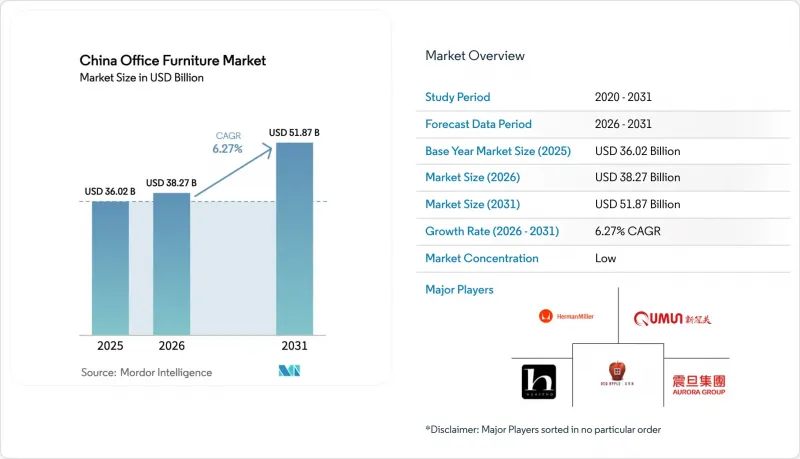
This report is Segmented by Furniture Type (Seating, Tables, Storage, Desks, Other Furniture Type), Distribution Channel (B2B/Directly From Manufacturer, B2C/Retail), and Geography (East China, North China, Northeast China, Central China, Rest of China). Market Forecasts are Provided in Terms of Value (USD).
China Office Furniture Market Trends and Insights
Flight-to-Quality Office Upgrades Propel Premium Fit-Out Spend Despite Vacancy Overhang
Corporate landlords and tenants are investing in higher-quality amenities and greener fit-outs to secure occupancy and support hybrid work policies, even as leasing markets adjust. Procurement cycles now favor solutions that combine embodied carbon transparency and human-wellbeing benefits to align with project certification targets, including WELL-aligned interiors and low-VOC finishes. Public-sector demand reinforces this preference because agency buyers are guided by national action plans that promote green construction materials and certified products in tendering. Suppliers that can document life-cycle impacts and meet tighter testing indicators under updated green product evaluation standards improve their eligibility for projects. Within this backdrop, the China office furniture market shows growing interest in products that raise day-one functionality and lower lifetime environmental impact, which helps premium fit-outs defend budgets during rental renegotiations.
Ergonomic Investments Surge as Hybrid Work Redefines Office Beyond CBD Towers
A larger share of buyers views ergonomic seating and height-adjustable desks as preventive health tools that support productivity in both homes and corporate sites. Health research and industry case studies have spotlighted musculoskeletal risks from prolonged sitting, which is pushing organizations and individuals to upgrade chairs, monitor arms, and sit-stand solutions. Smart seating has moved from concept to commercial reality, with models that capture posture and user biometrics to generate app-based guidance and alerts. For instance, in product launches at CIFF Guangzhou 2025, Sunon showcased dynamic sitting lines with IoT biometrics. Brands active in Asia-Pacific report that carbon-neutral certified ergonomic lines that pair recycled materials with high adjustability are gaining customer preference, which reinforces the link between health outcomes and sustainability performance.
Tier-1 Office Vacancy and Cautious Leasing Slow New Fit-Out Cycles
Weak leasing conditions in select large-city submarkets encourage tenants to renegotiate terms, lengthen decision cycles, and downsize space. These behaviors reduce the pace of new buildouts and delay refreshes that would otherwise activate larger orders for desks, seating, and storage systems. Suppliers respond by emphasizing retrofit-ready solutions and value-engineered packages, but discretionary upgrades can still slip into later budget periods. Landlords focus on incentives tied to renovation allowances and service quality to preserve occupancy, which narrows the window for premium pricing in the near term. In this context, the China office furniture market relies more on project selectivity and account retention strategies while it waits for stronger demand signals to support full-scale fit-outs.
Other drivers and restraints analyzed in the detailed report include:
- Omnichannel Procurement Acceleration Elevates Access, Speed, and Brand Discovery
- Green Product Certification and Procurement Preference Reshape Buying Criteria
- Raw-Material Inflation and Trade Actions Pressure Margins for Export-Oriented Manufacturers
For complete list of drivers and restraints, kindly check the Table Of Contents.
Segment Analysis
Seating captured 29.24% of the China office furniture market share in 2025 and is set to expand at the segment's fastest 8.84% CAGR through 2031, supported by health-centric ergonomics and smart features. Smart and sensor-enabled seating has moved beyond pilot deployments. Commercially available AI-enabled chairs, such as Unigamer's BC03P smart chair, first launched in China in 2023, integrate pressure sensors and posture-recognition algorithms into mass-market SKUs rather than research prototypes. Performance validation is supported by peer-reviewed evidence: a 2025 posture-monitoring study found smart chairs achieved 94.78% posture detection accuracy, with 97.59% of users correcting posture within 3.27 seconds after alerts, demonstrating quantifiable ergonomic impact rather than anecdotal benefit. Height-adjustable desk ecosystems and compatible seating are co-specified more frequently to ensure full-range adjustability and correct body positioning across tasks. The China office furniture market continues to reward platforms that demonstrate measurable environmental gains, such as carbon-neutral claims supported by life-cycle assessments and increased use of recycled inputs in seating frames and components.
Beyond seating, desks and tables benefit from hybrid work and modular planning needs that emphasize space reconfiguration without major structural changes. Configurable elements that allow quick shifts from individual to collaborative modes are common in contemporary fit-outs and support frequent team resizing. The China office furniture market also favors storage that integrates access control and environment monitoring to safeguard documents and equipment in open-plan settings. Vendors that build ecosystems instead of standalone items can cross-sell over longer cycles and create unified experiences across chairs, desks, and accessories. Certification readiness and emissions testing compliance are now table stakes for project bids in government and regulated sectors, which pushes even entry-level lines to step up materials and finishes.
Complete Report Scope:
- By Furniture Type
- Seating
- Tables
- Storage
- Desks
- Other Furniture Type (Desk Divider, Office Sofas, Bookcases, Benches, Stools etc.)
- By Distribution Channel
- B2B/Directly from Manufacturer
- B2C/Retail
- Home Centers
- Specialty Furniture Stores
- Online
- Other Distribution Channel
- By Geography
- East China
- North China
- Northeast China
- Central China
- Rest of China
List of Companies Covered in this Report:
- Sunon
- Dious
- Aurora (China)
- Lamex (KOKUYO Group)
- UE Furniture (Yongyi)
- Henglin Home Furnishings
- Loctek (LoctekMotion/FlexiSpot)
- Sihoo
- Sitzone (JE Group)
- Quama (Guanmei)
- Tiantan (BBMG)
- CJF (Changjiang Furniture)
- IKEA
- Okamura China
- KOKUYO (incl. Lamex brand)
- Steelcase (China operations)
- JEG/JE Group (international site)
- Burgeree (acoustic/office pods & panels)
- Mige/Meet&Co
- BOKE Furniture
Additional Benefits:
- The market estimate (ME) sheet in Excel format
- 3 months of analyst support
TABLE OF CONTENTS
1 Introduction
- 1.1 Study Assumptions & Market Definition
- 1.2 Scope of the Study
2 Research Methodology
3 Executive Summary
4 Market Landscape
- 4.1 Market Overview
- 4.2 Market Drivers
- 4.2.1 Flight-to-quality office upgrades and fit-outs
- 4.2.2 Ergonomics and employee health investments (sit-stand desks, monitor arms)
- 4.2.3 Omnichannel procurement acceleration (JD/Tmall, enterprise platforms)
- 4.2.4 Smart/IoT-integrated office furniture adoption
- 4.2.5 Green product certification and procurement preference (China GP/eco-label)
- 4.2.6 Manufacturing clusters enable rapid customization and DTC scale (Anji, Foshan)
- 4.3 Market Restraints
- 4.3.1 High office vacancy and rent declines in Tier-1 cities
- 4.3.2 Raw-material cost volatility and supply chain shocks
- 4.3.3 Trade policy friction & tariff risk affecting export demand
- 4.3.4 Structural industry constraints (OEM dependence, limited design/IP innovation)
- 4.4 Industry Value Chain Analysis
- 4.5 Porters Five Forces
- 4.5.1 Threat of New Entrants
- 4.5.2 Bargaining Power of Suppliers
- 4.5.3 Bargaining Power of Buyers
- 4.5.4 Threat of Substitutes
- 4.5.5 Industry Rivalry
- 4.6 Insights into the Latest Trends and Innovations in the Market
- 4.7 Insights on Recent Developments (New Product Launches, Strategic Initiatives, Investments, Partnerships, JVs, Expansion, M&As, etc.) in the Market
- 4.8 Insights on Regulatory Framework and Industry Standards for Office Furniture
5 Market Size & Growth Forecasts (Value)
- 5.1 By Furniture Type
- 5.1.1 Seating
- 5.1.2 Tables
- 5.1.3 Storage
- 5.1.4 Desks
- 5.1.5 Other Furniture Type (Desk Divider, Office Sofas, Bookcases, Benches, Stools etc.)
- 5.2 By Distribution Channel
- 5.2.1 B2B/Directly from Manufacturer
- 5.2.2 B2C/Retail
- 5.2.2.1 Home Centers
- 5.2.2.2 Specialty Furniture Stores
- 5.2.2.3 Online
- 5.2.2.4 Other Distribution Channel
- 5.3 By Geography
- 5.3.1 East China
- 5.3.2 North China
- 5.3.3 Northeast China
- 5.3.4 Central China
- 5.3.5 Rest of China
6 Competitive Landscape
- 6.1 Market Concentration
- 6.2 Strategic Moves
- 6.3 Market Share Analysis
- 6.4 Company Profiles (includes Global level Overview, Market level overview, Core Segments, Financials as available, Strategic Information, Market Rank/Share for key companies, Products & Services, and Recent Developments)
- 6.4.1 Sunon
- 6.4.2 Dious
- 6.4.3 Aurora (China)
- 6.4.4 Lamex (KOKUYO Group)
- 6.4.5 UE Furniture (Yongyi)
- 6.4.6 Henglin Home Furnishings
- 6.4.7 Loctek (LoctekMotion/FlexiSpot)
- 6.4.8 Sihoo
- 6.4.9 Sitzone (JE Group)
- 6.4.10 Quama (Guanmei)
- 6.4.11 Tiantan (BBMG)
- 6.4.12 CJF (Changjiang Furniture)
- 6.4.13 IKEA
- 6.4.14 Okamura China
- 6.4.15 KOKUYO (incl. Lamex brand)
- 6.4.16 Steelcase (China operations)
- 6.4.17 JEG/JE Group (international site)
- 6.4.18 Burgeree (acoustic/office pods & panels)
- 6.4.19 Mige/Meet&Co
- 6.4.20 BOKE Furniture
7 Market Opportunities & Future Outlook
- 7.1 Green-certified, low-VOC lines for government/enterprise procurement
- 7.2 Modular pods/partitions and turnkey fit-out for flex and flight-to-quality

