PUBLISHER: Mordor Intelligence | PRODUCT CODE: 2124328

PUBLISHER: Mordor Intelligence | PRODUCT CODE: 2124328
Indonesia Office Furniture - Market Share Analysis, Industry Trends & Statistics, Growth Forecasts (2026 - 2031)
According to Mordor Intelligence, the Indonesia office furniture market size is USD 2.12 billion in 2026 and is projected to reach USD 2.69 billion by 2031, translating into a 4.95% CAGR for the period to 2031.
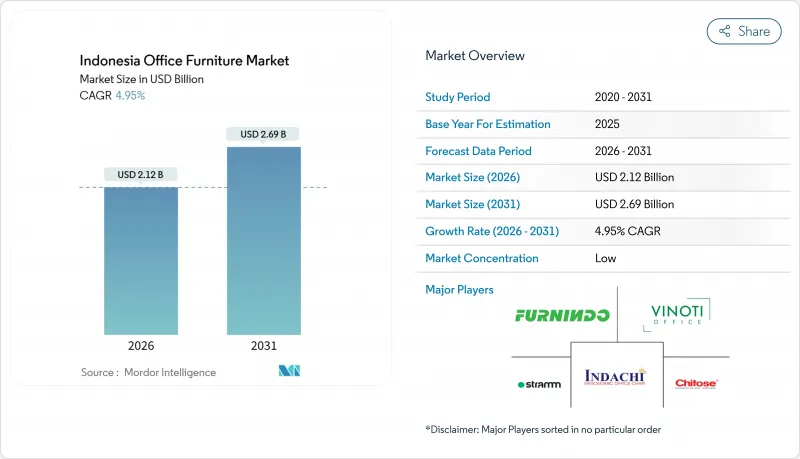
This report is Segmented by Furniture Type (Seating, Tables, Storage, Desks, Other Furniture), Distribution Channel (B2B/Direct, B2C/Retail Comprising Home Centres, Specialty Stores, Online, and Others), and Geography (Java, Sumatra, Kalimantan, Sulawesi, Bali & Nusa Tenggara, Maluku & Papua). Market Forecasts are Provided in Terms of Value (USD).
Indonesia Office Furniture Market Trends and Insights
Hybrid Work Adoption Drives Ergonomic Furniture Upgrades Across Corporate and Residential Settings
Enterprises are evolving facilities for hybrid teams, prompting parallel investments in office floors and home setups that support comfort and productivity. A University of Indonesia posture study reported a high prevalence of musculoskeletal issues, which has driven the procurement of AI-enabled ergonomic seating and height-adjustable desks as standard in refreshed layouts for staff and executives. Authorized distributors promote ergonomic systems that scale with headcount changes, including sit-stand workstations and monitor arms designed for rapid reconfiguration and consistent posture support. The Indonesia office furniture market is capturing this shift through premium task chairs, acoustic elements, and modular tables that move quickly from hot desks to enclosed rooms as teams flex across on-site and remote use cases. E-commerce storefronts show sustained traction for mid-tier ergonomic SKUs that balance price, adjustability, and durability, with verified unit sales and high ratings signalling repeatable demand outside corporate projects. The result is a broader addressable base for ergonomic products as employers extend support for workers switching between headquarters, satellite offices, and home environments.
Flight-to-Quality Tenant Behaviour in Jakarta CBD Accelerates Premium Office Refurbishment
Premium fitouts increasingly package furniture with design and installation services to reduce time to occupancy, which favours suppliers that can coordinate specification, assembly, and warranty at predictable budgets. Dedicated B2B programs demonstrate the value of integrated service, with IKEA for Business operating service points that include interior planning, bulk purchase promotions, and assembly support for companies managing compressed timelines. Contract furniture providers with long-standing corporate relationships have reported healthy activity in interiors and fit-out work, highlighting demand for ergonomic seating, modular desks, and collaboration furniture in quality-focused projects. The market benefits when landlords and corporate tenants coordinate turnkey solutions that standardize specifications across towers and floors, since this approach consolidates purchasing and simplifies vendor oversight. Suppliers with branded assortments and proven after-sales processes secure a natural advantage under these procurement models, especially when combined with financing or instalment offers for qualified clients. These dynamic tilts spend toward certified and service-capable brands that meet ergonomic norms while aligning with the sustainability preferences of blue-chip tenants and multinationals.
Jakarta Non-CBD Office Vacancy and Regional Oversupply Moderate Near-Term Fit-Out Cycles
Fit-out demand varies by location and building grade, as premium properties attract higher specification projects while cost-sensitive offices in secondary areas prioritize basic seating, desks, and storage. Suppliers that concentrate on turnkey or pre-awarded work scopes mitigate exposure to slow spot purchasing in price-sensitive corridors, especially when they lock in specifications before delivery phases begin. Branch networks and long-standing client relationships help firms serve commercial hubs outside Jakarta, with vendors maintaining a presence in Surabaya, Medan, and Makassar to support regional project cycles and after-sales needs. Public procurement pilots outside Java have identified challenges such as high logistics costs and limited availability of compliant furniture, which can delay or cancel purchase programs in certain provinces. The Indonesia office furniture market, therefore, sees uneven near-term momentum across submarkets, and suppliers hedge with a mix of premium frameworks, regional distribution, and online channels to balance the portfolio.
Other drivers and restraints analyzed in the detailed report include:
- Coworking Proliferation and Commercial Real Estate Expansion Amplify Flexible Furniture Demand
- IKN Nusantara Relocation Catalyses Multi-Year Government and Private Office Fit-Outs in East Kalimantan
- SVLK Timber Legality Compliance Raises Sourcing Costs and Extends Lead Times
For complete list of drivers and restraints, kindly check the Table Of Contents.
Segment Analysis
Seating captured 23.48% of 2025 revenue, while desks are the fastest-growing subcategory, projected to expand at 11.76% through 2031 as hybrid work drives demand for modular and height-adjustable stations that can be reconfigured quickly for changing team sizes. The market responds with ergonomic chairs that meet posture and support expectations and with benching systems that allow rapid assembly for shared or dedicated desks in agile layouts. Studio-style desking platforms and ergonomic chairs with adjustable features are common bundles that align with procurement needs for consistency and maintainability across floors and departments. Conference and meeting tables see steady usage in office, training, and hospitality spaces, while storage lines maintain relevance for documents and shared equipment despite digitalization. The Indonesia office furniture market includes more specialized items such as desk dividers, office sofas, and stools for breakout areas and reception zones, where comfort and compact dimensions drive purchasing decisions.
The Indonesia office furniture market size for desks is projected to expand at 11.76% CAGR to 2031 due to hybrid work and flexible planning, reinforcing demand for robust mechanisms, cable management, and accessory compatibility that simplify daily use and moves. Buyers also weigh compliance and durability across paints and finishes, with wood products subject to Indonesia's SVLK legality verification and V-Legal export documents in defined HS categories. Sales events and seasonal promotions play a role in converting small and medium businesses, with bundled offers on office sofas and seating often targeted at budget-sensitive purchases during year-end and new-year planning cycles. Certification portfolios that include SVLK and domestic content credentials ease participation in government and state-owned enterprise tenders, which prioritize compliance and localized value addition within procurement rules. The Indonesia office furniture industry continues to broaden assortments for both premium and value segments, adopting modular designs that support faster reconfiguration without compromising ergonomics or sustainability preferences.
Complete Report Scope:
- By Furniture Type
- Seating
- Tables
- Storage
- Desks
- Other Furniture Type (Desk Divider, Office Sofas, Bookcases, Benches, Stools etc.)
- By Distribution Channel
- B2B/Directly from Manufacturer
- B2C/Retail
- Home Centers
- Specialty Furniture Stores
- Online
- Other Distribution Channel
- By Geography
- Java
- Sumatra
- Kalimantan
- Sulawesi
- Bali & Nusa Tenggara
- Maluku & Papua
List of Companies Covered in this Report:
- PT. Furnindo International
- PT Vinotindo Grahasarana (VINOTI / VIVERE Commercial)
- PT Vivere Multi Kreasi (VIVERE Working)
- PT Chitose Internasional Tbk
- PT Indovickers Furnitama
- HighPoint (PT Timur Jaya Prestasi)
- IKEA Indonesia (IKEA for Business)
- Herman Miller (via Rifyo Indonesia)
- Steelcase (via Vinoti/VIVERE)
- Stramm
- PT ALBA Unggul Metal (Atlantic)
- PT Oscar Mitra Sukses Sejahtera Tbk (Oscar Living)
- Indotech Global (E-Katalog Furniture Provider)
- Kreasi Nusantara Perwira (KNP) - E-Katalog Furniture Provider
- Indachi Office Furniture
- Donati Seating
- Ichiko
- Savello
- Chairman Chair
- JEB Partition (via Vinoti)
- Wilkhahn (via Indovickers)
- KI - Krueger International (via Indovickers)
Additional Benefits:
- The market estimate (ME) sheet in Excel format
- 3 months of analyst support
TABLE OF CONTENTS
1 Introduction
- 1.1 Study Assumptions & Market Definition
- 1.2 Scope of the Study
2 Research Methodology
3 Executive Summary
4 Market Landscape
- 4.1 Market Overview
- 4.2 Market Drivers
- 4.2.1 Hybrid work adoption and ergonomic upgrades across corporate and home-office workflows
- 4.2.2 Flight-to-quality and fitted spaces in Jakarta CBD accelerating refurbishment cycles
- 4.2.3 APAC-led commercial real estate expansion and coworking proliferation
- 4.2.4 Digital channels enabling procurement (B2C/e-commerce and B2B platforms)
- 4.2.5 Government e-procurement & TKDN prioritization expanding local suppliers addressable demand
- 4.2.6 IKN Nusantara relocation catalyzing new office fit-outs and public sector demand
- 4.3 Market Restraints
- 4.3.1 Highly fragmented competition compresses margins and pricing power
- 4.3.2 Office real estate oversupply/vacancy moderating new fit-out cycles
- 4.3.3 Timber legality compliance (SVLK/EUDR alignment) raising costs and lead times
- 4.3.4 Domestic-content (TKDN) thresholds and e-Katalog process barriers for non-compliant imports
- 4.4 Value / Supply-Chain Analysis
- 4.5 Regulatory Landscape
- 4.5.1 TKDN/BMP and e-Katalog procurement rules
- 4.5.2 Timber Legality (SVLK) and export compliance
- 4.5.3 SNI standards, eco-labels and green public procurement
- 4.6 Technological Outlook
- 4.6.1 Modular systems, sit-stand desks, acoustic pods, ergonomic seating
- 4.6.2 Digital specification tools, 3D/AR visualization, and DfMA for fast installs
- 4.7 Porters Five Forces
- 4.7.1 Competitive Rivalry
- 4.7.2 Threat of New Entrants
- 4.7.3 Bargaining Power of Suppliers
- 4.7.4 Bargaining Power of Buyers
- 4.7.5 Threat of Substitutes
5 Market Size & Growth Forecasts (Value)
- 5.1 By Furniture Type
- 5.1.1 Seating
- 5.1.2 Tables
- 5.1.3 Storage
- 5.1.4 Desks
- 5.1.5 Other Furniture Type (Desk Divider, Office Sofas, Bookcases, Benches, Stools etc.)
- 5.2 By Distribution Channel
- 5.2.1 B2B/Directly from Manufacturer
- 5.2.2 B2C/Retail
- 5.2.2.1 Home Centers
- 5.2.2.2 Specialty Furniture Stores
- 5.2.2.3 Online
- 5.2.2.4 Other Distribution Channel
- 5.3 By Geography
- 5.3.1 Java
- 5.3.2 Sumatra
- 5.3.3 Kalimantan
- 5.3.4 Sulawesi
- 5.3.5 Bali & Nusa Tenggara
- 5.3.6 Maluku & Papua
6 Competitive Landscape
- 6.1 Market Concentration
- 6.2 Strategic Moves
- 6.3 Market Share Analysis
- 6.4 Company Profiles {(includes Global level Overview, Market level overview, Core Segments, Financials as available, Strategic Information, Market Rank/Share for key companies, Products & Services, and Recent Developments)}
- 6.4.1 PT. Furnindo International
- 6.4.2 PT Vinotindo Grahasarana (VINOTI / VIVERE Commercial)
- 6.4.3 PT Vivere Multi Kreasi (VIVERE Working)
- 6.4.4 PT Chitose Internasional Tbk
- 6.4.5 PT Indovickers Furnitama
- 6.4.6 HighPoint (PT Timur Jaya Prestasi)
- 6.4.7 IKEA Indonesia (IKEA for Business)
- 6.4.8 Herman Miller (via Rifyo Indonesia)
- 6.4.9 Steelcase (via Vinoti/VIVERE)
- 6.4.10 Stramm
- 6.4.11 PT ALBA Unggul Metal (Atlantic)
- 6.4.12 PT Oscar Mitra Sukses Sejahtera Tbk (Oscar Living)
- 6.4.13 Indotech Global (E-Katalog Furniture Provider)
- 6.4.14 Kreasi Nusantara Perwira (KNP) - E-Katalog Furniture Provider
- 6.4.15 Indachi Office Furniture
- 6.4.16 Donati Seating
- 6.4.17 Ichiko
- 6.4.18 Savello
- 6.4.19 Chairman Chair
- 6.4.20 JEB Partition (via Vinoti)
- 6.4.21 Wilkhahn (via Indovickers)
- 6.4.22 KI - Krueger International (via Indovickers)
7 Market Opportunities & Future Outlook
- 7.1 Smart Furniture Integration Boosts Workplace Efficiency and User Experience
- 7.2 Sustainable and Circular Furniture Solutions
- 7.3 Expansion of Acoustic and Privacy-Centric Furniture Designs
- 7.4 Scalable Customization and Personalization in Office Furniture

