PUBLISHER: Mordor Intelligence | PRODUCT CODE: 2124199

PUBLISHER: Mordor Intelligence | PRODUCT CODE: 2124199
Germany Office Furniture - Market Share Analysis, Industry Trends & Statistics, Growth Forecasts (2026 - 2031)
According to Mordor Intelligence, the Germany office furniture market size is expected to grow from USD 2.97 billion in 2025 to USD 3.04 billion in 2026 and is forecast to reach USD 3.43 billion by 2031 at 2.41% CAGR over 2026-2031.
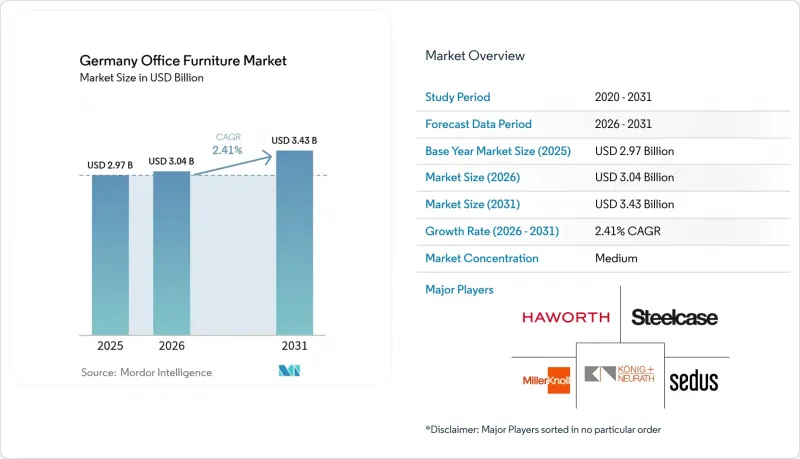
This report is Segmented by Product (Chairs, Tables, Storage Units, Sofas/Soft Seating, and More), Material (Wood, Metal, and More), Price Range (Economy, Mid-Range, Premium), End-User (Corporate Offices, and More), Distribution Channel (B2C/Retail, B2B/Direct From Manufacturers), and Geography (Northern Germany, and More). The Market Forecasts are Provided in Terms of Value (USD).
Germany Office Furniture Market Trends and Insights
Ergonomic & Health-Focused Seating Boom
German employers now treat seating as a risk-mitigation and talent-retention tool rather than a commodity purchase. DIN EN 1335 compliance underpins specification lists, and brands such as Sedus embed life-cycle analyses in early design to prove low environmental impact. Meanwhile, innovators like Aeris market "active-sitting" chairs that exceed DIN requirements by encouraging micro-movement, a feature popular with wellness-oriented firms. Corporate buyers also weigh return-to-office targets; providing comfortable, height-adjustable seating is viewed as a tangible incentive that makes on-site work more appealing. Because occupational-health statutes require suitable equipment, even cost-conscious companies continue to refresh chair fleets on predictable cycles, ensuring baseline demand stability within the Germany office furniture market.
Workspace Redesign for Hybrid Models
Office utilization has fallen to 40-50% of pre-pandemic norms, prompting facilities managers to slash dedicated desks and introduce flexible "activity-based" zones. Hot-desking ratios of 1:1.25 become viable when paired with modular furniture that employees can roll, stack, or fold within minutes, reducing wasted floor area and trimming rental costs by as much as USD 750 per workstation each year. Vendors able to ship coordinated suites-tables with locking casters, stackable storage, lounge modules with integrated power-win the new-build tenders. IoT-ready desks that feed occupancy data into smart-building dashboards also enter shortlists, signaling a blend of furniture and prop-tech that is reshaping procurement criteria across the Germany office furniture market.
Shrinking Leased Office Footprints
Hybrid work cuts demand for rows of identical workstations and erodes order volumes tied to pure seat counts. While flagship downtown towers remain desirable, landlords in peripheral zones struggle with double-digit vacancy, and tenants opt for smaller, higher-quality suites. Furniture producers reliant on large-plateau projects, therefore, see bid lists shrink or fragment into phased-purchase tranches. Vendors who pivot toward leasing, refurbishment, or quick-turnaround retrofit packages cushion revenue shortfalls and continue to meet the evolving space needs of the Germany office furniture market.
Other drivers and restraints analyzed in the detailed report include:
- Commercial Construction in Tech Hubs
- Sustainable Procurement Incentives
- Raw-Material Price Volatility
For complete list of drivers and restraints, kindly check the Table Of Contents.
Segment Analysis
Chairs remain the cornerstone of the Germany office furniture market and hold 36.74% of total sales. Employers view ergonomically certified task seating as compulsory for compliance, and hot-desking pushes demand for models with intuitive adjustments that suit multiple users in a single day. Meeting and guest chairs experience renewal as companies convert static conference rooms into dynamic collaboration hubs outfitted with lightweight seating that can be rearranged at will.
A new center of gravity is emerging around acoustic booths and dividers, the fastest-growing niche at 3.69% CAGR. Open-plan offices and video meetings strain acoustics, driving interest in pods that temper noise and supply visual privacy. Brands like Mute-Labs package LED lighting, ventilation, and integrated power in turnkey modules, making pods a quick upgrade for landlords seeking to attract tenants without structural alterations. As work modes fragment, even small firms allocate budget for at least one phone booth to ensure distraction-free calls, reinforcing long-term momentum within the Germany office furniture market.
Wood furniture accounts for 46.15% of spending because German buyers equate natural surfaces with quality, and domestic forests supply certified inputs at scale. Vendors tout regional sourcing to lower transport emissions and emphasize repairability that extends product life. Oak and beech veneers remain mainstream, complemented by sustainable finishes free of formaldehyde and solvents.
Plastics and advanced polymers, however, post the quickest 3.59% CAGR. Manufacturers inject recycled content and color-through resins that reduce paint steps, thereby shrinking carbon footprints. Lightweight shells also lower shipping costs and simplify end-of-life separation for recycling. Composite hybrids-polymer skins over metal or wood cores-gain favor in chairs and pods where complex geometries enhance ergonomics or acoustics. This shift signals a gradual, innovation-led diversification of materials in the Germany office furniture market.
Complete Report Scope:
- By Product
- Chairs
- Employee Chairs
- Meeting Chairs
- Guest Chairs
- Tables
- Conference Tables
- Desks
- Other Tables
- Storage Units
- Filing Cabinets
- Bookcases & Shelving
- Sofas / Soft Seating
- Booths & Office Dividers
- Other Office Furniture (Stools, Reception Furniture, Accessories, Others)
- Chairs
- By Material
- Wood
- Metal
- Plastic & Polymer
- Other Materials
- By Price Range
- Economy
- Mid-range
- Premium
- By End-user
- Corporate Offices
- Healthcare Offices
- Educational Institutions
- Government & Public Offices
- Hospitality & Retail Back-office
- Others
- By Distribution Channel
- B2C / Retail
- Home Centers
- Specialty Furniture Stores
- Online
- Other Distribution Channels
- B2B / Direct from Manufacturers
- B2C / Retail
- By Geography
- Northern Germany
- Western Germany
- Central Germany
- Eastern Germany
- Southern Germany
List of Companies Covered in this Report:
- Steelcase Inc.
- Haworth Inc.
- MillerKnoll Inc.
- Wiesner-Hager Furniture GmbH
- Konig + Neurath AG
- Sedus Stoll AG
- Vitra International AG
- Wilkhahn Wilkening + Hahne GmbH
- Bene GmbH
- Assmann Buromobel GmbH
- USM U. Scharer Sohne AG
- IKEA (Germany B2B)
- HNI Corporation
- Okamura Corporation
- Kinnarps AB
- Fantoni SpA
- Interstuhl Buromobel GmbH
- Thonet GmbH
- ROVO Chair GmbH
- Dauphin HumanDesign Group
Additional Benefits:
- The market estimate (ME) sheet in Excel format
- 3 months of analyst support
TABLE OF CONTENTS
1 Introduction
- 1.1 Study Assumptions & Market Definition
- 1.2 Scope of the Study
2 Research Methodology
3 Executive Summary
4 Market Landscape
- 4.1 Market Overview
- 4.2 Market Drivers
- 4.2.1 Ergonomic & health-focused seating boom
- 4.2.2 Workspace redesign for hybrid models
- 4.2.3 Commercial construction in tech hubs
- 4.2.4 Sustainable procurement incentives
- 4.2.5 DIN-driven demand for acoustic micro-pods
- 4.2.6 Circular-economy leasing models
- 4.3 Market Restraints
- 4.3.1 Shrinking leased office footprints
- 4.3.2 Raw-material price volatility
- 4.3.3 EU/German EPR compliance costs
- 4.3.4 Skilled upholsterer shortage
- 4.4 Industry Value Chain Analysis
- 4.5 Porter's Five Forces
- 4.5.1 Bargaining Power of Buyers
- 4.5.2 Bargaining Power of Suppliers
- 4.5.3 Threat of New Entrants
- 4.5.4 Threat of Substitutes
- 4.5.5 Competitive Rivalry
- 4.6 Insights into the Latest Trends and Innovations in the Market
- 4.7 Insights on Recent Developments (New Product Launches, Strategic Initiatives, Investments, Partnerships, JVs, Expansion, M&As, etc.) in the Market
- 4.8 Insights on Regulatory Framework and Industry Standards for Office Furniture
5 Market Size & Growth Forecasts (Value in USD)
- 5.1 By Product
- 5.1.1 Chairs
- 5.1.1.1 Employee Chairs
- 5.1.1.2 Meeting Chairs
- 5.1.1.3 Guest Chairs
- 5.1.2 Tables
- 5.1.2.1 Conference Tables
- 5.1.2.2 Desks
- 5.1.2.3 Other Tables
- 5.1.3 Storage Units
- 5.1.3.1 Filing Cabinets
- 5.1.3.2 Bookcases & Shelving
- 5.1.4 Sofas / Soft Seating
- 5.1.5 Booths & Office Dividers
- 5.1.6 Other Office Furniture (Stools, Reception Furniture, Accessories, Others)
- 5.1.1 Chairs
- 5.2 By Material
- 5.2.1 Wood
- 5.2.2 Metal
- 5.2.3 Plastic & Polymer
- 5.2.4 Other Materials
- 5.3 By Price Range
- 5.3.1 Economy
- 5.3.2 Mid-range
- 5.3.3 Premium
- 5.4 By End-user
- 5.4.1 Corporate Offices
- 5.4.2 Healthcare Offices
- 5.4.3 Educational Institutions
- 5.4.4 Government & Public Offices
- 5.4.5 Hospitality & Retail Back-office
- 5.4.6 Others
- 5.5 By Distribution Channel
- 5.5.1 B2C / Retail
- 5.5.1.1 Home Centers
- 5.5.1.2 Specialty Furniture Stores
- 5.5.1.3 Online
- 5.5.1.4 Other Distribution Channels
- 5.5.2 B2B / Direct from Manufacturers
- 5.5.1 B2C / Retail
- 5.6 By Geography
- 5.6.1 Northern Germany
- 5.6.2 Western Germany
- 5.6.3 Central Germany
- 5.6.4 Eastern Germany
- 5.6.5 Southern Germany
6 Competitive Landscape
- 6.1 Market Concentration
- 6.2 Strategic Moves
- 6.3 Market Share Analysis
- 6.4 Company Profiles (includes Global level Overview, Market level overview, Core Segments, Financials as available, Strategic Information, Market Rank/Share, Products & Services, Recent Developments)
- 6.4.1 Steelcase Inc.
- 6.4.2 Haworth Inc.
- 6.4.3 MillerKnoll Inc.
- 6.4.4 Wiesner-Hager Furniture GmbH
- 6.4.5 Konig + Neurath AG
- 6.4.6 Sedus Stoll AG
- 6.4.7 Vitra International AG
- 6.4.8 Wilkhahn Wilkening + Hahne GmbH
- 6.4.9 Bene GmbH
- 6.4.10 Assmann Buromobel GmbH
- 6.4.11 USM U. Scharer Sohne AG
- 6.4.12 IKEA (Germany B2B)
- 6.4.13 HNI Corporation
- 6.4.14 Okamura Corporation
- 6.4.15 Kinnarps AB
- 6.4.16 Fantoni SpA
- 6.4.17 Interstuhl Buromobel GmbH
- 6.4.18 Thonet GmbH
- 6.4.19 ROVO Chair GmbH
- 6.4.20 Dauphin HumanDesign Group
7 Market Opportunities & Future Outlook
- 7.1 Smart IoT Furniture Enhancing Workplace Productivity
- 7.2 Wellness-Oriented Designs Outpacing Market Growth

