PUBLISHER: Mordor Intelligence | PRODUCT CODE: 2124105

PUBLISHER: Mordor Intelligence | PRODUCT CODE: 2124105
Induction Motor - Market Share Analysis, Industry Trends & Statistics, Growth Forecasts (2026 - 2031)
According to Mordor Intelligence, the induction motor market size is expected to increase from USD 21.87 billion in 2025 to USD 23.14 billion in 2026 and reach USD 30.12 billion by 2031, growing at a CAGR of 5.41% over 2026-2031.
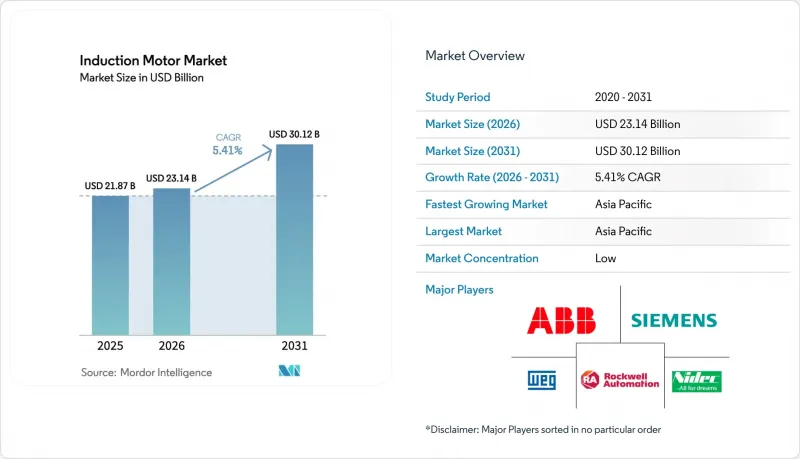
This report is Segmented by Rotor Type (Squirrel-Cage Induction Motors, and More), Phase (Single-Phase Induction Motors, Three-Phase Induction Motors), Efficiency Class (IE1 Standard Efficiency, and More), Application (Pumps, Fans and Blowers, and More), End-User Industry (Manufacturing, Oil and Gas and Chemicals, and More), and Geography. The Market Forecasts are Provided in Terms of Value (USD).
Global Induction Motor Market Trends and Insights
Rising Adoption of Energy-Efficient Motor Standards in Industrial Systems
Industrial motor systems account for a significant share of electricity use, making energy-efficiency policies the single strongest lever for performance upgrades and retrofit cycles. The European Union's Ecodesign framework set IE4 as the minimum for 75-200 kW three-phase motors from mid-2023. Meanwhile, the United States finalized fan and blower standards in January 2024, which promote variable speed and high-efficiency motor-drive pairings across commercial and industrial air systems. China's GB 18613-2020 has moved the baseline to IE3 for motors with a capacity of 0.75-375 kW, narrowing regional gaps and creating a scale for premium-efficiency designs. UN-led model regulations, published in 2025, provide a template for countries to accelerate adoption, with differentiated pathways for markets at varying levels of enforcement readiness. These rules shift purchase criteria toward lifecycle performance, which supports upgrades to IE3 and IE4 motors and broader deployment of VFDs in pumps and fans. Harmonized test protocols from IEC and national bodies reduce technical ambiguity and help the induction motors market capture savings from standardized compliance.
Acceleration of Industrial Automation and Process Optimization Programs
Factory modernization and digital operations are increasing demand for integrated motor-drive packages that operate efficiently at variable load. Variable frequency drives reduce energy consumption in variable torque applications and are central to modernization programs in HVAC, water pumping, and materials handling. Design standards for fans and blowers in the United States embed variable speed as a pathway to compliance, which filters through to motor selection and control strategies in new and retrofit projects. OEMs have updated drive platforms to support higher axis counts, tighter safety functions, and simpler integration, which lowers total cost of ownership for large-scale automation deployments. When paired with three-phase induction motors, drives improve part-load efficiency and reduce mechanical stress, extending service life in high-duty cycles. These dynamics continue to support the induction motors market as industrial users prioritize energy and uptime gains.
Competition from Permanent-Magnet and Synchronous-Reluctance Motor Alternatives
Permanent-magnet machines hold an efficiency edge in many duty cycles, and recent rules for fans and blowers acknowledge electronically commutated designs as the top-tier benchmark in air-moving equipment. Synchronous reluctance motors achieve IE5-class performance without magnets and are being positioned as lower-risk, high-efficiency options when paired with matched drives. These alternatives can divert premium-efficiency demand in segments that prioritize peak performance and compact form factors. That said, they require variable speed control and cannot operate direct-on-line, which preserves the role of induction motors in fixed-speed and rugged environments. Magnet supply concentration and price swings remain a concern for permanent-magnet designs, which keeps magnet-free approaches attractive on total cost and risk grounds. OEM roadmaps and product launches reflect this balance as companies hedge portfolios across induction, SynRM, and PM lines to meet diverse user needs.
Other drivers and restraints analyzed in the detailed report include:
- Expansion of Water and Wastewater Infrastructure Requiring Pumping Capacity
- Manufacturing Capacity Additions in Asia-Pacific and Supply Chain Reconfiguration
- Magnet-Free Design Preference Amid Rare-Earth Supply Risk in High-Power Drives
- Advances in Cast-Copper Rotor and Inverter-Duty Designs Improving Efficiency
- Volatility in Copper and Aluminum Prices Pressuring Motor BOM Costs
For complete list of drivers and restraints, kindly check the Table Of Contents.
Segment Analysis
Squirrel-cage induction motors held 55% of the induction motors market share in 2025 and are forecast to grow at a 7.34% CAGR through 2031. This leadership rests on brushless rotor construction, robust die-cast bars and end rings, and low maintenance in harsh duty cycles. As compliance moved to IE3 and IE4 across regions, inverter-duty induction motors with optimized windings, bearings, and insulation became a standard pairing with modern drives. Copper-rotor variants have reduced rotor losses, enabling efficiency gains without rare-earth magnets, supporting adoption in premium tiers. IEC test and efficiency classification frameworks provide comparative benchmarks across sinusoidal and VFD-fed conditions, helping procurement teams evaluate lifecycle savings. The induction motors market continues to see specification preferences for rugged squirrel-cage designs in pumps, fans, conveyors, and general-purpose drives in industry.
Wound-rotor designs remain in niche roles that require external rotor resistance for precise torque profiles, including large hoists and slurry pumps. VFD-driven squirrel-cage alternatives have displaced wound-rotor options in many cases by offering dynamic control without brushes or slip rings. This shift reduces maintenance and extends service life, which influences long-term cost decisions for operators. As OEMs extend copper-rotor availability to larger frames, the installed base will shift toward more efficient induction platforms at similar footprint. IE3 and IE4 rules for previously exempt motor categories, such as brake motors and explosion-proof units, are pulling the rest of the base toward premium tiers. These technical and regulatory trends support share stability for squirrel-cage configurations in the induction motors market.
Single-phase motors held 53% share in 2025, centered in residential and fractional-HP uses, while three-phase motors are forecast to expand at a 6.76% CAGR through 2031. Three-phase machines deliver higher torque density, smoother operation, and better power factor, which makes them the default choice in industrial and commercial installations. Variable speed drives allow precise control of flow and pressure, which unlocks energy savings in variable torque loads like pumps and fans. The move toward premium efficiency standards in both the European Union and China incentivizes three-phase upgrades in commercial HVAC and light industrial settings. In many retrofits, swapping to three-phase motors with VFDs improves part-load performance and reduces mechanical wear. These dynamics reinforce adoption of three-phase architectures in the induction motors market as automation and energy efficiency become core design goals.
Industrial distribution standards favor three-phase power at 400 V, 460 V, or 575 V, which simplifies motor selection for larger loads. Modular product families with multiple pole configurations and frame sizes support drop-in replacements that minimize downtime. Digital nameplates and integrated feedback via single-cable technologies make commissioning faster with modern controls. Predictive monitoring tools built into drives and gateways rely on stable three-phase waveforms for accurate diagnostics, which complements reliability goals. As commercial buildings and factories standardize on three-phase motors with VFDs, operators benefit from unified maintenance practices. The induction motors market reflects these preferences with broader catalog coverage and inverter-duty ratings across common size ranges.
Complete Report Scope:
- By Rotor Type
- Squirrel-Cage Induction Motors
- Wound-Rotor Induction Motors
- By Phase
- Single-Phase Induction Motors
- Three-Phase Induction Motors
- By Efficiency Class
- IE1 Standard Efficiency Induction Motors
- IE2 High Efficiency Induction Motors
- IE3 Premium Efficiency Induction Motors
- IE4 Super Premium Efficiency Induction Motors
- IE5 Ultra Premium Efficiency Induction Motors
- By Application
- Pumps
- Fans and Blowers
- Compressors
- Conveyors and Material Handling
- Elevators and Cranes
- HVAC Equipment
- Other Applications
- By End-User Industry
- Manufacturing
- Oil and Gas and Chemicals
- Power Generation and Utilities
- Water and Wastewater
- Mining and Metals
- Commercial and Buildings
- Transportation
- Residential
- Other End-User Industry
- By Geography
- North America
- United States
- Canada
- Mexico
- Rest of North America
- South America
- Brazil
- Argentina
- Chile
- Rest of South America
- Europe
- Germany
- United Kingdom
- France
- Italy
- Spain
- Russia
- Rest of Europe
- Asia-Pacific
- China
- India
- Japan
- South Korea
- Australia
- Rest of Asia-Pacific
- Middle East
- Saudi Arabia
- United Arab Emirates
- Turkey
- Israel
- Rest of Middle East
- Africa
- South Africa
- Egypt
- Nigeria
- Rest of Africa
- North America
Geography Analysis
The Asia-Pacific region held a 62% share in 2025 and is projected to grow at a 6.98% CAGR through 2031, as production depth and end-use demand reinforce each other in the region. Fabs, automotive assembly, and export-oriented manufacturing anchor multi-year procurement pipelines for motors and drives. Regional policy alignment with IE3 and above also supports the adoption of premium efficiency in larger frame sizes. Major coastal markets prioritize water treatment and high-efficiency HVAC, resulting in a steady order flow for three-phase, VFD-optimized systems. With more fab projects scheduled through the current cycle, cleanroom HVAC, pumps, and handling systems remain a reliable pull. These factors support the induction motor market as a critical supplier to APAC industrial development.
North America maintains an 18-20% range of global activity as a mature base that emphasizes retrofit quality and lifecycle services. The United States rulemaking for fans and blowers formalizes variable speed as a compliance pathway and strengthens the business case for high-efficiency motors and drives. Nearshoring has increased demand for motors in Mexican plants serving automotive and electronics supply chains. Data-center construction continues to drive orders for high-efficiency HVAC motors and precision systems that operate within strict uptime targets. OEMs invest in U.S. capacity, including new assembly and testing lines that are aligned with advanced HVAC and motion products. These actions strengthen the induction motors market as energy standards and infrastructure investments guide spending priorities.
Europe's share is 15-17% and is shaped by strict Ecodesign requirements and premium application demand in hazardous areas, offshore, and heavy industry. IE4 mandates in the 75-200 kW range, along with IE3 coverage across broader bands, continue to encourage users to move to higher tiers. OEMs have expanded European capacity for explosion-proof motors that meet IECEx and ATEX certifications. The region's focus on energy efficiency makes IE4 and integrated drive solutions attractive in pumps and fans. These drivers sustain the induction motors market across EU industries that demand consistent compliance and traceable performance. Investments in regional production and service capabilities support fast turnaround for complex projects.
- ABB Ltd.
- Siemens AG
- WEG S.A.
- Nidec Corporation
- Wolong Electric Group Co., Ltd.
- Regal Rexnord Corporation
- TECO Electric and Machinery Co., Ltd.
- Toshiba Corporation
- Toshiba Mitsubishi-Electric Industrial Systems Corporation
- Getriebebau NORD GmbH & Co. KG
- SEW-EURODRIVE GmbH & Co KG
- CG Power and Industrial Solutions Limited
- Kirloskar Electric Company Limited
- Rockwell Automation Inc.
- Hitachi, Ltd.
- Yaskawa Electric Corporation
- Oriental Motor Co., Ltd.
- Bonfiglioli Riduttori S.p.A.
- Sumitomo Heavy Industries, Ltd.
- Brook Crompton UK Limited
- Hyundai Electric and Energy Systems Co., Ltd.
Additional Benefits:
- The market estimate (ME) sheet in Excel format
- 3 months of analyst support
TABLE OF CONTENTS
1 INTRODUCTION
- 1.1 Study Assumptions and Market Definition
- 1.2 Scope of the Study
2 RESEARCH METHODOLOGY
3 EXECUTIVE SUMMARY
4 MARKET LANDSCAPE
- 4.1 Market Overview
- 4.2 Market Drivers
- 4.2.1 Rising Adoption of Energy-Efficient Motor Standards in Industrial Systems
- 4.2.2 Acceleration of Industrial Automation and Process Optimization Programs
- 4.2.3 Expansion of Water and Wastewater Infrastructure Requiring Pumping Capacity
- 4.2.4 Manufacturing Capacity Additions in Asia-Pacific and Supply Chain Reconfiguration
- 4.2.5 Magnet-Free Design Preference Amid Rare-Earth Supply Risk in High-Power Drives
- 4.2.6 Advances in Cast-Copper Rotor and Inverter-Duty Designs Improving Efficiency
- 4.3 Market Restraints
- 4.3.1 Competition from Permanent-Magnet and Synchronous-Reluctance Motor Alternatives
- 4.3.2 Upfront Price Premium of Premium-Efficiency Motors and VFD Retrofits
- 4.3.3 Volatility in Copper and Aluminum Prices Pressuring Motor BOM Costs
- 4.3.4 EC Fan Adoption in HVAC Displacing Traditional Induction Motors in Buildings
- 4.4 Impact of Macroeconomic Factors on the Market
- 4.5 Industry Value / Supply-Chain Analysis
- 4.6 Regulatory Landscape
- 4.7 Technological Outlook
- 4.8 Porter's Five Forces Analysis
- 4.8.1 Threat of New Entrants
- 4.8.2 Bargaining Power of Suppliers
- 4.8.3 Bargaining Power of Buyers
- 4.8.4 Threat of Substitutes
- 4.8.5 Industry Rivalry
5 MARKET SIZE AND GROWTH FORECASTS (Value)
- 5.1 By Rotor Type
- 5.1.1 Squirrel-Cage Induction Motors
- 5.1.2 Wound-Rotor Induction Motors
- 5.2 By Phase
- 5.2.1 Single-Phase Induction Motors
- 5.2.2 Three-Phase Induction Motors
- 5.3 By Efficiency Class
- 5.3.1 IE1 Standard Efficiency Induction Motors
- 5.3.2 IE2 High Efficiency Induction Motors
- 5.3.3 IE3 Premium Efficiency Induction Motors
- 5.3.4 IE4 Super Premium Efficiency Induction Motors
- 5.3.5 IE5 Ultra Premium Efficiency Induction Motors
- 5.4 By Application
- 5.4.1 Pumps
- 5.4.2 Fans and Blowers
- 5.4.3 Compressors
- 5.4.4 Conveyors and Material Handling
- 5.4.5 Elevators and Cranes
- 5.4.6 HVAC Equipment
- 5.4.7 Other Applications
- 5.5 By End-User Industry
- 5.5.1 Manufacturing
- 5.5.2 Oil and Gas and Chemicals
- 5.5.3 Power Generation and Utilities
- 5.5.4 Water and Wastewater
- 5.5.5 Mining and Metals
- 5.5.6 Commercial and Buildings
- 5.5.7 Transportation
- 5.5.8 Residential
- 5.5.9 Other End-User Industry
- 5.6 By Geography
- 5.6.1 North America
- 5.6.1.1 United States
- 5.6.1.2 Canada
- 5.6.1.3 Mexico
- 5.6.1.4 Rest of North America
- 5.6.2 South America
- 5.6.2.1 Brazil
- 5.6.2.2 Argentina
- 5.6.2.3 Chile
- 5.6.2.4 Rest of South America
- 5.6.3 Europe
- 5.6.3.1 Germany
- 5.6.3.2 United Kingdom
- 5.6.3.3 France
- 5.6.3.4 Italy
- 5.6.3.5 Spain
- 5.6.3.6 Russia
- 5.6.3.7 Rest of Europe
- 5.6.4 Asia-Pacific
- 5.6.4.1 China
- 5.6.4.2 India
- 5.6.4.3 Japan
- 5.6.4.4 South Korea
- 5.6.4.5 Australia
- 5.6.4.6 Rest of Asia-Pacific
- 5.6.5 Middle East
- 5.6.5.1 Saudi Arabia
- 5.6.5.2 United Arab Emirates
- 5.6.5.3 Turkey
- 5.6.5.4 Israel
- 5.6.5.5 Rest of Middle East
- 5.6.6 Africa
- 5.6.6.1 South Africa
- 5.6.6.2 Egypt
- 5.6.6.3 Nigeria
- 5.6.6.4 Rest of Africa
- 5.6.1 North America
6 COMPETITIVE LANDSCAPE
- 6.1 Market Concentration
- 6.2 Strategic Moves
- 6.3 Market Share Analysis
- 6.4 Company Profiles {(includes Global level Overview, Market level overview, Core Segments, Financials as available, Strategic Information, Market Rank/Share for key companies, Products and Services, and Recent Developments)}
- 6.4.1 ABB Ltd.
- 6.4.2 Siemens AG
- 6.4.3 WEG S.A.
- 6.4.4 Nidec Corporation
- 6.4.5 Wolong Electric Group Co., Ltd.
- 6.4.6 Regal Rexnord Corporation
- 6.4.7 TECO Electric and Machinery Co., Ltd.
- 6.4.8 Toshiba Corporation
- 6.4.9 Toshiba Mitsubishi-Electric Industrial Systems Corporation
- 6.4.10 Getriebebau NORD GmbH & Co. KG
- 6.4.11 SEW-EURODRIVE GmbH & Co KG
- 6.4.12 CG Power and Industrial Solutions Limited
- 6.4.13 Kirloskar Electric Company Limited
- 6.4.14 Rockwell Automation Inc.
- 6.4.15 Hitachi, Ltd.
- 6.4.16 Yaskawa Electric Corporation
- 6.4.17 Oriental Motor Co., Ltd.
- 6.4.18 Bonfiglioli Riduttori S.p.A.
- 6.4.19 Sumitomo Heavy Industries, Ltd.
- 6.4.20 Brook Crompton UK Limited
- 6.4.21 Hyundai Electric and Energy Systems Co., Ltd.
7 MARKET OPPORTUNITIES AND FUTURE OUTLOOK
- 7.1 White-Space and Unmet-Need Assessment

