PUBLISHER: Mordor Intelligence | PRODUCT CODE: 2125283

PUBLISHER: Mordor Intelligence | PRODUCT CODE: 2125283
North America Induction Motor - Market Share Analysis, Industry Trends & Statistics, Growth Forecasts (2026 - 2031)
According to Mordor Intelligence, the North America induction motor market size is projected to expand from USD 5.20 billion in 2025 and USD 5.47 billion in 2026 to USD 6.97 billion by 2031, registering a CAGR of 4.97% between 2026 to 2031.
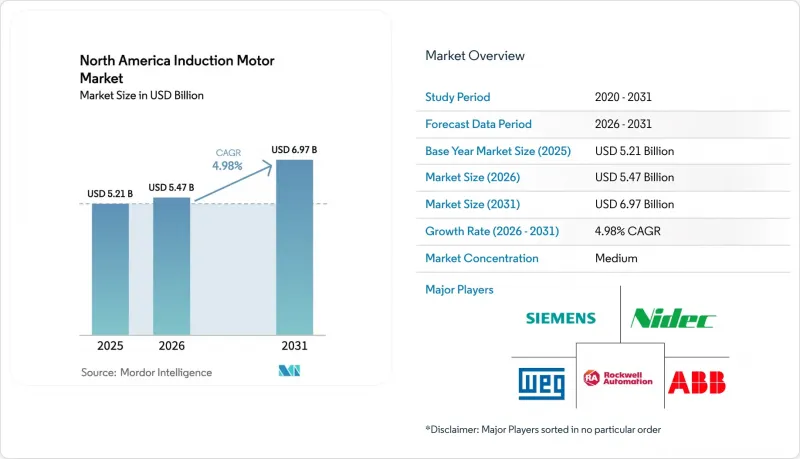
This report is Segmented by Type (Single-Phase, Three-Phase), Power Rating (<=7. 5 KW, and More), Efficiency Class (IE1, and More), Voltage (Lower Than 1 KV, and More), Application (Pumps and Compressors, and More), End-User (Oil and Gas, and More), Sales Channel (New, and Aftermarket), Mounting (Foot, Flange, and Vertical), and Geography. Market Forecasts are Provided in Terms of Value (USD).
North America Induction Motor Market Trends and Insights
Mandatory Efficiency Regulations in the United States and Canada
A 2024 rule now enforces IE3 minimums on 0.25-0.75 hp motors and will mandate IE4 for select frames above 500 hp in 2027, obliging OEMs to redesign pump and fan packages and forcing rewind shops to certify post-service efficiency. California's Title 24 tightened further in 2025, accelerating replacement cycles by nearly two years. Canada harmonized its federal code yet layered rebates in Ontario and British Columbia that subsidize up to 20% of IE4 cost. The combined effect bifurcates the North America induction motor market, with compliance-driven new sales surging while older IE1 and IE2 units exit through scrappage rather than rewind.
Shift Toward Electric Vehicles
Light-vehicle output reached 15.8 million units in 2025, 11.2% of which were battery-electric or plug-in hybrids, prompting assembly plants to specify tighter-tolerance, low-vibration three-phase drives. Gigafactory HVAC systems demand variable-frequency-drive-ready motors up to 185 kW to maintain +-1 °C humidity-controlled rooms. Mexico drew USD 20 billion of announced EV investment through 2025, driving local rotor-lamination lines that shorten supply chains. Domestic-content rules under the CHIPS Act compel suppliers to source copper and electrical steel regionally, further localizing production.
Competition From Permanent-Magnet Synchronous Motors
PMSMs deliver 2-5% higher efficiency and reached 12-15% share of new HVAC installs in the 7.5-37 kW band by 2025. Falling rare-earth prices erode the cost gap. However, demagnetization risks in high-temperature plants and limited rewind options curb universal uptake. Induction-motor makers counter with die-cast copper rotors that reclaim most of the efficiency delta at lower material cost.
Other drivers and restraints analyzed in the detailed report include:
- Smart Factories' Demand for Connected Motors
- Grid-Modernization Incentives for Industrial Efficiency
- Volatility in Copper and Aluminium Prices
For complete list of drivers and restraints, kindly check the Table Of Contents.
Segment Analysis
Three-phase machines held 71.19% of 2025 revenue, underscoring their dominance in balanced-load industrial applications where high starting torque, long life, and simple maintenance prevail. This share equates to the largest North America induction motor market share among all types. Single-phase adoption is rising at 5.55% CAGR as heat-pump retrofits under the Inflation Reduction Act permeate residential and light-commercial buildings.
The North America induction motor market benefits from the Department of Energy rule that extended IE3 thresholds to fractional-horsepower single-phase models, raising bill-of-material cost yet unlocking utility incentives. Three-phase units remain favoured for pumps and conveyors above 1 hp because they ride through momentary phase imbalances and broaden voltage tolerance. Single-phase motors now integrate drives that eliminate phase converters, widening their attractiveness in pool pumps, agricultural fans, and distributed building automation.
The 7.6 kW-37 kW segment accounted for 38.22% of 2025 value and therefore represents the largest slice of the North America induction motor market size. Rapid build-out of automated assembly lines and data-center cooling skews growth toward sub-7.5 kW frames, which expand at 5.39% CAGR.
Siemens' 5.5 kW IE5 launch targets electricity prices above USD 0.12 per kWh, offering a two-year payback to semiconductor and pharmaceutical users. Larger 37-185 kW motors remain steady in metals, mining, and automotive presses, while >185 kW machines stay niche in pipeline and power-plant service. California and New York codes now cover fractional-horsepower designs, hastening churn in small HVAC and commercial refrigeration.
IE3 still rules with 46.74% of 2025 demand, yet IE4 advances at 5.82% CAGR. Utilities in California, Massachusetts, and Ontario stack rebates on time-of-use tariffs, slicing the payback gap to under three years for many mid-load pumps. ABB's disclosure that IE4 now forms 22% of North American shipments signals a market pivot.
IE2 and IE1 remain in managed decline, limited to like-for-like replacements where switchgear or frame envelopes prevent upgrades. IE4's 1.5-2.5% efficiency boost yields USD 150-400 annual savings for 6,000-hour duty cycles at USD 0.10 per kWh. Regal Rexnord's IE5 debut extends the frontier for ultra-premium adopters in semiconductor and pharma clean rooms.
Complete Report Scope:
- By Type
- Single-Phase Induction Motors
- Three-Phase Induction Motors
- By Power Rating
- Less than equal to 7.5 kW
- 7.6 - 37 kW
- 37.1 - 185 kW
- More than 185 kW
- By Efficiency Class
- IE1 Standard Efficiency
- IE2 High Efficiency
- IE3 Premium Efficiency
- IE4 Super-Premium Efficiency
- By Voltage
- Low Voltage (Less than 1 kV)
- Medium Voltage (1 - 6.6 kV)
- High Voltage (More than 6.6 kV)
- By Application
- Pumps and Compressors
- HVAC and Refrigeration
- Material Handling (Conveyors, Hoists)
- Fans and Blowers
- Other Applications
- By End-User Industry
- Oil and Gas
- Chemicals and Petrochemicals
- Power Generation and Utilities
- Water and Wastewater
- Metals and Mining
- Food and Beverage
- Discrete Manufacturing (Automotive, Electronics)
- Other End-User Industries
- By Sales Channel
- New Sales
- Aftermarket
- By Mounting Type
- Foot-Mounted
- Flange-Mounted
- Vertical-Mounted
- By Country
- United States
- Canada
- Mexico
List of Companies Covered in this Report:
- ABB Ltd.
- Siemens AG
- Nidec Motor Corporation
- Rockwell Automation, Inc.
- WEG S.A.
- Emerson Electric Co.
- Schneider Electric SE
- Regal Rexnord Corp.
- Baldor Electric Company (ABB)
- Toshiba International Corporation
- TECO-Westinghouse Motor Company
- Franklin Electric Co., Inc.
- Johnson Electric Holdings Ltd.
- Leeson Electric (Regal Rexnord)
- Brook Crompton UK Ltd.
- Cantoni Motor S.A.
- Lafert North America
- Kollmorgen Corp.
- SEW-Eurodrive GmbH and Co KG
- GE Power Conversion
- Motion Industries, Inc.
- Allied Motion Technologies Inc.
Additional Benefits:
- The market estimate (ME) sheet in Excel format
- 3 months of analyst support
TABLE OF CONTENTS
1 INTRODUCTION
- 1.1 Study Assumptions and Market Definition
- 1.2 Scope of the Study
2 RESEARCH METHODOLOGY
3 EXECUTIVE SUMMARY
4 MARKET LANDSCAPE
- 4.1 Market Overview
- 4.2 Industry Stakeholder Analysis
- 4.3 Market Drivers
- 4.3.1 Shift Toward Electric Vehicles (EV / HEV)
- 4.3.2 Mandatory Efficiency Regulations in the United States and Canada
- 4.3.3 Smart Factories' Demand for Connected Motors
- 4.3.4 Grid-Modernization Incentives for Industrial Efficiency
- 4.3.5 On-Shoring of Critical Supply Chains in EV and HVAC Industries
- 4.3.6 Utility Decarbonization Targets Accelerating Motor Retrofits
- 4.4 Market Restraints
- 4.4.1 Competition From Permanent-Magnet Synchronous Motors
- 4.4.2 Volatility in Copper and Aluminum Prices
- 4.4.3 Skilled-Labor Shortages for Motor Rewinding
- 4.4.4 Cyber-Security Concerns in IIoT-Enabled Motors
- 4.5 Impact of Macroeconomic Factors on the Market
- 4.6 Industry Value-Chain Analysis
- 4.7 Regulatory Landscape
- 4.8 Technological Outlook
- 4.9 Porter's Five Forces Analysis
- 4.9.1 Bargaining Power of Suppliers
- 4.9.2 Bargaining Power of Buyers
- 4.9.3 Threat of New Entrants
- 4.9.4 Threat of Substitutes
- 4.9.5 Intensity of Competitive Rivalry
- 4.10 Investment Analysis
5 MARKET SIZE AND GROWTH FORECASTS (VALUE)
- 5.1 By Type
- 5.1.1 Single-Phase Induction Motors
- 5.1.2 Three-Phase Induction Motors
- 5.2 By Power Rating
- 5.2.1 Less than equal to 7.5 kW
- 5.2.2 7.6 - 37 kW
- 5.2.3 37.1 - 185 kW
- 5.2.4 More than 185 kW
- 5.3 By Efficiency Class
- 5.3.1 IE1 Standard Efficiency
- 5.3.2 IE2 High Efficiency
- 5.3.3 IE3 Premium Efficiency
- 5.3.4 IE4 Super-Premium Efficiency
- 5.4 By Voltage
- 5.4.1 Low Voltage (Less than 1 kV)
- 5.4.2 Medium Voltage (1 - 6.6 kV)
- 5.4.3 High Voltage (More than 6.6 kV)
- 5.5 By Application
- 5.5.1 Pumps and Compressors
- 5.5.2 HVAC and Refrigeration
- 5.5.3 Material Handling (Conveyors, Hoists)
- 5.5.4 Fans and Blowers
- 5.5.5 Other Applications
- 5.6 By End-User Industry
- 5.6.1 Oil and Gas
- 5.6.2 Chemicals and Petrochemicals
- 5.6.3 Power Generation and Utilities
- 5.6.4 Water and Wastewater
- 5.6.5 Metals and Mining
- 5.6.6 Food and Beverage
- 5.6.7 Discrete Manufacturing (Automotive, Electronics)
- 5.6.8 Other End-User Industries
- 5.7 By Sales Channel
- 5.7.1 New Sales
- 5.7.2 Aftermarket
- 5.8 By Mounting Type
- 5.8.1 Foot-Mounted
- 5.8.2 Flange-Mounted
- 5.8.3 Vertical-Mounted
- 5.9 By Country
- 5.9.1 United States
- 5.9.2 Canada
- 5.9.3 Mexico
6 COMPETITIVE LANDSCAPE
- 6.1 Market Concentration
- 6.2 Strategic Moves
- 6.3 Market Share Analysis
- 6.4 Company Profiles (includes Global Level Overview, Market Level Overview, Core Segments, Financials as available, Strategic Information, Market Rank / Share, Products and Services, Recent Developments)
- 6.4.1 ABB Ltd.
- 6.4.2 Siemens AG
- 6.4.3 Nidec Motor Corporation
- 6.4.4 Rockwell Automation, Inc.
- 6.4.5 WEG S.A.
- 6.4.6 Emerson Electric Co.
- 6.4.7 Schneider Electric SE
- 6.4.8 Regal Rexnord Corp.
- 6.4.9 Baldor Electric Company (ABB)
- 6.4.10 Toshiba International Corporation
- 6.4.11 TECO-Westinghouse Motor Company
- 6.4.12 Franklin Electric Co., Inc.
- 6.4.13 Johnson Electric Holdings Ltd.
- 6.4.14 Leeson Electric (Regal Rexnord)
- 6.4.15 Brook Crompton UK Ltd.
- 6.4.16 Cantoni Motor S.A.
- 6.4.17 Lafert North America
- 6.4.18 Kollmorgen Corp.
- 6.4.19 SEW-Eurodrive GmbH and Co KG
- 6.4.20 GE Power Conversion
- 6.4.21 Motion Industries, Inc.
- 6.4.22 Allied Motion Technologies Inc.
7 MARKET OPPORTUNITIES AND FUTURE OUTLOOK
- 7.1 White-Space and Unmet-Need Assessment

