PUBLISHER: Mordor Intelligence | PRODUCT CODE: 2124229

PUBLISHER: Mordor Intelligence | PRODUCT CODE: 2124229
MENA Mobile Virtual Network Operator - Market Share Analysis, Industry Trends & Statistics, Growth Forecasts (2026 - 2031)
According to Mordor Intelligence, MENA mobile virtual network operator market size in 2026 is estimated at USD 0.83 billion, growing from 2025 value of USD 0.78 billion with 2031 projections showing USD 1.14 billion, growing at 6.5% CAGR over 2026-2031.
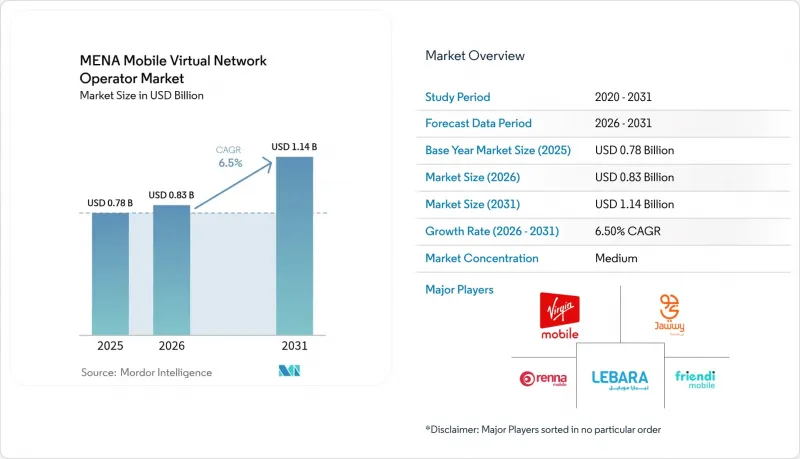
This report is Segmented by Deployment Model (Cloud, and On-Premise), Operational Mode (Service Operator, and More), Subscriber Type (Consumer, Enterprise, and More), Application (Discount, and More), Network Technology (2G/3G, and More), Distribution Channel (Online/Digital-only, and More), and Country. The Market Forecasts are Provided in Terms of Value (USD) and Volume (Subscribers).
MENA Mobile Virtual Network Operator Market Trends and Insights
Price-Sensitive Expatriate and Youth Segments Fuel Prepaid Churn
Roughly 10 million expatriates in Saudi Arabia and large youth cohorts across the GCC seek low-commitment prepaid plans, prompting steady subscriber migration toward MVNO offers that combine cheaper international minutes with flexible data allocations. Number-portability reforms and fully digital onboarding remove switching friction, accelerating churn away from incumbents. Virgin Mobile's jump to 3.5 million regional users illustrates how simplified tariffs plus in-app servicing capture scale quickly. The resulting pressure forces host operators to renegotiate wholesale terms to retain outbound traffic, indirectly improving MVNO economics. Expat and youth-led growth, therefore, secures a stable demand base for the MENA MVNO market without heavy marketing spend.
5G-Enabled Digital Brands Leverage eSIM and App-Only Onboarding
Regional eSIM connections are tracking 20% annual growth, with projections of 135 million active profiles by 2028, allowing MVNOs to forgo physical distribution and activate users in minutes. Platforms such as Jawwy by stc rely on cloud-native charging stacks that push real-time offers and policy controls to customer apps, lowering acquisition costs and supporting granular segmentation. The convergence of 5G network slicing with eSIM provisioning enables micro-bundles, daily gigabyte passes, or latency-optimized streams, creating monetizable use cases absent from SIM card channels. As a result, digital-only brands enhance stickiness and lift ARPU even when headline tariffs remain low, reinforcing growth prospects for the MENA MVNO market.
High Mobile-Data Floor Prices in Gulf States Squeeze ARPU
Wholesale data-floor regulations mean MVNOs in the UAE and Kuwait often pay per-gigabyte rates that are 15-20% above European comparables, constraining headline discounts and limiting addressable mass-market segments. While value-added features can offset some margin loss, operators struggle to undercut incumbents on data-hungry consumer plans. Competitive differentiation, therefore, shifts to lifestyle branding, loyalty perks, and fintech add-ons rather than aggressive price moves, tempering near-term upside for the MENA MVNO market.
Other drivers and restraints analyzed in the detailed report include:
- Regulator-Mandated Network-Sharing and Wholesale Price Caps Improve Economics
- Satellite-NTN Connectivity for Remote Oil and Gas Sites
- Limited Number-Portability in North Africa Curbs Switching
For complete list of drivers and restraints, kindly check the Table Of Contents.
Segment Analysis
Cloud implementations held 62.30% revenue in 2025 and pushed the MENA MVNO market size forward with an 11.45% CAGR. The operating model removes hefty capex items such as mobile switching nodes and allows pay-as-you-grow scaling, creating a breakeven horizon under 18 months for greenfield brands. AI-assisted fraud checks and real-time policy engines come bundled with most hyperscale offerings, reinforcing service quality.
On-premise environments persist where data-sovereignty clauses require local processing, notably in sovereign energy and defense verticals. These deployments impose longer deployment cycles yet deliver tight network integration for service-level commitments. Vendors are increasingly hybridizing solutions by anchoring mission-critical functions on private clouds while shifting mediation, analytics, and billing to multitenant regions, smoothing migration paths for legacy MVNOs.
Reseller/light/brand formats accounted for 62.85% of the MENA MVNO market share in 2025 as quick-launch brands leveraged existing host assets. Yet full MVNO frameworks, controlling core network elements and SIM profiles, are set to record 23.6% CAGR, signaling the market's march toward service autonomy.
Branded concepts like Red Bull Mobile experiment with perpetual Gigacoin data wallets, a structure unviable under restrictive reseller contracts. Full control allows independent roaming deals and on-demand quality tiers built atop 5G network slices. Over time, richer margins and differentiated feature sets propel full MVNO appeal, anchoring long-term competitiveness inside the MENA MVNO market.
Complete Report Scope:
- By Deployment Model
- Cloud
- On-premise
- By Operational Mode
- Reseller / Light / Brand MVNO
- Service Operator
- Full MVNO
- By Subscriber Type
- Consumer
- Enterprise
- IoT-specific
- By Application
- Discount
- Business
- Cellular M2M
- Others
- By Network Technology
- 2G/3G
- 4G/LTE
- 5G
- Satellite/NTN
- By Distribution Channel
- Online / Digital-only
- Traditional Retail Stores
- Carrier Sub-brand Stores
- Third-Party / Wholesale
- By Geography
- Middle East
- Saudi Arabia
- United Arab Emirates
- Turkey
- Rest of Middle East
- North Africa
- Egypt
- Morocco
- Tunisia
- Algeria
- Rest of North Africa
- Middle East
List of Companies Covered in this Report:
- Virgin Mobile Middle East and Africa (Beyond ONE)
- Lebara Mobile KSA
- FRiENDi Mobile Oman (Beyond ONE)
- Renna Mobile Oman
- Jawwy (Saudi Telecom Company)
- Salam Mobile
- Red Bull MOBILE Bahrain
- Swyp (Etisalat UAE)
- Lyca Mobile Tunisia
Additional Benefits:
- The market estimate (ME) sheet in Excel format
- 3 months of analyst support
TABLE OF CONTENTS
1 INTRODUCTION
- 1.1 Study Assumptions and Market Definition
- 1.2 Scope of the Study
2 RESEARCH METHODOLOGY
3 EXECUTIVE SUMMARY
4 MARKET LANDSCAPE
- 4.1 Market Overview
- 4.2 Market Drivers
- 4.2.1 Price-sensitive expatriate and youth segments fuel prepaid churn towards MVNOs
- 4.2.2 5G-enabled digital brands leverage eSIM and app-only onboarding
- 4.2.3 Regulator-mandated network-sharing/wholesale price caps improve MVNO economics
- 4.2.4 Cross-border remittance bundling (e.g., airtime-to-cash corridors)
- 4.2.5 Satellite-NTN connectivity for remote oil and gas sites
- 4.2.6 Green fintech-MVNO hybrids monetize carbon-credit micro-transactions
- 4.3 Market Restraints
- 4.3.1 High mobile-data floor prices in Gulf states squeeze MVNO ARPU
- 4.3.2 Limited number-portability in North Africa curbs subscriber switching
- 4.3.3 Rising wholesale 5G slicing fees vs. legacy 4G rates
- 4.3.4 Geopolitical spectrum-allocation delays (e.g., Libya, Yemen)
- 4.4 Value Chain Analysis
- 4.5 Regulatory Landscape
- 4.6 Porter's Five Forces Analysis
- 4.6.1 Threat of New Entrants
- 4.6.2 Bargaining Power of Buyers
- 4.6.3 Bargaining Power of Suppliers
- 4.6.4 Threat of Substitutes
- 4.6.5 Intensity of Competitive Rivalry
- 4.7 Assessment of Macroeconomic Factors on the Market
5 MARKET SIZE AND GROWTH FORECASTS (VALUE)
- 5.1 By Deployment Model
- 5.1.1 Cloud
- 5.1.2 On-premise
- 5.2 By Operational Mode
- 5.2.1 Reseller / Light / Brand MVNO
- 5.2.2 Service Operator
- 5.2.3 Full MVNO
- 5.3 By Subscriber Type
- 5.3.1 Consumer
- 5.3.2 Enterprise
- 5.3.3 IoT-specific
- 5.4 By Application
- 5.4.1 Discount
- 5.4.2 Business
- 5.4.3 Cellular M2M
- 5.4.4 Others
- 5.5 By Network Technology
- 5.5.1 2G/3G
- 5.5.2 4G/LTE
- 5.5.3 5G
- 5.5.4 Satellite/NTN
- 5.6 By Distribution Channel
- 5.6.1 Online / Digital-only
- 5.6.2 Traditional Retail Stores
- 5.6.3 Carrier Sub-brand Stores
- 5.6.4 Third-Party / Wholesale
- 5.7 By Geography
- 5.7.1 Middle East
- 5.7.1.1 Saudi Arabia
- 5.7.1.2 United Arab Emirates
- 5.7.1.3 Turkey
- 5.7.1.4 Rest of Middle East
- 5.7.2 North Africa
- 5.7.2.1 Egypt
- 5.7.2.2 Morocco
- 5.7.2.3 Tunisia
- 5.7.2.4 Algeria
- 5.7.2.5 Rest of North Africa
- 5.7.1 Middle East
6 COMPETITIVE LANDSCAPE
- 6.1 Market Concentration
- 6.2 Strategic Moves
- 6.3 Market Share Analysis
- 6.4 Company Profiles (includes Global level Overview, Market level overview, Core Segments, Financials as available, Strategic Information, Market Rank/Share for key companies, Products and Services, and Recent Developments)
- 6.4.1 Virgin Mobile Middle East and Africa (Beyond ONE)
- 6.4.2 Lebara Mobile KSA
- 6.4.3 FRiENDi Mobile Oman (Beyond ONE)
- 6.4.4 Renna Mobile Oman
- 6.4.5 Jawwy (Saudi Telecom Company)
- 6.4.6 Salam Mobile
- 6.4.7 Red Bull MOBILE Bahrain
- 6.4.8 Swyp (Etisalat UAE)
- 6.4.9 Lyca Mobile Tunisia
7 MARKET OPPORTUNITIES AND FUTURE OUTLOOK
- 7.1 White-Space and Unmet-Need Assessment

