PUBLISHER: Mordor Intelligence | PRODUCT CODE: 2124348

PUBLISHER: Mordor Intelligence | PRODUCT CODE: 2124348
Europe Battery Energy Storage System (BESS) - Market Share Analysis, Industry Trends & Statistics, Growth Forecasts (2026 - 2031)
According to Mordor Intelligence, the Europe battery energy storage system (BESS) market size is projected to expand from USD 20.69 billion in 2025 and USD 24.22 billion in 2026 to USD 52.72 billion by 2031, reflecting a 16.84% CAGR and confirming investor confidence in long-duration grid flexibility solutions.
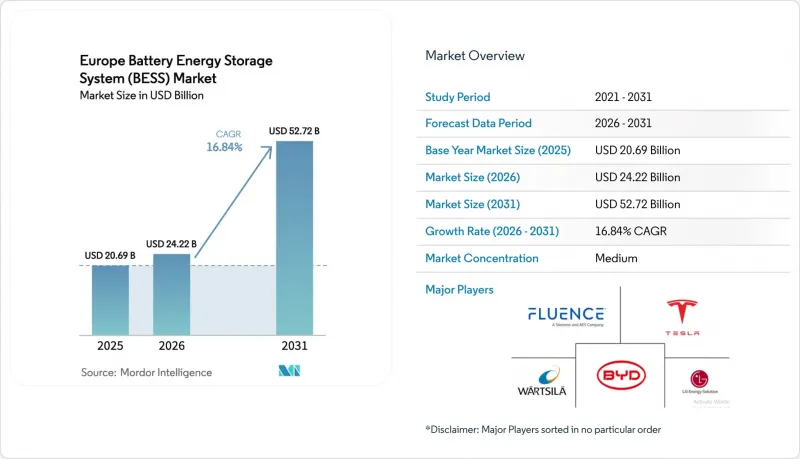
This report is Segmented by Battery Type (Lithium-Ion, Lead-Acid, and More), Connection Type (On-Grid and Off-Grid), Component (Battery Pack and Racks, Energy Management Software, and More), Energy Capacity Range (10 To 100 MWh, Above 500 MWh, and More), End-User Application (Utility, Commercial and Industrial, and Residential), and Geography (Germany, United Kingdom, and More).
Europe Battery Energy Storage System (BESS) Market Trends and Insights
EU-Wide Fit-for-55 Flexibility Mandates Accelerating BESS Procurement
The directive requires each member state to source at least 30% of balancing reserves from non-fossil resources by 2030, providing a structural demand floor for the European Battery Energy Storage Systems market. Battery projects now pre-qualify for automatic frequency restoration tenders that formerly went to hydro and gas assets, shortening payback periods below seven years in Germany and the Netherlands. Developers are racing to secure connection agreements ahead of expected queue reforms, while transmission operators add interim targets that further pull forward investment decisions.
Residential Prosumer Tariff-Arbitrage Amid Record-High Retail Prices
Retail electricity prices averaged EUR 0.41 per kWh in late 2025 in Germany, creating a spread of EUR 0.26-0.36 versus day-ahead wholesale prices. This margin underpins eight-to-ten-year payback periods for 10 kWh home systems even without feed-in tariffs. More than 60% of German residential batteries now use algorithms that charge during negative-price hours, which occurred 300 times in 2025, and discharge during evening peaks.
Grid-Connection Queues and Limited Interconnection Capacity
Germany's queue exceeded 100 GW by end-2025, stretching wait times to 36 months and eroding project NPVs by up to 20%. Spain and the United Kingdom face similar constraints, prompting the U.K. grid operator to adopt a first-ready approach that favors shovel-ready applications.
Other drivers and restraints analyzed in the detailed report include:
- National Capacity & Fast-Reserve Auctions Creating Bankable Revenue Stacks
- Germany's Smart-Meter Roll-out Unlocking Aggregation of Behind-the-Meter Storage
- Volatile Ancillary-Service Prices Undermining Project IRRs
For complete list of drivers and restraints, kindly check the Table Of Contents.
Segment Analysis
Lithium-ion held 87.8% of installed capacity in 2025, giving the segment the dominant Europe Battery Energy Storage Systems market share. Flow batteries, expanding at a 28.3% CAGR, appeal to grid operators that need 6-10 hour discharge profiles and wish to avoid lithium cost escalations. Sodium-ion and lithium titanate technologies are entering pilot phases for specific resilience or temperature-tolerant applications. Overall, chemistry diversification is likely to cap lithium's share below 80% by 2031, even as absolute lithium volume continues to rise.
The European Battery Energy Storage Systems market size for flow chemistries is expected to surpass USD 4 billion by 2031, supported by vendor-financed warranties exceeding 20 years. Utility preference for multi-hour assets aligns with interconnection upgrades that favor fewer, longer-duration systems, while corporate buyers value the environmental credentials embedded in vanadium recycling chains.
On-grid assets accounted for 85.5% of capacity in 2025, reflecting mature grid-service revenue models. Off-grid and hybrid microgrids will advance at a 28.9% CAGR, carving new demand pools inside industrial campuses and island communities. The European Battery Energy Storage Systems market size tied to off-grid mining operations already exceeds USD 1 billion, highlighted by Wartsila's 10 MW Swedish microgrid that delivered 40% savings in 2025.
As grid queues lengthen, data-center operators and chemical producers are securing off-grid permits that bypass transmission interconnection. Hybrid plants capable of islanding during outages support resilience mandates and reduce network charges that can reach EUR 150 per kW yearly in Germany.
Complete Report Scope:
- By Battery Type
- Lithium-ion (Lithium Iron Phosphate (LFP), Nickel-Manganese-Cobalt (NMC), Lithium Titanate (LTO))
- Lead-acid
- Flow Battery (Vanadium Redox, Zinc-Bromine)
- Sodium-ion
- Other Battery Technologies (NiCd, Hybrid Super-capacitors)
- By Connection Type
- On-Grid (Utility Interconnected)
- Off-Grid (Micro-Grid, Hybrid)
- By Component
- Battery Pack and Racks
- Power Conversion System (PCS)
- Energy Management Software (EMS)
- Balance-of-Plant and Services
- By Energy Capacity Range
- Below 10 MWh
- 10 to 100 MWh
- 100 to 500 MWh
- Above 500 MWh
- By End-user Application
- Utility
- Commercial and Industrial
- Residential
- By Geography
- Germany
- United Kingdom
- Italy
- France
- Spain
- Nordic Countries (Norway, Sweden, Denmark, Finland)
- Rest of Europe
List of Companies Covered in this Report:
- Fluence Energy Inc.
- Tesla Inc.
- BYD Co. Ltd.
- LG Energy Solution Ltd.
- Samsung SDI Co. Ltd.
- Wartsila Oyj Abp
- Northvolt AB
- Saft Groupe SAS (TotalEnergies)
- Panasonic Holdings Corp.
- Contemporary Amperex Technology Co. Ltd.
- Hitachi Energy Ltd.
- ABB Ltd.
- Toshiba Corp.
- Murata Manufacturing Co. Ltd.
- Leclanche SA
- EVE Energy Co. Ltd.
- NEC Energy Solutions (Koch)
- VARTA AG
- Zenobe Energy Ltd.
- Kokam Co. Ltd.
Additional Benefits:
- The market estimate (ME) sheet in Excel format
- 3 months of analyst support
TABLE OF CONTENTS
1 Introduction
- 1.1 Study Assumptions & Market Definition
- 1.2 Scope of the Study
2 Research Methodology
3 Executive Summary
4 Market Landscape
- 4.1 Market Overview
- 4.2 Market Drivers
- 4.2.1 EU-wide "Fit-for-55" Flexibility Mandates Accelerating BESS Procurement
- 4.2.2 Residential Prosumer Tariff-Arbitrage Amid Record-High Retail Prices
- 4.2.3 National Capacity & Fast-Reserve Auctions (UK, Italy) Creating Bankable Revenue Stacks
- 4.2.4 Germany's Smart-Meter Roll-out Unlocking Aggregation of Behind-the-Meter Storage
- 4.2.5 Corporate PPA Boom Driving Co-located BESS with Utility-Scale Solar & Wind
- 4.2.6 Accelerated De-Risking of Li-ion Supply via EU Battery Passport & Critical-Mineral Acts
- 4.3 Market Restraints
- 4.3.1 Grid-Connection Queues and Limited Interconnection Capacity
- 4.3.2 Volatile Ancillary-Service Prices Undermining Project IRRs
- 4.3.3 Fire-Safety & Urban-Zoning Rules Raising Capex for Dense EU Cities
- 4.3.4 Reliance on Chinese Cell Imports Exposing Projects to FX & Trade-Policy Risk
- 4.4 Supply-Chain Analysis
- 4.5 Regulatory Landscape
- 4.6 Technological Outlook
- 4.7 Porter's Five Forces Analysis
- 4.7.1 Bargaining Power of Suppliers
- 4.7.2 Bargaining Power of Buyers
- 4.7.3 Threat of New Entrants
- 4.7.4 Threat of Substitutes
- 4.7.5 Intensity of Competitive Rivalry
- 4.8 Investment Analysis
5 Market Size & Growth Forecasts
- 5.1 By Battery Type
- 5.1.1 Lithium-ion (Lithium Iron Phosphate (LFP), Nickel-Manganese-Cobalt (NMC), Lithium Titanate (LTO))
- 5.1.2 Lead-acid
- 5.1.3 Flow Battery (Vanadium Redox, Zinc-Bromine)
- 5.1.4 Sodium-ion
- 5.1.5 Other Battery Technologies (NiCd, Hybrid Super-capacitors)
- 5.2 By Connection Type
- 5.2.1 On-Grid (Utility Interconnected)
- 5.2.2 Off-Grid (Micro-Grid, Hybrid)
- 5.3 By Component
- 5.3.1 Battery Pack and Racks
- 5.3.2 Power Conversion System (PCS)
- 5.3.3 Energy Management Software (EMS)
- 5.3.4 Balance-of-Plant and Services
- 5.4 By Energy Capacity Range
- 5.4.1 Below 10 MWh
- 5.4.2 10 to 100 MWh
- 5.4.3 100 to 500 MWh
- 5.4.4 Above 500 MWh
- 5.5 By End-user Application
- 5.5.1 Utility
- 5.5.2 Commercial and Industrial
- 5.5.3 Residential
- 5.6 By Geography
- 5.6.1 Germany
- 5.6.2 United Kingdom
- 5.6.3 Italy
- 5.6.4 France
- 5.6.5 Spain
- 5.6.6 Nordic Countries (Norway, Sweden, Denmark, Finland)
- 5.6.7 Rest of Europe
6 Competitive Landscape
- 6.1 Market Concentration
- 6.2 Strategic Moves (M&A, Partnerships, PPAs)
- 6.3 Market Share Analysis (Market Rank/Share for key companies)
- 6.4 Company Profiles (includes Global level Overview, Market level overview, Core Segments, Financials as available, Strategic Information, Products & Services, and Recent Developments)
- 6.4.1 Fluence Energy Inc.
- 6.4.2 Tesla Inc.
- 6.4.3 BYD Co. Ltd.
- 6.4.4 LG Energy Solution Ltd.
- 6.4.5 Samsung SDI Co. Ltd.
- 6.4.6 Wartsila Oyj Abp
- 6.4.7 Northvolt AB
- 6.4.8 Saft Groupe SAS (TotalEnergies)
- 6.4.9 Panasonic Holdings Corp.
- 6.4.10 Contemporary Amperex Technology Co. Ltd.
- 6.4.11 Hitachi Energy Ltd.
- 6.4.12 ABB Ltd.
- 6.4.13 Toshiba Corp.
- 6.4.14 Murata Manufacturing Co. Ltd.
- 6.4.15 Leclanche SA
- 6.4.16 EVE Energy Co. Ltd.
- 6.4.17 NEC Energy Solutions (Koch)
- 6.4.18 VARTA AG
- 6.4.19 Zenobe Energy Ltd.
- 6.4.20 Kokam Co. Ltd.
7 Market Opportunities & Future Outlook
- 7.1 White-Space & Unmet-Need Assessment

