PUBLISHER: Mordor Intelligence | PRODUCT CODE: 2124359

PUBLISHER: Mordor Intelligence | PRODUCT CODE: 2124359
South America Battery Energy Storage System (BESS) - Market Share Analysis, Industry Trends & Statistics, Growth Forecasts (2026 - 2031)
According to Mordor Intelligence, South America battery energy storage system market size in 2026 is estimated at USD 3.26 billion, growing from 2025 value of USD 2.82 billion with 2031 projections showing USD 6.68 billion, growing at 15.46% CAGR over 2026-2031.
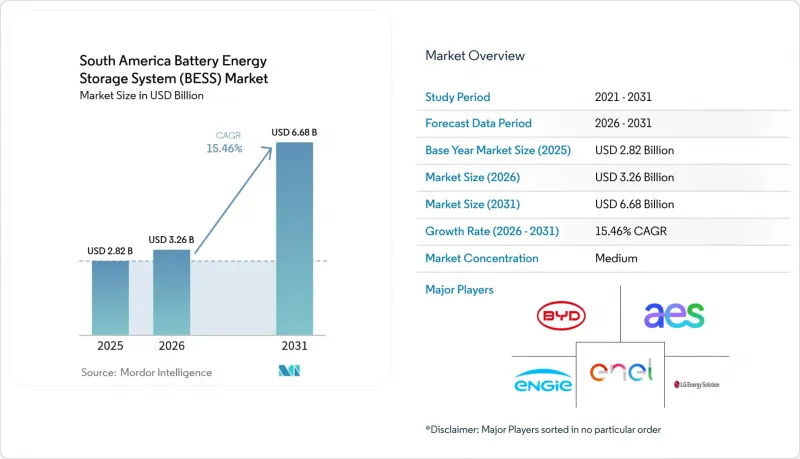
This report is Segmented by Battery Type (Lithium-Ion, and More), Connection Type (On-Grid and Off-Grid), Component (Battery Pack and Racks, Energy Management Software, and More), Energy Capacity Range (10 To 100 MWh, Above 500 MWh, and More), End-User Application (Utility, Commercial and Industrial, and Residential), and Geography (Brazil, Chile, Argentina, and More).
South America Battery Energy Storage System (BESS) Market Trends and Insights
Surging Variable-Renewable Penetration Across Brazil & Chile
Brazil added 8.8 GW of solar and wind energy in 2024, increasing variable renewables to 23% of the grid's supply. Chile's Atacama Desert hosts 4.2 GW of solar that faces midday curtailment, creating lucrative evening-peak arbitrage windows for 4-hour lithium-ion systems. The Chilean grid operator requires solar plants exceeding 100 MW to co-locate storage or face curtailment penalties. Brazil's system operator pilots synthetic-inertia services from batteries to replace retiring thermal plants. Argentina's Patagonia wind corridor experiences similar curtailment yet lacks capacity payments, resulting in storage investment remaining off-grid for mines.
Rapid Decline in Lithium-Ion (LFP & NMC) Battery USD/kWh
LFP cell prices declined to USD 115/kWh in 2024, representing a 17% year-over-year decrease, which drove levelized storage costs below USD 150/MWh for 4-hour systems. NMC chemistries fell to USD 128 / kWh, narrowing the cost gap and enabling hybrid stacks that combine LFP bulk capacity with NMC power bursts. Brazil's 2025 auction caps bids at USD 180 / kWh, a threshold only LFP suppliers can meet profitably. South Korean firms are redirecting NMC output to South American EV plants, creating a secondary supply for stationary integrators. Projections indicate 6-hour systems will match 4-hour costs by 2027, opening seasonal-firming applications.
High Upfront Capex & Limited Project-Finance Depth
Utility-scale systems cost USD 300-400 / kWh, implying USD 120 million for 300 MWh plants. Argentina's 1,500-basis-point risk premium blocks international lenders absent guarantees. Colombia's development bank issued USD 85 million in concessional loans in 2024, meeting a threefold demand. Peru's miners fund projects on a balance-sheet basis, narrowing participation to investment-grade firms. Brazil's BNDES limits loans to 70% of capex, forcing higher equity shares.
Other drivers and restraints analyzed in the detailed report include:
- Emerging Utility Procurement of Ancillary-Service BESS Through 2025 Storage Auctions
- Corporate PPAs & Micro-Grid Demand From Mining Sector in Andean Region
- Regulatory Gaps / Uncertain Remuneration Outside Chile & Brazil
For complete list of drivers and restraints, kindly check the Table Of Contents.
Segment Analysis
Flow batteries are set to grow at a 24.6% CAGR through 2031, reflecting rising demand for 8-12-hour discharge durations that lithium-ion cannot match economically. The South America battery energy storage system market size for flow batteries reached USD 0.28 billion in 2025 and is poised for accelerated expansion as grid codes internalize curtailment costs. ESS Inc.'s 75 MWh iron-flow project in Chile exemplifies 12-hour performance without capacity fade.
Lithium-ion retained a 90.05% share owing to LFP's cost and thermal advantages in hot climates. Sodium-ion pilots in Brazil aim to localize the supply chain. Niche chemistries such as hybrid super-capacitors serve sub-second response markets. Certification under UL 1973 is becoming mandatory, shaping procurement specifications. The South America battery energy storage system market continues to bifurcate between cost-optimized 4-hour lithium-ion stacks and longer-duration flow solutions.
Off-grid microgrids are forecasted to grow at a 25.1% CAGR, driven by decarbonization in the mining sector and electrification in remote communities. Peru's rural program aims for 500 solar-plus-storage microgrids by 2027. On-grid systems nonetheless dominate 79.85% of 2025 installs, underpinned by utility auctions in Brazil and market-based procurement in Chile. Hybrid configurations that allow islanding during outages blend both models.
The South America battery energy storage system market benefits from avoided transmission build-outs in off-grid sites, while on-grid projects capture multi-revenue stacking. Interconnection queues in Argentina typically stretch 12-18 months, favoring microgrids due to their time-to-market advantage. Net-metering reforms in Brazil permit behind-the-meter hybrid setups, intensifying distributed demand.
Complete Report Scope:
- By Battery Type
- Lithium-ion (Lithium Iron Phosphate (LFP), Nickel-Manganese-Cobalt (NMC), Lithium Titanate (LTO))
- Lead-acid
- Flow Battery (Vanadium Redox, Zinc-Bromine)
- Sodium-ion
- Other Battery Technologies (NiCd, Hybrid Super-capacitors)
- By Connection Type
- On-Grid (Utility Interconnected)
- Off-Grid (Micro-Grid, Hybrid)
- By Component
- Battery Pack and Racks
- Power Conversion System (PCS)
- Energy Management Software (EMS)
- Balance-of-Plant and Services
- By Energy Capacity Range
- Below 10 MWh
- 10 to 100 MWh
- 100 to 500 MWh
- Above 500 MWh
- By End-user Application
- Utility
- Commercial and Industrial
- Residential
- By Geography
- Brazil
- Chile
- Argentina
- Colombia
- Peru
- Rest of South America
List of Companies Covered in this Report:
- Enel S.p.A.
- AES Andes / AES Gener
- BYD Co Ltd
- Engie SA
- LG Energy Solution
- Fluence Energy
- Tesla Inc.
- Siemens Energy
- Schneider Electric SE
- ABB Ltd.
- CATL
- Panasonic Corp.
- Samsung SDI
- Saft Groupe SA
- EnerSys
- Acumuladores Moura S.A.
- Nidec ASI
- Hitachi Energy
- SUNRED
- Atlas Renewable Energy
Additional Benefits:
- The market estimate (ME) sheet in Excel format
- 3 months of analyst support
TABLE OF CONTENTS
1 Introduction
- 1.1 Study Assumptions & Market Definition
- 1.2 Scope of the Study
2 Research Methodology
3 Executive Summary
4 Market Landscape
- 4.1 Market Overview
- 4.2 Market Drivers
- 4.2.1 Surging variable-renewable penetration across Brazil & Chile
- 4.2.2 Rapid decline in lithium-ion (LFP & NMC) battery USD/kWh
- 4.2.3 Emerging utility procurement of ancillary-service BESS through 2025 storage auctions (Brazil, Chile)
- 4.2.4 Corporate PPAs & micro-grid demand from mining sector in Andean region
- 4.2.5 Local-production tax incentives for batteries under Brazil's 2024 green-industry law
- 4.2.6 Rise of Energy-as-a-Service & VPP aggregation models
- 4.3 Market Restraints
- 4.3.1 High upfront capex & limited project-finance depth
- 4.3.2 Regulatory gaps / uncertain remuneration for storage services outside Chile & Brazil
- 4.3.3 Supply-chain dependence on imported cells & critical minerals volatility
- 4.3.4 Fire-safety & permitting concerns slowing urban projects
- 4.4 Supply-Chain Analysis
- 4.5 Regulatory Landscape
- 4.6 Technological Outlook
- 4.7 Porter's Five Forces
- 4.7.1 Bargaining Power of Suppliers
- 4.7.2 Bargaining Power of Consumers
- 4.7.3 Threat of New Entrants
- 4.7.4 Threat of Substitutes
- 4.7.5 Intensity of Competitive Rivalry
- 4.8 Investment Analysis
5 Market Size & Growth Forecasts
- 5.1 By Battery Type
- 5.1.1 Lithium-ion (Lithium Iron Phosphate (LFP), Nickel-Manganese-Cobalt (NMC), Lithium Titanate (LTO))
- 5.1.2 Lead-acid
- 5.1.3 Flow Battery (Vanadium Redox, Zinc-Bromine)
- 5.1.4 Sodium-ion
- 5.1.5 Other Battery Technologies (NiCd, Hybrid Super-capacitors)
- 5.2 By Connection Type
- 5.2.1 On-Grid (Utility Interconnected)
- 5.2.2 Off-Grid (Micro-Grid, Hybrid)
- 5.3 By Component
- 5.3.1 Battery Pack and Racks
- 5.3.2 Power Conversion System (PCS)
- 5.3.3 Energy Management Software (EMS)
- 5.3.4 Balance-of-Plant and Services
- 5.4 By Energy Capacity Range
- 5.4.1 Below 10 MWh
- 5.4.2 10 to 100 MWh
- 5.4.3 100 to 500 MWh
- 5.4.4 Above 500 MWh
- 5.5 By End-user Application
- 5.5.1 Utility
- 5.5.2 Commercial and Industrial
- 5.5.3 Residential
- 5.6 By Geography
- 5.6.1 Brazil
- 5.6.2 Chile
- 5.6.3 Argentina
- 5.6.4 Colombia
- 5.6.5 Peru
- 5.6.6 Rest of South America
6 Competitive Landscape
- 6.1 Market Concentration
- 6.2 Strategic Moves (M&A, Partnerships, PPAs)
- 6.3 Market Share Analysis (Market Rank/Share for key companies)
- 6.4 Company Profiles (includes Global level Overview, Market level overview, Core Segments, Financials as available, Strategic Information, Products & Services, and Recent Developments)
- 6.4.1 Enel S.p.A.
- 6.4.2 AES Andes / AES Gener
- 6.4.3 BYD Co Ltd
- 6.4.4 Engie SA
- 6.4.5 LG Energy Solution
- 6.4.6 Fluence Energy
- 6.4.7 Tesla Inc.
- 6.4.8 Siemens Energy
- 6.4.9 Schneider Electric SE
- 6.4.10 ABB Ltd.
- 6.4.11 CATL
- 6.4.12 Panasonic Corp.
- 6.4.13 Samsung SDI
- 6.4.14 Saft Groupe SA
- 6.4.15 EnerSys
- 6.4.16 Acumuladores Moura S.A.
- 6.4.17 Nidec ASI
- 6.4.18 Hitachi Energy
- 6.4.19 SUNRED
- 6.4.20 Atlas Renewable Energy
7 Market Opportunities & Future Outlook
- 7.1 White-space & Unmet-need Assessment

