PUBLISHER: Mordor Intelligence | PRODUCT CODE: 2154312

PUBLISHER: Mordor Intelligence | PRODUCT CODE: 2154312
Middle East 5G Device - Market Share Analysis, Industry Trends & Statistics, Growth Forecasts (2026 - 2031)
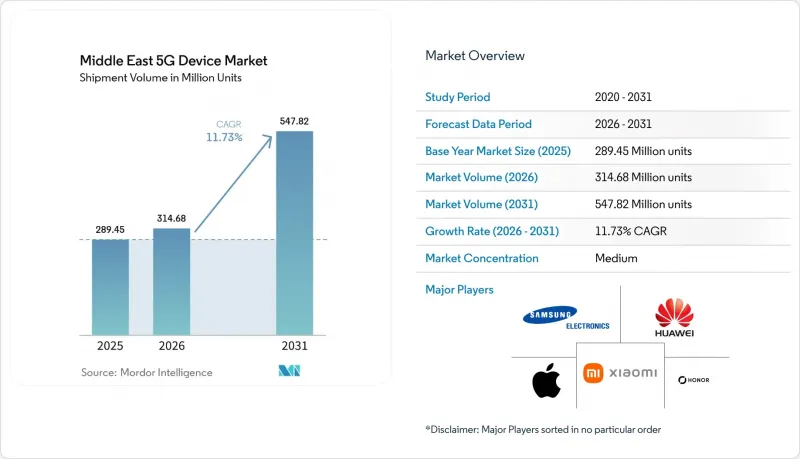
According to Mordor Intelligence, the Middle East 5G device market size, in terms of shipment volume, is expected to increase from 289.45 million units in 2025 to 314.68 million units in 2026, and to reach 547.82 million units by 2031, growing at a CAGR of 11.73% over 2026-2031.
Middle East 5G Device Market Trends and Insights
Rapid 5G Coverage Expansion Across GCC Urban Corridors
5G coverage is a central demand factor for the Middle East 5G device market because network availability makes compatible hardware more useful to consumers, households, public agencies, and businesses. GCC 5G subscription penetration reached 53% at the end of 2025 and is expected to reach 88% by 2031, representing 84 million subscriptions. The same outlook projected that global 5G mobile subscriptions would exceed 3 billion in the first quarter of 2026. Dense standalone coverage gives operators more locations to market high-capacity services and compatible devices, including areas that previously relied on older mobile standards. It also makes fixed wireless access viable in districts where fiber connections take longer to install, and service providers require a rapid broadband option. The Middle East 5G device market, therefore, benefits from a wider base of consumers, households, and businesses that can use the network's capabilities across everyday and operational settings.
Carrier-Led 5G Device Subsidies and Bundled Data Plans
Carrier promotions reduce the upfront cost of 5G handsets and can encourage customers to replace older phones sooner than they would through retail purchases alone. Operators in the UAE and Saudi Arabia use device offers with multi-year data plans, particularly for premium smartphones that can use high-capacity standalone networks. Samsung launched the Galaxy S26 Series in the UAE in March 2026, featuring 5G, Wi-Fi 7, and Galaxy AI. Average monthly mobile data use per active smartphone in the GCC is projected to increase from 30 GB in 2025 to 49 GB by 2031. Higher data use gives operators an incentive to maintain plans suited to high-throughput devices and recurring demand for capacity. In the Middle East 5G device market, revenue from fixed wireless access and enterprise connectivity can also support consumer device offers and sustain upgrade activity.
Spectrum Fragmentation Across Middle East Markets Raises RF and Certification Complexity
GCC countries have generally aligned their mid-band 5G deployments around n78 C-band spectrum, while several non-GCC countries use different arrangements and have moved through 5G deployment at different speeds. Non-GCC networks can rely on alternative or refarmed bands, which limits the benefit of a single regional device configuration and complicates planning for manufacturers. Device makers, therefore, need separate radio configurations for Gulf and non-Gulf markets, or they must opt for more costly multi-band designs to achieve broader coverage. Each GCC country also retains its own type-approval process, which delays the release of a device across the region and increases the administrative burden on suppliers. This combination can discourage the development of tailored products for smaller national markets, especially where expected device volumes cannot support customized design and testing. The Middle East 5G device market faces a slower rollout of advanced devices when regional launches require several approval paths, multiple tests, and country-specific product documentation.
Other drivers and restraints analyzed in the detailed report include:
- Replacement Cycle Acceleration Driven by 5G Standalone Adoption
- Enterprise Demand for Ruggedized 5G Devices in Oil and Gas, Logistics, and Construction
- Premium Device Pricing Limits Adoption Outside GCC Premium Urban Clusters
For complete list of drivers and restraints, kindly check the Table Of Contents.
Segment Analysis
Smartphones accounted for 65.33% of the Middle East's 5G device market in 2025, reflecting the regional consumer base for 5G adoption and the central role of personal mobile connectivity. Apple's iPhone 17 Series was available in the UAE and Saudi Arabia from September 2025 with support for regional 5G carrier capabilities. Samsung introduced the Galaxy S26 Series in the UAE during March 2026, adding Wi-Fi 7 and Galaxy AI to its flagship 5G range. Chinese brands, including Xiaomi, OPPO, vivo, and HONOR, continue to support mid-range volumes through competitive pricing, wider retail availability, and products aimed at younger consumers and expatriate communities. Laptops and tablets with 5G are gaining use among mobile professionals, while wearables and extended reality devices remain at an early stage as operators introduce more IoT-oriented service plans.
Customer-premises equipment, including indoor and outdoor units, is projected to expand at a 13.10% CAGR through 2031. Fixed wireless access deployments create demand for home gateways in new residential areas where fiber connections are not immediately available, or construction schedules delay last-mile installation. Industrial routers and gateways also serve oilfields, ports, warehouses, and smart factories in Saudi Arabia and the UAE, where stable connectivity is essential for operational monitoring and data exchange. Next-generation equipment increasingly includes Wi-Fi 7 to simplify installation, improve in-building connectivity, and reduce the burden on operator field teams. These uses broaden the Middle East 5G device market beyond smartphones and make CPE a durable equipment category for residential and enterprise buyers.
Sub-6 GHz devices accounted for 55.82% of the Middle East 5G device market size in 2025, supported by C-band deployments across major GCC operators. The n78 band, spanning 3.4-3.8 GHz, remains the primary network layer for broad-area coverage, including cities, transport corridors, and residential areas. Saudi Arabia and the UAE use substantial contiguous C-band allocations, which provide a volume advantage for sub-6 GHz hardware. mmWave devices are concentrated in enterprise locations, dense venues, and selected fixed wireless access zones where very high capacity is needed. This mix allows device makers to prioritize sub-6 GHz capability while adding mmWave features to selected products.
Hybrid sub-6 GHz and mmWave devices are projected to expand at a 13.35% CAGR through 2031. du and Ericsson completed a 5G standalone mmWave extended-range proof of concept in residential areas of the UAE during April 2026. The trial demonstrated gigabit-class performance across expanded coverage zones and strengthened the case for residential fixed wireless access, where conventional fiber deployment can take longer. Hybrid hardware can support users who move between wide-area sub-6 GHz coverage and targeted mmWave locations, enabling a single device to operate across different network environments. The approach is relevant as operators activate more 5G-Advanced features, including carrier aggregation and advanced multiple-input multiple-output functions, for homes, enterprises, and dense urban districts.
Complete Report Scope:
- By Form Factor
- Smartphones
- Customer-Premises Equipment (Indoor/Outdoor)
- Industrial Grade Routers/Gateways
- Modules
- Laptops/Tablets
- Hotspots
- Wearables and XR Devices
- By Spectrum Support
- Sub-6 GHz
- mmWave
- Hybrid (Sub-6 GHz and mmWave)
- By End-User Industry
- Consumer Electronics
- Industrial and Manufacturing
- Automotive and Transportation
- Healthcare
- Energy and Utilities
- Enterprise/Commercial
- By Application
- Enhanced Mobile Broadband (eMBB)
- Ultra-Reliable Low-Latency Comms (URLLC)
- Massive Machine-Type Comms (mMTC)
- Fixed Wireless Access
- Vehicle-to-Everything (V2X)
- By Country
- Saudi Arabia
- United Arab Emirates
- Rest of Middle East
List of Companies Covered in this Report:
- Apple Inc.
- Samsung Electronics Co., Ltd.
- Huawei Technologies Co., Ltd.
- Xiaomi Corporation
- OPPO (OPPO Mobile Telecommunications Corp. Ltd.)
- vivo Mobile Communication Co., Ltd.
- HONOR Device Co., Ltd.
- ZTE Corporation
- Nokia Corporation
- Sierra Wireless, Inc.
- Realme Mobile Telecommunications Co., Ltd.
- MediaTek Inc.
- TP-Link Corporation Limited
- D-Link Corporation
- Lenovo Group Limited
- HP Inc.
- Acer Inc.
- ASUSTeK Computer Inc.
- Inseego Corp.
- Netgear, Inc.
Additional Benefits:
- The market estimate (ME) sheet in Excel format
- 3 months of analyst support
TABLE OF CONTENTS
1 INTRODUCTION
- 1.1 Study Assumptions and Market Definition
- 1.2 Scope of the Study
2 RESEARCH METHODOLOGY
3 EXECUTIVE SUMMARY
4 MARKET LANDSCAPE
- 4.1 Market Overview
- 4.2 Market Drivers
- 4.2.1 Carrier-Led 5G Device Subsidies and Bundled Data Plans
- 4.2.2 Rapid 5G Coverage Expansion Across GCC Urban Corridors
- 4.2.3 Replacement Cycle Acceleration Driven by 5G Standalone Adoption
- 4.2.4 Enterprise Demand for Ruggedized 5G Devices in Oil and Gas, Logistics, and Construction
- 4.2.5 Smart City and Connected Infrastructure Procurement by Public Sector Buyers
- 4.2.6 Rising Demand for Localized SKU Portfolios to Match Country-Specific Band Plans
- 4.3 Market Restraints
- 4.3.1 Spectrum Fragmentation Across Middle East Markets Raises RF and Certification Complexity
- 4.3.2 Premium Device Pricing Limits Adoption Outside GCC Premium Urban Clusters
- 4.3.3 Heavy Dependence on Imported Devices and Components Exposes Supply Chains to Lead-Time Volatility
- 4.3.4 Multi-Operator Certification and Regulatory Approval Timelines Delay Device Launches
- 4.4 Industry Value Chain Analysis
- 4.5 Regulatory Landscape
- 4.6 Technological Outlook
- 4.7 Porter's Five Forces Analysis
- 4.7.1 Bargaining Power of Suppliers
- 4.7.2 Bargaining Power of Buyers
- 4.7.3 Threat of New Entrants
- 4.7.4 Threat of Substitutes
- 4.7.5 Intensity of Competitive Rivalry
5 MARKET SIZE AND GROWTH FORECASTS (VOLUME)
- 5.1 By Form Factor
- 5.1.1 Smartphones
- 5.1.2 Customer-Premises Equipment (Indoor/Outdoor)
- 5.1.3 Industrial Grade Routers/Gateways
- 5.1.4 Modules
- 5.1.5 Laptops/Tablets
- 5.1.6 Hotspots
- 5.1.7 Wearables and XR Devices
- 5.2 By Spectrum Support
- 5.2.1 Sub-6 GHz
- 5.2.2 mmWave
- 5.2.3 Hybrid (Sub-6 GHz and mmWave)
- 5.3 By End-User Industry
- 5.3.1 Consumer Electronics
- 5.3.2 Industrial and Manufacturing
- 5.3.3 Automotive and Transportation
- 5.3.4 Healthcare
- 5.3.5 Energy and Utilities
- 5.3.6 Enterprise/Commercial
- 5.4 By Application
- 5.4.1 Enhanced Mobile Broadband (eMBB)
- 5.4.2 Ultra-Reliable Low-Latency Comms (URLLC)
- 5.4.3 Massive Machine-Type Comms (mMTC)
- 5.4.4 Fixed Wireless Access
- 5.4.5 Vehicle-to-Everything (V2X)
- 5.5 By Country
- 5.5.1 Saudi Arabia
- 5.5.2 United Arab Emirates
- 5.5.3 Rest of Middle East
6 COMPETITIVE LANDSCAPE
- 6.1 Market Concentration
- 6.2 Strategic Moves
- 6.3 Market Share Analysis
- 6.4 Company Profiles (includes Global Level Overview, Market Level Overview, Core Segments, Financials as available, Strategic Information, Market Rank/Share, Products and Services, Recent Developments)
- 6.4.1 Apple Inc.
- 6.4.2 Samsung Electronics Co., Ltd.
- 6.4.3 Huawei Technologies Co., Ltd.
- 6.4.4 Xiaomi Corporation
- 6.4.5 OPPO (OPPO Mobile Telecommunications Corp. Ltd.)
- 6.4.6 vivo Mobile Communication Co., Ltd.
- 6.4.7 HONOR Device Co., Ltd.
- 6.4.8 ZTE Corporation
- 6.4.9 Nokia Corporation
- 6.4.10 Sierra Wireless, Inc.
- 6.4.11 Realme Mobile Telecommunications Co., Ltd.
- 6.4.12 MediaTek Inc.
- 6.4.13 TP-Link Corporation Limited
- 6.4.14 D-Link Corporation
- 6.4.15 Lenovo Group Limited
- 6.4.16 HP Inc.
- 6.4.17 Acer Inc.
- 6.4.18 ASUSTeK Computer Inc.
- 6.4.19 Inseego Corp.
- 6.4.20 Netgear, Inc.
7 MARKET OPPORTUNITIES AND FUTURE OUTLOOK
- 7.1 White-Space and Unmet-Need Assessment

