PUBLISHER: Mordor Intelligence | PRODUCT CODE: 2154963

PUBLISHER: Mordor Intelligence | PRODUCT CODE: 2154963
Africa 5G Device - Market Share Analysis, Industry Trends & Statistics, Growth Forecasts (2026 - 2031)
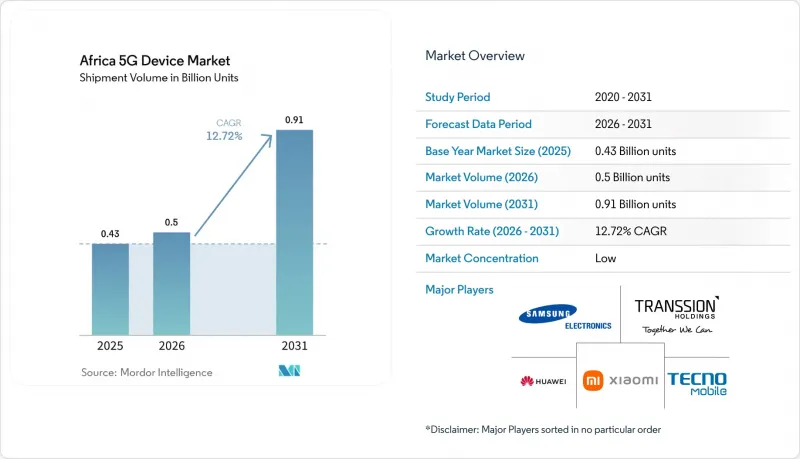
According to Mordor Intelligence, the Africa 5G device market size in terms of shipment volume is projected to be 0.43 billion units in 2025, 0.5 billion units in 2026, and reach 0.91 billion units by 2031, growing at a CAGR of 12.72% from 2026 to 2031.
Africa 5G Device Market Trends and Insights
Subsidized 5G Handset Financing Expands First-Time Adoption
Device financing has become a central near-term demand lever in the Africa 5G device market by reducing the initial payment required for a handset. It helps consumers who have traditionally stayed on feature phones or lower-priced 4G devices due to the cost of buying a smartphone outright. MTN MoMo launched its Handset Rent-to-Own program in South Africa in July 2025, offering 4G and 5G devices for ZAR 10 (USD 0.55) per day, with no credit checks. Vodacom's Easy2Own program had connected 18.8 million smartphones by May 2025, and smartphone penetration across the group reached 68.6%. Its financing arrangement totaled ZAR 3.75 billion (USD 201 million), supporting the wider distribution of financed devices. MTN Nigeria also partnered with Intelligra and Stanbic IBTC across more than 200 outlets to expand financing options for 5G device purchases.
FWA-Centric 5G Rollouts Pull Device Demand Beyond Urban Smartphones
Fixed wireless access is changing device demand in the Africa 5G device market because it requires customer-premises equipment as well as mobile handsets. As of May 2026, 40 of Africa's 61 commercial 5G networks offered fixed wireless access services. The continent had just under 1 million 5G fixed wireless access connections by mid-2026, while the connection base is expected to exceed 3.5 million by 2030. Ericsson expected Africa to record the fastest regional fixed wireless access CAGR at 15.06% through 2031. MTN Group identified Nigeria and Ghana as priority home-broadband investment markets in its H1 2026 results, and it noted that additional mid-band spectrum was important for fixed wireless access in Ghana. In locations without established copper or fiber networks, a 5G customer-premises device can provide a household's first fixed broadband connection.
High Device Cost Relative to Disposable Income
The entry-level 5G smartphone in Africa remained above USD 100 in 2026, which was more than a month's income for many potential users. This price level restricted the ability of financing programs to reach all consumers. The sub-USD 100 smartphone segment declined 34% year over year in Q2 2026 as higher memory prices forced manufacturers to raise prices or reduce device configurations. MTN Group reported that rising chipset costs were affecting handset affordability and that it was assessing operator financing as a longer-term response. The GSMA and six African operators signed a memorandum of understanding at MWC Barcelona 2026 to pilot entry-level smartphones priced between USD 30 and USD 40 across six countries. The initiative recognized that the existing device cost floor limited mass adoption of 5G-capable handsets.
Other drivers and restraints analyzed in the detailed report include:
- Local Assembly and Tax Optimization Reduce Device Landed Cost
- Midrange 5G Android Portfolio Expansion Improves Addressable Volume
- Uneven Spectrum Assignment Slows Device Ecosystem Readiness
For complete list of drivers and restraints, kindly check the Table Of Contents.
Segment Analysis
Smartphones accounted for 72.21% of Africa's 5G device market volume in 2025 and remained the leading form factor, as handsets are the principal internet access device across much of the continent. Transsion brands TECNO, Infinix, and itel accounted for 48% of Africa's smartphone shipments in 2025, while Samsung led the 5G-capable tier as 5G smartphone shipments increased 19% year over year in Q1 2026. Industrial routers, gateways, modules, laptops, tablets, hotspots, wearables, and XR devices were used for smaller, specialized applications. They supported mining automation, enterprise mobility, and early private-network deployments. Smartphone demand remained tied to consumer replacement cycles, financing availability, and a wider choice of midrange devices.
Customer-premises equipment is projected to expand at a CAGR of 14.11% from 2026 to 2031, the highest rate among form factors. The Africa 5G device market size for customer-premises equipment benefits from fixed wireless access where fiber is unavailable or difficult to extend, and MTN South Africa had reached 344,000 home broadband connections by H1 2025. The African 5G fixed wireless access base was just under 1 million connections by mid-2026. Equipment priced below USD 80 and operator bundles improved the economics of household broadband offers. Nigeria and Ghana were MTN's priority markets for fixed wireless access and fiber home broadband, making customer-premises equipment a practical way to monetize network investment beyond mobile subscriptions.
Sub-6 GHz devices accounted for 69.98% of the African 5G device market in 2025. Their stronger long-distance propagation is valuable in low-density areas, where coverage economics carry more weight than peak-speed positioning. Rain South Africa and Huawei launched a multi-thousand-site sub-1 GHz Massive MIMO 5G network in July 2026. The deployment reported a 5 dB uplink coverage improvement and capacity up to 3x higher than conventional 4T4R configurations, expanding the addressable base for compatible devices. mmWave devices remained limited in volume because they were concentrated in dense settings, although MTN Nigeria and Huawei completed a 25 Gbps full-duplex microwave link in April 2026 to support high-capacity wireless backhaul.
Hybrid Sub-6 GHz and mmWave devices are projected to expand at a CAGR of 13.89% from 2026 to 2031. The Africa 5G device market size for hybrid equipment is driven by private networks, industrial sites, and dense business locations that require both broad coverage and localized capacity. ICASA's July 2026 spectrum plan provided a clearer framework for mmWave IMT use in bands from 24.25 GHz to 48.2 GHz. This clarity supports planning for dual-mode customer-premises equipment and routers. MTN Zambia's five-band LampSite indoor 5G deployment in May 2026 illustrated the use of hybrid capabilities in commercial real estate and industrial facilities.
Complete Report Scope:
- By Form Factor
- Smartphones
- Customer-Premises Equipment (Indoor/Outdoor)
- Industrial Grade Routers/Gateways
- Modules
- Laptops/Tablets
- Hotspots
- Wearables and XR Devices
- By Spectrum Support
- Sub-6 GHz
- mmWave
- Hybrid (Sub-6 GHz and mmWave)
- By End-User Industry
- Consumer Electronics
- Industrial and Manufacturing
- Automotive and Transportation
- Healthcare
- Energy and Utilities
- Enterprise/Commercial
- By Application
- Enhanced Mobile Broadband (eMBB)
- Ultra-Reliable Low-Latency Comms (URLLC)
- Massive Machine-Type Comms (mMTC)
- Fixed Wireless Access
- Vehicle-to-Everything (V2X)
- By Country
- South Africa
- Nigeria
- Rest of Africa
List of Companies Covered in this Report:
- Samsung Electronics Co., Ltd.
- Apple Inc.
- Transsion Holdings Limited
- Xiaomi Corporation
- HUAWEI Technologies Co., Ltd.
- OPPO (OPPO Mobile Telecommunications Corp. Ltd.)
- vivo Communication Technology Co. Ltd.
- HONOR Device Co., Ltd.
- TECNO Mobile Limited
- Infinix Mobility Limited
- itel Mobile Limited
- Nokia Corporation
- HMD Global Oy
- ZTE Corporation
- Fibocom Wireless Inc.
- Askey Computer Corporation
- Quectel Wireless Solutions Inc.
- MTN Group Limited
- Vodacom Group Limited
- Safaricom PLC
- Airtel Africa plc
- Orange S.A.
Additional Benefits:
- The market estimate (ME) sheet in Excel format
- 3 months of analyst support
TABLE OF CONTENTS
1 INTRODUCTION
- 1.1 Study Assumptions and Market Definition
- 1.2 Scope of the Study
2 RESEARCH METHODOLOGY
3 EXECUTIVE SUMMARY
4 MARKET LANDSCAPE
- 4.1 Market Overview
- 4.2 Market Drivers
- 4.2.1 Subsidized 5G Handset Financing Expands First-Time Adoption
- 4.2.2 FWA-Centric 5G Rollouts Pull Device Demand Beyond Urban Smartphones
- 4.2.3 Local Assembly and Tax Optimization Reduce Device Landed Cost
- 4.2.4 5G-Ready Midrange Android Portfolio Expansion Improves Addressable Volume
- 4.2.5 Operator Bundling of Devices With Data Plans Accelerates Conversion
- 4.2.6 Enterprise Private Network Pilots Increase Demand for Routers and Modules
- 4.3 Market Restraints
- 4.3.1 High Effective Device Cost Versus Disposable Income
- 4.3.2 Uneven Spectrum Assignment Slows Device Ecosystem Readiness
- 4.3.3 Imported Handset Dependency Exposes Market to FX and Supply Disruptions
- 4.3.4 Weak Rural Backhaul Limits End-User Perception of 5G Value
- 4.4 Industry Value Chain Analysis
- 4.5 Regulatory Landscape
- 4.6 Technological Outlook
- 4.7 Porter's Five Forces Analysis
- 4.7.1 Bargaining Power of Suppliers
- 4.7.2 Bargaining Power of Buyers
- 4.7.3 Threat of New Entrants
- 4.7.4 Threat of Substitutes
- 4.7.5 Intensity of Competitive Rivalry
5 MARKET SIZE AND GROWTH FORECASTS (VOLUME)
- 5.1 By Form Factor
- 5.1.1 Smartphones
- 5.1.2 Customer-Premises Equipment (Indoor/Outdoor)
- 5.1.3 Industrial Grade Routers/Gateways
- 5.1.4 Modules
- 5.1.5 Laptops/Tablets
- 5.1.6 Hotspots
- 5.1.7 Wearables and XR Devices
- 5.2 By Spectrum Support
- 5.2.1 Sub-6 GHz
- 5.2.2 mmWave
- 5.2.3 Hybrid (Sub-6 GHz and mmWave)
- 5.3 By End-User Industry
- 5.3.1 Consumer Electronics
- 5.3.2 Industrial and Manufacturing
- 5.3.3 Automotive and Transportation
- 5.3.4 Healthcare
- 5.3.5 Energy and Utilities
- 5.3.6 Enterprise/Commercial
- 5.4 By Application
- 5.4.1 Enhanced Mobile Broadband (eMBB)
- 5.4.2 Ultra-Reliable Low-Latency Comms (URLLC)
- 5.4.3 Massive Machine-Type Comms (mMTC)
- 5.4.4 Fixed Wireless Access
- 5.4.5 Vehicle-to-Everything (V2X)
- 5.5 By Country
- 5.5.1 South Africa
- 5.5.2 Nigeria
- 5.5.3 Rest of Africa
6 COMPETITIVE LANDSCAPE
- 6.1 Market Concentration
- 6.2 Strategic Moves
- 6.3 Market Share Analysis
- 6.4 Company Profiles (includes Global Level Overview, Market Level Overview, Core Segments, Financials as available, Strategic Information, Market Rank/Share, Products and Services, Recent Developments)
- 6.4.1 Samsung Electronics Co., Ltd.
- 6.4.2 Apple Inc.
- 6.4.3 Transsion Holdings Limited
- 6.4.4 Xiaomi Corporation
- 6.4.5 HUAWEI Technologies Co., Ltd.
- 6.4.6 OPPO (OPPO Mobile Telecommunications Corp. Ltd.)
- 6.4.7 vivo Communication Technology Co. Ltd.
- 6.4.8 HONOR Device Co., Ltd.
- 6.4.9 TECNO Mobile Limited
- 6.4.10 Infinix Mobility Limited
- 6.4.11 itel Mobile Limited
- 6.4.12 Nokia Corporation
- 6.4.13 HMD Global Oy
- 6.4.14 ZTE Corporation
- 6.4.15 Fibocom Wireless Inc.
- 6.4.16 Askey Computer Corporation
- 6.4.17 Quectel Wireless Solutions Inc.
- 6.4.18 MTN Group Limited
- 6.4.19 Vodacom Group Limited
- 6.4.20 Safaricom PLC
- 6.4.21 Airtel Africa plc
- 6.4.22 Orange S.A.
7 MARKET OPPORTUNITIES AND FUTURE OUTLOOK
- 7.1 White-Space and Unmet-Need Assessment

