PUBLISHER: Mordor Intelligence | PRODUCT CODE: 2124513

PUBLISHER: Mordor Intelligence | PRODUCT CODE: 2124513
Europe Aviation Fuel - Market Share Analysis, Industry Trends & Statistics, Growth Forecasts (2026 - 2031)
According to Mordor Intelligence, the Europe aviation fuel market size is estimated at USD 75.93 billion in 2026, and is expected to reach USD 105.55 billion by 2031, at a CAGR of 6.81% during the forecast period (2026-2031).
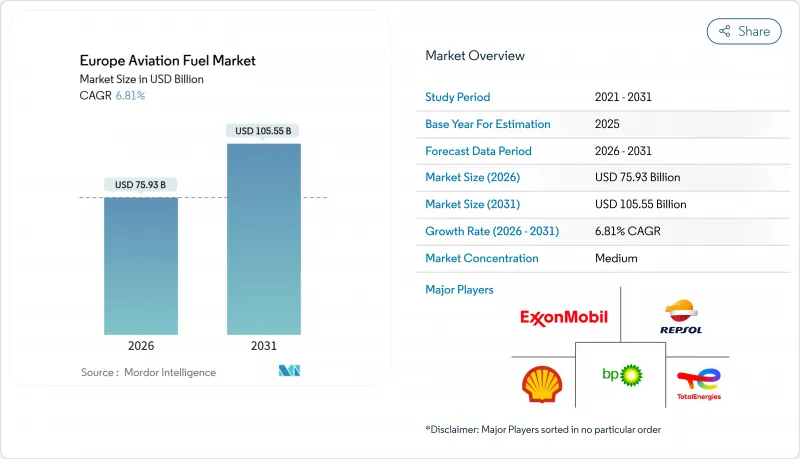
This report is Segmented by Fuel Type (Conventional Jet Fuel, Sustainable Aviation Fuel, and Avgas), Aircraft Type (Narrow-Body, Wide-Body, Regional Jets and Turboprops, and Cargo/Freighters), Application (Commercial Airlines, Defense/Military Aviation, and General and Business Aviation), and Geography (United Kingdom, Germany, France, Italy, Spain, NORDIC Countries, Russia, and Rest of Europe).
Europe Aviation Fuel Market Trends and Insights
Rising Air-Passenger Traffic Rebound Post-COVID-19
European carriers moved 1.1 billion passengers in 2024, surpassing pre-pandemic peaks. Low-cost airlines lifted capacity by 12% to tap pent-up leisure demand, yet competitive fares compressed yields on trunk routes. Legacy operators responded by retiring older wide-bodies and accelerating A321neo and 737 MAX deliveries to cut fuel burn. The decoupling of passenger growth from fuel demand keeps pressure on suppliers to predict uplift volume accurately across a fragmented airport network. As traffic continues to normalize, the European aviation fuel market benefits from higher load factors but faces thinner margins across the airline value chain.
EU-Wide Sustainable Aviation Fuel Blending Mandates
The ReFuelEU Aviation regulation became effective in January 2025, requiring a 2% SAF share, rising to 6% by 2030 and 20% by 2035. Non-compliance triggers penalties of up to EUR 5 per liter, driving refiners and distributors to secure SAF even at premium prices. Lufthansa's 800,000-ton SAF offtake with Shell and Air France-KLM's 10% sourcing pledge illustrate early-mover hedging strategies. Feedstock scarcity, however, constrains supply; Europe's used-cooking-oil pool covers only a fraction of mandated demand, forcing investment in alcohol-to-jet and Fischer-Tropsch pathways. As mandates tighten, the European aviation fuel market will hinge increasingly on advanced biofuel scalability and e-fuel economics.
High Crude-Oil Price Volatility and FX Risk
Brent fluctuated between USD 70-95 per barrel during 2024-2025. Fuel costs climbed to 38% of Ryanair's operating outlays, squeezing budgets of carriers lacking robust hedging books. Eastern European airlines grappled with currency depreciation against the euro, inflating dollar-denominated fuel invoices. Elevated option premiums limited hedge tenors, exposing smaller operators to spot-market swings. Persistent volatility narrows margins in the European aviation fuel market and may accelerate consolidation among financially weaker carriers.
Other drivers and restraints analyzed in the detailed report include:
- Ramp-Up of Long-Haul Narrow-Body Fleets in Europe
- Boom in Cross-Border E-Commerce Air Cargo
- Capacity Bottlenecks in European SAF Feedstocks
For complete list of drivers and restraints, kindly check the Table Of Contents.
Segment Analysis
Sustainable aviation fuel posted the quickest advance, expanding at a 25.2% CAGR over 2026-2031. Yet conventional kerosene retained 95.4% of 2025 consumption, highlighting the distance to full decarbonization. Shell, TotalEnergies, and Neste earmarked EUR 4.2 billion for European SAF facilities through 2027. Neste's Rotterdam complex doubled capacity plans to 1 million tons by 2028, tapping waste animal fats and forestry residues to diversify away from limited used-cooking-oil pools. EU Emissions Trading System Phase 4 lifted carbon costs to EUR 90 per ton, adding EUR 0.23 per liter to jet-fuel prices and sharpening the airline business case for SAF.
The synthetic e-fuel sub-quota of 1.2% by 2030 spurs power-to-liquid investment, yet only three European plants are commercial today, jointly supplying below 15,000 tons. Norsk e-Fuel's 10,000-ton Mosjoen facility delivered its first batch in 2025, showcasing potential scalability. Conventional refineries still dominate distribution infrastructure, reinforcing their short-term hold on the European aviation fuel market. However, escalating penalties and corporate ESG targets ensure a structural demand floor for SAF despite higher per-ton economics.
Complete Report Scope:
- By Fuel Type
- Conventional Jet Fuel
- Sustainable Aviation Fuel (SAF)
- Avgas
- By Aircraft Type
- Narrow-body
- Wide-body
- Regional Jets and Turboprops
- Cargo/Freighters
- By Application
- Commercial Airlines
- Defense/Military Aviation
- General and Business Aviation
- By Geography
- United Kingdom
- Germany
- France
- Italy
- Spain
- NORDIC Countries
- Russia
- Rest of Europe
List of Companies Covered in this Report:
- BP plc
- Royal Dutch Shell plc
- TotalEnergies SE
- Repsol SA
- Exxon Mobil Corp.
- Gazprom Neft PJSC
- Neste Oyj
- OMV AG
- Eni SpA
- MOL Group
- Vitol Aviation
- LanzaJet Inc.
- World Energy LLC
- SkyNRG BV
- Preem AB
- PKN Orlen SA
- PKN Orlen - LOTOS Asfalt
- Air Total Aviation Services
- Air BP (bp Subsidiary)
- Gazpromneft-Aero
Additional Benefits:
- The market estimate (ME) sheet in Excel format
- 3 months of analyst support
TABLE OF CONTENTS
1 Introduction
- 1.1 Study Assumptions & Market Definition
- 1.2 Scope of the Study
2 Research Methodology
3 Executive Summary
4 Market Landscape
- 4.1 Market Overview
- 4.2 Market Drivers
- 4.2.1 Rising air-passenger traffic rebound post-COVID-19
- 4.2.2 EU-wide sustainable aviation fuel (SAF) blending mandates
- 4.2.3 Ramp-up of long-haul narrow-body fleets in Europe
- 4.2.4 Boom in cross-border e-commerce air cargo
- 4.2.5 Phase-4 EU-ETS cost pass-through to fuel-efficient fleets
- 4.2.6 Air-to-e-fuel PtL pilot plants reaching commercial scale
- 4.3 Market Restraints
- 4.3.1 High crude-oil price volatility and FX risk
- 4.3.2 Capacity bottlenecks in European SAF feedstocks
- 4.3.3 Airport hydrant-system conversion capex burden
- 4.3.4 Geopolitical disruptions to fuel logistics (Black Sea)
- 4.4 Supply-Chain Analysis
- 4.5 Regulatory Landscape
- 4.6 Technological Outlook
- 4.7 Porter's Five Forces
- 4.7.1 Bargaining Power of Suppliers
- 4.7.2 Bargaining Power of Buyers
- 4.7.3 Threat of New Entrants
- 4.7.4 Threat of Substitutes
- 4.7.5 Competitive Rivalry
5 Market Size & Growth Forecasts
- 5.1 By Fuel Type
- 5.1.1 Conventional Jet Fuel
- 5.1.2 Sustainable Aviation Fuel (SAF)
- 5.1.3 Avgas
- 5.2 By Aircraft Type
- 5.2.1 Narrow-body
- 5.2.2 Wide-body
- 5.2.3 Regional Jets and Turboprops
- 5.2.4 Cargo/Freighters
- 5.3 By Application
- 5.3.1 Commercial Airlines
- 5.3.2 Defense/Military Aviation
- 5.3.3 General and Business Aviation
- 5.4 By Geography
- 5.4.1 United Kingdom
- 5.4.2 Germany
- 5.4.3 France
- 5.4.4 Italy
- 5.4.5 Spain
- 5.4.6 NORDIC Countries
- 5.4.7 Russia
- 5.4.8 Rest of Europe
6 Competitive Landscape
- 6.1 Market Concentration
- 6.2 Strategic Moves (M&A, Partnerships, PPAs)
- 6.3 Market Share Analysis (Market Rank/Share for key companies)
- 6.4 Company Profiles (includes Global level Overview, Market level overview, Core Segments, Financials as available, Strategic Information, Products & Services, and Recent Developments)
- 6.4.1 BP plc
- 6.4.2 Royal Dutch Shell plc
- 6.4.3 TotalEnergies SE
- 6.4.4 Repsol SA
- 6.4.5 Exxon Mobil Corp.
- 6.4.6 Gazprom Neft PJSC
- 6.4.7 Neste Oyj
- 6.4.8 OMV AG
- 6.4.9 Eni SpA
- 6.4.10 MOL Group
- 6.4.11 Vitol Aviation
- 6.4.12 LanzaJet Inc.
- 6.4.13 World Energy LLC
- 6.4.14 SkyNRG BV
- 6.4.15 Preem AB
- 6.4.16 PKN Orlen SA
- 6.4.17 PKN Orlen - LOTOS Asfalt
- 6.4.18 Air Total Aviation Services
- 6.4.19 Air BP (bp Subsidiary)
- 6.4.20 Gazpromneft-Aero
7 Market Opportunities & Future Outlook
- 7.1 White-space & Unmet-need Assessment

