PUBLISHER: Global Market Insights Inc. | PRODUCT CODE: 2071227

PUBLISHER: Global Market Insights Inc. | PRODUCT CODE: 2071227
Asia Pacific Gaming Handheld Market Opportunity, Growth Drivers, Industry Trend Analysis, and Forecast 2026 - 2035
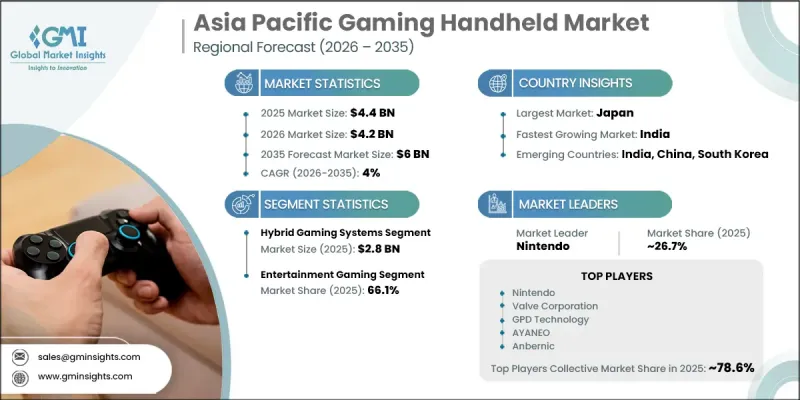
Asia Pacific Gaming Handheld Market was valued at USD 4.4 billion in 2025 and is estimated to grow at a CAGR of 4% to reach USD 6 billion by 2035.
Market expansion is shaped by the increasing popularity of mobile gaming and the rising demand for portable entertainment devices across the region. Growing smartphone gaming adoption has significantly strengthened consumer engagement with on-the-go gaming experiences, encouraging users to seek more advanced handheld systems with improved performance capabilities. Rising internet penetration, wider availability of affordable digital gaming content, and increasing participation from younger demographics are further supporting market development. Countries such as China, Japan, South Korea, and India continue to demonstrate strong demand for portable gaming solutions, driven by evolving consumer preferences and expanding digital entertainment ecosystems. In addition, manufacturers are focusing on enhancing product offerings with advanced processors, improved graphics performance, and longer battery life to meet rising user expectations. Increasing disposable income levels and growing spending on digital entertainment are further reinforcing market expansion across Asia Pacific. The rapid rise of esports and competitive gaming is also contributing to sustained engagement with handheld gaming platforms, as consumers increasingly participate in online multiplayer ecosystems and regional gaming events.
| Market Scope | |
|---|---|
| Start Year | 2025 |
| Forecast Year | 2026-2035 |
| Start Value | $4.4 Billion |
| Forecast Value | $6 Billion |
| CAGR | 4% |
The hybrid gaming systems segment accounted for USD 2.8 billion in 2025. This segment continues to lead due to its dual functionality, allowing users to switch between handheld and docked console modes for flexible gaming experiences. Strong demand for versatile gaming devices with high performance and portability features is supporting the segment's expansion across key markets, including Japan, China, and South Korea. Consumers increasingly prefer hybrid systems because they combine mobility with advanced gaming capabilities, enhanced graphics performance, and access to extensive game libraries. This combination of flexibility and functionality continues to strengthen adoption across both casual and dedicated gamer groups.
The entertainment gaming segment held a 66.1% share in 2025. It is projected to grow at a CAGR of 2.5% from 2026 to 2035. The segment's dominance is supported by widespread use of handheld devices for leisure and immersive entertainment experiences across the region. Consumers increasingly rely on portable gaming systems to access casual games, story-driven experiences, and multiplayer formats, reinforcing entertainment gaming as the primary usage category. Expanding internet connectivity, rising popularity of esports, and strong gaming culture across major Asian economies continue to drive demand for handheld gaming devices among diverse age groups.
Japan Gaming Handheld Market captured USD 2.3 billion in 2025 and is expected to grow at a CAGR of 1.5% through 2035. The country maintains a highly developed gaming ecosystem supported by strong consumer affinity for handheld gaming devices and advanced digital entertainment technologies. Demand remains strong for high-performance portable consoles featuring compact designs, advanced graphics capabilities, and integrated gaming ecosystems. Continuous innovation in gaming hardware and growing integration of cloud-based gaming services further support market stability. Japanese consumers continue to show a strong preference for versatile handheld devices that support both casual and competitive gaming experiences across different age groups.
Major companies operating in the Asia Pacific Gaming Handheld Market include Nintendo, Sony Interactive Entertainment, ASUS, Lenovo, MSI, Valve Corporation, Razer, AYN, Anbernic, GPD Technology, OneXPlayer, AYANEO, Retroid, Powkiddy, Logitech, Panic, Miyoo, ZOTAC, Trimui, GameSir, and GKD Game Kiddy. Companies in the Asia Pacific Gaming Handheld Market are adopting multiple strategic initiatives to strengthen their market position and expand their user base. Product innovation remains a core focus, with manufacturers introducing devices featuring upgraded processors, enhanced graphics performance, and improved battery efficiency. Firms are also prioritizing ergonomic design and lightweight construction to enhance portability and user comfort. Expansion of cloud gaming integration and cross-platform compatibility is helping companies improve ecosystem connectivity and user engagement. Strategic collaborations with game developers and esports organizations are further strengthening content offerings and driving brand visibility.
Table of Contents
Chapter 1 Methodology & Scope
- 1.1 Market scope and definition
- 1.2 Research design
- 1.2.1 Research approach
- 1.2.2 Data collection methods
- 1.3 Data mining sources
- 1.3.1 Global
- 1.3.2 Regional/Country
- 1.4 Base estimates and calculations
- 1.4.1 Base year calculation
- 1.4.2 Key trends for market estimation
- 1.5 Primary research and validation
- 1.5.1 Primary sources
- 1.6 Forecast model
- 1.7 Research assumptions and limitations
Chapter 2 Executive Summary
- 2.1 Industry 360° synopsis
- 2.2 Key market trends
- 2.2.1 Country
- 2.2.2 Product type
- 2.2.3 Form
- 2.2.4 Technology
- 2.2.5 Age group
- 2.2.6 Display size
- 2.2.7 Price range
- 2.2.8 Application
- 2.2.9 Distribution channel
Chapter 3 Industry Insights
- 3.1 Industry ecosystem analysis
- 3.1.1 Supplier landscape
- 3.1.2 Profit margin
- 3.1.3 Value addition at each stage
- 3.1.4 Factor affecting the value chain
- 3.2 Industry impact forces
- 3.2.1 Growth drivers
- 3.2.1.1 Rising popularity of portable and on-the-go gaming experiences
- 3.2.1.2 Expansion of high-performance gaming ecosystems and cloud gaming services
- 3.2.1.3 Growing gaming community and esports influence globally
- 3.2.2 Pitfalls & Challenges
- 3.2.2.1 High competition from smartphones and tablets as gaming alternatives
- 3.2.2.2 High product pricing for premium handheld gaming devices
- 3.2.3 Opportunities
- 3.2.3.1 Growth of subscription-based cloud gaming platforms
- 3.2.3.2 Rising demand for hybrid and modular gaming devices
- 3.2.1 Growth drivers
- 3.3 Growth potential analysis
- 3.4 Future market trends
- 3.5 Technology and innovation landscape
- 3.5.1 Current technological trends
- 3.5.2 Emerging technologies
- 3.6 Regulatory landscape
- 3.6.1 Standards and compliance requirements
- 3.6.2 Regional regulatory frameworks
- 3.6.3 Certification standards
- 3.7 Porter's analysis
- 3.8 PESTEL analysis
- 3.8.1 Pricing analysis (driven by primary research)
- 3.8.1.1 Historical price trend analysis (2019-2024) (driven by primary research)
- 3.8.1.2 Pricing strategy by player type (premium / value / cost-plus) (driven by primary research)
- 3.8.1.3 Regional price variations and purchasing power parity
- 3.8.1.4 Component cost dynamics and BOM analysis
- 3.8.1.5 Price elasticity of demand by segment
- 3.8.2 Trade data analysis (HS code- 9504.50) (driven by paid database)
- 3.8.2.1 Import/export volume and value trends (2019-2024) (driven by paid database)
- 3.8.2.2 Key trade corridors and tariff impact (driven by paid database)
- 3.8.2.3 HS code classification and trade flow mapping
- 3.8.2.4 Cross-border e-commerce dynamics
- 3.8.3 Impact of AI and generative AI on the market
- 3.8.3.1 AI-driven disruption of existing business models
- 3.8.3.2 GenAI use cases and adoption roadmap by segment
- 3.8.3.3 AI-powered game development and optimization
- 3.8.3.4 Personalized gaming experiences via AI
- 3.8.3.5 AI-enhanced performance management
- 3.8.3.6 Natural language processing for voice control
- 3.8.3.7 Computer vision for eye tracking and biometric controls
- 3.8.3.8 Risks, limitations and regulatory considerations
- 3.8.3.9 AI hardware integration trends (NPUs, edge AI chips)
- 3.8.4 Distribution infrastructure and channel penetration landscape (driven by primary research)
- 3.8.4.1 Channel coverage by region and format (modern vs. traditional trade) (driven by primary research)
- 3.8.4.2 Last-mile infrastructure gaps and emerging channel shifts (driven by primary research)
- 3.8.4.3 E-commerce platform penetration by geography
- 3.8.4.4 Retailer consolidation and shelf space dynamics
- 3.8.1 Pricing analysis (driven by primary research)
Chapter 4 Competitive Landscape, 2025
- 4.1 Introduction
- 4.2 Company market share analysis
- 4.2.1 By Country
- 4.2.1.1 China
- 4.2.1.2 Japan
- 4.2.1.3 India
- 4.2.1.4 South Korea
- 4.2.1.5 Australia
- 4.2.1.6 Philippines
- 4.2.1.7 Thailand
- 4.2.1.8 Vietnam
- 4.2.1 By Country
- 4.3 Company matrix analysis
- 4.4 Competitive analysis of major market players
- 4.5 Competitive positioning matrix
- 4.6 Key developments
- 4.6.1 Mergers & acquisitions
- 4.6.2 Partnerships & collaborations
- 4.6.3 New product launches
- 4.6.4 Expansion plans
Chapter 5 Market Estimates & Forecast, By Product Type, 2022 - 2035, (USD Billion) (Thousand Units)
- 5.1 Key trends
- 5.2 Dedicated handheld gaming consoles
- 5.3 Hybrid gaming systems
- 5.4 Handheld gaming PCs
- 5.5 Android gaming handhelds
Chapter 6 Market Estimates & Forecast, By Form, 2022 - 2035, (USD Billion) (Thousand Units)
- 6.1 Key trends
- 6.2 Traditional handheld
- 6.3 Clamshell
- 6.4 Slider
- 6.5 Modular
- 6.6 Foldable
Chapter 7 Market Estimates & Forecast, By Technology, 2022 - 2035, (USD Billion) (Thousand Units)
- 7.1 Key trends
- 7.2 Touch only
- 7.3 Physical controls
- 7.4 Hybrid touch & physical
- 7.5 Motion control
- 7.6 Voice control
- 7.7 Eye tracking & biometric
Chapter 8 Market Estimates & Forecast, By Age Group, 2022 - 2035, (USD Billion) (Thousand Units)
- 8.1 Key trends
- 8.2 Children
- 8.3 Teenagers
- 8.4 Adults
Chapter 9 Market Estimates & Forecast, By Display Size, 2022 - 2035, (USD Billion) (Thousand Units)
- 9.1 Key trends
- 9.2 Small screen devices (3-5 inches)
- 9.3 Medium screen devices (5-7 inches)
- 9.4 Large screen devices (7-9 inches)
- 9.5 Extra-large screen devices (9+ inches)
Chapter 10 Market Estimates & Forecast, By Price Range, 2022 - 2035, (USD Billion) (Thousand Units)
- 10.1 Key trends
- 10.2 Low
- 10.3 Medium
- 10.4 High
Chapter 11 Market Estimates & Forecast, By Application, 2022 - 2035, (USD Billion) (Thousand Units)
- 11.1 Key trends
- 11.2 Entertainment gaming
- 11.3 Professional & competitive gaming
- 11.4 Educational gaming applications
- 11.5 Cloud & streaming gaming
Chapter 12 Market Estimates & Forecast, By Distribution Channel, 2022 - 2035, (USD Billion) (Thousand Units)
- 12.1 Key trends
- 12.2 Offline
- 12.3 Online
Chapter 13 Market Estimates & Forecast, By Country, 2022 - 2035, (USD Billion) (Thousand Units)
- 13.1 Key trends
- 13.2 China
- 13.3 Japan
- 13.4 India
- 13.5 South Korea
- 13.6 Australia
- 13.7 Philippines
- 13.8 Thailand
- 13.9 Vietnam
Chapter 14 Company Profiles
- 14.1 Top Global Players
- 14.1.1 Nintendo
- 14.1.2 Sony Interactive Entertainment
- 14.1.3 ASUS
- 14.1.4 Lenovo
- 14.1.5 MSI
- 14.1.6 Valve Corporation
- 14.1.7 Razer
- 14.2 Regional Champions
- 14.2.1 AYN
- 14.2.2 Anbernic
- 14.2.3 GPD Technology
- 14.2.4 OneXPlayer
- 14.2.5 AYANEO
- 14.2.6 Retroid
- 14.2.7 Powkiddy
- 14.3 Emerging & Specialized Players
- 14.3.1 Logitech
- 14.3.2 Panic
- 14.3.3 Miyoo
- 14.3.4 ZOTAC
- 14.3.5 Trimui
- 14.3.6 GameSir
- 14.3.7 GKD Game Kiddy

