PUBLISHER: Mordor Intelligence | PRODUCT CODE: 2124741

PUBLISHER: Mordor Intelligence | PRODUCT CODE: 2124741
Europe Van - Market Share Analysis, Industry Trends & Statistics, Growth Forecasts (2026 - 2031)
According to Mordor Intelligence, the european van market size is projected to be USD 60.45 billion in 2025, USD 62.34 billion in 2026, and reach USD 72.76 billion by 2031, growing at a CAGR of 3.14% from 2026 to 2031.
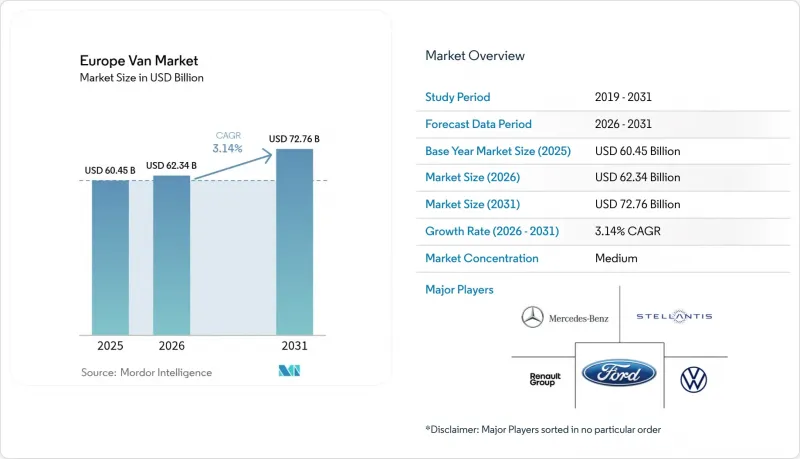
This report is Segmented by Gross Vehicle Weight (N1 Class I, N1 Class II, and More), Cargo Space (<=5 M3, Above 5 M3), End User (Commercial Fleets, Government and Municipal, and More), Drive Type (IC Engine - Petrol, IC Engine - Diesel, and More), Sales Channel (Direct OEM Fleet Sales, Authorized Dealerships, and More), and Country. The Market Forecasts are Provided in Terms of Value (USD) and Volume (Units).
Europe Van Market Trends and Insights
Rise in Sales of Electric Vans
Battery-electric vans accounted for 5.9% of new registrations in 2024 after subsidy cuts, but rebounded to 9.5% during H1 2025 as corporate fleet mandates intensified . The Clean Vehicles Directive mandates that public entities procure only zero-emission vans starting in 2026, ensuring consistent demand. Between 2024 and 2026, OEMs introduced new BEV models, offering a wider range of payload options. In the United Kingdom, total-cost-of-ownership parity is achieved when vehicles meet certain mileage thresholds, a target many fleets reach within a short period. This shift in procurement preferences favors zero-emission vehicles over diesel, despite existing charger limitations.
E-commerce Last-Mile Boom
By 2030, parcel volumes in Western Europe are expected to grow significantly. This growth is prompting fleets to increasingly opt for smaller vans, enabling them to navigate tight urban spaces and complete more delivery loops daily. The number of automated parcel machines has increased by 2024, highlighting a trend towards frequent, low-payload deliveries. Operators like Otto Group have reported achieving greater delivery efficiency using compact BEV vans compared to their diesel counterparts. Quick-commerce companies are strategically positioning micro-fulfilment hubs close to their consumers, driving up the demand for vans with smaller cargo volumes. With delivery frequency taking precedence over payload capacity, OEMs are now focusing on enhancing thermal management and fast-charging capabilities, rather than merely expanding cubic space.
High Battery and Vehicle CAPEX
In the United Kingdom, battery-electric vans remain significantly costlier than their diesel counterparts. High-mileage users can expect total-cost parity within a few years, but smaller fleets may take longer, hindering quicker adoption. While battery pack prices declined in recent years, stabilization of commodities has slowed further reductions. A decline in BEV van registrations in 2024, following Germany's subsidy withdrawal, underscores the fragility of such policies. Although leasing eases initial costs, it transfers the residual-value risk to lessors, who then factor this uncertainty into monthly rates.
Other drivers and restraints analyzed in the detailed report include:
- EU Low-Emission-Zone Mandates
- OEM Skateboard EV Platforms
- Limited Depot Fast-Charging Sites
For complete list of drivers and restraints, kindly check the Table Of Contents.
Segment Analysis
In 2025, N1 Class I vans (with a gross vehicle weight of <=2 tons) commanded a dominant 50.33% market share. These vans are projected to grow at a steady 3.85% CAGR through 2031, underscoring the e-commerce industry's preference for nimble vehicles adept at navigating tight urban spaces. Class II vans are gaining traction as fleets adapt to urban and regional delivery needs. These vans are increasingly used for city tasks or scaled up for broader regional operations. Class III vans, primarily serving construction and utility sectors, face challenges related to battery weight. For instance, a 75 kWh battery pack adds an extra 450 kg, pushing certain BEV models into a higher class and diminishing their usable capacity.
Stellantis has countered this challenge by introducing a composite cargo floor, effectively reducing weight by 60 kg. While licensing regulations permit standard B-category drivers to operate vans weighing up to 3.5 tons, certain states introduce additional testing for heavier BEVs, complicating compliance. Mercedes-Benz offers modular battery sizes, allowing fleets to prioritize either range or payload on a unified chassis. As urban zero-emission zones become more stringent, the European van market is increasingly favoring lighter classes.
Vans above 5 m3 commanded 64.11% share during 2025 because parcel carriers and tradespeople require cubic space for bulky loads. Growth is muted at a notable CAGR, while compact vans (<=5 m3) grow 5.01% as quick-commerce platforms prioritize trip frequency. The European van market size for compact formats is forecast to advance rapidly on the back of dense urban demand. Renault's Master E-Tech offers up to 22 m3 with a 130 kWh battery to maintain a 250 km range under load.
At the other extreme, Stellantis' e-Berlingo provides 4.4 m3 cargo space and qualifies for resident parking permits in Paris and Milan, lowering operational friction. Modular racking improves asset utilization by allowing fleets to switch between shelving and open cargo bays in minutes, blurring rigid segment lines. Payload trade-offs increasingly favor flexible interiors over sheer volume, prompting OEMs to market configurable decks and tool-less lashing systems.
Complete Report Scope:
- By Gross Vehicle Weight
- N1 Class I (<= 2 t GVW)
- N1 Class II (2-2.5 t GVW)
- N1 Class III (2.5-3.5 t GVW)
- By Cargo Space
- <= 5 m3
- Above 5 m3
- By End User
- Commercial Fleets
- Government and Municipal
- Rental and Leasing Operators
- By Drive Type
- IC Engine - Petrol
- IC Engine - Diesel
- Battery Electric
- Hybrid Electric
- Fuel-Cell Electric
- Alternative Fuel (CNG/LPG)
- By Sales Channel
- Direct OEM Fleet Sales
- Authorized Dealerships
- Online / Digital Platforms
- By Country
- Germany
- United Kingdom
- France
- Italy
- Spain
- Netherlands
- Sweden
- Norway
- Rest of Europe
List of Companies Covered in this Report:
- Stellantis N.V.
- Mercedes-Benz Group AG
- Volkswagen AG
- Ford Motor Company
- Renault Group
- Iveco S.p.A.
- Toyota Motor Corporation
- Nissan Motor Co., Ltd
- BYD Co., Ltd.
- Hyundai Motor Company
- SAIC Maxus Automotive Co. Ltd.
- MAN Truck & Bus SE
- London Electric Vehicle Company (LEVC)
- Rivian Automotive LLC
Additional Benefits:
- The market estimate (ME) sheet in Excel format
- 3 months of analyst support
TABLE OF CONTENTS
1 Introduction
- 1.1 Study Assumptions and Market Definition
- 1.2 Scope of the Study
2 Research Methodology
3 Executive Summary
4 Market Landscape
- 4.1 Market Overview
- 4.2 Market Drivers
- 4.2.1 Rise in Sales of Electric Vans
- 4.2.2 E-commerce Last-Mile Boom
- 4.2.3 EU Low-Emission-Zone Mandates
- 4.2.4 OEM Skateboard EV Platforms
- 4.2.5 Urban Micro-fulfilment Hub Adoption
- 4.2.6 Battery-as-a-Service Fleet Models
- 4.3 Market Restraints
- 4.3.1 High Battery and Vehicle CAPEX
- 4.3.2 Limited Depot Fast-Charging Sites
- 4.3.3 Semiconductor Supply Constraints
- 4.3.4 Driver Shortage and License Rules
- 4.4 Value / Supply-Chain Analysis
- 4.5 Regulatory Landscape
- 4.6 Technological Outlook
- 4.7 Porter's Five Forces
- 4.7.1 Threat of New Entrants
- 4.7.2 Bargaining Power of Buyers
- 4.7.3 Bargaining Power of Suppliers
- 4.7.4 Threat of Substitutes
- 4.7.5 Intensity of Competitive Rivalry
5 Market Size and Growth Forecasts (Value (USD) and Volume (Units))
- 5.1 By Gross Vehicle Weight
- 5.1.1 N1 Class I (<= 2 t GVW)
- 5.1.2 N1 Class II (2-2.5 t GVW)
- 5.1.3 N1 Class III (2.5-3.5 t GVW)
- 5.2 By Cargo Space
- 5.2.1 <= 5 m3
- 5.2.2 Above 5 m3
- 5.3 By End User
- 5.3.1 Commercial Fleets
- 5.3.2 Government and Municipal
- 5.3.3 Rental and Leasing Operators
- 5.4 By Drive Type
- 5.4.1 IC Engine - Petrol
- 5.4.2 IC Engine - Diesel
- 5.4.3 Battery Electric
- 5.4.4 Hybrid Electric
- 5.4.5 Fuel-Cell Electric
- 5.4.6 Alternative Fuel (CNG/LPG)
- 5.5 By Sales Channel
- 5.5.1 Direct OEM Fleet Sales
- 5.5.2 Authorized Dealerships
- 5.5.3 Online / Digital Platforms
- 5.6 By Country
- 5.6.1 Germany
- 5.6.2 United Kingdom
- 5.6.3 France
- 5.6.4 Italy
- 5.6.5 Spain
- 5.6.6 Netherlands
- 5.6.7 Sweden
- 5.6.8 Norway
- 5.6.9 Rest of Europe
6 Competitive Landscape
- 6.1 Market Concentration
- 6.2 Strategic Moves
- 6.3 Market Share Analysis
- 6.4 Company Profiles (Includes Global Level Overview, Market Level Overview, Core Segments, Financials as Available, Strategic Information, Market Rank/Share for Key Companies, Products and Services, SWOT Analysis, and Recent Developments)
- 6.4.1 Stellantis N.V.
- 6.4.2 Mercedes-Benz Group AG
- 6.4.3 Volkswagen AG
- 6.4.4 Ford Motor Company
- 6.4.5 Renault Group
- 6.4.6 Iveco S.p.A.
- 6.4.7 Toyota Motor Corporation
- 6.4.8 Nissan Motor Co., Ltd
- 6.4.9 BYD Co., Ltd.
- 6.4.10 Hyundai Motor Company
- 6.4.11 SAIC Maxus Automotive Co. Ltd.
- 6.4.12 MAN Truck & Bus SE
- 6.4.13 London Electric Vehicle Company (LEVC)
- 6.4.14 Rivian Automotive LLC
7 Market Opportunities and Future Outlook
- 7.1 White-space and Unmet-Need Assessment

