PUBLISHER: Mordor Intelligence | PRODUCT CODE: 2124869

PUBLISHER: Mordor Intelligence | PRODUCT CODE: 2124869
Malaysia E-commerce - Market Share Analysis, Industry Trends & Statistics, Growth Forecasts (2026 - 2031)
According to Mordor Intelligence, the Malaysia e-commerce market size is expected to increase from USD 10.62 billion in 2025 to USD 12.18 billion in 2026 and reach USD 23.11 billion by 2031, growing at a CAGR of 13.67% over 2026-2031.
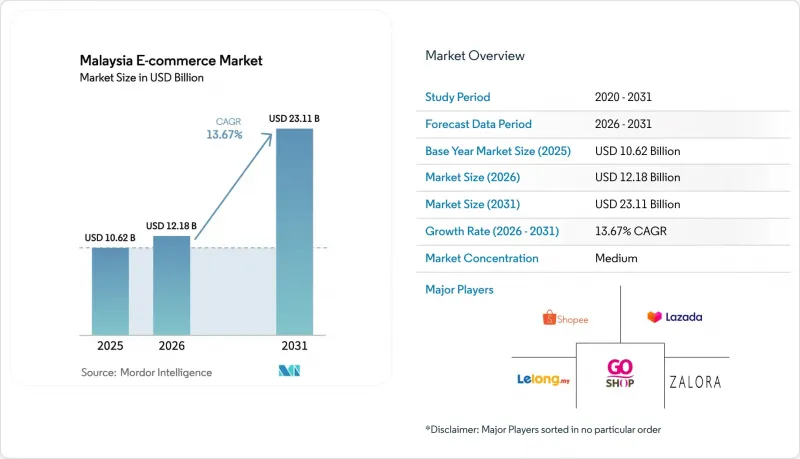
This report is Segmented by Business Model (B2C, and B2B), Device Type (Smartphone / Mobile, Desktop and Laptop, and More), Payment Method (Credit / Debit Cards, Digital Wallets, BNPL, and More), B2C Product Category (Beauty and Personal Care, Consumer Electronics, Fashion and Apparel, Food and Beverage, Furniture and Home, Toys, DIY and Media, and More). The Market Forecasts are Provided in Terms of Value (USD).
Malaysia E-commerce Market Trends and Insights
Government Digitalisation Agendas (NESR 2.0, MyDIGITAL)
Policy blueprints act as scaffolding that de-risk private investment in fulfilment, payments, and digital skills. Grants lowered onboarding costs for 1.148 million businesses by 2025, while mandatory e-invoicing in July 2025 nudged legacy retailers online. Customs pre-clearance slashed parcel transit times from China and Singapore by 30% in 2024, yet the MYR 1.65 trillion GMV target for 2025 still outpaces current infrastructure. Continued public spending until 2031 remains pivotal for rural inclusion.
90%+ Smartphone and 5G Coverage Boosting M-Commerce
5G covered 82.4% of populated areas by Q3 2025, though median speeds fell to 243 Mbps as user density surged. Smartphones already drive nearly three-quarters of Malaysia e-commerce market transactions, and progressive web apps that load under three seconds shield conversion rates even on congested towers. Planned mid-band spectrum in 2026 will triple capacity in Kuala Lumpur, Penang, and Johor Bahru, while rural Sabah and Sarawak still depend on 4G backhaul that struggles with high-definition product videos.
Rising Cyber-Fraud and Data-Breach Incidents Eroding Trust
The communications regulator logged over 70,000 online-scam cases in 2024, costing consumers more than MYR 1.8 billion (USD 420 million). High-profile telco breaches heightened fears around credential theft, pushing cart-abandonment to 68% in 2025. Two-factor authentication and biometrics reduce fraud but add 18 seconds to mobile checkout, straining user patience.
Other drivers and restraints analyzed in the detailed report include:
- Rapid E-Wallet Adoption and Interoperable DuitNow QR
- Live-Stream and Social-Commerce (TikTok Shop) GMV Surge
- Escalating CAC From Urban Market Saturation
For complete list of drivers and restraints, kindly check the Table Of Contents.
Segment Analysis
Business-to-consumer transactions retained 80.89% of the Malaysia e-commerce market in 2025 on the back of subsidies and influencer-led discovery. The Malaysia e-commerce market size for B2B platforms is projected to grow at 15.63% CAGR to 2031 as mandatory e-invoicing drives enterprises toward API-ready procurement portals. Wholesale marketplaces such as Dropee and Ralali automate invoices, unlock bulk discounts, and shrink working-capital cycles by up to 18 days. Despite the momentum, B2B GMV remains clustered in Peninsular Malaysia because East Malaysian manufacturers still face prohibitive air-freight costs.
Consumer-facing platforms spent an estimated MYR 3.5 billion (USD 814 million) on shipping rebates and cashback in 2025, a tactic expected to moderate as investors demand profit. Fashion, electronics, and beauty comprised roughly 60% of B2C GMV, aided by live-stream tags that convert impulse interest at triple the rate of keyword search. B2B growth provides a new revenue pool, yet capturing it requires deeper logistics integrations and embedded financing tools.
Smartphones generated 72.67% of 2025 transactions, and this slice of the Malaysia e-commerce market size is forecast to climb with a 15.87% CAGR to 2031. Progressive web apps that load rapidly on 4G and in-app wallets that remember credentials keep friction low.
Desktop usage lingers among enterprise buyers and older shoppers but is declining 8% each year. Tablets and smart TVs remain niche; however, voice-assisted grocery purchasing is gaining popularity in family households. New privacy rules around device fingerprinting shift attribution toward persistent app logins, a clear advantage for mobile-centric ecosystems.
Complete Report Scope:
- By Business Model
- B2C
- B2B
- By Device Type (B2C)
- Smartphone / Mobile
- Desktop and Laptop
- Other Device Types
- By Payment Method (B2C)
- Credit / Debit Cards
- Digital Wallets
- Buy Now Pay Later (BNPL)
- Other Payment Methods
- By Product Category (B2C)
- Beauty and Personal Care
- Consumer Electronics
- Fashion and Apparel
- Food and Beverages
- Furniture and Home
- Toys, DIY and Media
- Other Product Categories
List of Companies Covered in this Report:
- Shopee (Sea Ltd.)
- Lazada Group (Alibaba)
- TikTok Shop (ByteDance)
- Zalora (Global Fashion Group)
- Lelong.my
- PG Mall Sdn Bhd
- Presto Mall Sdn Bhd
- Mudah.my (Segnel Ventures)
- GoShop (Astro GS Shop Sdn Bhd)
- Senheng New Retail Bhd
- Hermo Creative (M) Sdn Bhd
- Sephora Digital SEA Pte Ltd.
- Grab Mart (Grab Holdings)
- Carousell
- FashionValet Sdn Bhd
- Ezbuy Holdings Ltd.
- IKEA Online (Malaysia)
- Apple.com (Malaysia)
- Hermo Creative (M) Sdn Bhd
- 11street
Additional Benefits:
- The market estimate (ME) sheet in Excel format
- 3 months of analyst support
TABLE OF CONTENTS
1 INTRODUCTION
- 1.1 Study Assumptions and Market Definition
- 1.2 Scope of the Study
2 RESEARCH METHODOLOGY
3 EXECUTIVE SUMMARY
4 MARKET LANDSCAPE
- 4.1 Market Overview
- 4.2 Market Drivers
- 4.2.1 Government Digitalisation Agendas (NESR 2.0, MyDIGITAL)
- 4.2.2 90%+ Smartphone and 5G Coverage Boosting M-Commerce
- 4.2.3 Rapid E-Wallet Adoption and Interoperable DuitNow QR
- 4.2.4 Dense Third-Party Logistics and On-Demand Delivery Build-Out
- 4.2.5 Live-Stream and Social-Commerce (TikTok Shop) GMV Surge
- 4.2.6 Halal-Certified Online Shelves Unlocking Rural and Export Demand
- 4.3 Market Restraints
- 4.3.1 Rising Cyber-Fraud and Data-Breach Incidents Eroding Trust
- 4.3.2 High Last-Mile Cost to East Malaysia and Remote Islands
- 4.3.3 Escalating CAC From Urban Market Saturation
- 4.3.4 Emerging Data-Localisation and Cross-Border Compliance Risk
- 4.4 Industry Value Chain Analysis
- 4.5 Regulatory Landscape
- 4.6 Technological Outlook
- 4.7 Porter's Five Forces Analysis
- 4.7.1 Bargaining Power of Suppliers
- 4.7.2 Bargaining Power of Buyers
- 4.7.3 Threat of New Entrants
- 4.7.4 Threat of Substitutes
- 4.7.5 Intensity of Competitive Rivalry
- 4.8 Key Market Trends and Retail Share
- 4.8.1 Impact of Macroeconomic Factors on the Market
- 4.8.2 Demographic Analysis
- 4.8.3 Transaction Modes Analysis
- 4.8.4 Cross-Border E-Commerce Analysis
- 4.8.5 Malaysia's Position in Southeast Asia Digital Economy
5 MARKET SIZE AND GROWTH FORECASTS (VALUES)
- 5.1 By Business Model
- 5.1.1 B2C
- 5.1.2 B2B
- 5.2 By Device Type (B2C)
- 5.2.1 Smartphone / Mobile
- 5.2.2 Desktop and Laptop
- 5.2.3 Other Device Types
- 5.3 By Payment Method (B2C)
- 5.3.1 Credit / Debit Cards
- 5.3.2 Digital Wallets
- 5.3.3 Buy Now Pay Later (BNPL)
- 5.3.4 Other Payment Methods
- 5.4 By Product Category (B2C)
- 5.4.1 Beauty and Personal Care
- 5.4.2 Consumer Electronics
- 5.4.3 Fashion and Apparel
- 5.4.4 Food and Beverages
- 5.4.5 Furniture and Home
- 5.4.6 Toys, DIY and Media
- 5.4.7 Other Product Categories
6 COMPETITIVE LANDSCAPE
- 6.1 Market Concentration
- 6.2 Strategic Moves
- 6.3 Market Share Analysis
- 6.4 Company Profiles
- 6.4.1 Shopee (Sea Ltd.)
- 6.4.2 Lazada Group (Alibaba)
- 6.4.3 TikTok Shop (ByteDance)
- 6.4.4 Zalora (Global Fashion Group)
- 6.4.5 Lelong.my
- 6.4.6 PG Mall Sdn Bhd
- 6.4.7 Presto Mall Sdn Bhd
- 6.4.8 Mudah.my (Segnel Ventures)
- 6.4.9 GoShop (Astro GS Shop Sdn Bhd)
- 6.4.10 Senheng New Retail Bhd
- 6.4.11 Hermo Creative (M) Sdn Bhd
- 6.4.12 Sephora Digital SEA Pte Ltd.
- 6.4.13 Grab Mart (Grab Holdings)
- 6.4.14 Carousell
- 6.4.15 FashionValet Sdn Bhd
- 6.4.16 Ezbuy Holdings Ltd.
- 6.4.17 IKEA Online (Malaysia)
- 6.4.18 Apple.com (Malaysia)
- 6.4.19 Hermo Creative (M) Sdn Bhd
- 6.4.20 11street
7 MARKET OPPORTUNITIES AND FUTURE OUTLOOK
- 7.1 White-Space and Unmet-Need Assessment

