PUBLISHER: Mordor Intelligence | PRODUCT CODE: 2124907

PUBLISHER: Mordor Intelligence | PRODUCT CODE: 2124907
Europe E-commerce - Market Share Analysis, Industry Trends & Statistics, Growth Forecasts (2026 - 2031)
According to Mordor Intelligence, Europe e-commerce market size in 2026 is estimated at USD 0.73 trillion, growing from 2025 value of USD 0.68 trillion with 2031 projections showing USD 1.07 trillion, growing at 7.86% CAGR over 2026-2031.
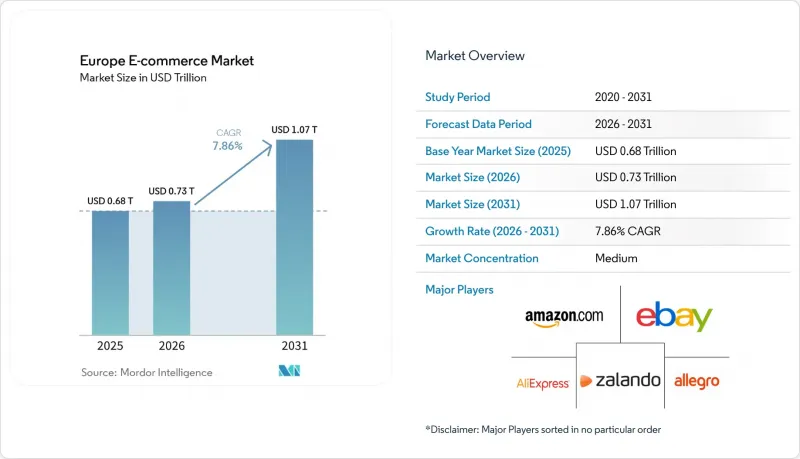
This report is Segmented by Business Model (B2C, B2B), Device Type (Smartphone / Mobile, Desktop and Laptop, Other Device Types), Payment Method (Credit / Debit Cards, Digital Wallets, BNPL, Other Payment Method), B2C Product Category (Beauty and Personal Care, Consumer Electronics, Fashion and Apparel, Food and Beverages, and More), and Country. The Market Forecasts are Provided in Terms of Value (USD).
Europe E-commerce Market Trends and Insights
Acceleration of 3P Marketplaces in Western Europe
Third-party marketplaces are reshaping the Europe e-commerce market by increasing brand reach and lowering entry barriers. They are expected to capture 50% of online consumer electronics sales by 2025, up from 40% in 2024. Nearly 79% of European brands now pursue multi-marketplace strategies to lessen dependence on Amazon, with vertical specialists such as fashion platform Zalando holding 9.8% share against Amazon's 8.3% in cross-border apparel. Marketplace adoption especially benefits SMEs that lack sizeable marketing budgets, but it increases the need for strong brand positioning and customer-relationship tools. The resulting shift toward niche platforms diversifies consumer choice and intensifies price transparency.
Ultra-Fast Grocery Delivery Boosts Urban Online Food Sales
In dense metropolitan areas, grocery orders fulfilled within 15-30 minutes have elevated the food & beverages segment to the fastest-growing vertical at a 17.3% CAGR. Dedicated urban fulfilment centres reduce delivery distance, and 21% of EU internet users ordered restaurant meals online in 2024, blending grocery and food service habits. Competition now pits traditional grocers against pure-play delivery specialists, which promotes consolidation while opening premium niches for organic or local products with higher margins. Although fulfilment costs remain high, speed creates customer loyalty that offsets partial delivery expense.
Last-Mile Cost Inflation in Southern EU Cities Hinders the Market
Logistics costs now equal 40-50% of delivery expenditure in Mediterranean cities, eroding retailer margins and challenging free-shipping offers. Dense street grids and congestion raise CO2 emissions, estimated at 3 million tonnes for courier fleets, prompting regulatory caps on urban traffic. Responses include consolidation centres, peer-to-peer delivery, and pick-up lockers, but capital costs discourage smaller firms and may accelerate market concentration around specialists with scale advantage.
Other drivers and restraints analyzed in the detailed report include:
- EU Digital Single Market Facilitates SME Cross-Border Trade
- BNPL & Open Banking APIs Lift Fashion/Electronics Conversion
- GDPR & DSA Compliance Costs for SMEs Hinders the Market
For complete list of drivers and restraints, kindly check the Table Of Contents.
Segment Analysis
The B2C segment retained 79.35% of revenue in 2025, underscoring its historical dominance in the Europe e-commerce market. Yet B2B transactions are forecast to eclipse USD 1.93 trillion by 2026, advancing at a 9.7% CAGR. This trajectory means the Europe e-commerce market size for corporate procurement channels will expand at more than double the overall pace to 2031. Transformation is driven by procurement teams demanding consumer-grade interfaces, prompting 65% of B2B sellers to enable online ordering.
Beyond simple catalogues, B2B platforms now integrate AI-powered product-matching, net-term payment automation, and role-based access that mirrors complex organisational hierarchies. The Europe e-commerce market benefits from vertical marketplaces in industrial supplies and healthcare that streamline fragmented supply chains. As a result, logistics providers build specialised fulfilment networks adapted to pallet-sized orders and compliance labelling, while SaaS vendors roll out purchase-to-pay modules that accelerate invoice reconciliation.
Smartphones processed 54.20% of transactions in 2025 across the Europe e-commerce market, reflecting 87% regional handset penetration. Despite this supremacy, the Europe e-commerce market share for other connected devices is rising, with smart TVs and voice assistants generating sales at a 12.16% CAGR, indicating shoppers welcome in-home, screen-large browsing. The Europe e-commerce market size associated with these emerging devices is expected to double by 2031.
Retailers are therefore adopting responsive architecture and progressive-web-app formats that scale across multiple displays while securing log-in via biometric authentication. Device diversification also affects payments: digital wallets dominate on mobile due to fingerprint or face recognition, whereas account-to-account transfers gain momentum on desktop sessions. Hardware variety obliges merchants to optimise for iOS, Android, and proprietary smart-TV systems, raising QA workloads but expanding reach into new consumption moments such as voice-prompt reorder.
Complete Report Scope:
- By Business Model
- B2C
- B2B
- By Device Type
- Smartphone / Mobile
- Desktop and Laptop
- Other Device Types
- By Payment Method
- Credit / Debit Cards
- Digital Wallets
- BNPL
- Other Payment Method
- By B2C Product Category
- Beauty and Personal Care
- Consumer Electronics
- Fashion and Apparel
- Food and Beverages
- Furniture and Home
- Toys, DIY and Media
- Other Product Categories
- By Country
- United Kingdom
- Germany
- France
- Spain
- Italy
- Netherlands
- Nordics
- Rest of Europe
List of Companies Covered in this Report:
- Amazon.com, Inc.
- eBay Inc.
- Alibaba Group Holding Ltd. (AliExpress)
- Zalando SE
- ASOS Plc
- Otto GmbH and Co. KG
- Allegro.eu SA
- Cdiscount SA
- Emag Group SRL
- Tesco Plc
- Carrefour SA
- HandM Hennes and Mauritz AB
- IKEA Systems BV
- About You Holding SE
- Bol.com BV
- PDD Holdings Inc.
- Wayfair Inc.
- Shopify Inc.
- JD Sports Fashion Plc
- Rakuten Group Inc.
- Flubit Ltd.
Additional Benefits:
- The market estimate (ME) sheet in Excel format
- 3 months of analyst support
TABLE OF CONTENTS
1 INTRODUCTION
- 1.1 Study Assumptions and Market Definition
- 1.2 Scope of the Study
2 RESEARCH METHODOLOGY
3 EXECUTIVE SUMMARY
4 MARKET LANDSCAPE
- 4.1 Market Overview
- 4.2 Market Drivers
- 4.2.1 Acceleration of 3P Marketplaces in Western Europe
- 4.2.2 Ultra-Fast Grocery Delivery Boosts Urban Online Food Sales
- 4.2.3 EU Digital Single Market Facilitates SME Cross-Border Trade
- 4.2.4 BNPL and Open Banking APIs Lift Fashion/Electronics Conversion
- 4.2.5 AI-Powered Localization Expands Non-Native Language Markets
- 4.2.6 Re-Commerce Platforms Shorten Electronics Upgrade Cycles
- 4.3 Market Restraints
- 4.3.1 Last-Mile Cost Inflation in Southern EU Cities Hinders the Market
- 4.3.2 GDPR and DSA Compliance Costs for SMEs Hinders the Market
- 4.3.3 High Apparel Returns Fraud and Reverse-Logistics Burden
- 4.3.4 Fragmented VAT/Eco-Tax Schemes Hit Cross-Border Scale
- 4.4 Value Chain Analysis
- 4.5 Regulatory Outlook
- 4.6 Porter's Five Forces Analysis
- 4.6.1 Bargaining Power of Suppliers
- 4.6.2 Bargaining Power of Buyers
- 4.6.3 Threat of New Entrants
- 4.6.4 Threat of Substitutes
- 4.6.5 Competitive Rivalry
- 4.7 Analysis of key demographic trends and patterns related to e-commerce industry in Europe (Coverage to include Population, Internet Penetration, ecommerce Penetration, Age and Income etc.)
- 4.8 Analysis of cross-border e-commerce industry in Europe (Current market value of cross-border and key trends)
- 4.9 Assessment of Macro Economic Trends on the Market
5 MARKET SIZE AND GROWTH FORECASTS (VALUES)
- 5.1 By Business Model
- 5.1.1 B2C
- 5.1.2 B2B
- 5.2 By Device Type
- 5.2.1 Smartphone / Mobile
- 5.2.2 Desktop and Laptop
- 5.2.3 Other Device Types
- 5.3 By Payment Method
- 5.3.1 Credit / Debit Cards
- 5.3.2 Digital Wallets
- 5.3.3 BNPL
- 5.3.4 Other Payment Method
- 5.4 By B2C Product Category
- 5.4.1 Beauty and Personal Care
- 5.4.2 Consumer Electronics
- 5.4.3 Fashion and Apparel
- 5.4.4 Food and Beverages
- 5.4.5 Furniture and Home
- 5.4.6 Toys, DIY and Media
- 5.4.7 Other Product Categories
- 5.5 By Country
- 5.5.1 United Kingdom
- 5.5.2 Germany
- 5.5.3 France
- 5.5.4 Spain
- 5.5.5 Italy
- 5.5.6 Netherlands
- 5.5.7 Nordics
- 5.5.8 Rest of Europe
6 COMPETITIVE LANDSCAPE
- 6.1 Market Concentration
- 6.2 Strategic Moves
- 6.3 Market Share Analysis
- 6.4 Company Profiles {(includes Global level Overview, Market level overview, Core Segments, Financials as available, Strategic Information, Market Rank/Share for key companies, Products and Services, and Recent Developments)}
- 6.4.1 Amazon.com, Inc.
- 6.4.2 eBay Inc.
- 6.4.3 Alibaba Group Holding Ltd. (AliExpress)
- 6.4.4 Zalando SE
- 6.4.5 ASOS Plc
- 6.4.6 Otto GmbH and Co. KG
- 6.4.7 Allegro.eu SA
- 6.4.8 Cdiscount SA
- 6.4.9 Emag Group SRL
- 6.4.10 Tesco Plc
- 6.4.11 Carrefour SA
- 6.4.12 HandM Hennes and Mauritz AB
- 6.4.13 IKEA Systems BV
- 6.4.14 About You Holding SE
- 6.4.15 Bol.com BV
- 6.4.16 PDD Holdings Inc.
- 6.4.17 Wayfair Inc.
- 6.4.18 Shopify Inc.
- 6.4.19 JD Sports Fashion Plc
- 6.4.20 Rakuten Group Inc.
- 6.4.21 Flubit Ltd.
7 MARKET OPPORTUNITIES AND FUTURE OUTLOOK
- 7.1 White-Space and Unmet-Need Assessment

