PUBLISHER: Mordor Intelligence | PRODUCT CODE: 2125437

PUBLISHER: Mordor Intelligence | PRODUCT CODE: 2125437
Thailand Cybersecurity - Market Share Analysis, Industry Trends & Statistics, Growth Forecasts (2026 - 2031)
According to Mordor Intelligence, the Thailand cybersecurity market size was valued at USD 484.48 million in 2025 and is estimated to grow from USD 543.19 million in 2026 to reach USD 994.15 million by 2031, at a CAGR of 12.85% during the forecast period (2026-2031).
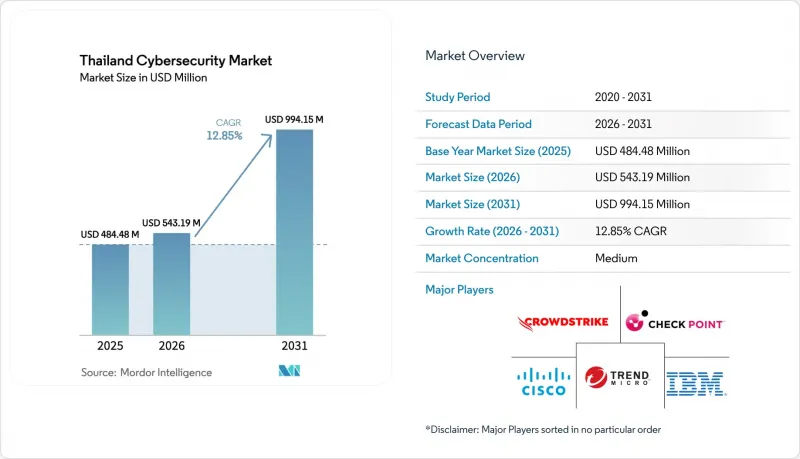
This report is Segmented by Offering (Solutions, and Services), Deployment Mode (On-Premise, and Cloud), End-Use Industry (IT and Telecom, BFSI, Healthcare, Industrial Manufacturing, Retail and E-Commerce, Energy and Utilities, and More), End-User Enterprise Size (Large Enterprises, and Small and Medium Enterprises). The Market Forecasts are Provided in Terms of Value (USD).
Thailand Cybersecurity Market Trends and Insights
Accelerated Digital-Banking Adoption in Thai BFSI
Four virtual-bank licenses issued in 2025 put Thailand on course for commercial launches in Q2-Q3 2026, prompting incumbents to inject AI into fraud-detection workflows so that anomalous transfers are blocked within milliseconds rather than overnight batches. Investment levels support the shift: Siam Commercial Bank and SCBX earmarked a combined THB 18.4 billion for cloud-native platforms that embed security at the API layer. PromptPay already flags more than 1,000 suspicious transactions every day, and the new PCI DSS 4.0.1 clause on continuous control validation further elevates operational visibility standards. Consequently, demand is tilting toward outcome-based managed detection and response as banks hedge against hiring constraints. The trend deepens the Thailand cybersecurity market reliance on service partners that can maintain 24 X 7 security-operations-center coverage.
Fast-Track Government Cloud Migration (G-Cloud And NDID)
The Cloud First directive obliges ministries to default to sovereign cloud unless national-security waivers apply, and a three-tier classification model specifies encryption levels for public, sensitive, and secret workloads. National Telecom's data-center arm monetized THB 1.49 billion of hosting fees in 2023, showing early fiscal upside for state-owned capacity. Meanwhile, NDID exceeded 40 million verified identities in 2025 and is piloting zero-knowledge-proof log-ins, cutting the data disclosure surface that attackers normally probe. The Electronic Transactions Development Agency's plan to oblige e-marketplaces to validate seller IDs further lifts demand for identity-verification APIs. Because only a handful of local firms can deliver cryptographic key escrow at scale, global providers entering the Thailand cybersecurity market gain an early credibility boost.
Shortage of Thai-Language Cybersecurity Talent
By 2025 only 431 professionals in Thailand held CISSP credentials, up by just 12% year on year and nowhere near the 10,000-certificate goal set for 2026. The National Cyber Academy has schooled more than 100,000 people, yet 72% of enterprises still cite staffing gaps as an operational risk. Cloud and AI security expertise top recruiting wish lists, but universities graduate fewer than 2,000 infosec majors annually, and multinationals offer salaries SMEs cannot match. Banks are sponsoring private curricula with Mandiant, keeping skills locked inside finance while healthcare and manufacturing scramble for bilingual analysts. Until more Thai-language threat feeds and playbooks emerge, human capital scarcity will temper the Thailand cybersecurity market growth potential.
Other drivers and restraints analyzed in the detailed report include:
- 5G Rollout Spurring IoT-Edge Security Demand
- Surge In Ransomware-As-A-Service Attacks on SMEs
- Price-Sensitive SME Buyer Behavior
For complete list of drivers and restraints, kindly check the Table Of Contents.
Segment Analysis
Solutions dominated spending with a 60.88% slice of the Thailand cybersecurity market share in 2025, anchored by long-installed firewalls and endpoint suites. Yet services are projected to outpace products at a 13.64% CAGR as boards confront the 72% operational-risk exposure tied to empty analyst seats. Managed detection, incident response, and vulnerability management contracts provide immediate coverage without HR overhead, and local integrators weave Thai-language threat feeds into dashboards to satisfy auditors. Network and endpoint security remain the largest solution buckets, propelled by True-dtac's 5G rollout and the regulator's imminent 2G-3G switch-off that pushes device fleets onto new attack surfaces.
Cloud security is moving at the fastest clip, fueled by the Cloud First mandate and PDPA localization clauses that reroute traffic to sovereign regions. Identity and access management gains extra momentum from NDID's 40-million-user milestone, spurring banks and e-tailers to federate logins via government APIs. Meanwhile, virtual banks slated for 2026 require AI-native fraud engines that embed security checks directly into the API flow, nudging developers toward DevSecOps. Data-protection tools also benefit as telemedicine platforms expand patient-record exchange, cementing encryption and key-governance requirements in hospital budgets.
On-premise estates still held 64.27% of Thailand cybersecurity market size in 2025 because critical-information-infrastructure owners rely on physical appliance chains for regulatory comfort. However, cloud-based controls are set to climb at a 13.71% CAGR thanks to ETDA's stricter localization guidance and the arrival of new hyperscaler regions. AWS committed USD 5 billion to a three-zone Bangkok region, Microsoft is rolling out a sovereign cloud with Gulf and True IDC, and Google Cloud inked a data-residency pact with Gulf Edge.
National Telecom's government cloud supports ministries, but capacity limits slow migration and force agencies into hybrid topologies that juggle ISO 27001 gear on-premise with SaaS in public cloud. The National Cyber Security Agency's Cybershield platform, co-engineered with Palo Alto Networks and Google, provides unified telemetry across both domains, helping auditors reconcile alerts in one pane. Financial and healthcare players increasingly view hybrid as a forever state, valuing the elasticity of cloud for compute-heavy analytics while pinning sensitive workloads behind local HSMs.
Complete Report Scope:
- By Offering
- Solutions
- Application Security
- Cloud Security
- Data Security
- Identity and Access Management
- Infrastructure Protection
- Integrated Risk Management
- Network Security
- Endpoint Security
- Services
- Professional Services
- Managed Services
- Solutions
- By Deployment Mode
- On-Premise
- Cloud
- By End-use Industry
- IT and Telecom
- BFSI
- Healthcare
- Industrial Manufacturing
- Retail and E-commerce
- Energy and Utilities
- Aerospace, Military and Defense
- Other End-use Industries
- By End-User Enterprise Size
- Large Enterprises
- Small and Medium Enterprises (SMEs)
List of Companies Covered in this Report:
- Cisco Systems, Inc.
- Palo Alto Networks, Inc.
- Fortinet, Inc.
- Check Point Software Technologies Ltd.
- Trend Micro Incorporated
- CrowdStrike Holdings, Inc.
- McAfee LLC
- International Business Machines Corporation
- Microsoft Corporation
- Amazon Web Services, Inc.
- Singtel Cyber Security
- Thales Group
- NEC Corporation
- Accenture plc
- KPMG Thailand
- MFEC Public Company Limited
- G-Able Company Limited
- ACinfotec Company Limited
- National Telecom Public Company Limited
- Bangkok Systems and Software Co., Ltd.
- Cybertron Co., Ltd.
- Netka System Co., Ltd.
Additional Benefits:
- The market estimate (ME) sheet in Excel format
- 3 months of analyst support
TABLE OF CONTENTS
1 INTRODUCTION
- 1.1 Study Assumptions and Market Definition
- 1.2 Scope of the Study
2 RESEARCH METHODOLOGY
3 EXECUTIVE SUMMARY
4 MARKET LANDSCAPE
- 4.1 Market Overview
- 4.2 Market Drivers
- 4.2.1 Accelerated Digital-Banking Adoption in Thai BFSI
- 4.2.2 Fast-Track Government Cloud Migration (G-Cloud and NDID)
- 4.2.3 5G Rollout Spurring IoT-Edge Security Demand
- 4.2.4 Surge in Ransomware-as-a-Service Attacks on SMEs
- 4.2.5 Stricter PDPA Data-Localization Enforcement
- 4.2.6 Real-Time Payment Fraud Driving AI-Based SOC Demand
- 4.3 Market Restraints
- 4.3.1 Shortage of Thai-Language Cybersecurity Talent
- 4.3.2 Price-Sensitive SME Buyer Behavior
- 4.3.3 Underinsured Cyber Incidents due to PDPA Liability Gaps
- 4.3.4 OT Security Integration Complexities in EEC Factories
- 4.4 Evaluation of Critical Regulatory Framework
- 4.5 Technological Outlook
- 4.6 Porter's Five Forces Analysis
- 4.6.1 Threat of New Entrants
- 4.6.2 Bargaining Power of Buyers/Consumers
- 4.6.3 Bargaining Power of Suppliers
- 4.6.4 Threat of Substitute Products
- 4.6.5 Intensity of Competitive Rivalry
- 4.7 Impact Assessment of Key Stakeholders
- 4.8 Key Use Cases and Case Studies
- 4.9 Impact of Macroeconomic Factors on the Market
- 4.10 Investment Analysis
5 MARKET SIZE AND GROWTH FORECASTS (VALUE)
- 5.1 By Offering
- 5.1.1 Solutions
- 5.1.1.1 Application Security
- 5.1.1.2 Cloud Security
- 5.1.1.3 Data Security
- 5.1.1.4 Identity and Access Management
- 5.1.1.5 Infrastructure Protection
- 5.1.1.6 Integrated Risk Management
- 5.1.1.7 Network Security
- 5.1.1.8 Endpoint Security
- 5.1.2 Services
- 5.1.2.1 Professional Services
- 5.1.2.2 Managed Services
- 5.1.1 Solutions
- 5.2 By Deployment Mode
- 5.2.1 On-Premise
- 5.2.2 Cloud
- 5.3 By End-use Industry
- 5.3.1 IT and Telecom
- 5.3.2 BFSI
- 5.3.3 Healthcare
- 5.3.4 Industrial Manufacturing
- 5.3.5 Retail and E-commerce
- 5.3.6 Energy and Utilities
- 5.3.7 Aerospace, Military and Defense
- 5.3.8 Other End-use Industries
- 5.4 By End-User Enterprise Size
- 5.4.1 Large Enterprises
- 5.4.2 Small and Medium Enterprises (SMEs)
6 COMPETITIVE LANDSCAPE
- 6.1 Market Concentration
- 6.2 Strategic Moves
- 6.3 Market Share Analysis
- 6.4 Company Profiles (includes Global Level Overview, Market Level Overview, Core Segments, Financials as available, Strategic Information, Market Rank/Share, Products and Services, Recent Developments)
- 6.4.1 Cisco Systems, Inc.
- 6.4.2 Palo Alto Networks, Inc.
- 6.4.3 Fortinet, Inc.
- 6.4.4 Check Point Software Technologies Ltd.
- 6.4.5 Trend Micro Incorporated
- 6.4.6 CrowdStrike Holdings, Inc.
- 6.4.7 McAfee LLC
- 6.4.8 International Business Machines Corporation
- 6.4.9 Microsoft Corporation
- 6.4.10 Amazon Web Services, Inc.
- 6.4.11 Singtel Cyber Security
- 6.4.12 Thales Group
- 6.4.13 NEC Corporation
- 6.4.14 Accenture plc
- 6.4.15 KPMG Thailand
- 6.4.16 MFEC Public Company Limited
- 6.4.17 G-Able Company Limited
- 6.4.18 ACinfotec Company Limited
- 6.4.19 National Telecom Public Company Limited
- 6.4.20 Bangkok Systems and Software Co., Ltd.
- 6.4.21 Cybertron Co., Ltd.
- 6.4.22 Netka System Co., Ltd.
7 MARKET OPPORTUNITIES AND FUTURE OUTLOOK
- 7.1 White-Space and Unmet-Need Assessment

