PUBLISHER: Mordor Intelligence | PRODUCT CODE: 2117250

PUBLISHER: Mordor Intelligence | PRODUCT CODE: 2117250
Nordics Cybersecurity - Market Share Analysis, Industry Trends & Statistics, Growth Forecasts (2026 - 2031)
According to Mordor Intelligence, nordics cybersecurity market size in 2026 is estimated at USD 14.92 billion, growing from 2025 value of USD 13.77 billion with 2031 projections showing USD 22.25 billion, growing at 8.36% CAGR over 2026-2031.
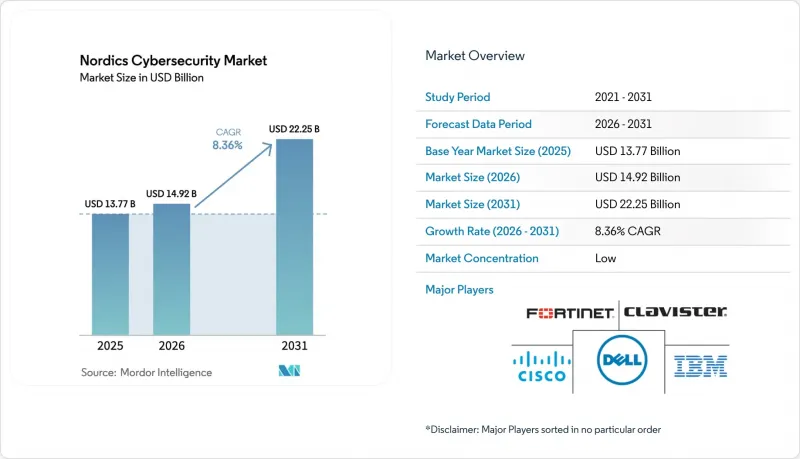
This report Segments Offering (Solutions, Services), Deployment Mode (On-Premises, Cloud), Organization Size (SMEs, Large Enterprises), End-User Vertical (BFSI, Healthcare and More) and by Country. The Market Forecasts are Provided in Terms of Value (USD).
Nordics Cybersecurity Market Trends and Insights
Accelerating roll-out of 5G-enabled Industry 4.0 production lines
Real-time connected robotics, machine-vision inspection, and predictive-maintenance workloads running across private 5G networks have multiplied OT entry points that legacy perimeter controls never addressed. Swedish automakers and Finnish electronics assemblers therefore allocate bigger budgets to zero-trust micro-segmentation, 5G-aware intrusion detection, and protocol translation gateways capable of bridging Modbus, OPC-UA, and IP traffic. Integrators report that each brownfield manufacturing site requires six to nine months of phased security retrofits, while co-developed security frameworks between IT and OT teams checkpoint every automation sprint. The resulting demand spike benefits Nordic vendors with deep OT know-how and global platform leaders that bundle 5G policy engines into consolidated firewalls, thereby raising average contract values and locking in multi-year managed-service revenues.
Public-sector "security-by-design" mandates under NIS2 and DORA
NIS2 obliges organisations exceeding 250 employees or EUR 50 million turnover to file breach reports within 24 hours and to pass yearly risk-maturity audits, while DORA layers mandatory threat-led penetration tests for financial entities. Denmark enacted the rules in March 2025 covering nearly 1,500 entities, and Norway's Digital Security Act applies fines up to 4% of global turnover for non-compliance. Compliance deadlines compress procurement cycles, pushing high-growth orders for policy-automation software, evidence-tracking modules, and managed compliance services. Nordic banks deploy resilience dashboards that map system dependencies against DORA stress-scenarios and auto-populate regulators' templates, cutting audit preparation by 70%.
Acute shortage of Nordic-language cyber talent
Vacancy ratios top 40% for roles requiring Swedish or Finnish language skills, and salary inflation tops 12% annually for mid-level security architects. Public agencies postpone SOC modernisation projects, while private-sector firms spend on international contractors who lack regional compliance fluency. Training programs sponsored by telecom operators add only 2,000 graduates yearly, leaving a persistent gap. This scarcity propels uptake of autonomous attack-surface monitoring and managed detection services embedded with local-language playbooks, yet long-term talent constraints continue to cap deployment velocity for bespoke security programmes.
Other drivers and restraints analyzed in the detailed report include:
- Vendor consolidation to managed XDR platforms
- AI-driven automated SOC and SecOps tooling
- High electricity prices limiting on-prem crypto workloads
For complete list of drivers and restraints, kindly check the Table Of Contents.
Segment Analysis
Cloud deployment commanded 62.10% share of the Nordics cybersecurity market size in 2025, equating to USD 8.55 billion. Cost-benefit analyses show 30-40% security infrastructure savings when shifting to shared-responsibility models, while threat telemetry coverage broadens through SaaS audit APIs. Nordic ministries migrate citizen-service portals to private-cloud zones, stipulating that workloads remain within Schengen borders, thereby elevating interest in regionally hosted cloud-native security stacks.
On-prem environments persist in energy, defence, and high-assurance manufacturing, where deterministic latency and air-gap policies remain non-negotiable. Statnett's OT control-room overhaul illustrates hybrid practice: administrative IT logs ship to a public-cloud SIEM, whereas grid-control enclaves retain on-prem collectors protected by host-based firewalls. Over the forecast period, as utilities modernise substations and automate patch-management, cloud-delivered security analytics will gradually absorb visibility, but sovereign-cloud constructs will still anchor final-mile compliance for classified data.
Complete Report Scope:
- By Offering
- Solutions
- Application Security
- Cloud Security
- Data Security
- Identity and Access Management
- Infrastructure Protection
- Integrated Risk Management
- Network Security Equipment
- Endpoint Security
- Other Solutions
- Services
- Professional Services
- Managed Services
- Solutions
- By Deployment Mode
- Cloud
- On-premise
- By Organisation Size
- SMEs
- Large Enterprises
- By End-User Vertical
- BFSI
- Healthcare
- IT and Telecom
- Industrial and Defence
- Retail
- Energy and Utilities
- Manufacturing
- Others
- By Country
- Denmark
- Norway
- Sweden
- Finland
List of Companies Covered in this Report:
- International Business Machines Corporation
- Cisco Systems, Inc.
- Dell Technologies Inc.
- Fortinet, Inc.
- Clavister Holding AB
- F5, Inc.
- Gen Digital Inc. (NortonLifeLock)
- Acronis International GmbH
- CyberArk Software Ltd.
- Proofpoint, Inc.
- Trend Micro Incorporated
- Trellix LLC
- Palo Alto Networks, Inc.
- CrowdStrike Holdings, Inc.
- WithSecure Corporation (F-Secure)
- Mnemonic AS
- NetClean Technologies AB
- Secunia ApS (Flexera)
- Promon AS
- Arctic Security Oy
- Visma AS
Additional Benefits:
- The market estimate (ME) sheet in Excel format
- 3 months of analyst support
TABLE OF CONTENTS
1 INTRODUCTION
- 1.1 Study Assumptions and Market Definition
- 1.2 Scope of the Study
2 RESEARCH METHODOLOGY
3 EXECUTIVE SUMMARY
4 MARKET LANDSCAPE
- 4.1 Market Overview
- 4.2 Market Drivers
- 4.2.1 Accelerating roll-out of 5G-enabled Industry 4.0 production lines
- 4.2.2 Public-sector "security-by-design" mandates under NIS2 and DORA
- 4.2.3 Vendor consolidation to managed XDR platforms
- 4.2.4 AI-driven automated SOC and SecOps tooling
- 4.2.5 Shift to cloud-native ERP modernisation in BFSI
- 4.2.6 NATO accession-linked defense cyber funding surge
- 4.3 Market Restraints
- 4.3.1 Acute shortage of Nordic-language cyber talent
- 4.3.2 High electricity prices limiting on-prem crypto workloads
- 4.3.3 SME under-investment below 5 % of IT budget
- 4.3.4 Fragmented legacy operational tech in utilities
- 4.4 Value/Supply-Chain Analysis
- 4.5 Regulatory Landscape
- 4.6 Technological Outlook
- 4.7 Porter's Five Forces Analysis
- 4.7.1 Bargaining Power of Suppliers
- 4.7.2 Bargaining Power of Buyers
- 4.7.3 Threat of New Entrants
- 4.7.4 Intensity of Competitive Rivalry
- 4.7.5 Threat of Substitutes
5 MARKET SIZE AND GROWTH FORECASTS (VALUE)
- 5.1 By Offering
- 5.1.1 Solutions
- 5.1.1.1 Application Security
- 5.1.1.2 Cloud Security
- 5.1.1.3 Data Security
- 5.1.1.4 Identity and Access Management
- 5.1.1.5 Infrastructure Protection
- 5.1.1.6 Integrated Risk Management
- 5.1.1.7 Network Security Equipment
- 5.1.1.8 Endpoint Security
- 5.1.1.9 Other Solutions
- 5.1.2 Services
- 5.1.2.1 Professional Services
- 5.1.2.2 Managed Services
- 5.1.1 Solutions
- 5.2 By Deployment Mode
- 5.2.1 Cloud
- 5.2.2 On-premise
- 5.3 By Organisation Size
- 5.3.1 SMEs
- 5.3.2 Large Enterprises
- 5.4 By End-User Vertical
- 5.4.1 BFSI
- 5.4.2 Healthcare
- 5.4.3 IT and Telecom
- 5.4.4 Industrial and Defence
- 5.4.5 Retail
- 5.4.6 Energy and Utilities
- 5.4.7 Manufacturing
- 5.4.8 Others
- 5.5 By Country
- 5.5.1 Denmark
- 5.5.2 Norway
- 5.5.3 Sweden
- 5.5.4 Finland
6 COMPETITIVE LANDSCAPE
- 6.1 Market Concentration
- 6.2 Strategic Moves
- 6.3 Market Share Analysis
- 6.4 Company Profiles (includes Global level Overview, Market level overview, Core Segments, Financials as available, Strategic Information, Market Rank/Share for key companies, Products and Services, and Recent Developments)
- 6.4.1 International Business Machines Corporation
- 6.4.2 Cisco Systems, Inc.
- 6.4.3 Dell Technologies Inc.
- 6.4.4 Fortinet, Inc.
- 6.4.5 Clavister Holding AB
- 6.4.6 F5, Inc.
- 6.4.7 Gen Digital Inc. (NortonLifeLock)
- 6.4.8 Acronis International GmbH
- 6.4.9 CyberArk Software Ltd.
- 6.4.10 Proofpoint, Inc.
- 6.4.11 Trend Micro Incorporated
- 6.4.12 Trellix LLC
- 6.4.13 Palo Alto Networks, Inc.
- 6.4.14 CrowdStrike Holdings, Inc.
- 6.4.15 WithSecure Corporation (F-Secure)
- 6.4.16 Mnemonic AS
- 6.4.17 NetClean Technologies AB
- 6.4.18 Secunia ApS (Flexera)
- 6.4.19 Promon AS
- 6.4.20 Arctic Security Oy
- 6.4.21 Visma AS
7 MARKET OPPORTUNITIES AND FUTURE OUTLOOK
- 7.1 White-space and Unmet-need Assessment

