PUBLISHER: Mordor Intelligence | PRODUCT CODE: 2125492

PUBLISHER: Mordor Intelligence | PRODUCT CODE: 2125492
Germany Last Mile Delivery - Market Share Analysis, Industry Trends & Statistics, Growth Forecasts (2026 - 2031)
According to Mordor Intelligence, the Germany last mile delivery market size was valued at USD 30.01 billion in 2025 and estimated to grow from USD 31.4 billion in 2026 to reach USD 39.39 billion by 2031, at a CAGR of 4.64% during the forecast period (2026-2031).
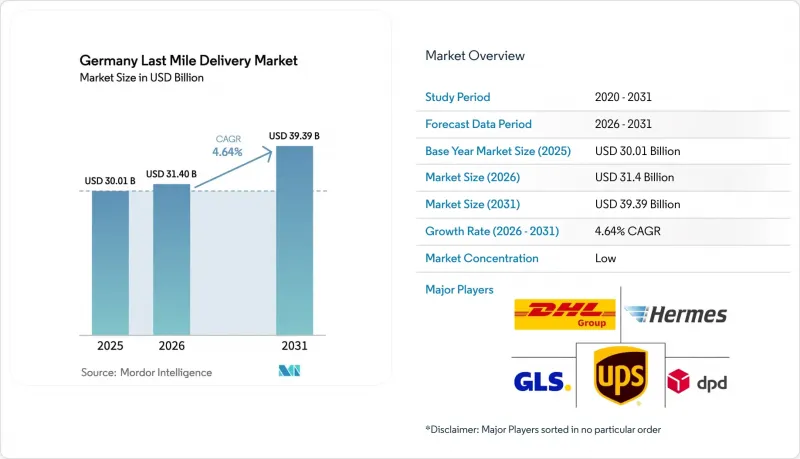
This report is Segmented by Service (Standard Delivery, Same-Day, and Express Delivery), Business Model (Business-To-Business (B2B), Business-To-Consumer (B2C), and Customer-To-Consumer (C2C)), End-User Industry (E-Commerce Retail, Fashion & Lifestyle, Beauty, and More), Federal State (Baden-Wurttemberg, Berlin, Bavaria, and More). The Market Forecasts are Provided in Terms of Value (USD).
Germany Last Mile Delivery Market Trends and Insights
Surge in Domestic E-commerce Parcel Volumes
Domestic B2C parcel flows continue to rise as German consumers deepen online shopping penetration, sending annual shipment counts to record highs Cross-border platforms such as Temu and Shein import sizeable parcel quantities, amplifying inbound volumes and stretching urban sorting hubs. Consumer surveys reveal higher expectations for predictable delivery windows, consolidating demand around carriers with dense stop coverage and automated sortation. The fashion-led Zalando-About You tie-up, signed in 2025, further amplifies parcel density by pooling fulfillment under unified logistics leadership. Larger operators gain scale economies that shield margins, whereas newcomers shoulder a higher cost-per-stop in sparsely served corridors.
Expansion of Parcel-Locker & PUDO Networks
The October 2024 DPD-GLS alliance created Germany's largest open locker system, enabling parcel hand-off interoperability across thousands of automated boxes. Deutsche Post DHL is on track to install a Packstation within walking distance for most urban residents by 2030. Building-integrated lockers launched through the 2025 myflexbox-DPD cooperation improve first-attempt success and shrink delivery dwell time. Retail checkout APIs now surface locker locations in real time, encouraging click-and-collect and cutting failed delivery costs. High up-front locker investment favors scale players able to underwrite multi-year site leases.
Rising Labor & Fuel Costs
Collective bargaining rounds in 2024 granted postal and parcel employees meaningful wage increases, lifting the cost base for carriers that already spend more than half of their operating expenses on personnel. Driver shortages remain chronic, forcing firms to raise entry pay and sign-on bonuses. Fuel outlays also climbed during 2024 amid energy-price volatility and higher highway tolls, compressing margins where contractual rate-adjustment clauses lag input inflation. Automation in sort centers and partial fleet electrification offset some pressure but require multiyear capital commitments.
Other drivers and restraints analyzed in the detailed report include:
- Sustainability Regulations Driving EV Fleets
- AI-Enabled Zonal Logistics & Route Optimization
- Scarce Inner-city Logistics Real Estate
For complete list of drivers and restraints, kindly check the Table Of Contents.
Segment Analysis
Standard delivery services captured 62.45% of the Germany last mile delivery market share in 2025, sustained by consumer sensitivity to shipping fees and the breadth of rural destinations served. Same-day options, though niche, is expected to log the strongest forward pace at a 3.62% CAGR (2026-2031) as urban shoppers increasingly value immediacy for time-critical purchases.
The Germany last mile delivery market size for same-day services is expected to rise steadily, helped by retailer partnerships that pool order cut-off times and micro-hub staging. Carriers employ AI sorting to feed evening rounds that deliver before midnight, maintaining service differentiation without eroding unit margins. Standard delivery profitability remains tied to high stop density and consolidated line-haul, while express-service demand stabilizes in B2B verticals needing guaranteed transit.
Complete Report Scope:
- By Service
- Standard Delivery
- Same-day
- Express Delivery
- By Business Model
- Business-to-Business (B2B)
- Business-to-Consumer (B2C)
- Customer-to-Consumer (C2C)
- By End-user Industry
- E-commerce Retail
- Fashion & Lifestyle
- Beauty, Wellness & Personal Care
- Home & Furniture
- Consumer Electronics & Appliances
- Healthcare & Medical Supplies
- Others
- By German Federal State
- Baden-Wurttemberg
- Berlin
- Bavaria
- North Rhine-Westphalia
- Rest of German Federal State
List of Companies Covered in this Report:
- Deutsche Post DHL Group
- Hermes
- UPS
- DPD
- GLS
- FedEx Express
- DSV
- Rhenus Logistics
- CEVA Logistics
- Speedlink Transport
- Delivery Hero
- GO Express & Logistics
- Berlin Last Mile
- Courier Service Germany
- Cencora
- PTV Logistics GmbH
- Redwood Fulfillment
- Landmark Global
- Yusen Logistics
- AIT Worldwide Logistics, Inc.
Additional Benefits:
- The market estimate (ME) sheet in Excel format
- 3 months of analyst support
TABLE OF CONTENTS
1 Introduction
- 1.1 Study Assumptions & Market Definition
- 1.2 Scope of the Study
2 Research Methodology
3 Executive Summary
4 Market Landscape
- 4.1 Market Overview
- 4.2 Market Drivers
- 4.2.1 Surge in domestic e-commerce parcel volumes
- 4.2.2 Expansion of parcel-locker & PUDO networks
- 4.2.3 Sustainability regulations driving EV fleets
- 4.2.4 Micro-hub reuse of vacant retail & parking assets
- 4.2.5 AI-enabled zonal logistics & route optimisation
- 4.2.6 German Postal Law 2024 boosting infrastructure spend
- 4.3 Market Restraints
- 4.3.1 Rising labour & fuel costs
- 4.3.2 Package theft/damage & failed first-attempts
- 4.3.3 Wage-inflation from collective bargaining rounds
- 4.3.4 Scarce inner-city logistics real-estate
- 4.4 Value / Supply-Chain Analysis
- 4.5 Regulatory Landscape
- 4.6 Technological Outlook
- 4.7 Porter's Five Forces
- 4.7.1 Bargaining Power of Buyers
- 4.7.2 Bargaining Power of Suppliers
- 4.7.3 Threat of New Entrants
- 4.7.4 Threat of Substitutes
- 4.7.5 Intensity of Competitive Rivalry
- 4.8 Impact of COVID-19 and Geo-Political Events
5 Market Size & Growth Forecasts
- 5.1 By Service
- 5.1.1 Standard Delivery
- 5.1.2 Same-day
- 5.1.3 Express Delivery
- 5.2 By Business Model
- 5.2.1 Business-to-Business (B2B)
- 5.2.2 Business-to-Consumer (B2C)
- 5.2.3 Customer-to-Consumer (C2C)
- 5.3 By End-user Industry
- 5.3.1 E-commerce Retail
- 5.3.2 Fashion & Lifestyle
- 5.3.3 Beauty, Wellness & Personal Care
- 5.3.4 Home & Furniture
- 5.3.5 Consumer Electronics & Appliances
- 5.3.6 Healthcare & Medical Supplies
- 5.3.7 Others
- 5.4 By German Federal State
- 5.4.1 Baden-Wurttemberg
- 5.4.2 Berlin
- 5.4.3 Bavaria
- 5.4.4 North Rhine-Westphalia
- 5.4.5 Rest of German Federal State
6 Competitive Landscape
- 6.1 Market Concentration
- 6.2 Strategic Moves
- 6.3 Market Share Analysis
- 6.4 Company Profiles (includes Global level Overview, Market level overview, Core Segments, Financials as available, Strategic Information, Market Rank/Share for key companies, Products & Services, and Recent Developments)
- 6.4.1 Deutsche Post DHL Group
- 6.4.2 Hermes
- 6.4.3 UPS
- 6.4.4 DPD
- 6.4.5 GLS
- 6.4.6 FedEx Express
- 6.4.7 DSV
- 6.4.8 Rhenus Logistics
- 6.4.9 CEVA Logistics
- 6.4.10 Speedlink Transport
- 6.4.11 Delivery Hero
- 6.4.12 GO Express & Logistics
- 6.4.13 Berlin Last Mile
- 6.4.14 Courier Service Germany
- 6.4.15 Cencora
- 6.4.16 PTV Logistics GmbH
- 6.4.17 Redwood Fulfillment
- 6.4.18 Landmark Global
- 6.4.19 Yusen Logistics
- 6.4.20 AIT Worldwide Logistics, Inc.
7 Market Opportunities & Future Outlook
- 7.1 White-space & Unmet-need Assessment

