PUBLISHER: Mordor Intelligence | PRODUCT CODE: 2116363

PUBLISHER: Mordor Intelligence | PRODUCT CODE: 2116363
India Direct-to-Consumer Logistics - Market Share Analysis, Industry Trends & Statistics, Growth Forecasts (2026 - 2031)
According to Mordor Intelligence, the India direct-to-Consumer logistics market size was valued at USD 7.55 billion in 2025 and estimated to grow from USD 8.03 billion in 2026 to reach USD 10.9 billion by 2031, at a CAGR of 6.31% during the forecast period (2026-2031).
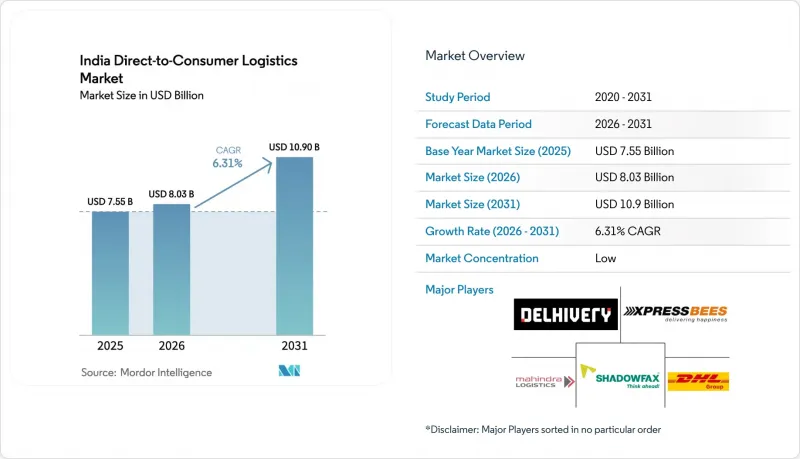
This report is Segmented by Service Type (Transportation, Warehousing and Storage, and Value-Added Services), End User (Fashion & Lifestyle, Consumer Electronics, FMCG, Home & Decor, and Others), Delivery Speed (Same-Day, Next-Day, and Standard), Distribution Channel (Online and Offline). The Market Forecasts are Provided in Terms of Value (USD).
India Direct-to-Consumer Logistics Market Trends and Insights
Surge in E-Commerce & Digital Infrastructure Boom
E-commerce payments grew 23.8% in 2024, accelerating volume inflows into parcel networks. Logistics operators responded by automating sortation; a major integrator now runs 20 such centers and handles 1.5 million parcels daily. Government-backed ULIP knits customs, port, and road databases into a single interface, trimming paperwork and enabling real-time track-and-trace. AI adoption spreads quickly: one FMCG shipper cut manual interventions by 80% after deploying predictive routing tools. Collectively, these advances lower error rates, shorten transit windows, and raise customer service benchmarks across the India direct-to-consumer logistics market.
Rise of 10-Minute Quick-Commerce Fulfillment
Quick-commerce platforms scaled annualized sales to USD 1.2 billion within 29 months, validating consumer appetite for impulse delivery. Operators expanded dark-store footprints but face mounting cash burn; a leading player spent INR 5,747 crore (USD 672 million) to earn INR 4,454 crore (USD 520 million) in FY 24, underscoring thin margins. Dense metro clusters deliver up to 85% of orders, whereas smaller cities add only 15-17% yet incur a higher cost per drop. Municipal zoning curbs dark-store density, prompting firms to refine merchandise assortments and leverage AI for sub-15-minute picking routines. Despite hurdles, investor confidence stays firm as valuations factor in eventual scale economies.
Hyper-Competitive Pricing from E-Tail Majors & 3PLs
Aggressive discounting compresses margins across fulfilment lanes as leading marketplaces leverage scale to negotiate sub-INR 10 per-parcel rates (USD 0.11 per parcel). Consolidation, highlighted by an INR 1,407 crore (USD 164.5 million) acquisition filing, signals the hunt for density-driven cost dilution. Quick-commerce apps post quarterly EBITDA losses exceeding INR 100 crore (USD 11.7 million) even after fee hikes, underscoring razor-thin unit economics. Smaller couriers, therefore, pivot toward niche verticals such as high-value electronics and healthcare to defend yields. The Competition Commission monitors tie-ups to avert monopolistic routing, yet near-term oversupply keeps spot rates volatile.
Other drivers and restraints analyzed in the detailed report include:
- Expansion into Tier-2/3 Cities via Omni-Channel Models
- National Logistics Policy & ONDC Enablement
- Quick-Commerce Unit-Economics Pressure/Dark-Store Risk
For complete list of drivers and restraints, kindly check the Table Of Contents.
Segment Analysis
Transportation services controlled 47.35% of the India direct-to-consumer logistics market share in 2025. Express parcel trains, EV fleets, and automated sorters combine to slash lead times, anchoring shipper loyalty. The India direct-to-consumer logistics market size for transportation stood at USD 3.58 billion in 2025 and is forecast to post steady gains through modular fleet expansion and dynamic routing. In parallel, value-added services, though smaller, are expected to post a 4.82% CAGR (2026-2031) on the back of high-touch needs such as reverse logistics, installation, and real-time visibility dashboards.
Warehouse and storage activities evolve toward micro-hubs near consumption centers. Dark-store nodes, many under 3,000 sq ft, facilitate 10-minute fulfilment, while AI-powered inventory systems reduce stock-outs. Regulatory compliance around food safety, temperature control, and data privacy drives investment in certified facilities. Integrated service bundles now blend intercity line-haul, intra-city distribution, and freight-forwarding, further blurring traditional silos in the India direct-to-consumer logistics market.
Fashion & lifestyle generated 31.45% of the India direct-to-consumer logistics market size in 2025, rising at a 4.55% CAGR (2026-2031) as omnichannel launches multiply seasonal drops. Quick-commerce platforms pilot premium apparel delivery within two hours, catering to impulse purchases. Brands broaden reach: one lingerie specialist derived 28% of 2024 sales from Tier-II/III towns via franchise roll-outs and D2C portals. Demand for returns management and size-exchange cycles reinforces value-added service uptake.
Consumer electronics remain sizeable due to high-value ticket sizes that justify insured, tamper-proof packaging. FMCG categories show triple-digit growth on quick-commerce rails, pushing for chilled chain nodes and continuous replenishment algorithms. Home & decor items leverage durable packaging innovations and room-of-choice delivery set-ups. Category compliance continues to diversify, with Bureau of Indian Standards codes, battery recycling mandates, and food safety rules shaping operating playbooks.
Complete Report Scope:
- By Service Type
- Transportation
- Warehousing and Storage
- Value-added Services
- By End User
- Fashion & Lifestyle
- Consumer Electronics
- FMCG
- Home & Decor
- Others
- By Delivery Speed
- Same-Day (Within 24 h)
- Next-Day
- Standard
- By Distribution Channel
- Online
- Offline
List of Companies Covered in this Report:
- Delhivery
- DHL
- XpressBees
- Shadowfax
- Mahindra Logistics Ltd.
- Pickrr
- Shipyaari
- Shipway
- FedEx
- Gati Ltd (Subsidiary of Allcargo Logistics Ltd)
- Unicommerce
- Zippee
- Shiprocket
- EZ Logistics
- QuickShift
- Eshopbox
- NimbusPost
- Porter
- Emiza
- Loadshare Networks
Additional Benefits:
- The market estimate (ME) sheet in Excel format
- 3 months of analyst support
TABLE OF CONTENTS
1 Introduction
- 1.1 Study Assumptions & Market Definition
- 1.2 Scope of the Study
2 Research Methodology
3 Executive Summary
4 Market Landscape
- 4.1 Market Overview
- 4.2 Market Drivers
- 4.2.1 Surge in e-commerce & digital infrastructure boom
- 4.2.2 Rise of 10-minute quick-commerce fulfillment
- 4.2.3 Expansion into Tier-2/3 cities via omni-channel models
- 4.2.4 National Logistics Policy & ONDC enablement
- 4.2.5 Vande Bharat parcel trains for express D2C shipping
- 4.2.6 EV/bike-taxi adoption lowering last-mile cost & CO2
- 4.3 Market Restraints
- 4.3.1 Hyper-competitive pricing from e-tail majors & 3PLs
- 4.3.2 Infrastructure bottlenecks & supply-chain disruption
- 4.3.3 Quick-commerce unit-economics pressure/dark-store risk
- 4.3.4 Regulatory uncertainty over gig-economy workforce
- 4.4 E-commerce Industry Outlook
- 4.5 Value / Supply-Chain Analysis
- 4.6 Regulatory Landscape
- 4.7 Technological Outlook
- 4.8 Impact of COVID-19 and Geo-Political Events
- 4.9 Porter's Five Forces
- 4.9.1 Bargaining Power of Suppliers
- 4.9.2 Bargaining Power of Buyers
- 4.9.3 Threat of New Entrants
- 4.9.4 Threat of Substitutes
- 4.9.5 Intensity of Competitive Rivalry
5 Market Size & Growth Forecasts
- 5.1 By Service Type
- 5.1.1 Transportation
- 5.1.2 Warehousing and Storage
- 5.1.3 Value-added Services
- 5.2 By End User
- 5.2.1 Fashion & Lifestyle
- 5.2.2 Consumer Electronics
- 5.2.3 FMCG
- 5.2.4 Home & Decor
- 5.2.5 Others
- 5.3 By Delivery Speed
- 5.3.1 Same-Day (Within 24 h)
- 5.3.2 Next-Day
- 5.3.3 Standard
- 5.4 By Distribution Channel
- 5.4.1 Online
- 5.4.2 Offline
6 Competitive Landscape
- 6.1 Market Concentration
- 6.2 Strategic Moves
- 6.3 Market Share Analysis
- 6.4 Company Profiles (includes Global level Overview, Market level overview, Core Segments, Financials as available, Strategic Information, Market Rank/Share for key companies, Products & Services, and Recent Developments)
- 6.4.1 Delhivery
- 6.4.2 DHL
- 6.4.3 XpressBees
- 6.4.4 Shadowfax
- 6.4.5 Mahindra Logistics Ltd.
- 6.4.6 Pickrr
- 6.4.7 Shipyaari
- 6.4.8 Shipway
- 6.4.9 FedEx
- 6.4.10 Gati Ltd (Subsidiary of Allcargo Logistics Ltd)
- 6.4.11 Unicommerce
- 6.4.12 Zippee
- 6.4.13 Shiprocket
- 6.4.14 EZ Logistics
- 6.4.15 QuickShift
- 6.4.16 Eshopbox
- 6.4.17 NimbusPost
- 6.4.18 Porter
- 6.4.19 Emiza
- 6.4.20 Loadshare Networks
7 Market Opportunities & Future Outlook
- 7.1 White-space & Unmet-need Assessment

