PUBLISHER: Mordor Intelligence | PRODUCT CODE: 2119699

PUBLISHER: Mordor Intelligence | PRODUCT CODE: 2119699
Singapore Last-Mile Delivery - Market Share Analysis, Industry Trends & Statistics, Growth Forecasts (2026 - 2031)
According to Mordor Intelligence, the Singapore last-Mile delivery market size is expected to grow from USD 12.98 billion in 2025 to USD 14.53 billion in 2026 and is forecast to reach USD 25.57 billion by 2031 at 11.97% CAGR over 2026-2031.
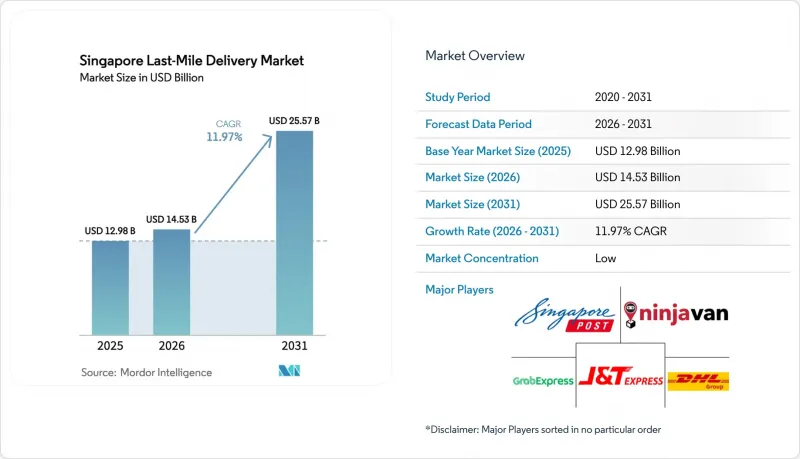
This report is Segmented by Service (Standard Delivery, Same-Day, and Express Delivery), Business Model (Business-To-Business (B2B), Business-To-Consumer (B2C), and Customer-To-Consumer (C2C)), End-User Industry (E-Commerce Retail, Fashion & Lifestyle, Beauty, Wellness & Personal Care, Consumer Electronics & Appliances, and More). The Market Forecasts are Provided in Terms of Value (USD).
Singapore Last-Mile Delivery Market Trends and Insights
E-commerce Penetration Surge Drives Structural Market Expansion
Close to 55% of online purchases in Singapore arrive from overseas merchants, straining last-mile capacity during shopping festivals. Social-commerce discovery channels-TikTok, Instagram, Facebook-now funnel 59% of all cross-border purchases, making micro-shipments the new normal. Shopee's International Platform multiplied seller orders eightfold during pilots, proving that free cross-border shipping incentives permanently elevate parcel flows. Sustained volume growth pushes carriers to invest in multi-modal customs clearance nodes and advanced small-parcel sortation capable of regional reach beyond the city-state.
Rising Same-Day and Express Demand Reshapes Service Expectations
Same-day options have become baseline as 52% of shoppers now expect sub-24-hour fulfillment across more categories. Express services grow at 7.4% CAGR, fueled by premium electronics, B2B restocking, and temperature-sensitive pharma orders. Aging demographics and telemedicine lift healthcare & medical supplies deliveries by 9.6% CAGR. Automated storage and retrieval systems capable of -35 °C to ambient handling protect cold-chain integrity and cut labor exposure. Integrated cold-chain plus express capacity therefore commands premium yields within the Singapore last-mile delivery market.
Tight Labour Market and Rising Manpower Costs Accelerate Automation Adoption
Eighty-nine percent of logistics employers report recruitment difficulties as sector revenue outpaces workforce growth. Autonomous mobile robots, AI route optimizers, and digital dispatch engines such as A*STAR SIMTech's Last-Mile Logistics Management allow carriers to scale parcel volumes without proportional headcount. Automation ROI shortens further when paired with mounting wage pressure and a 1.2% annual labor-supply increase against an 8.7% revenue rise.
Other drivers and restraints analyzed in the detailed report include:
- Government-Backed Nationwide Locker Network Creates Infrastructure Foundation
- Cross-Border Micro-Shipments Via Social Commerce Accelerate Regional Integration
- Urban Curb-Space and Traffic Congestion Constrain Operational Efficiency
For complete list of drivers and restraints, kindly check the Table Of Contents.
Segment Analysis
Standard delivery retained 52.34% of the Singapore last-mile delivery market share in 2025, reflecting entrenched cost-sensitive habits and optimized 1-to-3-day networks. Express services, however, post a 7.1% CAGR (2026-2031) as merchants weaponize speed for differentiation. Same-day courier apps deliver island-wide in 45 minutes, and GrabExpress leverages super-app driver pools for blended food-and-parcel dispatch. Cold-chain add-ons, secure handling, and white-glove furniture installation broaden express addressable revenue while cushioning margins against commoditized standard rates.
Asset-light micro-fulfilment nodes sited within retail estates compress lead times further. Yet escalating curb-space constraints trigger alternate modes: locker drop-offs, autonomous robots, or scheduled pick-ups. Compliance with GDP pharma standards and HACCP rules raises operational barriers, favoring incumbents with certified quality systems. The Singapore last-mile delivery market size for express services, therefore, rises faster than overall volume growth, signaling ongoing premiumization.
Complete Report Scope:
- By Service
- Standard Delivery
- Same-day
- Express Delivery
- By Business Model
- Business-to-Business (B2B)
- Business-to-Consumer (B2C)
- Customer-to-Consumer (C2C)
- By End-user Industry
- E-commerce Retail
- Fashion & Lifestyle
- Beauty, Wellness & Personal Care
- Home & Furniture
- Consumer Electronics & Appliances
- Healthcare & Medical Supplies
- Others
List of Companies Covered in this Report:
- Ninja Van
- Singapore Post
- J&T Express
- GrabExpress
- DHL Express
- Lalamove
- Pickupp
- Roadbull
- uParcel
- GoGoX
- DSV
- FedEx
- UPS
- Aramex
- YCH Group
- EVFY
- Locad
- BEST Inc
- Citywide Express Logistics Pte. Ltd.
- Fastbee Logistics
Additional Benefits:
- The market estimate (ME) sheet in Excel format
- 3 months of analyst support
TABLE OF CONTENTS
1 Introduction
- 1.1 Study Assumptions & Market Definition
- 1.2 Scope of the Study
2 Research Methodology
3 Executive Summary
4 Market Landscape
- 4.1 Market Overview
- 4.2 Market Drivers
- 4.2.1 E-commerce penetration surge
- 4.2.2 Rising same-day / express demand
- 4.2.3 Government-backed nationwide locker network
- 4.2.4 Cross-border micro-shipments via social-commerce platforms
- 4.2.5 Cold-chain B2B restocking opportunities
- 4.2.6 Availability of Grade-A urban logistics real estate
- 4.3 Market Restraints
- 4.3.1 Urban curb-space & traffic congestion
- 4.3.2 Tight labour market & rising manpower costs
- 4.3.3 Phasing-out of shipping subsidies by e-commerce platforms
- 4.3.4 High COE & EV-charging costs for fleet electrification
- 4.4 Value / Supply-Chain Analysis
- 4.5 Regulatory Landscape
- 4.6 Technological Outlook
- 4.7 Porter's Five Forces
- 4.7.1 Threat of New Entrants
- 4.7.2 Bargaining Power of Buyers
- 4.7.3 Bargaining Power of Suppliers
- 4.7.4 Threat of Substitutes
- 4.7.5 Competitive Rivalry
- 4.8 Reverse / Return Logistics Insights
- 4.9 Impact of Geo-Political Events on Supply Chain Shifts
5 Market Size & Growth Forecasts
- 5.1 By Service
- 5.1.1 Standard Delivery
- 5.1.2 Same-day
- 5.1.3 Express Delivery
- 5.2 By Business Model
- 5.2.1 Business-to-Business (B2B)
- 5.2.2 Business-to-Consumer (B2C)
- 5.2.3 Customer-to-Consumer (C2C)
- 5.3 By End-user Industry
- 5.3.1 E-commerce Retail
- 5.3.2 Fashion & Lifestyle
- 5.3.3 Beauty, Wellness & Personal Care
- 5.3.4 Home & Furniture
- 5.3.5 Consumer Electronics & Appliances
- 5.3.6 Healthcare & Medical Supplies
- 5.3.7 Others
6 Competitive Landscape
- 6.1 Market Concentration
- 6.2 Strategic Moves
- 6.3 Market Share Analysis
- 6.4 Company Profiles (includes Global level Overview, Market level overview, Core Segments, Financials as available, Strategic Information, Market Rank/Share, Products & Services, Recent Developments)
- 6.4.1 Ninja Van
- 6.4.2 Singapore Post
- 6.4.3 J&T Express
- 6.4.4 GrabExpress
- 6.4.5 DHL Express
- 6.4.6 Lalamove
- 6.4.7 Pickupp
- 6.4.8 Roadbull
- 6.4.9 uParcel
- 6.4.10 GoGoX
- 6.4.11 DSV
- 6.4.12 FedEx
- 6.4.13 UPS
- 6.4.14 Aramex
- 6.4.15 YCH Group
- 6.4.16 EVFY
- 6.4.17 Locad
- 6.4.18 BEST Inc
- 6.4.19 Citywide Express Logistics Pte. Ltd.
- 6.4.20 Fastbee Logistics
7 Market Opportunities & Future Outlook
- 7.1 White-Space & Unmet-Need Assessment

