PUBLISHER: Mordor Intelligence | PRODUCT CODE: 2125532

PUBLISHER: Mordor Intelligence | PRODUCT CODE: 2125532
Philippines Telecom MNO - Market Share Analysis, Industry Trends & Statistics, Growth Forecasts (2026 - 2031)
According to Mordor Intelligence, the Philippines telecom MNO market size in 2026 is estimated at USD 7.81 billion, growing from 2025 value of USD 7.5 billion with 2031 projections showing USD 9.58 billion, growing at 4.16% CAGR over 2026-2031.
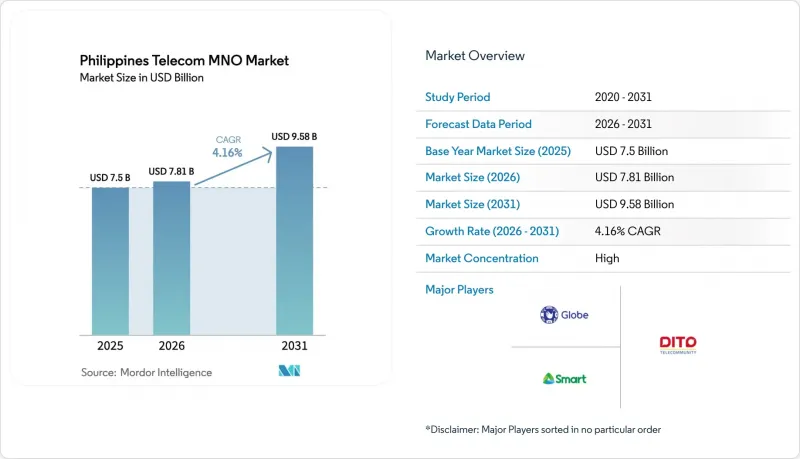
This report is Segmented by Service Type (Voice Services, Data and Internet Services, Messaging Services, Iot and M2M Services, OTT and PayTV Services, Other Services), End User (Enterprises, Consumers). The Market Forecasts are Provided in Terms of Value (USD) and Volume (Subscribers).
Philippines Telecom MNO Market Trends and Insights
Rising mobile-data consumption from video and gaming boom
Average monthly data use climbed to 8.7 GB in 2024, a 340% surge since 2022, as high-definition streaming and mobile esports moved into the mainstream. Video now absorbs 65% of peak evening traffic on Globe Telecom's network, prompting the operator to accelerate capacity upgrades on densest LTE and 5G sites. Gaming contributes a further uplift in premium plan uptake because competitive titles require latency below 30 ms. Localization of streaming catalogs by global providers has reinforced this data pull, with Filipino-language originals boosting subscriber acquisition. Together these factors have made mobile data the dominant revenue line in the Philippines telecom MNO market.
Accelerated 5G roll-out and device affordability
By late-2024 Smart Communications reported 95% population coverage in Metro Manila, while entry-level 5G handsets fell below PHP 10,000 (USD 175) for the first time. The confluence of coverage and cost has driven a 280% year-on-year increase in 5G SIMs. Regulatory streamlining under the Konektadong Pinoy Act trimmed tower-permit lead times from 18 months to 6 months, allowing operators to light up dense urban corridors ahead of schedule. Device manufacturers have also bundled installment schemes through e-wallets, further lowering adoption barriers. These trends underpin the long-run revenue uplift baked into the Philippines telecom MNO market forecasts.
Heavy 5G / fiber capex burden on operators
PLDT allocated PHP 92 billion (USD 1.6 billion) in capex during 2024-23% of service revenue-as it densified 5G radios and pushed fiber-to-the-home deeper into suburbs. Each 5G site needs 40-60% more cash than its 4G predecessor once spectrum, backhaul and edge upgrades are included. Upcoming spectrum auctions may add upfront costs running into hundreds of millions of USD. Consequently, carriers prioritize high-ARPU districts and postpone rural builds, slowing universal-service progress.
Other drivers and restraints analyzed in the detailed report include:
- Government common-tower and spectrum-reform programs
- Enterprise digital-transformation and IoT connectivity demand
- Low rural ARPU limiting ROI
For complete list of drivers and restraints, kindly check the Table Of Contents.
Segment Analysis
Mobile-data services generated 53.46% of 2025 operator revenue, confirming their primacy within the Philippines telecom MNO market. This share will widen as 5G penetration spreads beyond early adopters and as streaming video climbs beyond 60% of peak traffic loads. The Philippines telecom MNO market size attributable to IoT and M2M services is forecast to compound at 4.28% annually, underpinned by smart-city deployments in Metro Manila and agro-monitoring projects across Luzon's rice belt. Voice revenue continues its structural retreat-down 80% since 2020-as messaging apps absorb person-to-person traffic.
In response, operators bundle OTT video and music subscriptions, monetizing data while preserving engagement. Business messaging APIs are replacing legacy SMS for e-commerce order updates and two-factor authentication, mitigating revenue loss. Emerging edge-cloud services such as mobile private networks and network slicing are expected to anchor the next wave of enterprise contracts. These dynamics ensure that data-centric offerings will broaden the Philippines telecom MNO market over the forecast horizon.
Complete Report Scope:
- Overall Telecom Revenue and ARPU
- Service Type
- Voice Services
- Data and Internet Services
- Messaging Services
- IoT and M2M Services
- OTT and PayTV Services
- Other Services (VAS, Roaming and International Services, Enterprise and Wholesale Services, etc.)
- End-User
- Enterprises
- Consumer
List of Companies Covered in this Report:
- Globe Telecom
- Smart Communications
- DITO Telecommunity
Additional Benefits:
- The market estimate (ME) sheet in Excel format
- 3 months of analyst support
TABLE OF CONTENTS
1 INTRODUCTION
- 1.1 Study Assumptions and Market Definition
- 1.2 Scope of the Study
2 RESEARCH METHODOLOGY
3 EXECUTIVE SUMMARY
4 MARKET LANDSCAPE
- 4.1 Market Overview
- 4.2 Regulatory and Policy Framework
- 4.3 Spectrum Landscape and Competitive Holdings
- 4.4 Telecom Industry Ecosystem
- 4.5 Macroeconomic and External Drivers
- 4.6 Porter's Five Forces
- 4.6.1 Competitive Rivalry
- 4.6.2 Threat of New Entrants
- 4.6.3 Bargaining Power of Suppliers
- 4.6.4 Bargaining Power of Buyers
- 4.6.5 Threat of Substitutes
- 4.7 Key MNO KPIs (2020-2025)
- 4.7.1 Unique Mobile Subscribers and Penetration Rate
- 4.7.2 Mobile Internet Users and Penetration Rate
- 4.7.3 SIM Connections by Access Technology and Penetration
- 4.7.4 Cellular IoT / M2M Connections
- 4.7.5 Broadband Connections (Mobile and Fixed)
- 4.7.6 ARPU (Average Revenue Per User)
- 4.7.7 Average Data Usage per Subscription (GB/month)
- 4.8 Market Drivers
- 4.8.1 Rising mobile-data consumption from video and gaming boom
- 4.8.2 Accelerated 5G roll-out and device affordability
- 4.8.3 Government common-tower and spectrum-reform programs
- 4.8.4 Enterprise digital-transformation and IoT connectivity demand
- 4.8.5 Fin-tech super-apps (e.g., GCash) lifting stickiness and ARPU
- 4.8.6 Typhoon-resilient network requirements driving densification
- 4.9 Market Restraints
- 4.9.1 Heavy 5G / fibre capex burden on operators
- 4.9.2 Low rural ARPU limiting ROI
- 4.9.3 SIM Registration Act-driven prepaid de-activations
- 4.9.4 Climate-related outages raising opex and churn risk
- 4.10 Technological Outlook
- 4.11 Analysis of key business models in Telecom
- 4.12 Analysis of Pricing Models and Pricing
5 MARKET SIZE AND GROWTH FORECASTS (VALUE)
- 5.1 Overall Telecom Revenue and ARPU
- 5.2 Service Type
- 5.2.1 Voice Services
- 5.2.2 Data and Internet Services
- 5.2.3 Messaging Services
- 5.2.4 IoT and M2M Services
- 5.2.5 OTT and PayTV Services
- 5.2.6 Other Services (VAS, Roaming and International Services, Enterprise and Wholesale Services, etc.)
- 5.3 End-User
- 5.3.1 Enterprises
- 5.3.2 Consumer
6 COMPETITIVE LANDSCAPE
- 6.1 Market Concentration
- 6.2 Strategic Moves and Investments by key vendors, 2023-2025
- 6.3 Market share analysis for MNOs, 2024
- 6.4 Product Benchmarking Analysis for mobile network services
- 6.5 MNO snapshot (subscribers, churn rate, ARPU, etc.)
- 6.6 Company Profiles* of MNOs (Includes Business Overview | Service Portfolio | Financials | Business Strategy and Recent Developments | SWOT Analysis)
- 6.6.1 Globe Telecom
- 6.6.2 Smart Communications
- 6.6.3 DITO Telecommunity
7 MARKET OPPORTUNITIES AND FUTURE OUTLOOK
- 7.1 White-space and Unmet-Need Assessment

