PUBLISHER: Mordor Intelligence | PRODUCT CODE: 2125641

PUBLISHER: Mordor Intelligence | PRODUCT CODE: 2125641
Southeast Asia Compressed Natural Gas (CNG) Dispenser - Market Share Analysis, Industry Trends & Statistics, Growth Forecasts (2026 - 2031)
According to Mordor Intelligence, the Southeast Asia compressed natural gas dispenser market size was valued at USD 32.39 million in 2025 and is estimated to grow from USD 36.11 million in 2026 to reach USD 60.33 million by 2031, at a CAGR of 10.81% during the forecast period (2026-2031).
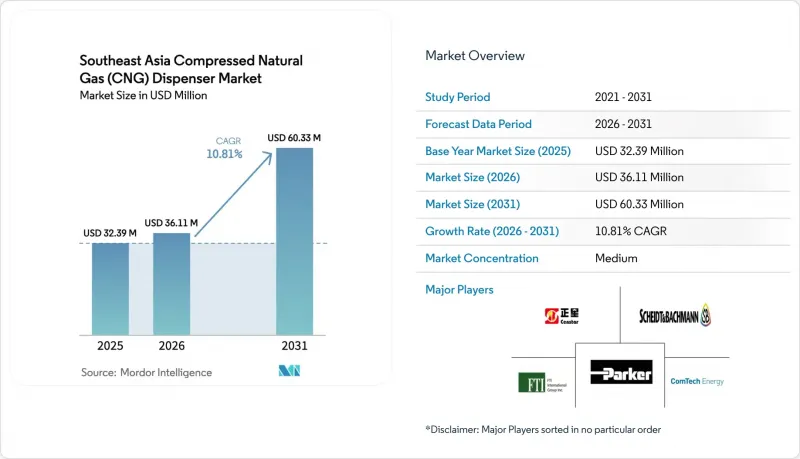
This report is Segmented by Dispenser Configuration (Single-Hose, Dual-Hose, and Multi-Hose), Station Type (Fast-Fill, Time-Fill, and Mobile/Portable), End-User (Public Retail Stations, Private Fleet Depots, Transit and Bus Fleets, and Industrial and Mining Sites), and Geography (Thailand, Singapore, Indonesia, Malaysia, Philippines, Vietnam, and Rest of Southeast Asia).
Southeast Asia Compressed Natural Gas (CNG) Dispenser Market Trends and Insights
Lower Total Cost of Ownership vs Diesel
Fleet operators in Indonesia and Vietnam have locked in five-to-seven-year CNG supply contracts that hedge against diesel swings exceeding 25% peak-to-trough in 2024, reducing depot payback periods to 3.2 years at throughputs above 150 vehicles daily. Delivered CNG costs in Java and Sumatra fell 18% after Pertamina's pipeline extensions, cementing a 30-40% operating-cost gap versus diesel that persists even during LNG price spikes. Vietnamese manufacturers mirrored the shift as private depots grew 22% year-on-year in 2025, with operators citing maintenance and engine-life advantages that close only when utilization drops below 60%. The Southeast Asia CNG dispenser market, therefore, draws its core growth from heavy-duty fleets, not urban consumer vehicles, and is increasingly insulated from retail-price politics through direct gas-supply agreements.
Regional LNG Import Capacity Build-Out
Between 2023 and 2025, Vietnam's Cai Mep and the Philippines' new terminals added 8.1 million t p.a. of regasification, enabling station operators to source spot LNG cargoes when Asia-Pacific prices dip below USD 12/MMBtu. Indonesia's state pipeline operator is pushing trunk lines into Central Java and South Sumatra, cutting virtual-pipeline truck costs. Thailand's Eastern Economic Corridor pilots small-scale satellite LNG stations that could disrupt legacy pipeline distribution if capex falls beneath USD 2 million per site. Yet Singapore's second terminal will not reach full output this decade, leaving operators there exposed to Malaysian pipeline imports and limiting network expansion.
Rising Competitiveness of Battery-Electric Mobility
Bangkok's 2025 order for 500 battery-electric buses and Ho Chi Minh City's December 2025 conversion of 58 CNG buses to electric cut urban CNG demand by roughly 15% year-on-year. Malaysia's July 2025 mandate eliminating 44,383 NGVs showed that policy can abruptly shrink the addressable base. With public-transport operators chasing zero-emission targets, dispenser utilization in city cores has dipped below break-even, forcing some sites to pivot to hydrogen or LPG. Regional suppliers are therefore redirecting sales teams toward industrial and mining clients less vulnerable to electrification.
Other drivers and restraints analyzed in the detailed report include:
- Government NGV Incentives & Subsidies
- Adoption of IoT-Enabled Dispensers
- High Upfront Station CAPEX & Land-Leasing Hurdles
For complete list of drivers and restraints, kindly check the Table Of Contents.
Segment Analysis
Multi-hose installations captured a rising share of the Southeast Asia CNG dispenser market as operators in Jakarta, Bangkok, and Ho Chi Minh City retrofit older dual-hose forecourts to serve three or four vehicles simultaneously. Dual-hose units still held 39.8% revenue in 2025, but multi-hose variants are projected to log a 12.8% CAGR, reflecting land constraints that make throughput per square meter critical. Single-hose equipment lingers in rural or low-traffic depots where simplicity trumps speed, although its share is ebbing as secondary cities tighten service-level rules.
Manufacturers now offer modular cabinets that add hoses in 12-month intervals, matching capex to realized demand and guarding against stranded assets. Integrating ISO 19880 compatibility prepares sites for future hydrogen blends with minimal retrofit, an insurance policy increasingly specified by risk-averse fuel retailers. Parker Hannifin and Gilbarco Veeder-Root have gained ground by bundling 24-hour parts support with software-subscription models that spread upfront costs across five-year service contracts. Chinese challengers compete on price but face perception gaps in premium urban stations, keeping competitive pressure moderate rather than destabilizing.
Complete Report Scope:
- By Dispenser Configuration
- Single-Hose
- Dual-Hose
- Multi-Hose
- By Station Type
- Fast-Fill
- Time-Fill
- Mobile/Portable
- By End-User
- Public Retail Stations
- Private Fleet Depots
- Transit and Bus Fleets
- Industrial and Mining Sites
- By Geography
- Thailand
- Singapore
- Indonesia
- Malaysia
- Philippines
- Vietnam
- Rest of Southeast Asia
List of Companies Covered in this Report:
- Parker Hannifin Corp
- Gilbarco Veeder-Root
- Censtar Science & Technology
- Tatsuno Corporation
- Scheidt & Bachmann
- Greka Engineering
- FTI International Group
- ComTech Energy
- Sanki Industry Group
- TGT Fuel Technologies India
- Compac Industries
- Tokheim Corporation
- ANGI Energy Systems
- WEH GmbH
- Linde Hydrogen & Gas Equipment
- Bosch Rexroth
- Chart Industries
- KwangShin Machine
- Armstrong Equipment
- Clean Energy Compression
Additional Benefits:
- The market estimate (ME) sheet in Excel format
- 3 months of analyst support
TABLE OF CONTENTS
1 Introduction
- 1.1 Study Assumptions & Market Definition
- 1.2 Scope of the Study
2 Research Methodology
3 Executive Summary
4 Market Landscape
- 4.1 Market Overview
- 4.2 Market Drivers
- 4.2.1 Government NGV incentives & subsidy programs
- 4.2.2 Lower total cost of ownership vs gasoline & diesel
- 4.2.3 Growing city-bus fleet conversions to CNG
- 4.2.4 Regional pipeline & LNG import capacity build-out
- 4.2.5 Rapid biogas-to-CNG project roll-outs
- 4.2.6 Adoption of IoT-enabled dispensers for predictive maintenance
- 4.3 Market Restraints
- 4.3.1 Rising competitiveness of battery-electric mobility
- 4.3.2 High upfront station CAPEX & land-leasing hurdles
- 4.3.3 Volatility of LNG spot prices impacting CNG retail price
- 4.3.4 Urban zoning limits on high-pressure fueling facilities
- 4.4 Supply-Chain Analysis
- 4.5 Regulatory Landscape
- 4.6 Technological Outlook
- 4.7 Porter's Five Forces
- 4.7.1 Bargaining Power of Suppliers
- 4.7.2 Bargaining Power of Consumers
- 4.7.3 Threat of New Entrants
- 4.7.4 Threat of Substitute Products & Services
- 4.7.5 Intensity of Competitive Rivalry
5 Market Size & Growth Forecasts
- 5.1 By Dispenser Configuration
- 5.1.1 Single-Hose
- 5.1.2 Dual-Hose
- 5.1.3 Multi-Hose
- 5.2 By Station Type
- 5.2.1 Fast-Fill
- 5.2.2 Time-Fill
- 5.2.3 Mobile/Portable
- 5.3 By End-User
- 5.3.1 Public Retail Stations
- 5.3.2 Private Fleet Depots
- 5.3.3 Transit and Bus Fleets
- 5.3.4 Industrial and Mining Sites
- 5.4 By Geography
- 5.4.1 Thailand
- 5.4.2 Singapore
- 5.4.3 Indonesia
- 5.4.4 Malaysia
- 5.4.5 Philippines
- 5.4.6 Vietnam
- 5.4.7 Rest of Southeast Asia
6 Competitive Landscape
- 6.1 Market Concentration
- 6.2 Strategic Moves (M&A, Partnerships, PPAs)
- 6.3 Market Share Analysis (Market Rank/Share for key companies)
- 6.4 Company Profiles (includes Global level Overview, Market level overview, Core Segments, Financials as available, Strategic Information, Products & Services, and Recent Developments)
- 6.4.1 Parker Hannifin Corp
- 6.4.2 Gilbarco Veeder-Root
- 6.4.3 Censtar Science & Technology
- 6.4.4 Tatsuno Corporation
- 6.4.5 Scheidt & Bachmann
- 6.4.6 Greka Engineering
- 6.4.7 FTI International Group
- 6.4.8 ComTech Energy
- 6.4.9 Sanki Industry Group
- 6.4.10 TGT Fuel Technologies India
- 6.4.11 Compac Industries
- 6.4.12 Tokheim Corporation
- 6.4.13 ANGI Energy Systems
- 6.4.14 WEH GmbH
- 6.4.15 Linde Hydrogen & Gas Equipment
- 6.4.16 Bosch Rexroth
- 6.4.17 Chart Industries
- 6.4.18 KwangShin Machine
- 6.4.19 Armstrong Equipment
- 6.4.20 Clean Energy Compression
7 Market Opportunities & Future Outlook
- 7.1 White-space & Unmet-Need Assessment

