PUBLISHER: Mordor Intelligence | PRODUCT CODE: 2154221

PUBLISHER: Mordor Intelligence | PRODUCT CODE: 2154221
Energy Logistics - Market Share Analysis, Industry Trends & Statistics, Growth Forecasts (2026 - 2031)
According to Mordor Intelligence, the energy logistics market size was valued at USD 193.02 billion in 2025, and is estimated to grow from USD 210.21 billion in 2026 to reach USD 306.73 billion by 2031, registering a CAGR of 7.85% between 2026 and 2031.
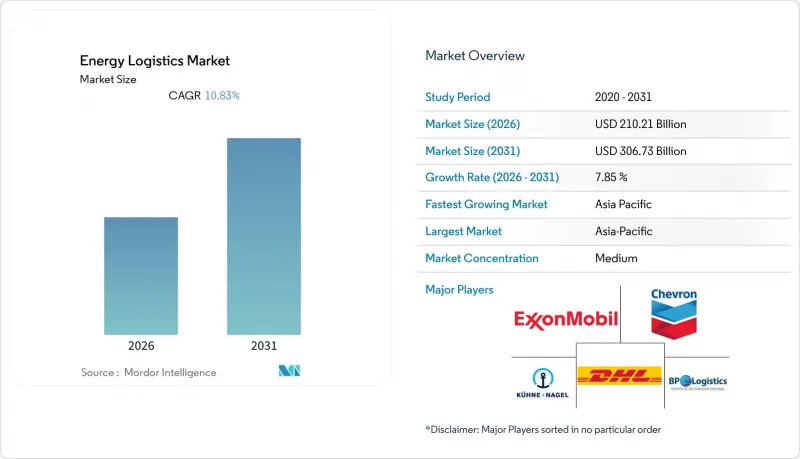
Cross-border trade in LNG, petroleum products, critical minerals, and renewable equipment continued to reshape freight planning across producing and consuming regions. This report is Segmented by Service (Transportation, Warehousing and Storage, Value-Added Services), by End-User (Oil and Gas, Power Generation and Utilities, Renewable Energy, Mining and Metals, EPC Contractors, Government and Public Infrastructure, Others), and by Geography (North America, South America, Europe, Asia-Pacific, Middle East and Africa). The Market Forecasts are Provided in Terms of Value (USD).
Global Energy Logistics Market Trends and Insights
Growth in Cross-Border Energy Trade and Energy-Security Investment
Cross-border energy trade created sustained freight requirements at export facilities and receiving infrastructure. Global LNG trade grew 6.7% in 2025, while LNG supply is forecast to expand by more than 7% by the end of 2026. North America accounted for more than 85% of incremental supply growth during 2026. North American LNG export capacity was on track to rise from 11.4 billion cubic feet per day at the start of 2024 to 28.7 billion cubic feet per day by 2029. LNG exports averaged 17.4 billion cubic feet per day in the first half of 2026, up 23% from the prior year. New export terminals required construction cargo, while import terminals required equipment procurement, transport, and storage capacity. The United States International Development Finance Corporation and I Squared Capital announced a USD 3 billion platform for LNG and petroleum products import, storage, and transport infrastructure across South and Southeast Asia.
Renewable Energy and Battery Storage Project Logistics Expansion
Renewable capacity additions increased demand for specialized transport, storage, and final-mile delivery across the energy logistics market. Renewable power capacity is projected to increase by nearly 4,600 GW between 2025 and 2030, with solar PV representing 80% of the expansion. Battery energy storage systems became a core project-cargo category because they needed hazardous-goods certification, thermal controls, and delivery timed to grid commissioning. DHL Group announced that it planned to expand New Energy logistics revenue from USD 650 million in 2025 to USD 3.3 billion by 2030. The energy logistics market, therefore, required providers to combine throughput capacity with cargo engineering. Battery systems created heavier-lift and more complex, dangerous-goods work than the solar modules they supported. Early renewable project budgets did not always fully reflect that handling complexity.
Fragmented Infrastructure and High Intermodal Transfer Costs
Fragmented infrastructure raised execution risk where remote facilities depended on several transport modes. Access routes often combined ports, roads, storage yards, river links, and local delivery capacity with uneven reliability. In African downstream networks, government price subsidies reduced margins and discouraged private investment in distribution infrastructure. The resulting gaps added logistics costs to project development and limited the ability of networks to handle greater volumes. Port, vessel, and heavy-lift bottlenecks also constrained renewable projects in Asia-Pacific, Europe, the Middle East, and Africa. In the energy logistics market, these bottlenecks delayed the movement of oversized components and reduced the usable capacity of otherwise growing project pipelines.
Other drivers and restraints analyzed in the detailed report include:
- Digital Tracking, Control Towers, and Logistics Automation
- Multimodal Infrastructure and Energy Project Development
- Complex Safety, Customs, and Environmental Compliance
For complete list of drivers and restraints, kindly check the Table Of Contents.
Segment Analysis
Transportation held 67.19% of the energy logistics market share in 2025. Its position reflected the continuous movement required by LNG trade and distributed renewable projects. Transportation covered the physical flow of cargo from ports, yards, and production sites to remote energy assets. Warehousing and storage developed alongside battery projects and LNG receiving terminals. Permanent staging facilities increasingly replaced temporary laydown areas as volumes increased. Port of Newcastle received state approval in late 2025 to stage grid-scale battery systems at its Mayfield Terminal. The port also invested USD 25 million in a berth extension for larger project-cargo vessels. These assets supported storage, consolidation, and controlled transfer before site delivery.
Value-added services recorded the highest forecast CAGR of 10.37% from 2026 to 2031 in the energy logistics market. This service group included customs brokerage, NORM waste management, health, safety, security, environment, and quality compliance, and shipment visibility. Energy operators used these services to manage regulatory requirements alongside transport execution. Integrated contracts placed transportation, staging, customs, and site delivery under one provider. This structure favored logistics companies that could coordinate the full project scope. ASCO secured a nine-figure North Sea services contract in June 2025, showing the long-duration model used in established energy relationships. The energy logistics industry benefited from such bundled contracts because they provided greater continuity than stand-alone project moves. Renewable contracts still had not replicated that level of recurring service revenue at scale.
Complete Report Scope:
- By Service
- Transportation
- Road
- Rail
- Air
- Sea and Inland Waterways
- Warehousing and Storage
- Value-added Services
- Transportation
- By End-User
- Oil and Gas
- Power Generation and Utilities
- Renewable Energy
- Mining and Metals
- EPC Contractors and Energy Equipment Manufacturers
- Government and Public Infrastructure
- Others
- By Geography
- North America
- United States
- Canada
- Mexico
- South America
- Brazil
- Argentina
- Peru
- Chile
- Rest of South America
- Europe
- Germany
- United Kingdom
- France
- Italy
- Spain
- Russia
- Nordics (Denmark, Finland, Iceland, Norway, and Sweden)
- Rest of Europe
- Asia-Pacific
- China
- India
- Japan
- South Korea
- Australia
- Southeast Asia (ASEAN)
- Rest of Asia-Pacific
- Middle East and Africa
- Saudi Arabia
- United Arab Emirates
- Qatar
- South Africa
- Nigeria
- Egypt
- Rest of Middle East and Africa
- North America
Geography Analysis
Asia-Pacific held 42.54% of revenue in 2025 and recorded the highest forecast CAGR of 9.61% from 2026 to 2031. LNG import projects, renewable developments, and cross-border energy links increased freight activity across the region. Inpex began work on the USD 21 billion Abadi LNG project in Indonesia in July 2026. Australia's July 2026 National Renewable Energy Priority List added 11 projects, including more than 4 GWh of battery storage. Asia-Pacific was estimated to account for more than 52.4% of global infrastructure investment through the forecast period, while utility-scale storage investment was projected to grow 300%. China, India, Japan, and South Korea supported demand through terminal operations and renewable project work.
North America underwent a major energy logistics transformation as LNG export capacity, pipelines, ports, and specialized carrier capacity expanded. United States LNG exports averaged 17.4 billion cubic feet per day during the first half of 2026, up 23% year-over-year. Cheniere took final investment decisions on additional trains in June 2025 and targeted a capacity of more than 60 million tonnes per annum by 2028. South America also developed as a growth area through Brazil's offshore expansion, Argentina's Vaca Muerta development, and Guyana's production base. ASCO and N.V. Dordt Gateway signed heads of terms in June 2026 for a Suriname marine-support-base venture with a 550-meter quay. The asset targeted offshore logistics demand in the Guyana-Suriname Basin.
Europe had separate logistics needs for hydrocarbons, hydrogen, offshore wind, and carbon capture during 2026. The European Hydrogen Backbone included 33 energy infrastructure operators and identified 40 pipeline projects with 31,500 kilometers of hydrogen pipelines planned for commissioning before 2030. Hydrogen imports into Germany through Amsterdam and Duisburg were technically feasible, with inland waterways, rail, trucks, and future pipelines included in the logistics design. Middle East and Africa carried a different set of risks because the Hormuz crisis constrained 20% of global LNG supply, equal to 3% of total global gas supply. The energy logistics market in these regions placed a premium on route diversification and reliable marine, road, and storage capacity.
- DHL Group
- Kuehne+Nagel
- A.P. Moller - Maersk A/S
- DSV A/S
- C.H. Robinson Worldwide, Inc.
- Expeditors International of Washington, Inc.
- CMA CGM Group (Including CEVA Logistics)
- GEODIS
- Rhenus Group
- Hellmann Worldwide Logistics
- NYK Line (Including Yusen Logistics Co., Ltd.)
- ASCO Group
- Peterson Energy Logistics
- ADNOC Logistics and Services plc
- Gulf Agency Company (GAC)
- Mammoet Group
- DP World
- deugro Group
- Fracht FWO, Inc.
- The Bertling Group
Additional Benefits:
- The market estimate (ME) sheet in Excel format
- 3 months of analyst support
TABLE OF CONTENTS
1 Introduction
- 1.1 Study Assumptions and Market Definition
- 1.2 Scope of the Study
2 Research Methodology
3 Executive Summary
4 Market Landscape
- 4.1 Market Overview
- 4.2 Market Drivers
- 4.2.1 Growth in Cross-Border Energy Trade and Energy-Security Investment
- 4.2.2 Renewable-Energy and Battery-Storage Project Logistics Expansion
- 4.2.3 Digital Tracking, Control Towers, and Logistics Automation
- 4.2.4 Multimodal Infrastructure and Energy-Project Development
- 4.2.5 Remote-Site and Offshore Supply-Chain Criticality
- 4.2.6 Specialized Logistics for Oversized, Hazardous, and Time-Critical Cargo
- 4.3 Market Restraints
- 4.3.1 Fragmented Infrastructure and High Intermodal Transfer Costs
- 4.3.2 Complex Safety, Customs, and Environmental Compliance
- 4.3.3 Port, Vessel, and Heavy-Lift Bottlenecks for Renewable Projects
- 4.3.4 Low Visibility of Scope-3 Emissions and Inconsistent Data Standards
- 4.4 Value / Supply-Chain Analysis
- 4.5 Regulatory Landscape
- 4.6 Technological Outlook
- 4.7 Porter's Five Forces Analysis
- 4.7.1 Bargaining Power of Suppliers
- 4.7.2 Bargaining Power of Buyers
- 4.7.3 Threat of New Entrants
- 4.7.4 Threat of Substitutes
- 4.7.5 Industry Rivalry
- 4.8 Impact of Geopolitical Events on the Market
5 Market Size and Growth Forecasts (Value in USD)
- 5.1 By Service
- 5.1.1 Transportation
- 5.1.1.1 Road
- 5.1.1.2 Rail
- 5.1.1.3 Air
- 5.1.1.4 Sea and Inland Waterways
- 5.1.2 Warehousing and Storage
- 5.1.3 Value-added Services
- 5.1.1 Transportation
- 5.2 By End-User
- 5.2.1 Oil and Gas
- 5.2.2 Power Generation and Utilities
- 5.2.3 Renewable Energy
- 5.2.4 Mining and Metals
- 5.2.5 EPC Contractors and Energy Equipment Manufacturers
- 5.2.6 Government and Public Infrastructure
- 5.2.7 Others
- 5.3 By Geography
- 5.3.1 North America
- 5.3.1.1 United States
- 5.3.1.2 Canada
- 5.3.1.3 Mexico
- 5.3.2 South America
- 5.3.2.1 Brazil
- 5.3.2.2 Argentina
- 5.3.2.3 Peru
- 5.3.2.4 Chile
- 5.3.2.5 Rest of South America
- 5.3.3 Europe
- 5.3.3.1 Germany
- 5.3.3.2 United Kingdom
- 5.3.3.3 France
- 5.3.3.4 Italy
- 5.3.3.5 Spain
- 5.3.3.6 Russia
- 5.3.3.7 Nordics (Denmark, Finland, Iceland, Norway, and Sweden)
- 5.3.3.8 Rest of Europe
- 5.3.4 Asia-Pacific
- 5.3.4.1 China
- 5.3.4.2 India
- 5.3.4.3 Japan
- 5.3.4.4 South Korea
- 5.3.4.5 Australia
- 5.3.4.6 Southeast Asia (ASEAN)
- 5.3.4.7 Rest of Asia-Pacific
- 5.3.5 Middle East and Africa
- 5.3.5.1 Saudi Arabia
- 5.3.5.2 United Arab Emirates
- 5.3.5.3 Qatar
- 5.3.5.4 South Africa
- 5.3.5.5 Nigeria
- 5.3.5.6 Egypt
- 5.3.5.7 Rest of Middle East and Africa
- 5.3.1 North America
6 Competitive Landscape
- 6.1 Market Concentration
- 6.2 Key Strategic Moves
- 6.3 Market Share Analysis
- 6.4 Company Profiles (includes Global Level Overview, Market Level Overview, Core Segments, Financials as available, Strategic Information, Geographic Coverage, Products and Services, Recent Developments)
- 6.4.1 DHL Group
- 6.4.2 Kuehne+Nagel
- 6.4.3 A.P. Moller - Maersk A/S
- 6.4.4 DSV A/S
- 6.4.5 C.H. Robinson Worldwide, Inc.
- 6.4.6 Expeditors International of Washington, Inc.
- 6.4.7 CMA CGM Group (Including CEVA Logistics)
- 6.4.8 GEODIS
- 6.4.9 Rhenus Group
- 6.4.10 Hellmann Worldwide Logistics
- 6.4.11 NYK Line (Including Yusen Logistics Co., Ltd.)
- 6.4.12 ASCO Group
- 6.4.13 Peterson Energy Logistics
- 6.4.14 ADNOC Logistics and Services plc
- 6.4.15 Gulf Agency Company (GAC)
- 6.4.16 Mammoet Group
- 6.4.17 DP World
- 6.4.18 deugro Group
- 6.4.19 Fracht FWO, Inc.
- 6.4.20 The Bertling Group
7 Market Opportunities and Future Outlook
- 7.1 White-Space and Unmet-Need Assessment

