PUBLISHER: Mordor Intelligence | PRODUCT CODE: 2154960

PUBLISHER: Mordor Intelligence | PRODUCT CODE: 2154960
South America Aseptic Packaging - Market Share Analysis, Industry Trends & Statistics, Growth Forecasts (2026 - 2031)
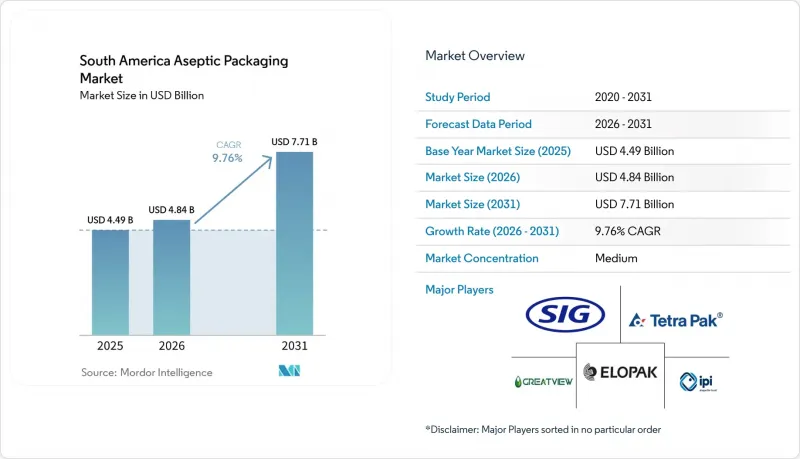
According to Mordor Intelligence, the South America aseptic packaging market size is projected to expand from USD 4.49 billion in 2025 to USD 4.84 billion in 2026, and to USD 7.71 billion by 2031, registering a CAGR of 9.76% between 2026 and 2031.
South America Aseptic Packaging Market Trends and Insights
Expansion of Shelf-Stable Dairy and Beverage Distribution
Dairy and beverage producers continued to invest in UHT processing and aseptic filling during 2024 and 2025. Shelf-stable distribution reduces the need for refrigerated storage at retail and foodservice locations. This is important in Brazil's interior and the Andean region, where refrigeration coverage is less reliable. The South America aseptic packaging market benefits when producers can serve dispersed retail corridors with fewer refrigerated assets. SIG reported broad-based regional performance in 2025, including new filling lines in Brazil, higher volumes from Colombian customers, and expanded dairy and beverage activity in Chile. This ongoing equipment activity supports the South America aseptic packaging market by expanding capacity for ambient products.
Growth of Convenient, Functional, and Plant-Based Beverages
Functional, protein-enhanced, and plant-based beverages need containers that maintain product quality during ambient storage. These products suit aseptic pouches and single-serve packs because they can be distributed through retail channels with limited chilled capacity. Kerry reported that 86% of South American consumers preferred hybrid protein formulations that combine plant and animal proteins. The development of smaller product batches also increases demand for equipment capable of changing formats quickly. This places the South America aseptic packaging market closer to fast-moving beverage launches than conventional high-volume carton production. It supports the use of spouted pouches for protein drinks, yogurt, fruit puree, and other portable products.
High Capital Intensity of Sterile Filling Systems
Food-grade aseptic filling lines can require investments above USD 5 million per line. Pharmaceutical-grade systems can cost USD 20 million or more due to stricter sterility and validation requirements. Small converters can struggle to justify this investment when volumes in plant-based drinks, functional beverages, or ophthalmic solutions remain limited. Sterile product manufacturers must also pay for audits, process validation, and environmental monitoring. Colombia's INVIMA provides technical guidance on the validation of aseptic filling processes, reinforcing the detailed controls required for these installations. The result is a smaller group of well-capitalized facilities, especially in Brazil and Argentina, capable of offering pharmaceutical contract filling.
Other drivers and restraints analyzed in the detailed report include:
- Rising Packaged Food and Ready-to-Eat Consumption
- Expansion of Pharmaceutical and Ophthalmic Aseptic Filling
- Limited Recycling Capacity for Multilayer Packs
For complete list of drivers and restraints, kindly check the Table Of Contents.
Segment Analysis
Cartons held 52.43% of regional aseptic packaging revenue in 2025. Their position reflects the large UHT dairy and ambient juice base in Brazil, Argentina, and Colombia. High-speed carton lines are widely installed at leading regional food and beverage producers. The format provides low unit costs for large-volume, price-sensitive products. Tetra Pak and SIG continue to improve carton systems with paper-based barriers and traceability features. These upgrades help carton users extend existing filling assets rather than replace them. Cartons also remain familiar to consumers buying milk, juice, and shelf-stable dairy products.
Bags and pouches are projected to expand at a 10.74% CAGR through 2031. Their lower weight and efficient shape can reduce freight costs compared with rigid formats. Spouted versions are well-suited to protein drinks, yogurt, fruit purees, and other products consumed away from home. SIG reported rising pouch activity in South America for fruit puree, yogurt, and dairy products. The South America aseptic packaging market is using these formats where convenience and transport efficiency matter more than the throughput advantages of cartons. Bottles support premium ready-to-drink beverages and pharmaceutical liquid dosing, while cans remain a smaller option for specialty coffee and nutritional drinks. Vials and ampoules remain important for sterile injectables, with plastic blow-fill-seal formats qualifying unit-dose ophthalmic and parenteral applications.
Paper and paperboard accounted for 56.82% of the South America aseptic packaging market size in 2025. Liquid packaging board supply chains connect global and regional fiber producers with filling sites across Brazil and Argentina. Paperboard is cost-effective for high-volume cartons and provides a renewable-material proposition for food and beverage brands. Its installed base also supports established purchasing, converting, and filling relationships. Paperboard remains central to milk and juice cartons because it provides stiffness and printability. These characteristics keep it relevant even as the material mix changes.
Composite laminates are expected to register a 10.78% CAGR through 2031. These structures combine barrier performance with lower material weight and can support flexible aseptic formats. Tetra Pak launched a 1-liter aseptic carton with a paper-based barrier in April 2026. The company said the design raises paper content to 80% and can reduce carbon footprint by up to 43%. Tetra Pak also invested EUR 60 million (USD 67.8 million) in a pilot plant for paper-based barrier technology in January 2026. Plastics remain necessary as barrier layers and for blow-fill-seal containers. Glass maintains a niche in pharmaceuticals because of its inertness and established regulatory acceptance, while metal remains limited to specialty beverage and industrial uses.
Complete Report Scope:
- By Product
- Cartons
- Bottles
- Cans
- Bags and Pouches
- Vials and Ampoules
- By Material
- Paper and Paperboard
- Plastics
- Glass
- Metal
- Composite Laminates
- By Application
- Beverages
- Readyto-Drink (RTD) Beverages
- Dairy-Based Beverages
- Food
- Processed Food and Soups
- Fruits and Vegetables
- Dairy Food
- Pharmaceutical and Healthcare
- Personal Care and Cosmetics
- Beverages
- By Filling Technology
- Form-Fill Seal (FFS)
- Blow-Fill Seal (BFS)
- Injection Aseptic Filling
- Rotary Aseptic Filling
- By Geography
- Brazil
- Argentina
- Colombia
- Rest of South America
List of Companies Covered in this Report:
- Tetra Pak International S.A.
- SIG Group AG
- Elopak ASA
- Greatview Aseptic Packaging Co., Ltd.
- Liquibox Corporation
- Lamipak International Sdn. Bhd.
- Ecolean AB
- IPI S.r.l.
- Goglio S.p.A.
- Gerresheimer AG
- Uflex Limited
- Amcor plc
- Mondi plc
- Smurfit Westrock plc
- Stora Enso Oyj
- Huhtamaki Oyj
- Sonoco Products Company
- Klabin S.A.
- ProAmpac Holdings Inc.
- Evergreen Packaging LLC
Additional Benefits:
- The market estimate (ME) sheet in Excel format
- 3 months of analyst support
TABLE OF CONTENTS
1 INTRODUCTION
- 1.1 Study Assumptions and Market Definition
- 1.2 Scope of the Study
2 RESEARCH METHODOLOGY
3 EXECUTIVE SUMMARY
4 MARKET LANDSCAPE
- 4.1 Market Overview
- 4.2 Market Drivers
- 4.2.1 Expansion of Shelf-Stable Dairy and Beverage Distribution
- 4.2.2 Growth of Convenient, Functional and Plant-Based Beverages
- 4.2.3 Rising Packaged Food and Ready-to-Eat Consumption
- 4.2.4 Expansion of Pharmaceutical and Ophthalmic Aseptic Filling
- 4.2.5 Lower Cold-Chain Dependence in Remote Retail Corridors
- 4.2.6 Localized Recycling Infrastructure Enabling Mono-Material Conversion
- 4.3 Market Restraints
- 4.3.1 High Capital Intensity of Sterile Filling Systems
- 4.3.2 Limited Recycling Capacity for Multilayer Packs
- 4.3.3 Volatile Resin, Aluminum Foil and Paperboard Input Costs
- 4.3.4 Fragmented Extended-Producer-Responsibility Execution
- 4.4 Impact of Macroeconomic Factors on the Market
- 4.5 Industry Value Chain Analysis
- 4.6 Regulatory Landscape
- 4.7 Technological Outlook
- 4.8 Porter's Five Forces Analysis
- 4.8.1 Bargaining Power of Suppliers
- 4.8.2 Bargaining Power of Buyers
- 4.8.3 Threat of New Entrants
- 4.8.4 Threat of Substitutes
- 4.8.5 Competitive Rivalry
5 MARKET SIZE AND GROWTH FORECASTS (VALUE)
- 5.1 By Product
- 5.1.1 Cartons
- 5.1.2 Bottles
- 5.1.3 Cans
- 5.1.4 Bags and Pouches
- 5.1.5 Vials and Ampoules
- 5.2 By Material
- 5.2.1 Paper and Paperboard
- 5.2.2 Plastics
- 5.2.3 Glass
- 5.2.4 Metal
- 5.2.5 Composite Laminates
- 5.3 By Application
- 5.3.1 Beverages
- 5.3.1.1 Readyto-Drink (RTD) Beverages
- 5.3.1.2 Dairy-Based Beverages
- 5.3.2 Food
- 5.3.2.1 Processed Food and Soups
- 5.3.2.2 Fruits and Vegetables
- 5.3.2.3 Dairy Food
- 5.3.3 Pharmaceutical and Healthcare
- 5.3.4 Personal Care and Cosmetics
- 5.3.1 Beverages
- 5.4 By Filling Technology
- 5.4.1 Form-Fill Seal (FFS)
- 5.4.2 Blow-Fill Seal (BFS)
- 5.4.3 Injection Aseptic Filling
- 5.4.4 Rotary Aseptic Filling
- 5.5 By Geography
- 5.5.1 Brazil
- 5.5.2 Argentina
- 5.5.3 Colombia
- 5.5.4 Rest of South America
6 Competitive Landscape
- 6.1 Market Concentration
- 6.2 Strategic Moves
- 6.3 Market Share Analysis
- 6.4 Company Profiles (includes Global Level Overview, Market Level Overview, Core Segments, Financials as available, Strategic Information, Market Rank/Share, Products and Services, Recent Developments)
- 6.4.1 Tetra Pak International S.A.
- 6.4.2 SIG Group AG
- 6.4.3 Elopak ASA
- 6.4.4 Greatview Aseptic Packaging Co., Ltd.
- 6.4.5 Liquibox Corporation
- 6.4.6 Lamipak International Sdn. Bhd.
- 6.4.7 Ecolean AB
- 6.4.8 IPI S.r.l.
- 6.4.9 Goglio S.p.A.
- 6.4.10 Gerresheimer AG
- 6.4.11 Uflex Limited
- 6.4.12 Amcor plc
- 6.4.13 Mondi plc
- 6.4.14 Smurfit Westrock plc
- 6.4.15 Stora Enso Oyj
- 6.4.16 Huhtamaki Oyj
- 6.4.17 Sonoco Products Company
- 6.4.18 Klabin S.A.
- 6.4.19 ProAmpac Holdings Inc.
- 6.4.20 Evergreen Packaging LLC
7 Market Opportunities and Future Outlook
- 7.1 White-Space and Unmet-Need Assessment

