PUBLISHER: Mordor Intelligence | PRODUCT CODE: 2154973

PUBLISHER: Mordor Intelligence | PRODUCT CODE: 2154973
Europe Net-Zero Energy Buildings - Market Share Analysis, Industry Trends & Statistics, Growth Forecasts (2026 - 2031)
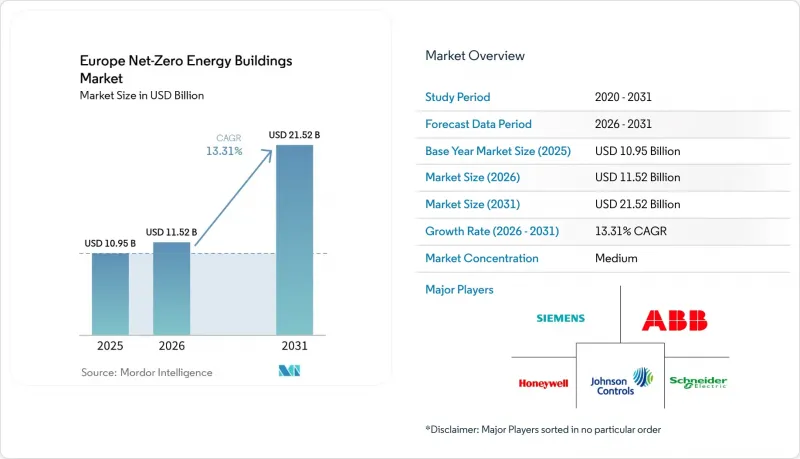
According to Mordor Intelligence, the Europe Net-Zero energy buildings market size is projected to be USD 10.95 billion in 2025, USD 11.52 billion in 2026, and reach USD 21.52 billion by 2031, growing at a CAGR of 13.31% from 2026 to 2031.
Europe Net-Zero Energy Buildings Market Trends and Insights
Revised EPBD and Zero-Emission Building Deadlines Accelerate Adoption
The recast EPBD entered into force on May 28, 2024, and required national transposition by May 29, 2026. This deadline is creating a clearer project pipeline for providers of design, energy management, commissioning, and certification services. All new public buildings must be zero-emission buildings from January 1, 2028. All new buildings must meet the same standard as of January 1, 2030. The standard requires very high energy performance and no on-site fossil-fuel carbon emissions. Germany's proposed Building Modernization Act closely adopts the EPBD definition, and a June 2026 study described the transition's legal structure.
Renovation Wave Funding Drives Deep Energy Retrofit Activity
The Europe net-zero energy buildings market is supported by public renovation funding, although funding alone does not close the delivery gap. The Recovery and Resilience Facility provided more than EUR 80 billion (USD 88 billion), and Cohesion Policy Funds provided EUR 17 billion (USD 18.7 billion) to improve energy performance between 2021 and 2027. The European Commission also identified annual investment needs of more than EUR 242 billion (USD 266.2 billion) for buildings through 2030. France's state spending on building energy renovation reached EUR 7.9 billion (USD 8.7 billion) in 2025. Germany's residential renovation rate was 0.7% in 2025, compared with the 2% rate needed for climate goals. France and the Nordic countries have delivery systems better positioned to absorb a near-term increase in deep retrofit work.
High Upfront Capital Costs and Long Payback Periods Limit Adoption
Whole-building renovation can require EUR 300 to EUR 500 per square meter (USD 330 to USD 550 per square meter), extending payback periods beyond many owners' planning horizons. The pressure is most acute for owner-occupied and fragmented residential stock. Residential energy renovation investment in France fell 22% in real terms between 2022 and 2024 after changes to the MaPrimeRenov subsidy structure. Renovate Europe has called for a dedicated EU Renovation Loan Facility to support guarantees for low-interest renovation loans. The campaign noted that owner-occupied homes account for 70% of EU residences and remain poorly served by existing financial products. Without standard financing products, suppliers have less certainty to invest in installation capacity.
Other drivers and restraints analyzed in the detailed report include:
- Energy Cost Volatility Increases Demand For Building Energy Resilience
- Green Finance and ESG Reporting Support Net-Zero Building Investments
- Shortage of Building Physics and Retrofit Professionals Delays Projects
For complete list of drivers and restraints, kindly check the Table Of Contents.
Segment Analysis
Commercial buildings held 44.6% of the Europe net-zero energy buildings market share in 2025. Corporate sustainability obligations and investor reporting requirements have increased the urgency of upgrades in non-residential property. Office and retail portfolios in Germany, France, and the United Kingdom face significant compliance exposure because of their large floor areas. The EPBD requires member states to address the worst-performing 16% of non-residential buildings by 2030. Residential properties offer a large opportunity, but fragmented ownership and financing constraints slow decision-making. Serial renovation using prefabricated facade panels is emerging as a way to reduce time on site and lower delivery costs.
Institutional buildings are forecast to grow at a 14.2% CAGR from 2026 to 2031. Hospitals, universities, and public portfolios must manage large, operationally complex assets within defined deadlines. The January 1, 2028, public-building deadline gives these owners a shorter decision window than private-sector owners. Johnson Controls reported energy savings of up to 80% at Aalborg University Hospital in Denmark through an integrated retrofit approach. These projects favor suppliers that can combine design, project management, commissioning, and building energy management systems. Industrial buildings remain the smallest of the 4 building types, although decarbonization plans are supporting activity in Central European manufacturing facilities.
Complete Report Scope:
- By Building Type
- Residential
- Commercial
- Institutional
- Industrial
- By Offerings
- Solutions (New Net-Zero Energy Building Development, Net-Zero Building Retrofit, Integrated Design & Delivery and Smart Net-Zero Building Solutions)
- Services (Architectural & Engineering Design, Construction Services, Commissioning & Certification Services and Consulting Services)
- By Construction Type
- New Construction
- Renovation
- By Geography
- United Kingdom
- Germany
- France
- Italy
- Spain
- Rest of Europe
List of Companies Covered in this Report:
- Siemens AG
- Schneider Electric SE
- Johnson Controls International plc
- ABB Ltd.
- Honeywell International Inc.
- Daikin Industries, Ltd.
- Carrier Global Corporation
- Trane Technologies plc
- Saint-Gobain S.A.
- Kingspan Group plc
- ROCKWOOL A/S
- Bosch Building Technologies
- Legrand SA
- Mitsubishi Electric Corporation
- Eaton Corporation plc
- Skanska AB
- VINCI Construction
- Bouygues Construction
- WSP Global Inc.
- Belimo Holding AG
Additional Benefits:
- The market estimate (ME) sheet in Excel format
- 3 months of analyst support
TABLE OF CONTENTS
1 Introduction
- 1.1 Study Assumptions and Market Definition
- 1.2 Scope of the Study
2 Research Methodology
3 Executive Summary
4 Market Landscape
- 4.1 Market Overview
- 4.2 Market Drivers
- 4.2.1 Revised EPBD and Zero-Emission Building Deadlines Accelerate Adoption
- 4.2.2 Renovation Wave Funding Drives Deep Energy Retrofit Activity
- 4.2.3 Energy Cost Volatility Increases Demand For Building Energy Resilience
- 4.2.4 Green Finance and ESG Reporting Support Net-Zero Building Investments
- 4.2.5 Grid-Interactive Buildings Generate Demand Response Revenue Opportunities
- 4.2.6 Verified Energy Performance Increases Green Building Rental Premiums
- 4.3 Market Restraints
- 4.3.1 High Upfront Capital Costs and Long Payback Periods Limit Adoption
- 4.3.2 Shortage Of Building Physics and Retrofit Professionals Delays Projects
- 4.3.3 Legacy System Integration Challenges Increase Performance Gap Risks
- 4.3.4 Cybersecurity, Data Governance, and Interoperability Risks Hinder Smart Building Deployment
- 4.4 Value and Supply-Chain Analysis
- 4.5 Regulatory Landscape
- 4.6 Technological Outlook
- 4.7 Market Evolution and Adoption Trends
- 4.8 Key Net-Zero Energy Building Projects
- 4.9 Porter's Five Forces Analysis
- 4.9.1 Bargaining Power of Suppliers
- 4.9.2 Bargaining Power of Consumers
- 4.9.3 Threat of New Entrants
- 4.9.4 Threat of Substitutes
- 4.9.5 Intensity of Competitive Rivalry
5 Market Size & Growth Forecasts (Value, USD)
- 5.1 By Building Type
- 5.1.1 Residential
- 5.1.2 Commercial
- 5.1.3 Institutional
- 5.1.4 Industrial
- 5.2 By Offerings
- 5.2.1 Solutions (New Net-Zero Energy Building Development, Net-Zero Building Retrofit, Integrated Design & Delivery and Smart Net-Zero Building Solutions)
- 5.2.2 Services (Architectural & Engineering Design, Construction Services, Commissioning & Certification Services and Consulting Services)
- 5.3 By Construction Type
- 5.3.1 New Construction
- 5.3.2 Renovation
- 5.4 By Geography
- 5.4.1 United Kingdom
- 5.4.2 Germany
- 5.4.3 France
- 5.4.4 Italy
- 5.4.5 Spain
- 5.4.6 Rest of Europe
6 Competitive Landscape
- 6.1 Market Concentration
- 6.2 Strategic Moves
- 6.3 Market Share Analysis
- 6.4 Company Profiles (Includes Global Level Overview, Market Level Overview, Core Segments, Financials as Available, Strategic Information, Products & Services, and Recent Developments)
- 6.4.1 Siemens AG
- 6.4.2 Schneider Electric SE
- 6.4.3 Johnson Controls International plc
- 6.4.4 ABB Ltd.
- 6.4.5 Honeywell International Inc.
- 6.4.6 Daikin Industries, Ltd.
- 6.4.7 Carrier Global Corporation
- 6.4.8 Trane Technologies plc
- 6.4.9 Saint-Gobain S.A.
- 6.4.10 Kingspan Group plc
- 6.4.11 ROCKWOOL A/S
- 6.4.12 Bosch Building Technologies
- 6.4.13 Legrand SA
- 6.4.14 Mitsubishi Electric Corporation
- 6.4.15 Eaton Corporation plc
- 6.4.16 Skanska AB
- 6.4.17 VINCI Construction
- 6.4.18 Bouygues Construction
- 6.4.19 WSP Global Inc.
- 6.4.20 Belimo Holding AG
7 Market Opportunities & Future Outlook
- 7.1 White-Space and Unmet-Need Assessment

