PUBLISHER: Mordor Intelligence | PRODUCT CODE: 2154981

PUBLISHER: Mordor Intelligence | PRODUCT CODE: 2154981
South America 5G Technology - Market Share Analysis, Industry Trends & Statistics, Growth Forecasts (2026 - 2031)
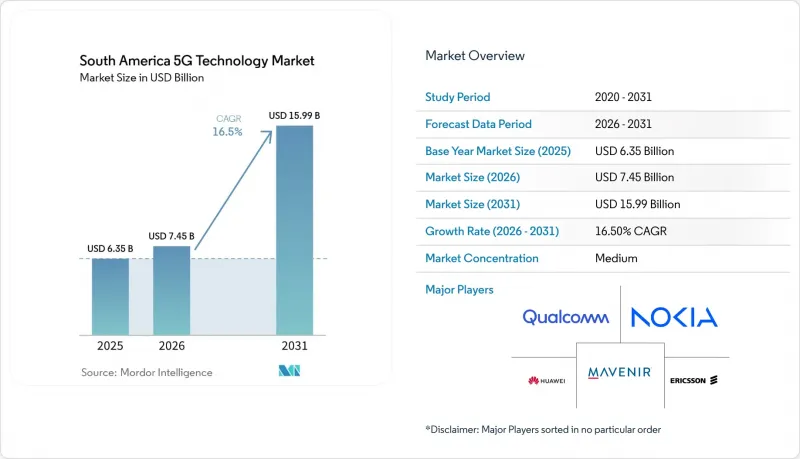
According to Mordor Intelligence, the South America 5G technology market size is projected to be USD 6.35 billion in 2025, USD 7.45 billion in 2026, and reach USD 15.99 billion by 2031, growing at a CAGR of 16.50% from 2026 to 2031.
South America 5G Technology Market Trends and Insights
Rising 5G Rollout Across Major South American Economies
Brazil's spectrum obligations have made 5G rollout a phased statutory requirement for operators, connecting license conditions to deployment deadlines and making network extension a formal part of the operating environment. Anatel requires service in 30% of municipalities below 30,000 residents by December 2026. The requirement rises to universal coverage by 2029. 5G had reached 1,966 municipalities by early 2026. The Ministry of Communications expects service to be available in more than 2,220 cities by the end of 2026. TIM Brasil approved Huawei and Nokia supply contracts for more than 6,500 4G and 5G sites during January 2026. These obligations support demand for radio access networks and fixed wireless access in locations with limited commercial appeal, while giving suppliers clearer timing for equipment deliveries, installation work, and service contracts.
Expanding Enterprise Demand for Low-Latency Connectivity
Enterprise deployment is moving from trials toward operational networks in mining, ports, energy, and manufacturing, where the commercial case rests on better monitoring, more dependable communications, automation, and site-specific network control. Nokia expanded its TIM Brasil partnership across 14 additional states in March 2026. The coverage reaches 42% of Brazil's population. The program supports network slicing, image analysis, voice recognition, and autonomous operations. Nokia uses Habrok Massive MIMO radios and NVIDIA AI-RAN computing in the deployment. Vale, Petrobras, Gerdau, AXIA Energia, and Flex have commissioned private networks in Brazil. Their activity makes private wireless connectivity a planned capital investment rather than an experimental technology. This demand gives the South America 5G technology market a path to recurring enterprise revenue, since industrial customers require deployment support, ongoing optimization, secure operations, and connectivity tailored to specific sites.
Uneven Spectrum Availability and Auction Complexity
South American spectrum rules create different rollout conditions across national markets, so equipment suppliers and operators face different auction schedules, licensing terms, spectrum availability, and technical conditions from one country to another. Brazil and Chile have moved earlier, while other countries remain at earlier stages. Chile was conducting a consultation on the remaining 3.5 GHz allocations in early 2026. Brazil also opened a public consultation on the 6 GHz band. These processes extend the period between spectrum planning and physical deployment. Each delay can postpone the availability of devices and enterprise service launches. Argentina, Peru, Ecuador, and Bolivia also apply different technical and procedural requirements. Vendors, therefore, need country-specific compliance work instead of standardized regional designs, which can slow procurement, complicate project planning, and limit the immediate benefits of a region-wide equipment approach.
Other drivers and restraints analyzed in the detailed report include:
- Growth in Fixed Wireless Access for Broadband-Underserved Areas
- Telecom Virtualization and Cloud-Native Core Modernization
- Elevated Rural Backhaul and Fiber Deployment Costs
For complete list of drivers and restraints, kindly check the Table Of Contents.
Segment Analysis
Hardware accounted for 50.35% of the South America 5G technology market in 2025, reflecting the early rollout stage, when operators needed large volumes of radio equipment before service and software revenues could become more prominent. The first deployment phase required base stations, antennas, and radio units at scale, with coverage programs demanding physical infrastructure before operators can offer more advanced service capabilities. Brazilian coverage obligations sustained this equipment requirement. Argentina's early deployment program also supported demand for hardware. Software is becoming increasingly important as operators modernize OSS/BSS systems, because newer networks require coordinated provisioning, customer support, billing processes, and service assurance across multiple technology layers. Cloud-native network functions also require software investment. Nokia's MantaRay SON supports automated network management. The component mix is therefore moving beyond radio equipment alone, as operators need systems that coordinate provisioning, service assurance, automation, and core-network functions alongside physical infrastructure.
Services are projected to expand at an 18.35% CAGR from 2026 to 2031. Operators need specialist support for deployment, optimization, and managed operations. Nokia's TIM Brasil agreement includes AirScale installation and MantaRay SON automation services. It also includes enterprise solution development across 14 Brazilian states. Stand-alone networks require SIM migration and core configuration work. They also require radio-to-core latency optimization. Open RAN can make hardware interfaces more interchangeable. Service delivery and software integration, therefore, become more important to contract value, since customers need compatible systems, operational continuity, and technical support after the initial network installation is completed.
Sub-6 GHz accounted for 68.90% of the South America 5G technology market in 2025, underscoring the priority given to coverage and usable propagation across a region where commercial and geographic conditions vary widely. The band provides useful coverage in dense cities and rural areas. This suits South America's varied geography, which includes dense metropolitan areas, distant municipalities, rural communities, mountainous territory, and industrial locations with very different coverage needs. Brazil assigned 3.5 GHz spectrum nationally in its 2021 auction. Claro, Vivo, and TIM received national allocations. Anatel also awarded 700 MHz lots during May 2026. The awards included investment obligations for underserved locations and federal highways. This layered spectrum approach supports coverage before higher-capacity overlays become widespread, allowing operators to extend service beyond central urban areas while planning additional capacity for dense locations.
Hybrid configurations are projected to expand at an 18.80% CAGR from 2026 to 2031. Operators combine sub-6 GHz macro coverage with mmWave capacity in dense settings. Stadiums and enterprise locations are early use cases for mmWave, where large numbers of users or data-intensive industrial functions can justify focused capacity investment and specialized network design. More than 150 commercial mmWave-capable devices were available by June 2025. The total was 21 at the end of 2019. The GSMA estimates that each market will need 2 GHz of mid-band spectrum by 2030. Chile, Argentina, and Peru therefore face longer-term capacity constraints. Hybrid networks provide a practical way to match coverage and concentrated traffic demand, because each spectrum layer can be used where its propagation and capacity characteristics are most useful.
Complete Report Scope:
- By Component
- Hardware
- Software
- Services
- By Spectrum Band
- Sub-6 GHz
- mmWave
- Hybrid (Sub-6 GHz and mmWave)
- By Application
- Enhanced Mobile Broadband (eMBB)
- Fixed Wireless Access (FWA)
- Massive Machine-Type Communications (mMTC)
- Ultra-Reliable Low-Latency Communications (URLLC)
- By End-User Industry
- Consumer
- Manufacturing
- Healthcare
- Automotive
- Energy and Utilities
- Media and Entertainment
- Public Safety and Defense
- By Network Architecture
- Stand-Alone (SA)
- Non-Stand-Alone (NSA)
- By Country
- Brazil
- Argentina
- Rest of South America
List of Companies Covered in this Report:
- Huawei Technologies Co., Ltd.
- Telefonaktiebolaget LM Ericsson (Ericsson)
- Nokia Corporation
- Qualcomm Incorporated
- Samsung Electronics Co., Ltd.
- ZTE Corporation
- Intel Corporation
- MediaTek Inc.
- Cisco Systems, Inc.
- NEC Corporation
- CommScope Holding Company, Inc.
- Apple Inc.
- Skyworks Solutions, Inc.
- Analog Devices, Inc.
- Juniper Networks, Inc.
- Mavenir plc
- Parallel Wireless, Inc.
- America Movil, S.A.B. de C.V.
- Telefonica Brasil S.A.
Additional Benefits:
- The market estimate (ME) sheet in Excel format
- 3 months of analyst support
TABLE OF CONTENTS
1 INTRODUCTION
- 1.1 Study Assumptions and Market Definition
- 1.2 Scope of the Study
2 RESEARCH METHODOLOGY
3 EXECUTIVE SUMMARY
4 MARKET LANDSCAPE
- 4.1 Market Overview
- 4.2 Market Drivers
- 4.2.1 Rising 5G Network Rollout Across Major South American Economies
- 4.2.2 Expanding Enterprise Demand for Low-Latency Connectivity
- 4.2.3 Growth in Fixed Wireless Access for Broadband Underserved Areas
- 4.2.4 Telecom Virtualization and Cloud-Native Core Modernization
- 4.2.5 Private 5G Adoption in Mining, Ports, and Industrial Corridors
- 4.2.6 Spectrum Refarming and New Auction Programs Supporting Capacity Expansion
- 4.3 Market Restraints
- 4.3.1 Uneven Spectrum Availability and High Auction Complexity
- 4.3.2 Elevated Rural Backhaul and Fiber Deployment Costs
- 4.3.3 Macroeconomic Pressure on Operator Capex and Device Affordability
- 4.3.4 Slow Monetization Beyond Consumer Mobile Broadband
- 4.4 5G Timeline and Evolution
- 4.5 Current Adoption Cycle (Forerunners, Adopters, and Laggards)
- 4.6 Industry Value Chain Analysis
- 4.7 Regulatory and Policy Landscape
- 4.8 Technological Outlook
- 4.9 Porter's Five Forces Analysis
- 4.9.1 Threat of New Entrants
- 4.9.2 Bargaining Power of Suppliers
- 4.9.3 Bargaining Power of Buyers
- 4.9.4 Threat of Substitutes
- 4.9.5 Competitive Rivalry
- 4.10 5G and Beyond (6G Pathways)
- 4.11 Impact of Macroeconomic Factors on the Market
5 MARKET SIZE AND GROWTH FORECASTS (VALUE)
- 5.1 By Component
- 5.1.1 Hardware
- 5.1.2 Software
- 5.1.3 Services
- 5.2 By Spectrum Band
- 5.2.1 Sub-6 GHz
- 5.2.2 mmWave
- 5.2.3 Hybrid (Sub-6 GHz and mmWave)
- 5.3 By Application
- 5.3.1 Enhanced Mobile Broadband (eMBB)
- 5.3.2 Fixed Wireless Access (FWA)
- 5.3.3 Massive Machine-Type Communications (mMTC)
- 5.3.4 Ultra-Reliable Low-Latency Communications (URLLC)
- 5.4 By End-User Industry
- 5.4.1 Consumer
- 5.4.2 Manufacturing
- 5.4.3 Healthcare
- 5.4.4 Automotive
- 5.4.5 Energy and Utilities
- 5.4.6 Media and Entertainment
- 5.4.7 Public Safety and Defense
- 5.5 By Network Architecture
- 5.5.1 Stand-Alone (SA)
- 5.5.2 Non-Stand-Alone (NSA)
- 5.6 By Country
- 5.6.1 Brazil
- 5.6.2 Argentina
- 5.6.3 Rest of South America
6 COMPETITIVE LANDSCAPE
- 6.1 Market Concentration
- 6.2 Strategic Moves
- 6.3 Market Share Analysis
- 6.4 Company Profiles (includes Global Level Overview, Market Level Overview, Core Segments, Financials as Available, Strategic Information, Market Rank/Share, Products and Services, Recent Developments)
- 6.4.1 Huawei Technologies Co., Ltd.
- 6.4.2 Telefonaktiebolaget LM Ericsson (Ericsson)
- 6.4.3 Nokia Corporation
- 6.4.4 Qualcomm Incorporated
- 6.4.5 Samsung Electronics Co., Ltd.
- 6.4.6 ZTE Corporation
- 6.4.7 Intel Corporation
- 6.4.8 MediaTek Inc.
- 6.4.9 Cisco Systems, Inc.
- 6.4.10 NEC Corporation
- 6.4.11 CommScope Holding Company, Inc.
- 6.4.12 Apple Inc.
- 6.4.13 Skyworks Solutions, Inc.
- 6.4.14 Analog Devices, Inc.
- 6.4.15 Juniper Networks, Inc.
- 6.4.16 Mavenir plc
- 6.4.17 Parallel Wireless, Inc.
- 6.4.18 America Movil, S.A.B. de C.V.
- 6.4.19 Telefonica Brasil S.A.
7 MARKET OPPORTUNITIES AND FUTURE OUTLOOK
- 7.1 White-Space and Unmet-Need Assessment

