PUBLISHER: Mordor Intelligence | PRODUCT CODE: 2155603

PUBLISHER: Mordor Intelligence | PRODUCT CODE: 2155603
Middle East 5G Technology - Market Share Analysis, Industry Trends & Statistics, Growth Forecasts (2026 - 2031)
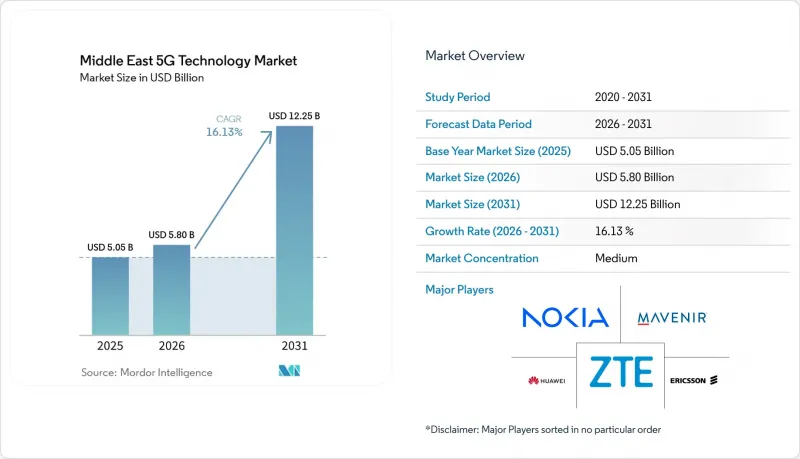
According to Mordor Intelligence, the Middle East 5G technology market size is expected to increase from USD 5.05 billion in 2025 to USD 5.80 billion in 2026 and reach USD 12.25 billion by 2031, growing at a CAGR of 16.13% over 2026-2031.
Middle East 5G Technology Market Trends and Insights
Government-Led 5G Programs and Spectrum Roadmaps Drive Deployment at Scale
National policy is a central force behind the Middle East 5G Technology market. Government roadmaps turn broad digital goals into spectrum allocations, coverage obligations, and incentives for operators. Saudi Arabia's National Spectrum Strategy 2025 prioritized 5G+ deployment and authorized private networks for manufacturing, logistics, and smart-city uses. The strategy was supported by USD 15 billion in 5G infrastructure investment under Vision 2030. Turkey's 2025 auction allocated 400 MHz across the 700 MHz and 3.5 GHz bands, giving operators the spectrum base for a national launch. Large public procurement programs can reduce uncertainty for major suppliers, but they can also concentrate contracts among a small group of vendors.
Enterprise Digitalization Across Energy, Logistics, and Public Services Reshapes Revenue Mix
Enterprise demand is directing the Middle East 5G Technology market toward managed connectivity and integrated digital services. Energy sites, ports, utilities, and public services need dependable networks that connect equipment, people, and operational systems. GSMA reported that enterprises in the region were advancing the adoption of AI, big data, private 5G, and edge computing. The UAE's Operation 300bn program identifies advanced technology as part of its industrial development agenda through 2031. Automotive, utilities, and logistics activities have clear needs for connected monitoring and control. Operators that add integration and managed-service capabilities can participate in more of this spending than operators that only sell bandwidth.
High Fiber Backhaul and Site Acquisition Costs Constrain Densification Economics
Fiber backhaul remains a significant constraint outside the largest GCC cities. Dense mid-band and mmWave networks need fiber-connected radio sites, which are costly in older urban areas and remote corridors. New macro-site permits can take 4-8 months, where zoning and municipal coordination add complexity. Remote macro-site deployment costs can reach USD 25,000, compared with USD 8,000-15,000 for urban sites. Traditional site-by-site buildouts can make coverage expansion difficult in lower-revenue areas of Turkey and Iraq. Shared infrastructure and fixed wireless access can offer operators other ways to extend coverage when fiber economics are weak.
Other drivers and restraints analyzed in the detailed report include:
- Private 5G and Campus Networks in Industrial Clusters Move From Pilots to Production
- Network Slicing for Mission-Critical Connectivity Differentiates Standalone Network Revenue
- Uneven Device Affordability and 5G Handset Replacement Cycles Limit Consumer Adoption
For complete list of drivers and restraints, kindly check the Table Of Contents.
Segment Analysis
Hardware accounted for 46.12% of the Middle East 5G Technology market share in 2025, reflecting the ongoing buildout of radio access networks. Base stations, remote radio units, massive MIMO antennas, and outdoor small cells remain necessary to meet coverage targets. Software generates revenue from network orchestration, cloud-native core platforms, and AI-based management tools. Vendors are shifting from periodic firmware work toward continuous software delivery and managed operations. Hardware demand remains essential, as operators need new sites and additional capacity. Its relative role may lessen as large GCC networks move beyond their first coverage phase.
Services are projected to expand at a 17.21% CAGR from 2026 to 2031. Multiyear managed-service contracts, integration work, and network-as-a-service models support recurring revenue. These arrangements connect hardware supply with ongoing operating requirements. stc Group's five-year agreement with Ericsson, signed in December 2025, covered 5G hardware and software, cloud-native solutions, managed services, SA, 5G-Advanced, and massive MIMO. The Middle East 5G Technology industry is therefore placing more value on full-lifecycle supplier relationships.
Sub-6 GHz held 64.59% of the Middle East 5G Technology market in 2025. GCC operators have used C-band spectrum to provide broad coverage and high mobile data speeds. Saudi Arabia and the UAE hold large contiguous mid-band allocations that support this approach. The band offers greater coverage than mmWave while providing more capacity than the lower-frequency spectrum. It is therefore the core layer for most public network deployments. This position supports consumer services and early enterprise use cases across urban and suburban areas.
mmWave remains most suitable for dense venues, corporate campuses, and sports facilities. These locations can justify more demanding site design and beamforming requirements. Hybrid (sub-6 GHz and mmWave) networks are projected to expand at an 18.51% CAGR from 2026 to 2031. They combine mid-band coverage with high localized capacity for indoor services and fixed wireless access. Ericsson and du completed a UAE proof of concept for standalone mmWave extended-range fixed wireless access in 2026. This shows that the hybrid deployment can extend beyond enterprise campuses into residential access use cases.
Complete Report Scope:
- By Component
- Hardware
- Software
- Services
- By Spectrum Band
- Sub-6 GHz
- mmWave
- Hybrid (Sub-6 GHz and mmWave)
- By Application
- Enhanced Mobile Broadband (eMBB)
- Fixed Wireless Access (FWA)
- Massive Machine-Type Communications (mMTC)
- Ultra-Reliable Low-Latency Communications (URLLC)
- By End-User Industry
- Consumer
- Manufacturing
- Healthcare
- Automotive
- Energy and Utilities
- Media and Entertainment
- Public Safety and Defense
- By Network Architecture
- Stand-Alone (SA)
- Non-Stand-Alone (NSA)
- By Country
- Saudi Arabia
- United Arab Emirates
- Turkey
- Rest of Middle East
List of Companies Covered in this Report:
- Huawei Technologies Co., Ltd.
- Telefonaktiebolaget LM Ericsson (Ericsson)
- Nokia Corporation
- Qualcomm Incorporated
- Samsung Electronics Co., Ltd.
- ZTE Corporation
- Cisco Systems, Inc.
- Intel Corporation
- MediaTek Inc.
- NEC Corporation
- Fujitsu Limited
- CommScope Holding Company, Inc.
- Ciena Corporation
- Skyworks Solutions, Inc.
- Analog Devices, Inc.
- Juniper Networks, Inc.
- Mavenir plc
- Parallel Wireless, Inc.
- stc Group
- Emirates Telecommunications Group Company P.J.S.C. (e&)
Additional Benefits:
- The market estimate (ME) sheet in Excel format
- 3 months of analyst support
TABLE OF CONTENTS
1 INTRODUCTION
- 1.1 Study Assumptions and Market Definition
- 1.2 Scope of the Study
2 RESEARCH METHODOLOGY
3 EXECUTIVE SUMMARY
4 MARKET LANDSCAPE
- 4.1 Market Overview
- 4.2 Market Drivers
- 4.2.1 Government-Led 5G Infrastructure Programs and Spectrum Roadmaps
- 4.2.2 Enterprise Digitalization Across Energy, Logistics, and Public Services
- 4.2.3 Private 5G and Campus Network Demand in Industrial Clusters
- 4.2.4 Rising Use of Network Slicing for Mission-Critical Connectivity
- 4.2.5 Cross-Border Carrier and Cloud Interconnect Investment
- 4.2.6 Edge Computing Demand for Low-Latency Industrial Applications
- 4.3 Market Restraints
- 4.3.1 High Fiber Backhaul and Site Acquisition Costs in Non-Core Markets
- 4.3.2 Uneven Device Affordability and 5G Handset Replacement Cycles
- 4.3.3 Spectrum Fragmentation and Cross-Country Regulatory Variation
- 4.3.4 Power Availability and Energy Efficiency Constraints for Dense 5G Rollouts
- 4.4 5G Timeline and Evolution
- 4.5 Current Adoption Cycle (Forerunners, Adopters, and Laggards)
- 4.6 Industry Value Chain Analysis
- 4.7 Regulatory and Policy Landscape
- 4.8 Technological Outlook
- 4.9 Porter's Five Forces Analysis
- 4.9.1 Threat of New Entrants
- 4.9.2 Bargaining Power of Suppliers
- 4.9.3 Bargaining Power of Buyers
- 4.9.4 Threat of Substitutes
- 4.9.5 Competitive Rivalry
- 4.10 5G and Beyond (6G Pathways)
- 4.11 Impact of Macroeconomic Factors on the Market
5 MARKET SIZE AND GROWTH FORECASTS (VALUE)
- 5.1 By Component
- 5.1.1 Hardware
- 5.1.2 Software
- 5.1.3 Services
- 5.2 By Spectrum Band
- 5.2.1 Sub-6 GHz
- 5.2.2 mmWave
- 5.2.3 Hybrid (Sub-6 GHz and mmWave)
- 5.3 By Application
- 5.3.1 Enhanced Mobile Broadband (eMBB)
- 5.3.2 Fixed Wireless Access (FWA)
- 5.3.3 Massive Machine-Type Communications (mMTC)
- 5.3.4 Ultra-Reliable Low-Latency Communications (URLLC)
- 5.4 By End-User Industry
- 5.4.1 Consumer
- 5.4.2 Manufacturing
- 5.4.3 Healthcare
- 5.4.4 Automotive
- 5.4.5 Energy and Utilities
- 5.4.6 Media and Entertainment
- 5.4.7 Public Safety and Defense
- 5.5 By Network Architecture
- 5.5.1 Stand-Alone (SA)
- 5.5.2 Non-Stand-Alone (NSA)
- 5.6 By Country
- 5.6.1 Saudi Arabia
- 5.6.2 United Arab Emirates
- 5.6.3 Turkey
- 5.6.4 Rest of Middle East
6 COMPETITIVE LANDSCAPE
- 6.1 Market Concentration
- 6.2 Strategic Moves
- 6.3 Market Share Analysis
- 6.4 Company Profiles (includes Global Level Overview, Market Level Overview, Core Segments, Financials as available, Strategic Information, Market Rank/Share, Products and Services, Recent Developments)
- 6.4.1 Huawei Technologies Co., Ltd.
- 6.4.2 Telefonaktiebolaget LM Ericsson (Ericsson)
- 6.4.3 Nokia Corporation
- 6.4.4 Qualcomm Incorporated
- 6.4.5 Samsung Electronics Co., Ltd.
- 6.4.6 ZTE Corporation
- 6.4.7 Cisco Systems, Inc.
- 6.4.8 Intel Corporation
- 6.4.9 MediaTek Inc.
- 6.4.10 NEC Corporation
- 6.4.11 Fujitsu Limited
- 6.4.12 CommScope Holding Company, Inc.
- 6.4.13 Ciena Corporation
- 6.4.14 Skyworks Solutions, Inc.
- 6.4.15 Analog Devices, Inc.
- 6.4.16 Juniper Networks, Inc.
- 6.4.17 Mavenir plc
- 6.4.18 Parallel Wireless, Inc.
- 6.4.19 stc Group
- 6.4.20 Emirates Telecommunications Group Company P.J.S.C. (e&)
7 MARKET OPPORTUNITIES AND FUTURE OUTLOOK
- 7.1 White-Space and Unmet-Need Assessment

