PUBLISHER: Mordor Intelligence | PRODUCT CODE: 2155611

PUBLISHER: Mordor Intelligence | PRODUCT CODE: 2155611
Africa 5G Technology - Market Share Analysis, Industry Trends & Statistics, Growth Forecasts (2026 - 2031)
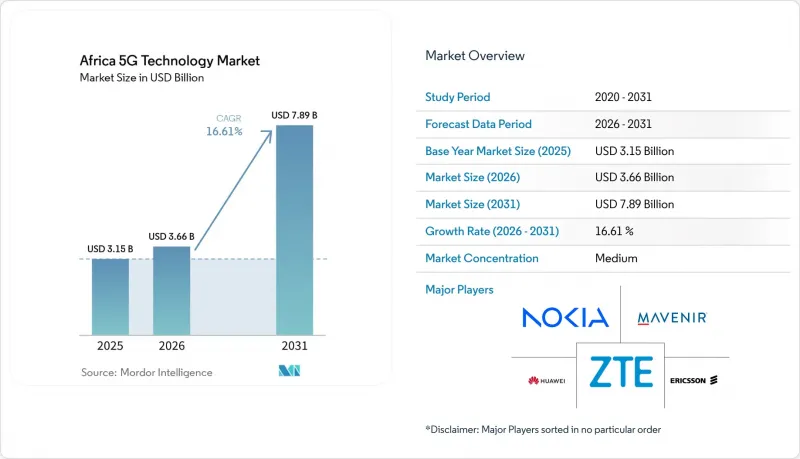
According to Mordor Intelligence, the Africa 5G technology market size is projected to be USD 3.15 billion in 2025, USD 3.66 billion in 2026, and reach USD 7.89 billion by 2031, growing at a CAGR of 16.61% from 2026 to 2031.
Africa 5G Technology Market Trends and Insights
Leapfrogging From 4G to 5G in Low-Fixed-Broadband Markets
Fixed broadband penetration remained in the low single digits in several African countries. Mobile networks have therefore remained the most viable broadband channel for households and businesses. This makes 5G a broadband alternative rather than only an upgrade to existing mobile plans. Sub-Saharan Africa's monthly mobile data traffic is projected to increase from 2.8 exabytes in 2025 to 9.7 exabytes by 2031. Spectrum availability will determine whether operators can carry this traffic at sustainable network costs. Mobile technologies generated USD 240 billion in economic value across Africa in 2025, equal to 7.8% of regional GDP.
Fixed Wireless Access Closing Broadband Gaps Faster Than Fiber
FWA can reduce the cost and time required to connect homes by avoiding last-mile civil works. This gives the Africa 5G technology market a practical route into areas where fiber deployment is difficult to justify. By late 2025, 25 operators had activated FWA services in markets including Angola, South Africa, Nigeria, Kenya, and Zambia. MTN Group identified FWA and fiber as the main pillars of its home broadband strategy in Nigeria and Ghana. Airtel Africa had 3,609 operational 5G sites across 7 markets in the quarter ended June 2026. Its USD 1.1 billion 2026 capital expenditure program identified home broadband as a primary investment area.
Spectrum Fragmentation Across Markets Slowing Scale Economics
Different spectrum rules make regional deployments more expensive for equipment suppliers and operators. Fewer than 16 African countries had completed 5G spectrum assignments by mid-2025. In comparison, more than 90% of European countries had allocated 5G spectrum. Egypt concluded a USD 3.5 billion spectrum package with its 4 operators in early 2026. National licensing, pricing, and coverage obligations differ across South Africa, Nigeria, and Egypt. These differences limit equipment standardization and delay the realization of regional-scale benefits across the African 5G technology market.
Other drivers and restraints analyzed in the detailed report include:
- Mobile Money, Fintech, and Enterprise Digitalization Raising Traffic Intensity
- Pan-African Neutral-Host and Infrastructure-Sharing Models Improving ROI
- High Energy and Diesel Reliance Raising Site Operating Costs
For complete list of drivers and restraints, kindly check the Table Of Contents.
Segment Analysis
Hardware accounted for 54.51% of Africa's 5G technology market share in 2025. This reflected the buildout of macro-cell sites, radio access network equipment, and antenna systems. Ericsson, Huawei, Nokia, and ZTE secured major equipment contracts in South Africa, Egypt, Nigeria, and Kenya. Licensing requirements also pushed operators to meet defined coverage commitments. MTN South Africa completed a dual-mode 5G core upgrade during the first half of 2025. The cloud-native packet core carried 2.52 million active sessions and 40 Gbps of live traffic. Hardware demand is therefore increasingly linked to software and cloud core investment. Site construction remains necessary even when core functions move into cloud environments. Coverage obligations make timing as important as the equipment selection itself. This keeps physical network assets central during the present rollout phase.
Services are projected to expand at an 18.98% CAGR from 2026 to 2031. Managed services, network-as-a-service contracts, and systems integration are becoming more important after initial coverage is established. Operators can use these arrangements to manage network complexity and contain operating costs. Software includes core network functions, OSS/BSS platforms, and network-slicing tools. Its adoption depends on the pace of SA core deployment. Ghana's wholesale network uses a software-driven Nokia cloud core, while MTN Group has pursued cloud-native modernization in South Africa, Zimbabwe, Angola, and Uganda. These deployments support longer-term service and software demand in the Africa 5G technology market.
Sub-6 GHz accounted for 75.89% of the Africa 5G technology market size in 2025. Frequencies below 6 GHz give operators a practical balance between coverage and capacity. This is important where networks must serve wide areas without very dense site deployment. Morocco licensed 3.5 GHz spectrum to Maroc Telecom, Inwi, and Orange Maroc in July 2025. The licenses required 45% population coverage by the end of 2026. ICASA's National Radio Frequency Plan 2026 also identified the upper 6 GHz and millimeter-wave capacity for mobile use. Sub-6 GHz should therefore remain the main initial rollout layer. The band supports national coverage targets with fewer base stations than higher-frequency alternatives.
Hybrid configurations are projected to expand at a 19.12% CAGR through 2031. They combine Sub-6 GHz coverage with millimeter-wave capacity in high-traffic locations. This approach may become more relevant once operators have established broader coverage footprints. Comsol is building an SA 5G core in South Africa using a single 60 MHz spectrum block. Its plan to serve millions of households by 2028 shows that the dedicated capacity can support later hybrid deployment. Private networks in ports, mines, and industrial sites can also introduce millimeter-wave systems where short-range, high-throughput links are justified.
Complete Report Scope:
- By Component
- Hardware
- Software
- Services
- By Spectrum Band
- Sub-6 GHz
- mmWave
- Hybrid (Sub-6 GHz and mmWave)
- By Application
- Enhanced Mobile Broadband (eMBB)
- Fixed Wireless Access (FWA)
- Massive Machine-Type Communications (mMTC)
- Ultra-Reliable Low-Latency Communications (URLLC)
- By End-User Industry
- Consumer
- Manufacturing
- Healthcare
- Automotive
- Energy and Utilities
- Media and Entertainment
- Public Safety and Defense
- By Network Architecture
- Stand-Alone (SA)
- Non-Stand-Alone (NSA)
- By Country
- South Africa
- Nigeria
- Egypt
- Kenya
- Rest of Africa
List of Companies Covered in this Report:
- Huawei Technologies Co., Ltd.
- Telefonaktiebolaget LM Ericsson (Ericsson)
- Nokia Corporation
- Qualcomm Incorporated
- Samsung Electronics Co., Ltd.
- ZTE Corporation
- Cisco Systems, Inc.
- Intel Corporation
- MediaTek Inc.
- NEC Corporation
- Fujitsu Limited
- CommScope Holding Company, Inc.
- Mavenir plc
- Parallel Wireless Inc.
- Juniper Networks, Inc.
- Sterlite Technologies Limited
- Aviat Networks, Inc.
- Radisys Corporation
- Ceragon Networks Ltd.
Additional Benefits:
- The market estimate (ME) sheet in Excel format
- 3 months of analyst support
TABLE OF CONTENTS
1 INTRODUCTION
- 1.1 Study Assumptions and Market Definition
- 1.2 Scope of the Study
2 RESEARCH METHODOLOGY
3 EXECUTIVE SUMMARY
4 MARKET LANDSCAPE
- 4.1 Market Overview
- 4.2 Market Drivers
- 4.2.1 Leapfrogging From 4G to 5G in Low-Fixed-Broadband Markets
- 4.2.2 Fixed Wireless Access Closing Broadband Gaps Faster Than Fiber
- 4.2.3 Mobile Money, Fintech, and Enterprise Digitalization Raising Traffic Intensity
- 4.2.4 Pan-African Neutral-Host and Infrastructure-Sharing Models Improving ROI
- 4.2.5 Lower-Cost Sub-6 GHz Device Ecosystems Improving Consumer Adoption
- 4.2.6 Network Modernization Tied to Data Sovereignty and Edge-Ready Cloud Programs
- 4.3 Market Restraints
- 4.3.1 Spectrum Fragmentation Across Markets Slowing Scale Economics
- 4.3.2 High Energy and Diesel Reliance Raising Site Operating Costs
- 4.3.3 FX Volatility and Import Dependence Inflating CAPEX
- 4.3.4 Limited Fiber Backhaul and Rural Power Availability Delaying Standalone 5G Economics
- 4.4 5G Timeline and Evolution
- 4.5 Current Adoption Cycle (Forerunners, Adopters, and Laggards)
- 4.6 Industry Value Chain Analysis
- 4.7 Regulatory and Policy Landscape
- 4.8 Technological Outlook
- 4.9 Porter's Five Forces Analysis
- 4.9.1 Threat of New Entrants
- 4.9.2 Bargaining Power of Suppliers
- 4.9.3 Bargaining Power of Buyers
- 4.9.4 Threat of Substitutes
- 4.9.5 Competitive Rivalry
- 4.10 5G and Beyond (6G Pathways)
- 4.11 Impact of Macroeconomic Factors on the Market
5 MARKET SIZE AND GROWTH FORECASTS (VALUE)
- 5.1 By Component
- 5.1.1 Hardware
- 5.1.2 Software
- 5.1.3 Services
- 5.2 By Spectrum Band
- 5.2.1 Sub-6 GHz
- 5.2.2 mmWave
- 5.2.3 Hybrid (Sub-6 GHz and mmWave)
- 5.3 By Application
- 5.3.1 Enhanced Mobile Broadband (eMBB)
- 5.3.2 Fixed Wireless Access (FWA)
- 5.3.3 Massive Machine-Type Communications (mMTC)
- 5.3.4 Ultra-Reliable Low-Latency Communications (URLLC)
- 5.4 By End-User Industry
- 5.4.1 Consumer
- 5.4.2 Manufacturing
- 5.4.3 Healthcare
- 5.4.4 Automotive
- 5.4.5 Energy and Utilities
- 5.4.6 Media and Entertainment
- 5.4.7 Public Safety and Defense
- 5.5 By Network Architecture
- 5.5.1 Stand-Alone (SA)
- 5.5.2 Non-Stand-Alone (NSA)
- 5.6 By Country
- 5.6.1 South Africa
- 5.6.2 Nigeria
- 5.6.3 Egypt
- 5.6.4 Kenya
- 5.6.5 Rest of Africa
6 COMPETITIVE LANDSCAPE
- 6.1 Market Concentration
- 6.2 Strategic Moves
- 6.3 Market Share Analysis
- 6.4 Company Profiles (includes Global Level Overview, Market Level Overview, Core Segments, Financials as available, Strategic Information, Market Rank/Share, Products and Services, Recent Developments)
- 6.4.1 Huawei Technologies Co., Ltd.
- 6.4.2 Telefonaktiebolaget LM Ericsson (Ericsson)
- 6.4.3 Nokia Corporation
- 6.4.4 Qualcomm Incorporated
- 6.4.5 Samsung Electronics Co., Ltd.
- 6.4.6 ZTE Corporation
- 6.4.7 Cisco Systems, Inc.
- 6.4.8 Intel Corporation
- 6.4.9 MediaTek Inc.
- 6.4.10 NEC Corporation
- 6.4.11 Fujitsu Limited
- 6.4.12 CommScope Holding Company, Inc.
- 6.4.13 Mavenir plc
- 6.4.14 Parallel Wireless Inc.
- 6.4.15 Juniper Networks, Inc.
- 6.4.16 Sterlite Technologies Limited
- 6.4.17 Aviat Networks, Inc.
- 6.4.18 Radisys Corporation
- 6.4.19 Ceragon Networks Ltd.
7 MARKET OPPORTUNITIES AND FUTURE OUTLOOK
- 7.1 White-Space and Unmet-Need Assessment

