PUBLISHER: Mordor Intelligence | PRODUCT CODE: 2154990

PUBLISHER: Mordor Intelligence | PRODUCT CODE: 2154990
Europe 5G Technology - Market Share Analysis, Industry Trends & Statistics, Growth Forecasts (2026 - 2031)
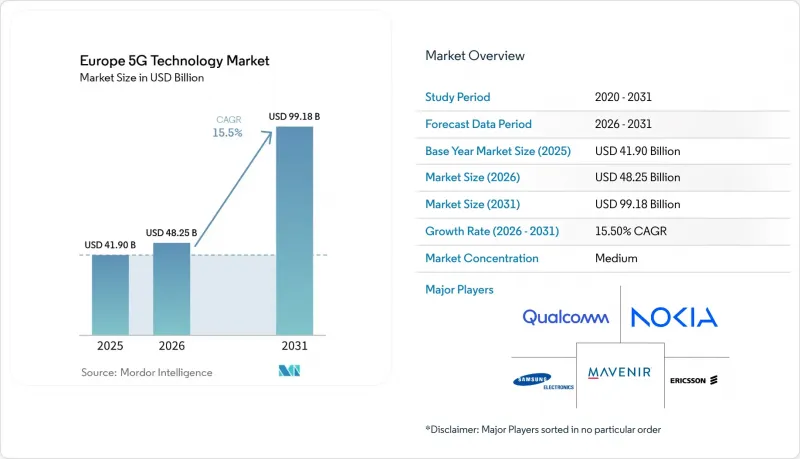
According to Mordor Intelligence, the Europe 5G technology market size is expected to increase from USD 41.90 billion in 2025 to USD 48.25 billion in 2026 and reach USD 99.18 billion by 2031, growing at a CAGR of 15.5% over 2026-2031.
Europe 5G Technology Market Trends and Insights
Ongoing 5G Standalone Network Rollouts Across Major European Economies
VodafoneThree committed GBP 11 billion (USD 14.85 billion) to a 10-year network investment plan, including GBP 2 billion (USD 2.7 billion) in supply agreements with Ericsson and Nokia for more than 17,000 United Kingdom sites. The September 2025 agreements placed standalone deployment at the center of a plan intended to extend 5G standalone coverage to more than 99% of the United Kingdom population by 2034. The European 5G technology market benefits when large operators move from limited trials to repeatable national programs with common technical standards, established suppliers, long-term commitments, and a clear route from initial network coverage to widely available standalone capability. Standalone networks provide the technical base for network slicing, private connectivity, and enterprise service packages that use dedicated performance characteristics rather than standard best-effort mobile access. Those capabilities matter because basic mobile coverage alone gives operators limited scope to differentiate their offerings or to explain why a customer should pay for an advanced service. The European Commission proposed the Digital Networks Act on January 21, 2026, with measures covering spectrum management and cross-border authorizations.
Rising Private 5G Demand in Industrial Manufacturing Clusters
Private 5G moved from isolated testing to operational deployment during 2025 and 2026, particularly in industrial settings that require predictable wireless performance across large, active production sites. Siemens expanded its industrial private 5G offer to 15 countries in April 2026, adding Belgium, Finland, France, Norway, Poland, and the United Kingdom. This wider availability supports companies that want to apply a common network design across multiple facilities rather than designing a separate solution for each location. The European 5G technology market gains recurring demand when private systems support automation, machine vision, mobile robots, and connected business systems that must work within the same operational environment, including sites with varied equipment, production stages, and safety requirements. 3GPP Release 16 defined URLLC capabilities for demanding use cases that require near-1 ms latency and high reliability under controlled conditions. These requirements explain that manufacturing sites may replace or supplement fixed industrial connections with private cellular networks when mobile equipment, sensors, and production processes require consistent performance. Replicable deployment plans can reduce the effort needed to introduce private 5G at midsize industrial sites and make cross-site deployment more practical.
High Capital Intensity of Dense Mid-Band and mmWave Infrastructure
GSMA Intelligence estimated that Europe requires EUR 475 billion (USD 536.8 billion) in mobile investment from 2026 to 2036. It estimated an operator-accessible pool of EUR 270 billion (USD 305.1 billion), leaving over EUR 200 billion (USD 233.19 billion). GSMA Nearly half of the required spending relates to 5G along major transport routes, where coverage continuity and capacity demand require more extensive network infrastructure. Dense mid-band and mmWave networks need closer site spacing and specialized radio equipment than broad sub-6 GHz macro coverage, adding both deployment and site-related costs. This requirement makes the investment burden particularly difficult in markets with weaker network economics and in areas where high-capacity traffic demand is not yet proven. Operators may keep non-standalone networks in service longer when capital is constrained and prioritize only the sites with the clearest return. That decision can delay the software and services spending associated with full standalone capabilities and slow the transition from basic coverage to advanced service delivery.
Other drivers and restraints analyzed in the detailed report include:
- Expanding Fixed Wireless Access Adoption in Underserved European Broadband Markets
- Open RAN and Virtualized Network Adoption to Improve Vendor Flexibility
- Slow Enterprise Monetization of Advanced 5G Use Cases
For complete list of drivers and restraints, kindly check the Table Of Contents.
Segment Analysis
Hardware accounted for 44.85% of the European 5G technology market share in 2025, while services are projected to expand at a 17.41% CAGR through 2031. Hardware demand remains centered on massive MIMO radio units, base stations, and remote radio heads that form the physical access layer of 5G deployment. These assets support sub-6 GHz densification programs across European operator networks and provide the equipment needed to add capacity in high-traffic areas, where demand increases as consumer data use, fixed wireless access, and enterprise traffic share the same radio infrastructure. Hardware also remains necessary when operators extend coverage, upgrade sites, or install specialized equipment for enterprise locations. Europe's 5G technology sector, therefore, retains a large equipment base even as the composition of spending begins to change.
Services are expected to gain importance as cloud-native deployment, managed radio operations, and network-as-a-service arrangements become more common across multi-year network programs. These activities create recurring engagements that extend beyond the original equipment purchase and encompass design, integration, optimization, support, and operational management. Open RAN supports this shift because software can replace some proprietary hardware functions and requires closer coordination between multiple suppliers. Software also supports orchestration, virtual network functions, operations support systems, and business support systems that connect network performance with commercial delivery as operators replace legacy core processes and manage public networks alongside enterprise deployments. The Europe 5G technology market, therefore, has a broader mix of hardware, software, and services requirements than in the initial phase of 5G coverage deployment.
Sub-6 GHz accounted for 66.48% of the European 5G technology market in 2025, reflecting its role as the primary capacity layer in operator portfolios. Band n78 has been a central part of this coverage and capacity strategy because it can serve a wide range of locations with a consistent network design. Its balance of reach and capacity makes it suitable for broad deployment across urban, suburban, and many rural areas. Operators can use this band to expand 5G availability without relying on the dense site grids and specialized equipment needed for higher frequencies. It remains the practical base for most nationwide 5G network plans and for later additions of more targeted capacity, allowing operators to prioritize broad availability before committing major resources to localized high-frequency infrastructure.
Hybrid (sub-6 GHz and mmWave) configurations are projected to expand at a 17.98% CAGR through 2031. These configurations add mmWave capacity where traffic is concentrated at venues, enterprise campuses, and broadcast locations that need higher local throughput. Nokia and EOLO deployed Europe's first 5G standalone mmWave network in Italy in December 2024. The European 5G technology market can use hybrid networks in which dependable sub-6 GHz coverage must coexist with very high local capacity at specific sites. European harmonization of the 26 GHz band provides a spectrum basis for these targeted deployments and gives operators a common reference for equipment planning.
Complete Report Scope:
- By Component
- Hardware
- Software
- Services
- By Spectrum Band
- Sub-6 GHz
- mmWave
- Hybrid (Sub-6 GHz and mmWave)
- By Application
- Enhanced Mobile Broadband (eMBB)
- Fixed Wireless Access (FWA)
- Massive Machine-Type Communications (mMTC)
- Ultra-Reliable Low-Latency Communications (URLLC)
- By End-User Industry
- Consumer
- Manufacturing
- Healthcare
- Automotive
- Energy and Utilities
- Media and Entertainment
- Public Safety and Defense
- By Network Architecture
- Stand-Alone (SA)
- Non-Stand-Alone (NSA)
- By Country
- Germany
- United Kingdom
- France
- Italy
- Spain
- Russia
- Rest of Europe
List of Companies Covered in this Report:
- Huawei Technologies Co., Ltd.
- Telefonaktiebolaget LM Ericsson (Ericsson)
- Nokia Corporation
- Qualcomm Incorporated
- Samsung Electronics Co., Ltd.
- ZTE Corporation
- Intel Corporation
- MediaTek Inc.
- Cisco Systems, Inc.
- NEC Corporation
- Fujitsu Limited
- CommScope Holding Company, Inc.
- Vodafone Group plc
- Skyworks Solutions, Inc.
- Analog Devices, Inc.
- Juniper Networks, Inc.
- Mavenir plc
- Parallel Wireless, Inc.
- Rohde and Schwarz GmbH and Co. KG
- Deutsche Telekom AG
Additional Benefits:
- The market estimate (ME) sheet in Excel format
- 3 months of analyst support
TABLE OF CONTENTS
1 INTRODUCTION
- 1.1 Study Assumptions and Market Definition
- 1.2 Scope of the Study
2 RESEARCH METHODOLOGY
3 EXECUTIVE SUMMARY
4 MARKET LANDSCAPE
- 4.1 Market Overview
- 4.2 Market Drivers
- 4.2.1 Ongoing 5G Standalone Network Rollouts Across Major European Economies
- 4.2.2 Rising Private 5G Demand in Industrial Manufacturing Clusters
- 4.2.3 Expanding Fixed Wireless Access Adoption in Underserved European Broadband Markets
- 4.2.4 Open RAN and Virtualized Network Adoption to Improve Vendor Flexibility
- 4.2.5 Network Slicing Requirements From Enterprise and Public Sector Use Cases
- 4.2.6 Cross-Border Spectrum Harmonization Supporting Pan-European Deployment Efficiency
- 4.3 Market Restraints
- 4.3.1 High Capital Intensity of Dense Mid-Band and mmWave Infrastructure
- 4.3.2 Slow Enterprise Monetization of Advanced 5G Use Cases
- 4.3.3 Spectrum Fragmentation and Varying National Licensing Conditions
- 4.3.4 Elevated Energy Use and Site-Level Sustainability Pressures
- 4.4 5G Timeline and Evolution
- 4.5 Current Adoption Cycle (Forerunners, Adopters, and Laggards)
- 4.6 Industry Value Chain Analysis
- 4.7 Regulatory and Policy Landscape
- 4.8 Technological Outlook
- 4.9 Porter's Five Forces Analysis
- 4.9.1 Threat of New Entrants
- 4.9.2 Bargaining Power of Suppliers
- 4.9.3 Bargaining Power of Buyers
- 4.9.4 Threat of Substitutes
- 4.9.5 Competitive Rivalry
- 4.10 5G and Beyond (6G Pathways)
- 4.11 Impact of Macroeconomic Factors on the Market
5 MARKET SIZE AND GROWTH FORECASTS (VALUE)
- 5.1 By Component
- 5.1.1 Hardware
- 5.1.2 Software
- 5.1.3 Services
- 5.2 By Spectrum Band
- 5.2.1 Sub-6 GHz
- 5.2.2 mmWave
- 5.2.3 Hybrid (Sub-6 GHz and mmWave)
- 5.3 By Application
- 5.3.1 Enhanced Mobile Broadband (eMBB)
- 5.3.2 Fixed Wireless Access (FWA)
- 5.3.3 Massive Machine-Type Communications (mMTC)
- 5.3.4 Ultra-Reliable Low-Latency Communications (URLLC)
- 5.4 By End-User Industry
- 5.4.1 Consumer
- 5.4.2 Manufacturing
- 5.4.3 Healthcare
- 5.4.4 Automotive
- 5.4.5 Energy and Utilities
- 5.4.6 Media and Entertainment
- 5.4.7 Public Safety and Defense
- 5.5 By Network Architecture
- 5.5.1 Stand-Alone (SA)
- 5.5.2 Non-Stand-Alone (NSA)
- 5.6 By Country
- 5.6.1 Germany
- 5.6.2 United Kingdom
- 5.6.3 France
- 5.6.4 Italy
- 5.6.5 Spain
- 5.6.6 Russia
- 5.6.7 Rest of Europe
6 COMPETITIVE LANDSCAPE
- 6.1 Market Concentration
- 6.2 Strategic Moves
- 6.3 Market Share Analysis
- 6.4 Company Profiles (includes Global Level Overview, Market Level Overview, Core Segments, Financials as available, Strategic Information, Market Rank/Share, Products and Services, Recent Developments)
- 6.4.1 Huawei Technologies Co., Ltd.
- 6.4.2 Telefonaktiebolaget LM Ericsson (Ericsson)
- 6.4.3 Nokia Corporation
- 6.4.4 Qualcomm Incorporated
- 6.4.5 Samsung Electronics Co., Ltd.
- 6.4.6 ZTE Corporation
- 6.4.7 Intel Corporation
- 6.4.8 MediaTek Inc.
- 6.4.9 Cisco Systems, Inc.
- 6.4.10 NEC Corporation
- 6.4.11 Fujitsu Limited
- 6.4.12 CommScope Holding Company, Inc.
- 6.4.13 Vodafone Group plc
- 6.4.14 Skyworks Solutions, Inc.
- 6.4.15 Analog Devices, Inc.
- 6.4.16 Juniper Networks, Inc.
- 6.4.17 Mavenir plc
- 6.4.18 Parallel Wireless, Inc.
- 6.4.19 Rohde and Schwarz GmbH and Co. KG
- 6.4.20 Deutsche Telekom AG
7 MARKET OPPORTUNITIES AND FUTURE OUTLOOK
- 7.1 White-Space and Unmet-Need Assessment

