PUBLISHER: Mordor Intelligence | PRODUCT CODE: 2155296

PUBLISHER: Mordor Intelligence | PRODUCT CODE: 2155296
South America Tourism Vehicle Rental - Market Share Analysis, Industry Trends & Statistics, Growth Forecasts (2026 - 2031)
According to Mordor Intelligence, the South America tourism vehicle rental market size was valued at USD 4.25 billion in 2025, is estimated at USD 4.51 billion in 2026, and is projected to reach USD 6.10 billion by 2031, growing at a CAGR of 6.21% from 2026 to 2031.
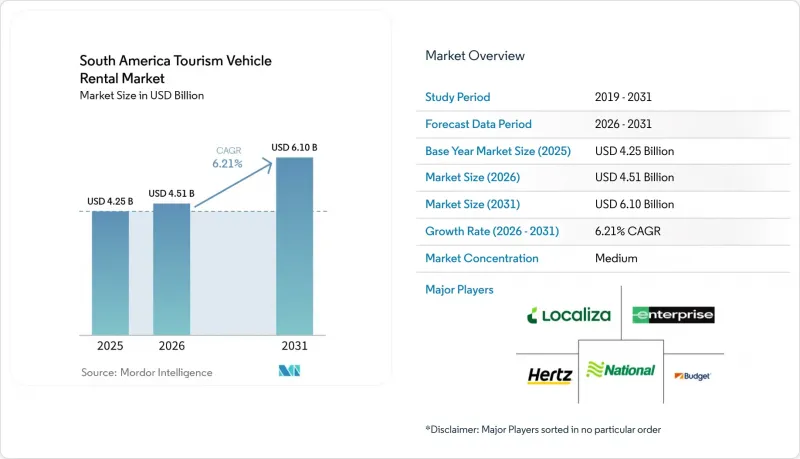
South America Tourism Vehicle Rental Market Trends and Insights
International Tourism and Domestic Road-Trip Recovery
International tourism is expanding the pool of travelers who need independent ground transport across the tourism and vehicle rental markets in South America. Brazil's international arrivals increased by 37% in 2025, according to UN Tourism data, reflecting stronger cross-border travel to a major destination . Longer visitor stays can support longer rental periods and higher revenue per agreement. Visitors increasingly use rental vehicles to reach destinations beyond large cities. This pattern supports longer bookings in coastal, mountain, and nature-focused routes. Chile, Peru, Colombia, and Brazil benefit when travelers build multi-stop itineraries. The South American tourism vehicle rental market gains when road travel becomes part of the visitor experience rather than only a local transport option.
Online and Mobile Booking Conversion
Digital reservations have become central to how travelers compare vehicles, prices, insurance options, and pickup locations. Online platforms accounted for most of the bookings in 2025, confirming that pre-trip planning is increasingly conducted through digital channels. Mobile applications support this shift by allowing travelers to manage reservations during their journeys. Integrated travel platforms can place rental inventory alongside flights, accommodation, and local services. Clear pricing and well-organized booking information also matter because travelers need to compare total costs before arrival. These changes favor operators that can maintain reliable digital inventory and provide localized service information across the tourism vehicle rental market in South America.
High Interest Rates and Fleet-Financing Costs
High borrowing costs limit rental companies' ability to purchase vehicles and expand their fleets. Because fleet acquisition requires significant capital investment, higher financing expenses can reduce returns on each vehicle. Limited vehicle purchases may constrain availability during seasonal peaks and major events. Smaller regional operators face greater pressure because they have fewer financing options than large fleet operators or franchise networks. This constraint affects the South American tourism vehicle rental market by increasing the importance of fleet utilization and vehicle selection.
Other drivers and restraints analyzed in the detailed report include:
- Airport and Low-Cost Airline Connectivity Expansion
- Fleet Renewal and Digital Fleet Management
- Ride-Hailing and Alternative Mobility Substitution
For complete list of drivers and restraints, kindly check the Table Of Contents.
Segment Analysis
Economy cars accounted for 43.47% of the South American tourism vehicle rental market share in 2025, making them the largest vehicle category. Their affordability suits many leisure travelers and helps operators maintain broad availability. SUVs and vans address family travel, groups, and journeys that need additional space. Motorhomes and specialty vehicles support outdoor routes in Patagonia and the Amazon basin. Luxury cars are forecast to register a 7.32% CAGR through 2031. Premium inbound tourism, event hospitality, and chauffeur-driven services support this faster growth.
Economy cars generate the recurring rental volume that supports fleet renewal in the South American tourism vehicle rental market. Luxury and executive vehicles enable operators to serve visitors seeking more tailored services. Specialized fleets require maintenance, insurance, and deployment practices that differ from those for standard airport rental vehicles. As operators expand vehicle options, hybrid and electric models may enter the economy and mid-range rental fleets. Localiza announced an agreement with BYD to procure hybrid and electric vehicles for rental and related applications. The agreement includes the Song Plus, Song Pro, Dolphin, and Dolphin Mini models.
Online platforms accounted for 54.29% of the tourism vehicle rental market share in South America in 2025 and were the leading booking mode. The same channel is forecast to grow at an 8.19% CAGR through 2031. Travelers can reserve vehicles before departure and compare terms across locations. Mobile applications add flexibility during the booking, pickup, and return process. Offline agencies still serve travelers who arrange a vehicle in person. Their role is narrowing as digital reservation behavior becomes more familiar.
Digital distribution can improve advanced visibility of demand and support more efficient fleet allocation. It can also reduce dependence on counter-based reservations at airport locations. Travel platforms, loyalty programs, and embedded mobility services can place rental choices beside other travel purchases. Operators need accurate availability and transparent pricing across these channels. The booking change does not remove the importance of branch operations, since vehicles still need to be delivered and serviced locally. It does, however, make digital service quality a key part of competition in the tourism vehicle rental market in South America.
Complete Report Scope:
- By Vehicle Type
- Economy Cars
- Sports Utility Vehicles
- Luxury Cars
- Vans
- Motorhomes (RVs)
- Specialty Vehicles
- By Booking Mode
- Online Platforms
- Offline Rental Agencies
- By Rental Duration
- Hourly Rentals
- Daily Rentals
- Weekly Rentals
- Monthly Subscriptions
- By End User
- Self-Driven Rentals
- Chauffeur-Driven Rentals
- By Customer Type
- Leisure Travelers
- Business Travelers
- Domestic Tourists
- International Tourists
- By Application
- Airport Rentals
- City Rentals
- Intercity Rentals
- Adventure and Eco-Tourism Rentals
- By Country
- Brazil
- Argentina
- Chile
- Colombia
- Peru
- Rest of South America
List of Companies Covered in this Report:
- Localiza Rent a Car S.A.
- Movida Participacoes S.A.
- Unidas S.A.
- Hertz Global Holdings, Inc.
- Enterprise Holdings, Inc.
- Budget Rent a Car System, Inc.
- National Car Rental
- Alamo
- SIXT SE
- Europcar Mobility Group
- Rentcars
- Royal Rent A Car
- America Car Rental
- Mex Rent A Car
Additional Benefits:
- The market estimate (ME) sheet in Excel format
- 3 months of analyst support
TABLE OF CONTENTS
1 Introduction
- 1.1 Study Assumptions and Market Definition
- 1.2 Scope of the Study
2 Research Methodology
3 Executive Summary
4 Market Landscape
- 4.1 Market Overview
- 4.2 Market Drivers
- 4.2.1 International Tourism and Domestic Road-Trip Recovery
- 4.2.2 Online and Mobile Booking Conversion
- 4.2.3 Airport and Low-Cost Airline Connectivity Expansion
- 4.2.4 Integrated Travel Platforms, Bundles, and Loyalty Programs
- 4.2.5 Fleet Renewal and Telematics-Enabled Utilization
- 4.2.6 Event-Led and Nature-Based Tourism Corridors
- 4.3 Market Restraints
- 4.3.1 High Interest Rates and Fleet-Financing Costs
- 4.3.2 Currency Volatility and Vehicle Import Constraints
- 4.3.3 Ride-Hailing and Alternative Mobility Substitution
- 4.3.4 Electric Vehicle Residual-Value, Charging, and Maintenance Risk
- 4.4 Value and Supply-Chain Analysis
- 4.5 Regulatory Landscape
- 4.6 Technological Outlook
- 4.7 Porter's Five Forces Analysis
- 4.7.1 Threat of New Entrants
- 4.7.2 Bargaining Power of Buyers
- 4.7.3 Bargaining Power of Suppliers
- 4.7.4 Threat of Substitute Products
- 4.7.5 Intensity of Competitive Rivalry
5 Market Size and Growth Forecasts (Value in USD)
- 5.1 By Vehicle Type
- 5.1.1 Economy Cars
- 5.1.2 Sports Utility Vehicles
- 5.1.3 Luxury Cars
- 5.1.4 Vans
- 5.1.5 Motorhomes (RVs)
- 5.1.6 Specialty Vehicles
- 5.2 By Booking Mode
- 5.2.1 Online Platforms
- 5.2.2 Offline Rental Agencies
- 5.3 By Rental Duration
- 5.3.1 Hourly Rentals
- 5.3.2 Daily Rentals
- 5.3.3 Weekly Rentals
- 5.3.4 Monthly Subscriptions
- 5.4 By End User
- 5.4.1 Self-Driven Rentals
- 5.4.2 Chauffeur-Driven Rentals
- 5.5 By Customer Type
- 5.5.1 Leisure Travelers
- 5.5.2 Business Travelers
- 5.5.3 Domestic Tourists
- 5.5.4 International Tourists
- 5.6 By Application
- 5.6.1 Airport Rentals
- 5.6.2 City Rentals
- 5.6.3 Intercity Rentals
- 5.6.4 Adventure and Eco-Tourism Rentals
- 5.7 By Country
- 5.7.1 Brazil
- 5.7.2 Argentina
- 5.7.3 Chile
- 5.7.4 Colombia
- 5.7.5 Peru
- 5.7.6 Rest of South America
6 Competitive Landscape
- 6.1 Market Concentration
- 6.2 Strategic Moves
- 6.3 Market Share Analysis
- 6.4 Company Profiles (Includes Global Level Overview, Market Level Overview, Core Segments, Financials as available, Strategic Information, Market Rank/Share, Products and Services, Recent Developments)
- 6.4.1 Localiza Rent a Car S.A.
- 6.4.2 Movida Participacoes S.A.
- 6.4.3 Unidas S.A.
- 6.4.4 Hertz Global Holdings, Inc.
- 6.4.5 Enterprise Holdings, Inc.
- 6.4.6 Budget Rent a Car System, Inc.
- 6.4.7 National Car Rental
- 6.4.8 Alamo
- 6.4.9 SIXT SE
- 6.4.10 Europcar Mobility Group
- 6.4.11 Rentcars
- 6.4.12 Royal Rent A Car
- 6.4.13 America Car Rental
- 6.4.14 Mex Rent A Car
7 Market Opportunities and Future Outlook

