PUBLISHER: Mordor Intelligence | PRODUCT CODE: 2155298

PUBLISHER: Mordor Intelligence | PRODUCT CODE: 2155298
Closed-Loop Network Automation Software - Market Share Analysis, Industry Trends & Statistics, Growth Forecasts (2026 - 2031)
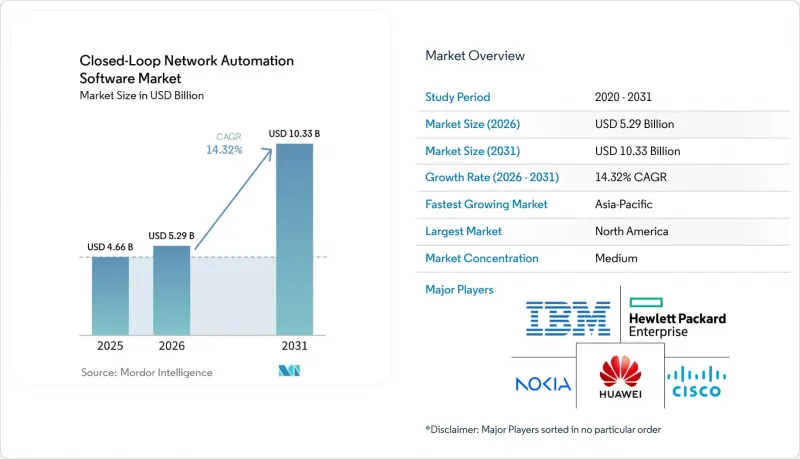
According to Mordor Intelligence, the closed-loop network automation software market size is projected to be USD 4.66 billion in 2025, USD 5.29 billion in 2026, and reach USD 10.33 billion by 2031, growing at a CAGR of 14.32% from 2026 to 2031.
Global Closed-Loop Network Automation Software Market Trends and Insights
Rising Hybrid and Multicloud Network Complexity
Organizations increasingly operate several cloud environments alongside legacy sites, edge nodes, and distributed applications, making routine changes harder to coordinate. The closed-loop network automation software market addresses this operational burden by linking network state, policies, and automated actions across separate environments. Network teams often work across multiple monitoring and management consoles when automation is not consolidated, slowing investigations and creating inconsistent operating practices. Microsoft described a 2025 internal program that changed hybrid-cloud integration from a months-long manual process into a one-day automated workflow using an AI orchestration agent. Cisco introduced Multicloud Fabric in 2026 to provide an automated site-to-cloud and cloud-to-cloud fabric through Cisco Cloud Control. Each new cloud or network domain increases the operational value of a shared control framework, particularly when teams must preserve security and service policies across those domains.
AI-Driven Predictive Operations and Network Analytics
AI-driven operations are moving from basic anomaly identification to systems that can recommend or perform routine corrective actions under defined policy controls. The closed-loop network automation software market benefits when operators seek faster fault handling and lower manual work in network operations centers. Nokia and Indosat Ooredoo Hutchison described autonomous-network work in 2026 that used validated automation capabilities for network operations. The shift also changes workforce needs, as policy design, data quality, model governance, and multivendor integration require skills that differ from those of traditional network administration. Vendors therefore compete on explainability, data management, and safeguards around autonomous actions, not only on the speed of analytics. As core AI capabilities become more common, platforms that connect AI recommendations to auditable operational workflows can hold a clearer position with regulated operators and enterprises.
High Integration Costs Across Legacy and Multivendor Environments
Legacy operational support systems, network-management platforms, and multivendor equipment often lack consistent interfaces for programmatic control. This makes integration effort a central barrier to adoption in the closed-loop network automation software market, even when the software license itself is affordable. Routing, switching, SD-WAN, security, and radio networks can use different APIs, configuration models, and data structures. These differences require connectors and testing before an automated workflow can operate safely across the full environment. Nokia and Ericsson announced interoperability work in 2026, including cooperation between Nokia's SMO Marketplace and Ericsson's rApp Ecosystem. Wider use of standards-compliant management interfaces can reduce this friction, but mixed installed equipment will continue to slow fully automated deployments.
Other drivers and restraints analyzed in the detailed report include:
- Expansion of 5G, Network Slicing, and Programmable Connectivity
- Demand for Zero-Touch Provisioning and Lower Operational Costs
- Shortage of Network Automation and AI Operations Skills
For complete list of drivers and restraints, kindly check the Table Of Contents.
Segment Analysis
Software accounted for 58.21% of the closed-loop network automation software market share in 2025 and is projected to grow at a CAGR of 15.54% through 2031. This position reflects operators' shift from capital-intensive hardware renewals toward continuous investment in intelligence and orchestration layers. Software includes intent-based networking engines, policy-driven automation, analytics, and control functions that operate across multiple infrastructure domains. These capabilities enable teams to move from isolated configuration tasks to a more coordinated operating model.
Hardware-embedded automation remains relevant for greenfield deployments and functions directly linked to network operating systems or controllers. However, it is expanding more slowly as orchestration logic shifts to vendor-neutral software layers. Services also remain important, as implementation, integration, and managed operations can reduce adoption barriers for customers without in-house automation teams. The component mix indicates that commercial value is increasingly concentrated in the software layer rather than in a single physical device category. This trend benefits suppliers that can continuously update capabilities as customer requirements evolve. It also increases the value of platforms that operate across existing equipment rather than requiring customers to replace installed hardware.
Cloud deployment accounted for 45.44% of revenue in 2025, while hybrid deployment is projected to grow at a 16.54% CAGR through 2031. Cloud-delivered OSS, BSS, and orchestration platforms can reduce implementation barriers for organizations adopting automation for the first time. They also make analytics and centralized policy management more accessible across distributed sites. Hybrid deployment addresses a different requirement by allowing customers to use cloud-based analytics while retaining sensitive traffic, audit data, or change execution in controlled environments. This model is particularly relevant for healthcare, BFSI, energy and utilities, government, and other regulated end users.
On-premises deployment remains important for defense, public-sector, and sovereign operators, where data-residency requirements limit the use of hosted orchestration platforms. Therefore, deployment choices reflect operational and compliance requirements rather than technology preferences alone. Hybrid models enable customers to benefit from cloud agility without immediately moving all operational control to a public cloud. As a result, hybrid deployment provides an important transition path for organizations progressing cautiously toward higher levels of autonomy.
Complete Report Scope:
- By Component
- Software
- Hardware-Embedded Automation
- Services
- By Deployment
- Cloud
- On-Premises
- Hybrid
- By Network Infrastructure
- Physical Network Infrastructure
- Virtual Network Infrastructure
- Cloud-Native Network Infrastructure
- Hybrid Network Infrastructure
- By End User
- Communications Service Providers
- Mobile Network Operators
- Fixed-Line Operators
- Cable and Broadband Providers
- Internet Service Providers
- Enterprises
- Banking, Financial Services, and Insurance
- Manufacturing
- Healthcare
- Energy and Utilities
- Government and Public Sector
- Retail and E-Commerce
- Media and Entertainment
- Transportation and Logistics
- Managed Service Providers and Cloud Service Providers
- Communications Service Providers
- By Organization Size
- Large Enterprises
- Small and Medium-Sized Enterprises
- By Geography
- North America
- United States
- Canada
- Mexico
- South America
- Brazil
- Argentina
- Rest of South America
- Europe
- United Kingdom
- Germany
- France
- Italy
- Rest of Europe
- Asia-Pacific
- China
- India
- Japan
- South Korea
- Rest of Asia-Pacific
- Middle East
- Saudi Arabia
- United Arab Emirates
- Rest of Middle East
- Africa
- South Africa
- Nigeria
- Rest of Africa
- North America
Geography Analysis
North America is expected to hold a 33.32% share of the closed-loop network automation software market in 2025. The region benefits from strong enterprise technology spending, active 5G initiatives, and the presence of major cloud and network platform providers. AI infrastructure buildouts are creating traffic patterns and operational requirements that increase the need for dynamic network management. Financial services and healthcare organizations represent significant enterprise adopters because they require reliable, secure, and auditable network services. Canada is generating demand from users in the financial services and natural resources sectors, while Mexico presents an emerging CSP opportunity as operators rationalize their networks. Cisco is set to unveil Multicloud Fabric and its AgenticOps model at Cisco Live 2026 in Las Vegas. These developments reflect the region's focus on integrating cloud connectivity, security, and automation within a unified operating environment.
Asia-Pacific is projected to expand at a CAGR of 16.54% through 2031, making it the fastest-growing region. China is expected to deploy more than 4 million 5G base stations by early 2026, creating substantial automation requirements across radio, core, and transport networks. India is advancing its digital and 5G infrastructure, encouraging operators to adopt AI-based optimization as subscriber demand rises. Japan and South Korea are also driving demand through network slicing and private 5G initiatives. NTT DOCOMO and NEC are expected to launch Japan's first commercial 5G core on AWS in 2026. Indonesia, Malaysia, and Vietnam are adopting automated provisioning as their 5G networks expand. Malaysia has emerged as an early example of validated advanced autonomy in an emerging operator market. The closed-loop network automation software market benefits from these deployments, which require repeatable, standards-based operations across large-scale networks.
Europe remains an important market, as Deutsche Telekom, Orange, Vodafone, and Telefonica continue to invest in open RAN-aligned automation and slicing orchestration. Orange and Ericsson are collaborating on automated 5G service creation for enterprise and subscriber use cases across European operations. South America is developing through CSP automation initiatives in Brazil and Argentina, with early adoption focused on provisioning and fault management. The Middle East is gaining momentum through infrastructure programs in Saudi Arabia and 5G-Advanced deployments in the UAE. Nokia selected du as an early adopter of agentic AI-powered network slicing at MWC 2026. Africa remains at an earlier stage of adoption, although operators in South Africa and Nigeria are exploring autonomous network approaches. Huawei documented Level 4 autonomous network deployments with MTN in South Africa and MasOrange in Spain during 2025. These regional differences create varied opportunities for suppliers, ranging from foundational provisioning tools to broader intent-based orchestration platforms.
- Cisco Systems, Inc.
- Hewlett Packard Enterprise Company
- Huawei Technologies Co., Ltd.
- Telefonaktiebolaget LM Ericsson
- Nokia Corporation
- Ciena Corporation
- IBM Corporation
- Arista Networks, Inc.
- Extreme Networks, Inc.
- VMware by Broadcom
- Amdocs Limited
- Netcracker Technology Corporation
- Oracle Corporation
- NEC Corporation
- Red Hat, Inc.
- Forward Networks, Inc.
- NetBrain Technologies, Inc.
- Itential, Inc.
- Gluware, Inc.
- BackBox Software Inc.
Additional Benefits:
- The market estimate (ME) sheet in Excel format
- 3 months of analyst support
TABLE OF CONTENTS
1 INTRODUCTION
- 1.1 Study Assumptions and Market Definition
- 1.2 Scope of the Study
2 RESEARCH METHODOLOGY
3 EXECUTIVE SUMMARY
4 MARKET LANDSCAPE
- 4.1 Market Overview
- 4.2 Market Drivers
- 4.2.1 Rising Hybrid and Multicloud Network Complexity
- 4.2.2 AI-Driven Predictive Operations and Network Analytics
- 4.2.3 Expansion of 5G, Network Slicing, and Programmable Connectivity
- 4.2.4 Demand for Zero-Touch Provisioning and Lower Operational Costs
- 4.2.5 Network-as-Code Monetization by Communications Service Providers
- 4.2.6 Trustworthy Agentic Automation With Digital Twin Validation
- 4.3 Market Restraints
- 4.3.1 High Integration Costs Across Legacy and Multivendor Environments
- 4.3.2 Shortage of Network Automation and AI Operations Skills
- 4.3.3 Limited Explainability and Governance of Autonomous Changes
- 4.3.4 Data Quality and State-Synchronization Gaps Across Operational Systems
- 4.4 Impact of Macroeconomic Factors on the Market
- 4.5 Industry Value Chain Analysis
- 4.6 Regulatory Landscape
- 4.7 Technological Outlook
- 4.8 Porter's Five Forces Analysis
- 4.8.1 Threat of New Entrants
- 4.8.2 Bargaining Power of Suppliers
- 4.8.3 Bargaining Power of Buyers
- 4.8.4 Threat of Substitutes
- 4.8.5 Competitive Rivalry
5 MARKET SIZE AND GROWTH FORECASTS (VALUE)
- 5.1 By Component
- 5.1.1 Software
- 5.1.2 Hardware-Embedded Automation
- 5.1.3 Services
- 5.2 By Deployment
- 5.2.1 Cloud
- 5.2.2 On-Premises
- 5.2.3 Hybrid
- 5.3 By Network Infrastructure
- 5.3.1 Physical Network Infrastructure
- 5.3.2 Virtual Network Infrastructure
- 5.3.3 Cloud-Native Network Infrastructure
- 5.3.4 Hybrid Network Infrastructure
- 5.4 By End User
- 5.4.1 Communications Service Providers
- 5.4.1.1 Mobile Network Operators
- 5.4.1.2 Fixed-Line Operators
- 5.4.1.3 Cable and Broadband Providers
- 5.4.1.4 Internet Service Providers
- 5.4.2 Enterprises
- 5.4.2.1 Banking, Financial Services, and Insurance
- 5.4.2.2 Manufacturing
- 5.4.2.3 Healthcare
- 5.4.2.4 Energy and Utilities
- 5.4.2.5 Government and Public Sector
- 5.4.2.6 Retail and E-Commerce
- 5.4.2.7 Media and Entertainment
- 5.4.2.8 Transportation and Logistics
- 5.4.3 Managed Service Providers and Cloud Service Providers
- 5.4.1 Communications Service Providers
- 5.5 By Organization Size
- 5.5.1 Large Enterprises
- 5.5.2 Small and Medium-Sized Enterprises
- 5.6 By Geography
- 5.6.1 North America
- 5.6.1.1 United States
- 5.6.1.2 Canada
- 5.6.1.3 Mexico
- 5.6.2 South America
- 5.6.2.1 Brazil
- 5.6.2.2 Argentina
- 5.6.2.3 Rest of South America
- 5.6.3 Europe
- 5.6.3.1 United Kingdom
- 5.6.3.2 Germany
- 5.6.3.3 France
- 5.6.3.4 Italy
- 5.6.3.5 Rest of Europe
- 5.6.4 Asia-Pacific
- 5.6.4.1 China
- 5.6.4.2 India
- 5.6.4.3 Japan
- 5.6.4.4 South Korea
- 5.6.4.5 Rest of Asia-Pacific
- 5.6.5 Middle East
- 5.6.5.1 Saudi Arabia
- 5.6.5.2 United Arab Emirates
- 5.6.5.3 Rest of Middle East
- 5.6.6 Africa
- 5.6.6.1 South Africa
- 5.6.6.2 Nigeria
- 5.6.6.3 Rest of Africa
- 5.6.1 North America
6 COMPETITIVE LANDSCAPE
- 6.1 Market Concentration
- 6.2 Strategic Moves
- 6.3 Market Share Analysis
- 6.4 Company Profiles (includes Global Level Overview, Market Level Overview, Core Segments, Financials as available, Strategic Information, Market Rank/Share, Products and Services, Recent Developments)
- 6.4.1 Cisco Systems, Inc.
- 6.4.2 Hewlett Packard Enterprise Company
- 6.4.3 Huawei Technologies Co., Ltd.
- 6.4.4 Telefonaktiebolaget LM Ericsson
- 6.4.5 Nokia Corporation
- 6.4.6 Ciena Corporation
- 6.4.7 IBM Corporation
- 6.4.8 Arista Networks, Inc.
- 6.4.9 Extreme Networks, Inc.
- 6.4.10 VMware by Broadcom
- 6.4.11 Amdocs Limited
- 6.4.12 Netcracker Technology Corporation
- 6.4.13 Oracle Corporation
- 6.4.14 NEC Corporation
- 6.4.15 Red Hat, Inc.
- 6.4.16 Forward Networks, Inc.
- 6.4.17 NetBrain Technologies, Inc.
- 6.4.18 Itential, Inc.
- 6.4.19 Gluware, Inc.
- 6.4.20 BackBox Software Inc.
7 MARKET OPPORTUNITIES AND FUTURE OUTLOOK
- 7.1 White-Space and Unmet-Need Assessment

