PUBLISHER: Mordor Intelligence | PRODUCT CODE: 2156946

PUBLISHER: Mordor Intelligence | PRODUCT CODE: 2156946
United States Disaster Restoration Services - Market Share Analysis, Industry Trends & Statistics, Growth Forecasts (2026 - 2031)
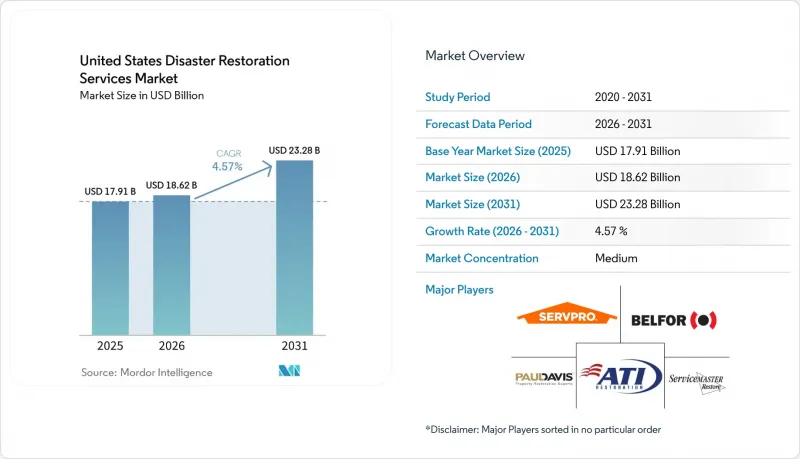
According to Mordor Intelligence, the United States disaster restoration services market size is expected to grow from USD 17.91 billion in 2025 to USD 18.62 billion in 2026 and is forecast to reach USD 23.28 billion by 2031 at 4.57% CAGR over 2026-2031.
United States Disaster Restoration Services Market Trends and Insights
More Frequent Severe Convective Storm and Flood-Related Property Losses
The United States disaster restoration services market receives a major demand stimulus when widespread storms damage homes, businesses, and public facilities at the same time. Climate Central recorded USD 23 billion in weather and climate disasters in 2025, with total damages of USD 115 billion. Severe convective storms accounted for 21 of those events, which was a new annual record and reflected concentrated tornado outbreaks across the central United States. January 2025 Los Angeles wildfires caused USD 61.2 billion in estimated damage, damaged or destroyed more than 16,000 properties, and led to more than 200,000 evacuations. The interval between billion-dollar disasters fell from 82 days in the 1980s to 16 days during 2016-2025, leaving less time for contractors and carriers to clear prior losses. A 2025 study estimated a 54% probability that aggregate United States weather and climate disaster damages would exceed USD 1 trillion during 2026-2030, supporting the need for larger restoration capacity.
Aging Housing Stock and Building Systems Requiring Repeated Mitigation
Aging homes create recurring repair needs for the United States disaster restoration services market because older plumbing, electrical, roofing, and HVAC systems fail more often. Nearly 48% of owner-occupied homes were built before 1980, and the median age of owner-occupied housing reached 41 years in 2023, up from 31 years in 2005. Harvard University's Joint Center for Housing Studies found that maintenance spending for homes built before 1980 was 76% higher than for homes built from 2010 onward. That spending gap reflects more frequent system failures that can lead to water damage, fire damage, mold, and related remediation work. New construction added only 3% to the owner-occupied housing stock from 2020 through 2023, so new supply did little to change the age profile. Older homes with delayed upkeep can require work across several systems after one event, increasing both the scope and the billable value of a job. This base of recurring work gives providers a steadier assignment flow beyond major catastrophe periods.
Business-Interruption Avoidance and Demand for End-To-End Recovery
Commercial clients use the United States disaster restoration services market to reduce the period during which a damaged site cannot operate. Business-interruption coverage commonly addresses lost income during the period of restoration, so policyholders and insurers both have a reason to shorten recovery time. The Insurance Information Institute stated that business-interruption losses can range from USD 500,000 to USD 3 million for mid-tier operations and from USD 5 million to USD 50 million or more for major facilities with complex supply chains. This financial exposure favors contractors that coordinate emergency mitigation, structural repair, and reconstruction through one project team. Risk managers and underwriters have placed more attention on restoration duration as business-interruption coverage has become harder to secure. Providers that complete work efficiently can therefore compete on recovery planning and documentation, rather than only on initial cleanup pricing. The United States disaster restoration services market benefits when broader recovery work is assigned to one contractor after a large commercial loss.
Other drivers and restraints analyzed in the detailed report include:
- Insurer Preferred-Vendor Networks Expanding Outsourced Restoration Volume
- Skilled Technician Shortages and Certification Bottlenecks
- Insurance Payment Delays, Scope Disputes, and Claims-Administration Friction
For complete list of drivers and restraints, kindly check the Table Of Contents.
Segment Analysis
Water damage restoration held 32.60% of the United States disaster restoration services market share in 2025. The segment has a large volume of calls because plumbing failures, appliance leaks, sewage backups, and weather-related flooding occur in every region. The Insurance Information Institute estimated that 1 in 60 insured homes filed a water or freezing damage claim each year. This recurring incidence gives water work a dependable demand floor and supports local response networks. Fire and smoke damage restoration saw heavier demand after the January 2025 Los Angeles wildfires. ATI Restoration deployed more than 1,000 team members and managed more than 500 recovery projects in Southern California during that response. Storm and catastrophe work also increased with the 21 severe-storm billion-dollar events recorded in 2025. These events can require providers to move crews and equipment across state lines while maintaining everyday local assignments.
Others is the fastest-growing service group, with a projected 6.90% CAGR through 2031 for the United States disaster restoration services market size. This category includes contents restoration, pack-out, cleaning, storage, personal property management, and document drying. Clients often seek one provider that can address property contents and structural work in the same recovery plan. Mold remediation grows after water events create secondary contamination that needs specialized treatment. Biohazard and trauma cleanup is also extending into health care, multifamily housing, and commercial settings under IICRC S540 protocols. Specialty services can gain scope where pre-assessment is needed for older buildings, including properties subject to EPA lead paint disclosure rules. The combination of secondary services and full recovery expectations gives companies more opportunities to retain work after the initial emergency call.
Complete Report Scope:
- By Service Type
- Water Damage Restoration (drying/dehumidification, sewage backup)
- Fire & Smoke Damage Restoration
- Mold Remediation
- Storm / Catastrophe Restoration (wind, hail, flood response, large-loss)
- Biohazard & Trauma Cleanup (crime scene, unattended death, infectious cleanup)
- Specialty Services
- Others (contents restoration, pack-out, cleaning, storage, etc.)
- By Application
- Residential
- Commercial & Industrial
- By Customer/Payor Type
- Insurance-funded Restoration Work
- Self-funded / Direct-pay Restoration Work
- Public-sector / Government-funded Restoration Work
List of Companies Covered in this Report:
- SERVPRO Industries, LLC
- BELFOR Holdings Inc.
- ServiceMaster Restore
- ATI Restoration
- Paul Davis Restoration, Inc.
- First Onsite Property Restoration
- Blackmon Mooring and BMS CAT
- Rainbow Restoration
- PuroClean
- DKI Services
- BluSky Restoration Contractors
- Kustom US
- Cotton Global Disaster Solutions
- Signal Restoration Services
- Steamatic Inc.
- Restoration 1
- Rytech Restoration
- FRSTeam
- Bio-One Inc.
- United Water Restoration Group
- Polygon Group
Additional Benefits:
- The market estimate (ME) sheet in Excel format
- 3 months of analyst support
TABLE OF CONTENTS
1 INTRODUCTION
- 1.1 Study Assumptions and Market Definition
- 1.2 Scope of the Study
2 RESEARCH METHODOLOGY
3 EXECUTIVE SUMMARY
4 MARKET LANDSCAPE
- 4.1 Market Overview
- 4.1.1 United States Market Structure and Operating Model
- 4.1.2 Restoration Service Mix: Mitigation, Remediation, Restoration and Reconstruction
- 4.1.3 Recurring Losses vs. Catastrophe-Driven Demand
- 4.1.4 Demand by Property Type: Residential, Commercial and Industrial
- 4.1.5 Demand by Loss Type: Water, Fire & Smoke, Storm & Flood, Mold and Specialty Restoration
- 4.1.6 Insurance-Assigned vs. Direct-Pay Restoration
- 4.1.7 Response Time, Service Coverage and Catastrophe Capacity
- 4.1.8 Seasonal Demand and Disaster-Driven Demand Surges
- 4.2 Restoration Ecosystem
- 4.2.1 Property Owners, Facility Managers and Property Managers
- 4.2.2 Insurers, Adjusters, TPAs and Managed-Repair Networks
- 4.2.3 Restoration Contractors, Franchise Networks and National Platforms
- 4.2.4 General Contractors and Specialty Service Providers
- 4.2.5 Equipment, Technology and Restoration Supply Providers
- 4.2.6 Government and Public-Sector Restoration Buyers
- 4.2.7 Certification, Training and Regulatory Organizations
- 4.3 Demand Patterns
- 4.3.1 Water and Plumbing-Related Losses
- 4.3.2 Fire, Smoke and Wildfire Damage
- 4.3.3 Storm, Flood and Severe Weather Damage
- 4.3.4 Mold and Environmental Restoration
- 4.3.5 Specialty and Biohazard Restoration
- 4.3.6 Catastrophe vs. Recurring Loss Demand
- 4.4 Regional Dynamics
- 4.4.1 Northeast
- 4.4.2 Midwest
- 4.4.3 South and Gulf Coast
- 4.4.4 West
- 4.4.5 Major Catastrophe-Prone Markets
- 4.4.6 Metropolitan vs. Rural Service Coverage
- 4.5 Insurance Involvement
- 4.5.1 Property and Casualty Insurance Claims
- 4.5.2 Homeowners, Commercial Property and Specialty Insurance
- 4.5.3 Deductibles, Coverage Limits and Underinsurance
- 4.5.4 Preferred-Vendor and Managed-Repair Programs
- 4.5.5 Claims Documentation, Estimation and Scope Management
- 4.5.6 Catastrophe Insurance Capacity and Market Changes
- 4.5.7 Federal Disaster Assistance and Flood Insurance
- 4.6 Market Drivers
- 4.6.1 More Frequent Severe Convective Storm and Flood-Related Property Losses
- 4.6.2 Aging Housing Stock and Building Systems Requiring Repeated Mitigation
- 4.6.3 Insurer Preferred-Vendor Networks Expanding Outsourced Restoration Volume
- 4.6.4 Business-Interruption Avoidance and Demand for End-to-End Recovery
- 4.6.5 Connected Leak Detection and Digital Claims Integration Creating Earlier Intervention Demand
- 4.6.6 Secondary-Market Franchise Expansion Improving Coverage in Underserved U.S. Territories
- 4.7 Market Restraints
- 4.7.1 Skilled Technician Shortages and Certification Bottlenecks
- 4.7.2 Insurance Payment Delays, Scope Disputes, and Claims-Administration Friction
- 4.7.3 Catastrophe Surge Capacity Mismatch and Local Labor Displacement
- 4.7.4 Preventive Monitoring Reducing the Volume of Severe Reactive Losses
- 4.8 Value & Supply-Chain Analysis
- 4.8.1 Restoration Services Value Chain
- 4.8.2 Equipment, Chemicals and Consumables Supply Chain
- 4.8.3 Claims, Billing and Payment Workflow
- 4.9 Regulatory Landscape
- 4.9.1 Federal and State Restoration Regulations
- 4.9.2 Environmental and Safety Regulations
- 4.9.3 Insurance and Consumer-Protection Regulations
- 4.10 Technological Outlook
- 4.10.1 AI, Digital Inspection and Automation
- 4.10.2 IoT, Remote Monitoring and Loss Prevention
- 4.10.3 Advanced Restoration Technologies
- 4.10.4 Digital Claims, Dispatch and Workflow Platforms
5 MARKET SIZE AND GROWTH FORECASTS (Value, In USD Billion)
- 5.1 By Service Type
- 5.1.1 Water Damage Restoration (drying/dehumidification, sewage backup)
- 5.1.2 Fire & Smoke Damage Restoration
- 5.1.3 Mold Remediation
- 5.1.4 Storm / Catastrophe Restoration (wind, hail, flood response, large-loss)
- 5.1.5 Biohazard & Trauma Cleanup (crime scene, unattended death, infectious cleanup)
- 5.1.6 Specialty Services
- 5.1.7 Others (contents restoration, pack-out, cleaning, storage, etc.)
- 5.2 By Application
- 5.2.1 Residential
- 5.2.2 Commercial & Industrial
- 5.3 By Customer/Payor Type
- 5.3.1 Insurance-funded Restoration Work
- 5.3.2 Self-funded / Direct-pay Restoration Work
- 5.3.3 Public-sector / Government-funded Restoration Work
6 COMPETITIVE LANDSCAPE
- 6.1 Market Concentration
- 6.2 Strategic Moves
- 6.3 Market Share Analysis
- 6.4 Company Profiles (includes Global Level Overview, Market Level Overview, Core Segments, Financials as available, Strategic Information, Products and Services, Recent Developments)
- 6.4.1 SERVPRO Industries, LLC
- 6.4.2 BELFOR Holdings Inc.
- 6.4.3 ServiceMaster Restore
- 6.4.4 ATI Restoration
- 6.4.5 Paul Davis Restoration, Inc.
- 6.4.6 First Onsite Property Restoration
- 6.4.7 Blackmon Mooring and BMS CAT
- 6.4.8 Rainbow Restoration
- 6.4.9 PuroClean
- 6.4.10 DKI Services
- 6.4.11 BluSky Restoration Contractors
- 6.4.12 Kustom US
- 6.4.13 Cotton Global Disaster Solutions
- 6.4.14 Signal Restoration Services
- 6.4.15 Steamatic Inc.
- 6.4.16 Restoration 1
- 6.4.17 Rytech Restoration
- 6.4.18 FRSTeam
- 6.4.19 Bio-One Inc.
- 6.4.20 United Water Restoration Group
- 6.4.21 Polygon Group
7 MARKET OPPORTUNITIES AND FUTURE OUTLOOK
- 7.1 White-Space & Unmet-Need Assessment
- 7.1.1 Underserved Geographic and Customer Markets
- 7.1.2 Rapid-Response and Catastrophe Capacity
- 7.1.3 Underinsured Customer Restoration
- 7.1.4 Commercial Pre-Loss and Business-Continuity Services
- 7.1.5 Preventive and Subscription-Based Restoration
- 7.2 Future Outlook
- 7.2.1 Market Consolidation and Platform Expansion
- 7.2.2 Digital and Insurance-Integrated Restoration
- 7.2.3 Climate-Adapted Restoration Services
- 7.2.4 Full-Service Restoration and Reconstruction
- 7.2.5 Predictive Monitoring and Remote Assessment
- 7.2.6 Sustainable Restoration Practices

