PUBLISHER: Mordor Intelligence | PRODUCT CODE: 2157060

PUBLISHER: Mordor Intelligence | PRODUCT CODE: 2157060
Asia-Pacific Disaster Restoration Services - Market Share Analysis, Industry Trends & Statistics, Growth Forecasts (2026 - 2031)
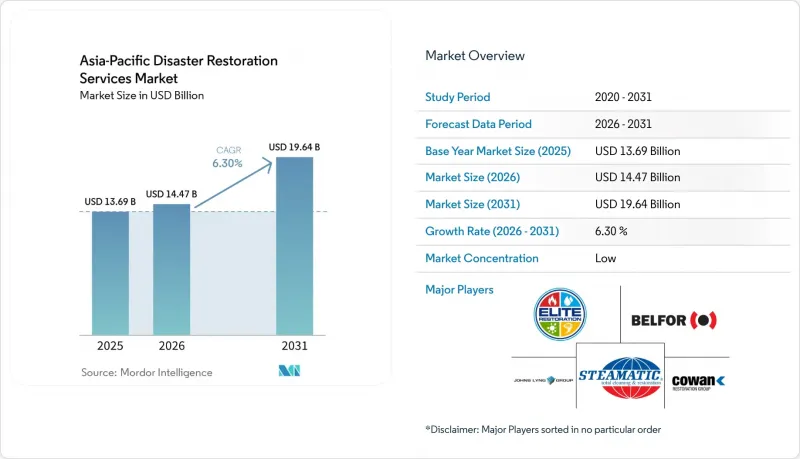
According to Mordor Intelligence, the Asia-Pacific disaster restoration services market size was valued at USD 13.69 billion in 2025 and is estimated to grow from USD 14.47 billion in 2026 to reach USD 19.64 billion by 2031, at a CAGR of 6.30% during the forecast period (2026-2031).
Asia-Pacific Disaster Restoration Services Market Trends and Insights
Rising Flood, Typhoon, Earthquake, and Bushfire Loss Exposure
Flooding generated USD 31 billion in economic losses across Asia during 2025 and represented more than half of the region's natural catastrophe losses. This loss pattern kept water removal, dehumidification, cleaning, and rebuilding work in steady demand across the Asia-Pacific disaster restoration services market. A sequence of tropical systems affected Thailand, Indonesia, and Malaysia from late November to early December 2025. The events occurred within 5-15 days, saturated soil, overwhelmed flood defenses, and generated at least USD 11 billion in losses. The March 2025 Myanmar earthquake added a different form of recovery demand, including structural remediation and cross-border mobilization. Australia's Cyclone Alfred, May flooding, and late-year hail events also tested restoration panel capacity during 2025.
Increasing Insurance Penetration and Property-Insurance Claims Outsourcing
Insurance penetration remained uneven across Asia-Pacific, yet insured flood losses increased as more property owners entered formal coverage channels. The regional protection gap remained significant, which left governments and households responsible for a large share of disaster costs. The Asia-Pacific disaster restoration services market, therefore, includes both insurer-directed work and self-funded or public recovery activity. In Australia and Japan, insurer-panel systems have supported the use of certified providers with established reporting processes. Johns Lyng Group reported new multiyear contracts with Zurich, AIG, Aidacare, and TIO in FY2025, together with extensions involving Suncorp, Hollard, Allianz, Auto & General, and Market Lane Group. ASEAN+3 finance ministers endorsed the Disaster Risk Financing Initiative's 2026-28 roadmap in May 2026, supporting stronger disaster-risk financing structures across the region.
Uneven Insurance Coverage and High Self-Pay Friction in Emerging Asia-Pacific Markets
Non-life insurance penetration in emerging and developing Asia-Pacific remained well below the average level across OECD countries during 2025. Many disaster-affected property owners therefore paid for recovery directly, delayed work, reduced the scope of repairs, or relied on informal labor. This pattern constrained formal demand in the Asia-Pacific disaster restoration services market despite substantial physical damage exposure. AMRO reported an 88% protection gap for Asia over the 2016-2025 period. Government funding often filled part of this gap, but it did not always create standardized restoration assignments. Wider use of microinsurance, parametric products, and public risk pools could improve access over time, although these mechanisms have not reached a broad operating scale in lower-middle-income economies.
Other drivers and restraints analyzed in the detailed report include:
- Urban Property Density and Higher Replacement Value of Contents and Equipment
- Government and Corporate Investment in Resilient Infrastructure and Business Continuity
- Shortage of Certified Technicians and Catastrophe-Scale Equipment Outside Major Cities
For complete list of drivers and restraints, kindly check the Table Of Contents.
Segment Analysis
Water damage restoration held 38.0% of the Asia-Pacific disaster restoration services market size in 2025. The category included drying, dehumidification, and sewage backup remediation. Recurrent monsoons and typhoon flooding supported its leading position across the region. Floods accounted for more than half of Asia's natural catastrophe losses in 2025, keeping water-related recovery work central to the service mix. Tropical humidity made timely moisture mapping and drying especially important for building assemblies and concealed mechanical systems. Providers with desiccant or refrigerant drying capability and microbial risk controls were better placed to manage insurer-funded assignments. Storm and catastrophe restoration also expanded as wind, hail, and flood events affected the Philippines, Japan, and Australia.
The others category is forecast to grow at a 7.2% CAGR during 2026-2031, making it the fastest-growing service type. It included contents restoration, pack-out logistics, cleaning, and storage. Higher values for electronics, furnishings, and business equipment increased the need to recover content rather than replace them. Specialty services included electronics and data recovery, cleanroom decontamination, and infrastructure-grade restoration. These services gained importance among semiconductor and logistics clients who used preferred vendor arrangements. Fire and smoke restoration remained relevant in Australia because of bushfire exposure and in dense cities where electrical faults can affect multiple floors. Biohazard and trauma cleanup remained smaller by revenue but continued to form part of the regional service offering. IICRC S500 and S520 standards shaped eligibility for water damage and mold remediation work in mature insurance systems.
Complete Report Scope:
- By Service Type
- Water Damage Restoration (drying/dehumidification, sewage backup)
- Fire & Smoke Damage Restoration
- Mold Remediation
- Storm / Catastrophe Restoration (wind, hail, flood response, large-loss)
- Biohazard & Trauma Cleanup (crime scene, unattended death, infectious cleanup)
- Specialty Services
- Others (contents restoration, pack-out, cleaning, storage, etc.)
- By Application
- Residential
- Commercial & Industrial
- By Customer/Payor Type
- Insurance-funded Restoration Work
- Self-funded / Direct-pay Restoration Work
- Public-sector / Government-funded Restoration Work
- By Geography
- China
- India
- Japan
- Australia
- Indonesia
- Philippines
- Thailand
- Vietnam
- Malaysia
- Bangladesh
- Rest of Asia-Pacific
List of Companies Covered in this Report:
- BELFOR Holdings, Inc.
- Johns Lyng Group Limited
- Steamatic Australia
- Cowan Restoration Group
- Elite Restoration
- MSA Property Care and Restorations
- Flood Services Australia
- AllAces
- Biodec Restoration Specialists
- Water Damage Specialist
- Reztor Restoration
- Big Red Pte Ltd
- Approved Group International
- Bright Symphony Sdn Bhd
- RecoveryPRO
- SPREAD CO Limited
- ServiceMaster Restore
- Polygon group
- SERVPRO Industries LLC
Additional Benefits:
- The market estimate (ME) sheet in Excel format
- 3 months of analyst support
TABLE OF CONTENTS
1 INTRODUCTION
- 1.1 Study Assumptions and Market Definition
- 1.2 Scope of the Study
2 RESEARCH METHODOLOGY
3 EXECUTIVE SUMMARY
4 MARKET LANDSCAPE
- 4.1 Market Overview
- 4.1.1 Demand by Disaster Event and Property Type
- 4.1.2 Restoration Service Mix
- 4.1.3 Customer and Demand Structure
- 4.1.4 Market Structure and Competitive Landscape
- 4.1.5 Insurance Involvement
- 4.1.6 Regional Dynamics
- 4.1.7 Response Capacity and Mobilization
- 4.2 Market Drivers
- 4.2.1 Rising Flood, Typhoon, Earthquake, and Bushfire Loss Exposure
- 4.2.2 Increasing Insurance Penetration and Property-Insurance Claims Outsourcing
- 4.2.3 Urban Property Density and Higher Replacement Value of Contents and Equipment
- 4.2.4 Government and Corporate Investment in Resilient Infrastructure and Business Continuity
- 4.2.5 Insurer Demand for Documented, Certified and Rapid Loss Mitigation
- 4.2.6 Humidity-Driven Secondary Damage and Hidden-Moisture Detection in Tropical Buildings
- 4.3 Market Restraints
- 4.3.1 Uneven Insurance Coverage and High Self-Pay Friction in Emerging Asia-Pacific Markets
- 4.3.2 Shortage of Certified Technicians and Catastrophe-Scale Equipment Outside Major Cities
- 4.3.3 Fragmented Claims Protocols, Local Licensing and Inconsistent Restoration Standards
- 4.3.4 Limited Salvageability Windows for Water-Impacted Electronics, Data Centres and Industrial Assets
- 4.4 Value & Supply-Chain Analysis
- 4.4.1 Restoration Services Value Chain
- 4.4.2 Equipment, Chemicals, and Consumables Supply Chain
- 4.4.3 Labour and Specialist-Service Availability
- 4.4.4 Claims and Quality-Management Workflow
- 4.5 Regulatory Landscape
- 4.5.1 Building, Environmental, and Safety Regulations
- 4.5.2 Hazardous-Material and Environmental-Health Regulations
- 4.5.3 Insurance and Consumer-Protection Regulations
- 4.5.4 Disaster Management and Public-Procurement Framework
- 4.6 Technological Outlook
- 4.6.1 Digital Inspection and Remote Monitoring
- 4.6.2 AI, IoT, and Claims Automation
- 4.6.3 Drones and Remote Damage Assessment
- 4.6.4 Advanced Restoration Technologies
- 4.6.5 Robotics and Automation
5 MARKET SIZE AND GROWTH FORECASTS (VALUE, IN USD BILLION)
- 5.1 By Service Type
- 5.1.1 Water Damage Restoration (drying/dehumidification, sewage backup)
- 5.1.2 Fire & Smoke Damage Restoration
- 5.1.3 Mold Remediation
- 5.1.4 Storm / Catastrophe Restoration (wind, hail, flood response, large-loss)
- 5.1.5 Biohazard & Trauma Cleanup (crime scene, unattended death, infectious cleanup)
- 5.1.6 Specialty Services
- 5.1.7 Others (contents restoration, pack-out, cleaning, storage, etc.)
- 5.2 By Application
- 5.2.1 Residential
- 5.2.2 Commercial & Industrial
- 5.3 By Customer/Payor Type
- 5.3.1 Insurance-funded Restoration Work
- 5.3.2 Self-funded / Direct-pay Restoration Work
- 5.3.3 Public-sector / Government-funded Restoration Work
- 5.4 By Geography
- 5.4.1 China
- 5.4.2 India
- 5.4.3 Japan
- 5.4.4 Australia
- 5.4.5 Indonesia
- 5.4.6 Philippines
- 5.4.7 Thailand
- 5.4.8 Vietnam
- 5.4.9 Malaysia
- 5.4.10 Bangladesh
- 5.4.11 Rest of Asia-Pacific
6 COMPETITIVE LANDSCAPE
- 6.1 Market Concentration
- 6.2 Strategic Moves
- 6.3 Market Share Analysis
- 6.4 Company Profiles (includes Global Level Overview, Market Level Overview, Core Segments, Financials as available, Strategic Information, Products and Services, Recent Developments)
- 6.4.1 BELFOR Holdings, Inc.
- 6.4.2 Johns Lyng Group Limited
- 6.4.3 Steamatic Australia
- 6.4.4 Cowan Restoration Group
- 6.4.5 Elite Restoration
- 6.4.6 MSA Property Care and Restorations
- 6.4.7 Flood Services Australia
- 6.4.8 AllAces
- 6.4.9 Biodec Restoration Specialists
- 6.4.10 Water Damage Specialist
- 6.4.11 Reztor Restoration
- 6.4.12 Big Red Pte Ltd
- 6.4.13 Approved Group International
- 6.4.14 Bright Symphony Sdn Bhd
- 6.4.15 RecoveryPRO
- 6.4.16 SPREAD CO Limited
- 6.4.17 ServiceMaster Restore
- 6.4.18 Polygon group
- 6.4.19 SERVPRO Industries LLC
7 MARKET OPPORTUNITIES AND FUTURE OUTLOOK
- 7.1 White-Space & Unmet-Need Assessment
- 7.1.1 Underserved Geographic and Customer Markets
- 7.1.2 Specialized Restoration for Industrial and Critical Infrastructure
- 7.1.3 Preventive and Pre-Loss Restoration Services
- 7.1.4 Public-Sector and Resilience-Based Restoration
- 7.2 Future Outlook
- 7.2.1 Demand and Market Expansion Outlook
- 7.2.2 Insurance and Digitalization Trends
- 7.2.3 Technology Adoption
- 7.2.4 Strategic Priorities for Market Participants
- 7.2.5 Technology Adoption Outlook
- 7.2.6 Strategic Priorities for Regional and Local Operators

