PUBLISHER: Mordor Intelligence | PRODUCT CODE: 2156949

PUBLISHER: Mordor Intelligence | PRODUCT CODE: 2156949
North America Disaster Restoration Services - Market Share Analysis, Industry Trends & Statistics, Growth Forecasts (2026 - 2031)
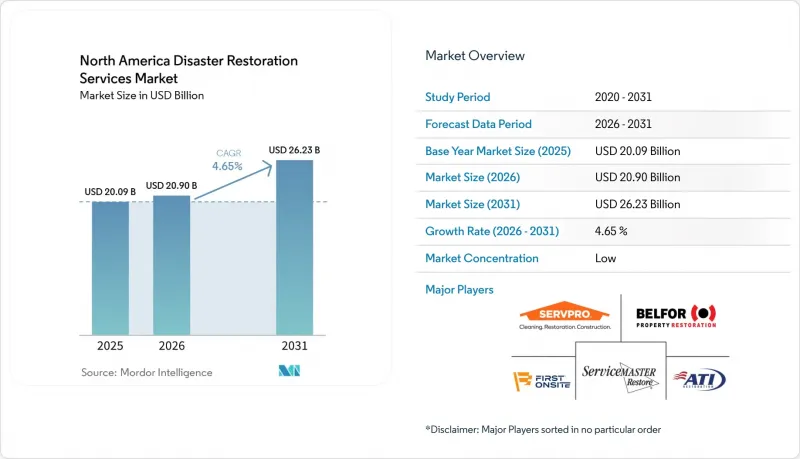
According to Mordor Intelligence, the North America disaster restoration services market size was valued at USD 20.09 billion in 2025 and is estimated to grow from USD 20.90 billion in 2026 to reach USD 26.23 billion by 2031, at a CAGR of 4.65% during the forecast period (2026-2031).
North America Disaster Restoration Services Market Trends and Insights
Increasing Secondary-Peril Losses Across Wildfire and Severe Convective Storm Corridors
Wildfires, severe convective storms, hail, and atmospheric-river flooding are increasing restoration demand across most of the parts of North America. The United States recorded 23 billion-dollar disasters in weather and climate disasters in 2025, including 21 severe convective weather events, with USD 115 billion in direct losses. The January 2025 Los Angeles wildfire complex caused USD 61.2 billion in losses and placed sustained pressure on local restoration capacity. A 2025 Geophysical Research Letters study placed the probability of the United States weather and climate disaster losses exceeding USD 1 trillion during 2026 to 2030 above 50%. These events increase demand for emergency mitigation, cleaning, reconstruction, and content recovery services. Operators with equipment, certified crews, and cross-regional capacity can accept work that smaller local firms may not be able to take. The North America disaster restoration services market benefits when carrier networks need contractors that can respond quickly in affected locations. This driver also reinforces the value of established franchise and large-loss networks during extended recovery periods.
Aging Buildings and Deferred Maintenance Increasing Water-Loss Frequency
Aging water, stormwater, and wastewater systems create a consistent source of restoration work outside major catastrophe periods. ASCE gave the United States stormwater infrastructure a D grade and wastewater infrastructure a D+ grade in its 2025 report card The same report identified a USD 3.7 trillion national infrastructure investment gap. Pipe failures, sewage backups, and moisture intrusion require drying, cleanup, and remediation work in homes and commercial buildings. The National Park Service reported USD 24 billion in deferred maintenance and repair needs across more than 70,000 assets in FY 2025. Contractors use moisture mapping, thermal imaging, and drying equipment to document losses and control the risk of mold. The North America disaster restoration services market, therefore, has a recurring demand base that is not limited to weather-related claims. IICRC standards and worker safety requirements favor firms that maintain formal training and documentation processes.
Insurance Retrenchment, Coverage Gaps and Claim-Settlement Friction
Insurance coverage withdrawals can reduce the pool of funded restoration work in high-risk locations. NAIC data showed that company-initiated homeowner policy nonrenewal rates rose between 96% and 216% across four major United States regions between 2018 and 2025. A 2025 NAIC paper reported that seven large California homeowners' insurers, representing 35% of the state market, stopped writing new policies between 2023 and 2025. The paper also reported that the national share of uninsured homeowners rose from 5% in 2019 to 12% in 2023. In California, residual-market policy exposure rose from 50,000 in 2023 to more than 320,000 at the end of 2025. Restoration firms can encounter delayed, disputed, or unavailable reimbursement when claims coverage is limited. Lower reimbursement can restrict margin and investment in the areas with the most frequent property losses. The North America disaster restoration services market faces this constraint most directly in wildfire and coastal catastrophe corridors. NAIC's ZIP-code-level homeowners data call covering 2018 to 2025 may inform future policy and regulatory decisions.
Other drivers and restraints analyzed in the detailed report include:
- Insurance Claim Digitization and Preferred-Vendor Routing
- Franchise and Catastrophe-Capacity Expansion into Underserved Secondary Markets
- Shortage of Certified Technicians and Reconstruction Trades
For complete list of drivers and restraints, kindly check the Table Of Contents.
Segment Analysis
Water damage restoration accounted for 32.6% of the North America disaster restoration services market size in 2025. The segment includes drying, dehumidification, sewage backup response, and moisture mitigation. Aging plumbing systems create frequent losses in homes, commercial properties, and public buildings. Severe storms and atmospheric river flooding also increase the need for water removal and drying work. Incomplete drying can lead to mold conditions, which can expand the scope of an original claim. Water damage restoration is therefore linked to both everyday property maintenance issues and weather-related events. Contractors use moisture mapping, thermal imaging, and documented drying procedures to define the required work. IICRC S500 standards guide professional water damage restoration practices.
The Others category is expected to be the fastest-growing service type, with a CAGR of 6.90% through 2031. The category includes contents restoration, pack-out, cleaning, and storage services. Insurers increasingly require contents inventories and pack-out services for large water and fire claims. These services add work that can follow policy activity rather than only major catastrophe events. Fire and smoke restoration also has higher job values because it requires specialized decontamination, odor control, and contents cleaning. IICRC S700 standards guide fire and smoke restoration processes. Specialty work can include asbestos abatement, lead paint remediation, and environmental cleanup during reconstruction. EPA and OSHA requirements affect how contractors manage this work. This range of services helps providers support a broader restoration scope after property damage.
Complete Report Scope:
- By Service Type
- Water Damage Restoration (drying/dehumidification, sewage backup)
- Fire & Smoke Damage Restoration
- Mold Remediation
- Storm / Catastrophe Restoration (wind, hail, flood response, large-loss)
- Biohazard & Trauma Cleanup (crime scene, unattended death, infectious cleanup)
- Specialty Services
- Others (contents restoration, pack-out, cleaning, storage, etc.)
- By Application
- Residential
- Commercial & Industrial
- By Customer/Payor Type
- Insurance-funded Restoration Work
- Self-funded / Direct-pay Restoration Work
- Public-sector / Government-funded Restoration Work
- By Geography
- United States
- Canada
- Mexico
List of Companies Covered in this Report:
- SERVPRO Industries, LLC
- BELFOR Holdings, Inc.
- ServiceMaster Restore
- First Onsite Property Restoration
- ATI Restoration
- Paul Davis Restoration, Inc.
- PuroClean
- Polygon Group
- DKI Services
- On Side Restoration
- WINMAR
- BMS CAT
- BluSky Restoration Contractors
- Rainbow Restoration
- Restoration 1
- Signal Restoration Services
- Steamatic
- United Water Restoration Group
- Johns Lyng Group
- Delta Restoration Services
- Ideal Restoration
Additional Benefits:
- The market estimate (ME) sheet in Excel format
- 3 months of analyst support
TABLE OF CONTENTS
1 INTRODUCTION
- 1.1 Study Assumptions and Market Definition
- 1.2 Scope of the Study
2 RESEARCH METHODOLOGY
3 EXECUTIVE SUMMARY
4 MARKET LANDSCAPE
- 4.1 Market Overview
- 4.1.1 North America Demand Profile and Loss-Frequency Patterns
- 4.1.2 Recurring Losses vs. Catastrophe-Driven Demand
- 4.1.3 Demand Mix by Water, Fire & Smoke, Storm & Flood, Mold & Environmental, and Other Losses
- 4.1.4 Demand Mix by Residential, Commercial & Industrial
- 4.1.5 Insured Claims vs. Direct-Pay and Public-Funded Restoration
- 4.1.6 Restoration Workflow: Emergency Response, Mitigation, Remediation and Reconstruction
- 4.1.7 Customer Buying Criteria: Response Time, Cost, Documentation and Certification
- 4.2 Market Drivers
- 4.2.1 Increasing Secondary-Peril Losses Across Wildfire and Severe Convective Storm Corridors
- 4.2.2 Aging Buildings and Deferred Maintenance Increasing Water-Loss Frequency
- 4.2.3 Insurance Claim Digitization and Preferred-Vendor Routing
- 4.2.4 Franchise and Catastrophe-Capacity Expansion Into Underserved Secondary Markets
- 4.2.5 Resilience, Building-Code, and Public-Recovery Investment Expanding Restoration Scope
- 4.2.6 Smart Leak Detection and Pre-Loss Monitoring Creating Recurring Restoration Contracts
- 4.3 Market Restraints
- 4.3.1 Insurance Retrenchment, Coverage Gaps and Claim-Settlement Friction
- 4.3.2 Shortage of Certified Technicians and Reconstruction Trades
- 4.3.3 Rising Equipment, Materials, Labor, and Compliance Costs Compressing Margins
- 4.3.4 Demand Volatility and Capacity Mismatch Between Catastrophe Surges and Normal Periods
- 4.4 Value and Supply-Chain Analysis
- 4.4.1 Lead Generation, Claims Notification and Estimation
- 4.4.2 Emergency Mitigation and Restoration Services
- 4.4.3 Remediation, Cleaning and Contents Restoration
- 4.4.4 Repair and Reconstruction Services
- 4.4.5 Equipment, Chemicals, Consumables and Waste-Disposal Supply Chain
- 4.4.6 Insurance, Financing and Payment-Collection Ecosystem
- 4.5 Market Structure & Competitive Ecosystem
- 4.5.1 National Franchise Platforms
- 4.5.2 Regional and Independent Restoration Contractors
- 4.5.3 Insurers, TPAs, Adjusters and Managed-Repair Networks
- 4.5.4 Technology, Equipment Rental and Estimating Platforms
- 4.5.5 Market Fragmentation, Consolidation and Private-Equity Activity
- 4.6 Regional Dynamics
- 4.6.1 United States vs. Canada
- 4.6.2 United States Regional Demand: Southeast & Gulf Coast, West, Midwest, Northeast
- 4.6.3 Canada Regional Demand: Western Canada, Central & Eastern Canada
- 4.6.4 Regional Demand Drivers: Hurricanes, Floods, Wildfires, Winter Storms, Freeze Events and Severe Storms
- 4.6.5 Seasonal Demand and Cross-Regional Capacity Mobilization
- 4.7 Insurance & Payment Structure
- 4.7.1 Insured Property Claims
- 4.7.2 Direct-Pay and Uninsured Restoration
- 4.7.3 Government Disaster Assistance and Public-Sector Contracts
- 4.7.4 Preferred-Vendor and Managed-Repair Programs
- 4.7.5 Claim Documentation, Estimation and Audit Requirements
- 4.7.6 Coverage, Deductibles and Underinsurance
- 4.8 Regulatory Landscape
- 4.8.1 Federal, State and Provincial Restoration Requirements
- 4.8.2 Contractor Licensing, Environmental and Occupational-Safety Requirements
- 4.8.3 Mold, Asbestos, Lead, Biohazard and Hazardous-Material Regulations
- 4.8.4 Building Codes, Reconstruction Permits and Resilience Standards
- 4.8.5 Waste Disposal, Transportation and Water-Discharge Regulations
- 4.9 Technological Outlook
- 4.9.1 Digital Inspection, Thermal Imaging and Moisture Mapping
- 4.9.2 IoT-Based Leak Detection and Pre-Loss Monitoring
- 4.9.3 AI-Assisted Estimating, Scoping and Claims Documentation
- 4.9.4 Drones, 3D Site Capture and Digital Assessment
- 4.9.5 Cloud-Based Workflow, Dispatch and Customer-Communication Platforms
- 4.9.6 Advanced Drying, Containment and Air-Quality Technologies
- 4.9.7 Sustainable Chemicals, Energy-Efficient Equipment and Low-Waste Restoration
5 MARKET SIZE AND GROWTH FORECASTS(Value, In USD Billion)
- 5.1 By Service Type
- 5.1.1 Water Damage Restoration (drying/dehumidification, sewage backup)
- 5.1.2 Fire & Smoke Damage Restoration
- 5.1.3 Mold Remediation
- 5.1.4 Storm / Catastrophe Restoration (wind, hail, flood response, large-loss)
- 5.1.5 Biohazard & Trauma Cleanup (crime scene, unattended death, infectious cleanup)
- 5.1.6 Specialty Services
- 5.1.7 Others (contents restoration, pack-out, cleaning, storage, etc.)
- 5.2 By Application
- 5.2.1 Residential
- 5.2.2 Commercial & Industrial
- 5.3 By Customer/Payor Type
- 5.3.1 Insurance-funded Restoration Work
- 5.3.2 Self-funded / Direct-pay Restoration Work
- 5.3.3 Public-sector / Government-funded Restoration Work
- 5.4 By Geography
- 5.4.1 United States
- 5.4.2 Canada
- 5.4.3 Mexico
6 COMPETITIVE LANDSCAPE
- 6.1 Market Concentration
- 6.2 Strategic Moves
- 6.3 Market Share Analysis
- 6.4 Company Profiles (includes Global Level Overview, Market Level Overview, Core Segments, Financials as available, Strategic Information, Products and Services, Recent Developments)
- 6.4.1 SERVPRO Industries, LLC
- 6.4.2 BELFOR Holdings, Inc.
- 6.4.3 ServiceMaster Restore
- 6.4.4 First Onsite Property Restoration
- 6.4.5 ATI Restoration
- 6.4.6 Paul Davis Restoration, Inc.
- 6.4.7 PuroClean
- 6.4.8 Polygon Group
- 6.4.9 DKI Services
- 6.4.10 On Side Restoration
- 6.4.11 WINMAR
- 6.4.12 BMS CAT
- 6.4.13 BluSky Restoration Contractors
- 6.4.14 Rainbow Restoration
- 6.4.15 Restoration 1
- 6.4.16 Signal Restoration Services
- 6.4.17 Steamatic
- 6.4.18 United Water Restoration Group
- 6.4.19 Johns Lyng Group
- 6.4.20 Delta Restoration Services
- 6.4.21 Ideal Restoration
7 MARKET OPPORTUNITIES AND FUTURE OUTLOOK
- 7.1 White-Space and Unmet-Need Assessment
- 7.1.1 Underserved Geographic and Customer Segments
- 7.1.2 Pre-Loss Prevention, Monitoring and Planning Services
- 7.1.3 Underinsured and Uninsured Property Restoration
- 7.1.4 Emerging Disaster-Specific Restoration Services
- 7.1.5 Sustainable and Low-Carbon Restoration Solutions
- 7.2 Future Outlook
- 7.2.1 Digital Claims Automation and Straight-Through Processing
- 7.2.2 Predictive Monitoring and Preventive Restoration Services
- 7.2.3 Resilience, Mitigation and Restoration Solutions
- 7.2.4 Industry Consolidation and Multi-Regional Expansion
- 7.2.5 Workforce Productivity and Technology-Enabled Operations

