PUBLISHER: Mordor Intelligence | PRODUCT CODE: 2156951

PUBLISHER: Mordor Intelligence | PRODUCT CODE: 2156951
ASEAN Disaster Restoration Services - Market Share Analysis, Industry Trends & Statistics, Growth Forecasts (2026 - 2031)
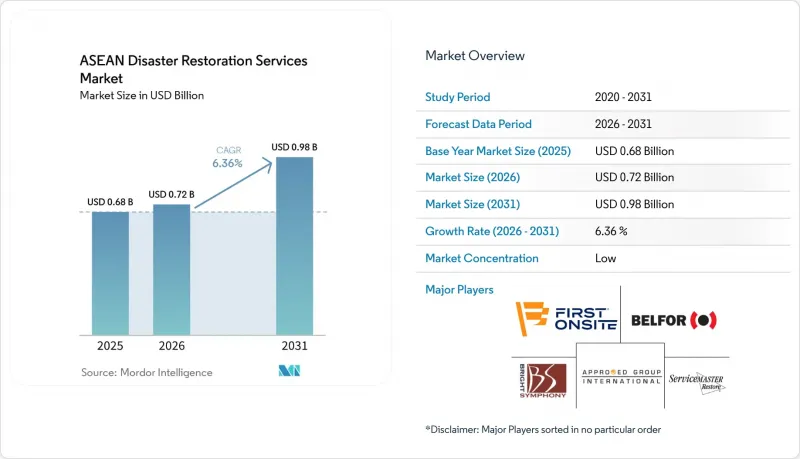
According to Mordor Intelligence, the ASEAN disaster restoration services market size was valued at USD 0.68 billion in 2025 and is estimated to grow from USD 0.72 billion in 2026 to reach USD 0.98 billion by 2031, at a CAGR of 6.36% during the forecast period (2026-2031).
ASEAN Disaster Restoration Services Market Trends and Insights
Increasing Flood, Typhoon, and Extreme-Weather Losses
Floods, typhoons, and tropical storms create the most direct demand base for the ASEAN disaster restoration services market because water, wind, and debris can affect buildings across several countries during the same season. Consecutive events can leave soil saturated and flood defenses under pressure for extended periods, leaving properties more vulnerable to additional water intrusion. That pattern can damage more buildings, widen the affected area, and complicate access to homes, commercial sites, industrial facilities, and public infrastructure. Restoration teams must then manage drying, dehumidification, debris removal, cleaning, and follow-up mold work across many locations with limited time and available crews. The ASEAN disaster restoration services market is affected not only by the number of events but also by their timing, location, and whether they occur in quick succession. Short intervals between disasters can strain crews, extend completion times, delay access to equipment, and raise the value of work required at each damaged structure.
Urbanization and Rising Concentration of High-Value Property
Urban development is concentrating valuable residential, commercial, and industrial property in coastal and riverine locations that are exposed to recurring flood and storm conditions. This concentration raises the cost of restoring a single damaged district after a severe event because more expensive property and more occupants may be affected together. Jakarta illustrates the issue because a large share of Indonesia's economic activity is located within its metropolitan area, where flood-related disruption can affect a wide range of assets. High-value condominiums and branded residences add specialized materials, finishes, fittings, and contents that require more careful recovery than basic repair work. The ASEAN disaster restoration services market, therefore, gains demand from the increasing value of assets at risk rather than from event frequency alone. Greater housing density can also increase the number of households needing professional water removal, cleaning, drying, and mold remediation after neighborhood flooding.
Uneven Insurance Penetration and High Out-of-Pocket Payment Burden
Low insurance penetration limits the portion of disaster damage that can be converted into formal restoration assignments. The ASEAN Secretariat reported 2025 penetration rates from 0.24% in Myanmar to 9.9% in Singapore. Indonesia, Vietnam, and the Philippines remained below the levels seen in more mature insurance markets. Many affected households and smaller businesses consequently rely on direct payments or informal repairs. Indonesia's average annual disaster losses reached USD 31.2 billion, while public funding capacity was USD 750 million. The ASEAN disaster restoration services market remains constrained, where recovery funding cannot support certified restoration work.
Other drivers and restraints analyzed in the detailed report include:
- Industrial, Logistics, and Critical-Infrastructure Expansion
- Rising Insurance-Linked Demand and Claims Professionalization
- Shortage of Certified Technicians and Catastrophe-Response Crews
For complete list of drivers and restraints, kindly check the Table Of Contents.
Segment Analysis
Water damage restoration held 38.5% of the ASEAN disaster restoration services market share in 2025, making it the largest service category across the region. Floods and typhoons create a steady need for drying, dehumidification, cleaning, and mold prevention after water enters homes, workplaces, and public buildings. Water intrusion can affect structures, finishes, furniture, electrical systems, stored materials, and internal spaces at the same site. These related losses increase the scope of work after a single event and require action before moisture causes further deterioration. Indonesia recorded at least 604 flood-related fatalities by December 2025, reflecting the continued severity of flood exposure across affected communities. Commercial clients often need rapid recovery because site closures can disrupt production schedules, inventory handling, logistics, and customer service. Fire and smoke services remain relevant where electrical faults or activated suppression systems create combined losses alongside water damage. Mold remediation follows water damage in humid conditions and can create repeat work after the initial emergency response is complete. The ASEAN disaster restoration services industry must therefore combine urgent work at the site with detailed follow-up recovery work.
The others category, including contents restoration, pack-out, cleaning, and storage, is forecast to grow at a 7.3% CAGR through 2031. Rising household and commercial contents values make restoration more attractive than replacement in claims where damaged items remain recoverable. Electronics, appliances, documents, stored inventory, and specialized business equipment can require separate handling, assessment, cleaning, and recovery. Pack-out services also protect movable contents while structural drying and repair are completed inside the affected property. Digital documentation can make it easier to record damaged items, maintain a clear claim file, and support insurance settlements. The ASEAN Digital Masterplan supports wider use of digital systems that can improve disaster management processes and information sharing. The ASEAN disaster restoration services market has room to develop specialist document and electronics recovery where clients have higher-value possessions or business-critical records. Such services are especially relevant to industrial facilities, logistics operations, and data-intensive businesses with sensitive equipment. Service providers can differentiate themselves when they can restore both the building and the contents inside it with coordinated handling.
Complete Report Scope:
- By Service Type
- Water Damage Restoration (drying/dehumidification, sewage backup)
- Fire & Smoke Damage Restoration
- Mold Remediation
- Storm / Catastrophe Restoration (wind, hail, flood response, large-loss)
- Biohazard & Trauma Cleanup (crime scene, unattended death, infectious cleanup)
- Specialty Services
- Others (contents restoration, pack-out, cleaning, storage, etc.)
- By Application
- Residential
- Commercial & Industrial
- By Customer/Payor Type
- Insurance-funded Restoration Work
- Self-funded / Direct-pay Restoration Work
- Public-sector / Government-funded Restoration Work
- By Geography
- Indonesia
- Philippines
- Thailand
- Vietnam
- Malaysia
- Myanmar
- Rest of ASEAN (Myanmar, Cambodia, Singapore, Laos, Brunei, and Timor-Leste)
List of Companies Covered in this Report:
- BELFOR Holdings Inc.
- Approved Group International
- Bright Symphony Sdn Bhd
- Disaster Restoration Sdn Bhd
- ServiceMaster Restore
- SERVPRO Industries LLC
- First Onsite Restoration
- Polygon Group
- Paul Davis Restoration
- Rainbow International Restoration
- PuroClean
- Restoration 1
- DKI Services
- Bio-One Inc.
- RestorePro Reconstruction
- BMS CAT
- Steamatic
- ATI Restoration
- Johns Lyng Group
- COIT Services
Additional Benefits:
- The market estimate (ME) sheet in Excel format
- 3 months of analyst support
TABLE OF CONTENTS
1 INTRODUCTION
- 1.1 Study Assumptions and Market Definition
- 1.2 Scope of the Study
- 1.3 Revenue and Volume Conventions
- 1.4 ASEAN Country Coverage and Taxonomy
- 1.5 Disaster Restoration Services Included in the Market
- 1.6 Services Excluded from the Market
2 RESEARCH METHODOLOGY
3 EXECUTIVE SUMMARY
4 MARKET LANDSCAPE
- 4.1 Market Overview
- 4.1.1 Disaster Exposure and Event Trends
- 4.1.2 Restoration Service Demand
- 4.1.3 Restoration Service Mix
- 4.1.4 Demand by Property Type
- 4.1.5 Customer and Payor Structure
- 4.1.6 Market Structure and Competitive Landscape
- 4.2 Insurance Involvement & Claims Economics
- 4.2.1 Insurance vs. Direct-Pay Restoration
- 4.2.2 Public-Sector Restoration
- 4.2.3 Claims and Settlement Processes
- 4.2.4 Preferred-Vendor and Loss-Adjuster Networks
- 4.2.5 Insurance Coverage and Underinsurance
- 4.3 Restoration Ecosystem & Value Chain
- 4.3.1 Restoration Services Value Chain
- 4.3.2 Construction and Reconstruction Ecosystem
- 4.3.3 Equipment and Restoration Supply Chain
- 4.3.4 Environmental and Waste-Management Services
- 4.3.5 Technology and Claims-Management Ecosystem
- 4.4 Country Dynamics
- 4.4.1 Indonesia - Disaster Exposure, Market Potential and Industrial Restoration Demand
- 4.4.2 Philippines - Catastrophe Exposure, Restoration Demand and Recovery Ecosystem
- 4.4.3 Vietnam - Disaster Risk, Industrial Growth and Restoration Market Development
- 4.4.4 Thailand - Flood Exposure, Industrial Restoration and Commercial Demand
- 4.4.5 Malaysia - Disaster Exposure, Insurance-Led Restoration and Industrial Demand
- 4.4.6 Singapore - Mature Commercial Market and Specialist Restoration Services
- 4.4.7 Myanmar - Disaster Exposure, Market Development and Restoration-Service Penetration
- 4.4.8 Rest of ASEAN - Market Potential, Disaster Exposure and Service Availability
- 4.5 Market Structure
- 4.5.1 Local and Regional Restoration Contractors
- 4.5.2 International Restoration Networks and Specialists
- 4.5.3 Insurance-Preferred Vendor Networks
- 4.5.4 Market Entry and Service-Capacity Barriers
- 4.5.5 Formal vs. Informal Restoration Activity
- 4.6 Market Drivers
- 4.6.1 Increasing Flood, Typhoon and Extreme-Weather Losses
- 4.6.2 Urbanization and Rising Concentration of High-Value Property
- 4.6.3 Industrial, Logistics and Critical-Infrastructure Expansion
- 4.6.4 Rising Insurance-Linked Demand and Claims Professionalization
- 4.6.5 Faster Adoption of Digital Damage Assessment and Moisture Monitoring
- 4.6.6 Insufficient Specialist Capacity in Secondary Cities and Islands
- 4.7 Market Restraints
- 4.7.1 Uneven Insurance Penetration and High Out-of-Pocket Payment Burden
- 4.7.2 Shortage of Certified Technicians and Catastrophe-Response Crews
- 4.7.3 Fragmented Informal Competition and Inconsistent Service Standards
- 4.7.4 Difficult Mobilization, Import Dependence and Equipment Bottlenecks
- 4.8 Value & Supply-Chain Analysis
- 4.8.1 Restoration Services Value Chain
- 4.8.2 Equipment, Chemicals and Consumables Supply Chain
- 4.8.3 Labour and Specialist-Service Availability
- 4.9 Regulatory Landscape
- 4.9.1 Building, Environmental and Safety Regulations
- 4.9.2 Hazardous-Material and Waste-Management Regulations
- 4.9.3 Insurance and Contractor Requirements
- 4.9.4 Public-Procurement and Disaster-Management Framework
- 4.10 Technological Outlook
- 4.10.1 Digital Inspection and Remote Assessment
- 4.10.2 IoT and Predictive Monitoring
- 4.10.3 Drones and GIS-Based Assessment
- 4.10.4 Digital Claims and Workflow Automation
- 4.10.5 Sustainable Restoration Technologies
5 MARKET SIZE & GROWTH FORECASTS (VALUE, IN USD BILLION)
- 5.1 By Service Type
- 5.1.1 Water Damage Restoration (drying/dehumidification, sewage backup)
- 5.1.2 Fire & Smoke Damage Restoration
- 5.1.3 Mold Remediation
- 5.1.4 Storm / Catastrophe Restoration (wind, hail, flood response, large-loss)
- 5.1.5 Biohazard & Trauma Cleanup (crime scene, unattended death, infectious cleanup)
- 5.1.6 Specialty Services
- 5.1.7 Others (contents restoration, pack-out, cleaning, storage, etc.)
- 5.2 By Application
- 5.2.1 Residential
- 5.2.2 Commercial & Industrial
- 5.3 By Customer/Payor Type
- 5.3.1 Insurance-funded Restoration Work
- 5.3.2 Self-funded / Direct-pay Restoration Work
- 5.3.3 Public-sector / Government-funded Restoration Work
- 5.4 By Geography
- 5.4.1 Indonesia
- 5.4.2 Philippines
- 5.4.3 Thailand
- 5.4.4 Vietnam
- 5.4.5 Malaysia
- 5.4.6 Myanmar
- 5.4.7 Rest of ASEAN (Myanmar, Cambodia, Singapore, Laos, Brunei, and Timor-Leste)
6 COMPETITIVE LANDSCAPE
- 6.1 Market Concentration
- 6.2 Strategic Moves
- 6.3 Market Share Analysis
- 6.4 Company Profiles (includes Global Level Overview, Market Level Overview, Core Segments, Financials as available, Strategic Information, Products and Services, Recent Developments)
- 6.4.1 BELFOR Holdings Inc.
- 6.4.2 Approved Group International
- 6.4.3 Bright Symphony Sdn Bhd
- 6.4.4 Disaster Restoration Sdn Bhd
- 6.4.5 ServiceMaster Restore
- 6.4.6 SERVPRO Industries LLC
- 6.4.7 First Onsite Restoration
- 6.4.8 Polygon Group
- 6.4.9 Paul Davis Restoration
- 6.4.10 Rainbow International Restoration
- 6.4.11 PuroClean
- 6.4.12 Restoration 1
- 6.4.13 DKI Services
- 6.4.14 Bio-One Inc.
- 6.4.15 RestorePro Reconstruction
- 6.4.16 BMS CAT
- 6.4.17 Steamatic
- 6.4.18 ATI Restoration
- 6.4.19 Johns Lyng Group
- 6.4.20 COIT Services
7 MARKET OPPORTUNITIES & FUTURE OUTLOOK
- 7.1 White-Space & Unmet-Need Assessment
- 7.1.1 Underserved Geographic and Customer Markets
- 7.1.2 Industrial and Critical-Asset Restoration
- 7.1.3 Specialized Disaster Restoration Services
- 7.1.4 Digital and Preventive Restoration Solutions
- 7.1.5 Climate-Resilient and Sustainable Restoration
- 7.2 Future Outlook
- 7.2.1 Professionalization and Market Formalization
- 7.2.2 Restoration, Construction and Engineering Convergence
- 7.2.3 Cross-Border Catastrophe Response
- 7.2.4 Insurance and Government Resilience Investment

