PUBLISHER: Mordor Intelligence | PRODUCT CODE: 2156998

PUBLISHER: Mordor Intelligence | PRODUCT CODE: 2156998
United States Secure Logistics - Market Share Analysis, Industry Trends & Statistics, Growth Forecasts (2026 - 2031)
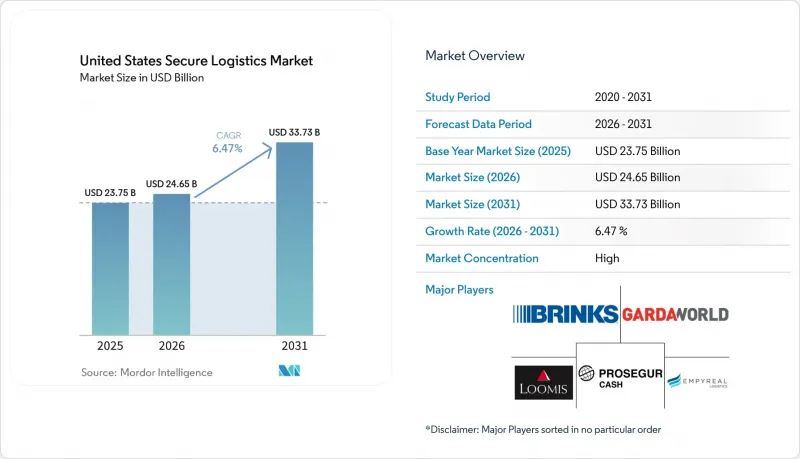
According to Mordor Intelligence, the United States secure logistics market size was valued at USD 23.75 billion in 2025 and is estimated to grow from USD 24.65 billion in 2026 to reach USD 33.73 billion by 2031, at a CAGR of 6.47% from 2026 to 2031.
United States Secure Logistics Market Trends and Insights
Rising Need for High-Value Goods Protection in Transit and Storage
The United States secure logistics market is responding to a greater concentration of value in individual shipments and cash movements. Criminal groups have increasingly targeted high-value loads instead of smaller, opportunistic thefts. The FBI reported nearly USD 725 million in estimated cargo theft losses across the United States and Canada in 2025. Manufacturers, luxury retailers, and pharmaceutical distributors are therefore placing tighter transport and custody requirements into their procurement contracts. These requirements move secure transport from a cost-control decision toward a liability and risk-management decision. Demand also extends to specialty warehousing, where clients require clear custody records for high-value components and finished goods.
Expansion of Cash-Intensive Retail and Branch Networks Requiring Armored Logistics
The United States secure logistics market benefits when convenience stores, pharmacies, cannabis dispensaries, and quick-service restaurants add locations. Each new outlet can create a recurring cash pickup requirement that is difficult for the operator to manage internally. Scheduled collections also create predictable routes for armored carriers in nearby geographic clusters. Cannabis dispensaries remain a notable opportunity because federal restrictions limit their access to conventional banking. Their point-of-sale revenue can accumulate as physical cash and requires transport under applicable state rules. State armored-car licensing, bonded operations, trained personnel, and licensed vehicles continue to restrict participation by providers that lack the required operating base.
High Labor, Vehicle Hardening, and Insurance Costs
Armored operations require substantial spending on specialized vehicles, training, protective equipment, and insurance. These costs are especially difficult for regional carriers with small fleets. Smaller operators cannot spread fixed procurement and insurance expenses across the route density available to national providers. Steel and aluminum tariffs raised the cost of body-hardening materials and specialty vehicle modifications by mid-2025. Fleet renewal can therefore add pressure at a time when traditional cash-in-transit activity is growing more slowly. The result can encourage smaller providers to seek acquisition, exit selected routes, or focus on specialized local work.
Other drivers and restraints analyzed in the detailed report include:
- Growth in ATM Replenishment and Cash Vault Outsourcing
- Increasing Compliance Pressure on Chain of Custody and Asset Accountability
- Driver Shortages and Workforce Retention Challenges in Armored Operations
For complete list of drivers and restraints, kindly check the Table Of Contents.
Segment Analysis
Transportation accounted for 62.50% of the United States secure logistics market share in 2025. It remains the core fulfillment layer for cash circulation, ATM replenishment, and high-value asset movement. Road-based armored fleets handle most domestic movements because ATM networks, bank branches, and retailers require frequent scheduled visits. Rail and air services serve more specialized needs, including interstate bullion movements, auction consignments, and time-sensitive pharmaceutical transfers. Sea and inland waterway activity remains limited and is associated mainly with port-linked precious-metal movements. These services require bonded documentation and specialized custody procedures.
The value-added services segment is forecast to grow at a 7.70% CAGR through 2031. This category includes secure processing, cash reconciliation, custody reporting, and tailored compliance documentation. Providers can turn individual transport contracts into longer managed-service arrangements by combining these capabilities. Empyreal Logistics and Paythings announced a partnership in April 2026 to combine smart-safe technology with armored transport and vaulting services. The arrangement provides real-time tracking and reconciliation from deposit through settlement. Warehousing and secure storage also benefit from demand for off-site cash custody and reduced handling risk at branches and stores.
Cash management held 48.15% of the United States secure logistics market size in 2025 and remained the largest application in the United States secure logistics industry. Bank branches, ATMs, credit unions, and large retailers need regular cash collection, processing, and redistribution. This demand remains necessary for deposit-taking institutions and for retailers that handle cash at scale. Manufacturing secure logistics serves a smaller but distinct requirement for high-value components, prototype assets, and regulated materials. These movements may require documented custody alongside export-control obligations. The others category includes cannabis, gaming, and pharmaceutical transport, where cash or asset risks resemble those in banking and jewelry.
The jewelry and precious metals segment is projected to record a 7.80% CAGR through 2031. Higher-value parcels, bullion movements, and cross-border trade create greater demand for specialist handling. The growth of digital fine-jewelry sales adds more high-value shipments to carrier networks. Specialist providers in New York City's diamond district work through established relationships with manufacturers, wholesalers, and auction houses. Bullion reporting obligations and transaction thresholds narrow the pool of compliant carriers for certain movements. Fine art remains a small revenue application, but it requires specialized handling and insurance capabilities that can support premium service terms.
Complete Report Scope:
- By Service Type
- Transportation
- Road
- Rail
- Air
- Sea and Inland Waterways
- Warehousing and Storage (including Secure Storage and Vault Services)
- Value-added Services
- Transportation
- By Application
- Cash Management
- Diamonds
- Jewelry and Precious Metals
- Manufacturing
- Others
- By Type
- Static
- Mobile
- By End User
- Financial Institutions
- Retailers
- Government
- Others
List of Companies Covered in this Report:
- The Brink's Company
- Garda World Security Corporation
- Loomis Holding US Inc.
- Prosegur Cash, S.A.
- Empyreal Enterprises, LLC
- Rochester Armored Car Co., Inc.
- Davis Bancorp, Inc.
- Sectran Security, Inc.
- Security Incorporated
- Ferrari Express, Inc.
- SecureCash LLC
- Eastern Armored Services, Inc.
- Waltco Inc.
- ACS ATM, Inc.
- Blue Line Protection Group, Inc.
- Malca-Amit USA, LLC
- IBI Armored Services, Inc.
- Shields Business Solutions
- Federal Armored Truck Inc.
- Axiom Armored, Inc.
Additional Benefits:
- The market estimate (ME) sheet in Excel format
- 3 months of analyst support
TABLE OF CONTENTS
1 Introduction
- 1.1 Study Assumptions and Market Definition
- 1.2 Scope of the Study
2 Research Methodology
3 Executive Summary
4 Market Landscape
- 4.1 Market Overview
- 4.2 Market Drivers
- 4.2.1 Rising Need for High-Value Goods Protection in Transit and Storage
- 4.2.2 Expansion of Cash Intensive Retail and Branch Networks Requiring Armored Logistics
- 4.2.3 Growth in ATM Replenishment and Cash Vault Outsourcing
- 4.2.4 Increasing Compliance Pressure on Chain of Custody and Asset Accountability
- 4.2.5 Insurance and Risk Transfer Incentives Favoring Specialized Secure Carriers
- 4.2.6 Adoption of Digitized Route Monitoring and Real-Time Visibility Tools
- 4.3 Market Restraints
- 4.3.1 High Labor, Vehicle Hardening, and Insurance Costs
- 4.3.2 Driver Shortages and Workforce Retention Challenges in Armored Operations
- 4.3.3 Cash Volume Migration to Digital Payments Reducing Some Legacy Service Demand
- 4.3.4 Exposure to Theft, Fraud, and Liability Risk Increasing Operating Complexity
- 4.4 Value / Supply-Chain Analysis
- 4.5 Regulatory Landscape
- 4.6 Technological Outlook
- 4.7 Porter's Five Forces Analysis
- 4.7.1 Bargaining Power of Suppliers
- 4.7.2 Bargaining Power of Buyers
- 4.7.3 Threat of New Entrants
- 4.7.4 Threat of Substitutes
- 4.7.5 Industry Rivalry
- 4.8 Impact of Geopolitical Events on the Market
5 Market Size and Growth Forecasts (Value in USD)
- 5.1 By Service Type
- 5.1.1 Transportation
- 5.1.1.1 Road
- 5.1.1.2 Rail
- 5.1.1.3 Air
- 5.1.1.4 Sea and Inland Waterways
- 5.1.2 Warehousing and Storage (including Secure Storage and Vault Services)
- 5.1.3 Value-added Services
- 5.1.1 Transportation
- 5.2 By Application
- 5.2.1 Cash Management
- 5.2.2 Diamonds
- 5.2.3 Jewelry and Precious Metals
- 5.2.4 Manufacturing
- 5.2.5 Others
- 5.3 By Type
- 5.3.1 Static
- 5.3.2 Mobile
- 5.4 By End User
- 5.4.1 Financial Institutions
- 5.4.2 Retailers
- 5.4.3 Government
- 5.4.4 Others
6 Competitive Landscape
- 6.1 Market Concentration
- 6.2 Strategic Moves
- 6.3 Market Share Analysis
- 6.4 Company Profiles (includes Global Level Overview, Market Level Overview, Core Segments, Financials as available, Strategic Information, Geographic Coverage, Products and Services, Recent Developments)
- 6.4.1 The Brink's Company
- 6.4.2 Garda World Security Corporation
- 6.4.3 Loomis Holding US Inc.
- 6.4.4 Prosegur Cash, S.A.
- 6.4.5 Empyreal Enterprises, LLC
- 6.4.6 Rochester Armored Car Co., Inc.
- 6.4.7 Davis Bancorp, Inc.
- 6.4.8 Sectran Security, Inc.
- 6.4.9 Security Incorporated
- 6.4.10 Ferrari Express, Inc.
- 6.4.11 SecureCash LLC
- 6.4.12 Eastern Armored Services, Inc.
- 6.4.13 Waltco Inc.
- 6.4.14 ACS ATM, Inc.
- 6.4.15 Blue Line Protection Group, Inc.
- 6.4.16 Malca-Amit USA, LLC
- 6.4.17 IBI Armored Services, Inc.
- 6.4.18 Shields Business Solutions
- 6.4.19 Federal Armored Truck Inc.
- 6.4.20 Axiom Armored, Inc.
7 Market Opportunities and Future Outlook
- 7.1 White-Space and Unmet-Need Assessment

