PUBLISHER: Mordor Intelligence | PRODUCT CODE: 2157020

PUBLISHER: Mordor Intelligence | PRODUCT CODE: 2157020
Singapore Secure Logistics - Market Share Analysis, Industry Trends & Statistics, Growth Forecasts (2026 - 2031)
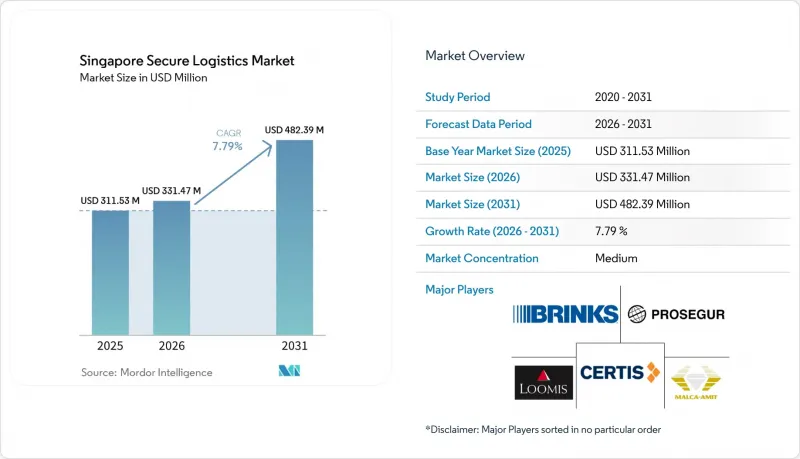
According to Mordor Intelligence, the Singapore secure logistics market size was valued at USD 311.53 million in 2025 and is estimated to grow from USD 331.47 million in 2026 to reach USD 482.39 million by 2031, at a CAGR of 7.79% during the forecast period (2026-2031).
Singapore remains a financial, trade, and transshipment center where the movement and storage of high-value assets require documented custody, armored transport, and secure vaulting. This report is Segmented by Service Type (Transportation, Warehousing and Storage, and Value-Added Services), by Application (Cash Management, Diamonds, Jewelry and Precious Metals, Manufacturing, and Others), by Type (Static and Mobile), and by End User (Financial Institutions, Retailers, Government, and Others). The Forecasts are Provided in Terms of Value in USD.
Singapore Secure Logistics Market Trends and Insights
Rising High-Value Trade Through Singapore Free Trade and Transshipment Hubs
Singapore's position as a transshipment hub concentrates high-value cargo movements within a compact and tightly managed jurisdiction. Cargo moving between air, sea, and bonded storage facilities requires protected transfers and clear custody records. This setting supports demand in the Singapore secure logistics market for guarded transport, bonded warehousing, and specialized handling. Expansion of storage and handling capacity around Singapore's major logistics corridors can increase the need for secure services beyond conventional container operations. Operators that establish warehousing and guarded transport relationships before new capacity is commissioned can secure customer commitments before competition becomes more intense. This activity shifts part of the addressable demand beyond the established Changi and Le Freeport corridor and toward facilities that support controlled complex cross-border high-value cargo flows.
Rising Demand for Chain-Of-Custody Visibility in Bullion and Jewelry Movements
The Monetary Authority of Singapore and the Singapore Bullion Market Association announced plans in March 2026 to develop Singapore as an Asia-Pacific gold trading and clearing center. The plan includes over-the-counter gold clearing infrastructure by the end of 2026 and central bank gold vaulting services by October 2026. Bullion entering this system must be moved from refineries to vaults under documented custody procedures that meet recognized industry requirements. Le Freeport's basement space is near full utilization, which increases the importance of additional vault capacity designed for institutional and sovereign clients. SBMA standards, LBMA alignment, and refinery certification requirements raise the operational threshold for both transport and storage providers. In the Singapore secure logistics market, institutional reputation, reliable audit trails, and insurance capacity therefore matter as much as shipment volumes.
Cashless Payment Adoption Reducing Some Cash-In-Transit Demand
Singapore's widespread use of digital payments reduces the need for some retail cash replenishment and ATM servicing runs. The Monetary Authority of Singapore has described its objective as a cash-lite society rather than a fully cashless one. This approach preserves cash access for residents and visitors who continue to depend on physical currency. It also limits the potential decline in cash-in-transit activity, even as digital payment use changes transaction patterns. Cash logistics providers still face pressure because lower shipment volumes do not remove fixed costs for vehicles, insurance, or trained guards. Diversified operators can offset part of that pressure through precious metals and fine art services, but the cash segment requires a shift toward higher-value, more specialized work.
Other drivers and restraints analyzed in the detailed report include:
- Hybrid Physical-Digital Security Adoption Across Logistics Hubs
- Growth in Secure Vaulting and Secured Transit for Cash and Valuables
- High Labor Cost and Tight Manpower Availability for Guarded Operations
For complete list of drivers and restraints, kindly check the Table Of Contents.
Segment Analysis
Transportation accounted for 65.55% of the Singapore secure logistics market share in 2025, reflecting armored road runs for banks and Changi Airport and specialist air freight for bullion and diamonds. Road transport remains the largest domestic activity because it supports banking, retail, and secure collection routes, although it is most exposed to lower cash-in-transit frequency as digital payments become more common. Secured air freight has a stronger long-term role because Singapore connects high-value cargo with global custody locations. Transportation in the Singapore secure logistics industry also includes controlled sea movements and inland waterway services for bonded bullion and high-value manufactured goods. These channels contribute steadily but grow more slowly than road and air services, and they require secure handoffs between vehicles, airport facilities, bonded areas, and vaults, where a break in documentation or handling control can undermine the custody assurance expected by institutional customers.
The value-added services segment is forecast to grow at a 10.10% CAGR from 2026 to 2031, the highest rate within the service type segmentation. The LionGlobal fully insured physical gold fund was launched in November 2025 with storage at Le Freeport and Standard Chartered as custodian. Such arrangements require coordinated transport, custody documentation, insurance support, asset monitoring, audits, and compliance reporting, which brings activities that were often handled as separate logistics, security, and administrative tasks into one closely managed service relationship. The Singapore secure logistics market size for value-added services benefits when these activities are obtained through one contract, rather than separate arrangements focused only on transport. Warehousing and storage include secure storage and vault services for sovereign wealth managers, family offices, foreign central banks, and other institutional users that need controlled access and documented custody.
Cash management accounted for 52.50% of the Singapore secure logistics market size in 2025. Singapore's commercial banking network has historically supported substantial volumes across these activities. Digital wallets, PayNow, and contactless payments are reducing cash velocity through the banking system, which lowers replenishment frequency and can pressure individual-run profitability. Cash management still requires reliable collection, sorting, storage, and controlled delivery for users who retain physical currency needs. Providers can protect value through integrated cash management and operational data that improves collection and replenishment scheduling, reducing unnecessary movements while retaining the trained personnel, vehicles, security processes, and incident-response capacity needed for higher-value cash activity.
The jewelry and precious metals segment is forecast to grow at a 9.70% CAGR from 2026 to 2031, making it the fastest-growing application. Singapore's gold clearing and custody plans increase demand for protected movement between refineries, airport facilities, vaults, and buyers. The 41st World Diamond Congress was held in Singapore in July 2026, reinforcing the city's role in the gemstone trade, while diamond shipments require customs-cleared transit, tamper-evident packaging, and Kimberley Process compliance. Manufacturing users need protected movement for high-value precision components, including semiconductors, aerospace parts, and pharmaceutical actives. At the same time, fine art, luxury goods, wine, and collectibles are served by relationship-focused specialists whose service depends on discretion, careful timing, condition-sensitive handling, and trusted customer relationships. Singapore Mint launched its first investment-grade gold bullion in September 2025 with secure vault storage included in its offering, adding a retail-adjacent source of demand for precious metals storage and movement.
Complete Report Scope:
- By Service Type
- Transportation
- Road
- Rail
- Air
- Sea and Inland Waterways
- Warehousing and Storage (including Secure Storage and Vault Services)
- Value-added Services
- Transportation
- By Application
- Cash Management
- Diamonds
- Jewelry and Precious Metals
- Manufacturing
- Others
- By Type
- Static
- Mobile
- By End User
- Financial Institutions
- Retailers
- Government
- Others
List of Companies Covered in this Report:
- The Brink's Company
- Malca-Amit
- Prosegur Group
- Loomis AB
- Certis
- J. Rotbart & Co.
- Fine Art Logistics Pte. Ltd.
- Ferrari Group
- Helutrans
- Crown Worldwide Group
- Temis Luxury
- SATS Security Services Pte Ltd
- Lotus Fine Arts Logistics (S) Pte Ltd
- GEODIS
- Kuehne + Nagel International AG
- DHL Group
- DSV A/S
- Nippon Express Holdings, Inc.
- Expeditors International of Washington, Inc.
- Le Freeport Management Pte Ltd
- Silver Bullion Pte Ltd
Additional Benefits:
- The market estimate (ME) sheet in Excel format
- 3 months of analyst support
TABLE OF CONTENTS
1 Introduction
- 1.1 Study Assumptions and Market Definition
- 1.2 Scope of the Study
2 Research Methodology
3 Executive Summary
4 Market Landscape
- 4.1 Market Overview
- 4.2 Market Drivers
- 4.2.1 Rising High-Value Trade Through Singapore Free Trade And Transshipment Hubs
- 4.2.2 Rising Demand For Chain-Of-Custody Visibility In Bullion And Jewelry Movements
- 4.2.3 Hybrid Physical-Digital Security Adoption Across Logistics Hubs
- 4.2.4 Growth In Secure Vaulting And Secured Transit For Cash And Valuables
- 4.2.5 Cross-Border Compliance Needs For High-Sensitivity Cargo Movements
- 4.2.6 Rising Outsourcing Of Security-Intensive Logistics Operations
- 4.3 Market Restraints
- 4.3.1 Cashless Payment Adoption Reducing Some Cash-In-Transit Demand
- 4.3.2 High Labor Cost And Tight Manpower Availability For Guarded Operations
- 4.3.3 Insurance And Compliance Costs For High-Risk Or High-Value Cargo Routes
- 4.3.4 Limited Route Flexibility In A Highly Regulated Urban Logistics Network
- 4.4 Value / Supply-Chain Analysis
- 4.5 Regulatory Landscape
- 4.6 Technological Outlook
- 4.7 Porter's Five Forces Analysis
- 4.7.1 Bargaining Power of Suppliers
- 4.7.2 Bargaining Power of Buyers
- 4.7.3 Threat of New Entrants
- 4.7.4 Threat of Substitutes
- 4.7.5 Industry Rivalry
- 4.8 Impact of Geopolitical Events on the Market
5 Market Size and Growth Forecasts (Value in USD)
- 5.1 By Service Type
- 5.1.1 Transportation
- 5.1.1.1 Road
- 5.1.1.2 Rail
- 5.1.1.3 Air
- 5.1.1.4 Sea and Inland Waterways
- 5.1.2 Warehousing and Storage (including Secure Storage and Vault Services)
- 5.1.3 Value-added Services
- 5.1.1 Transportation
- 5.2 By Application
- 5.2.1 Cash Management
- 5.2.2 Diamonds
- 5.2.3 Jewelry and Precious Metals
- 5.2.4 Manufacturing
- 5.2.5 Others
- 5.3 By Type
- 5.3.1 Static
- 5.3.2 Mobile
- 5.4 By End User
- 5.4.1 Financial Institutions
- 5.4.2 Retailers
- 5.4.3 Government
- 5.4.4 Others
6 Competitive Landscape
- 6.1 Market Concentration
- 6.2 Strategic Moves
- 6.3 Market Share Analysis
- 6.4 Company Profiles (includes Global Level Overview, Market Level Overview, Core Segments, Financials as available, Strategic Information, Geographic/Network Coverage, Products and Services, Recent Developments)
- 6.4.1 The Brink's Company
- 6.4.2 Malca-Amit
- 6.4.3 Prosegur Group
- 6.4.4 Loomis AB
- 6.4.5 Certis
- 6.4.6 J. Rotbart & Co.
- 6.4.7 Fine Art Logistics Pte. Ltd.
- 6.4.8 Ferrari Group
- 6.4.9 Helutrans
- 6.4.10 Crown Worldwide Group
- 6.4.11 Temis Luxury
- 6.4.12 SATS Security Services Pte Ltd
- 6.4.13 Lotus Fine Arts Logistics (S) Pte Ltd
- 6.4.14 GEODIS
- 6.4.15 Kuehne + Nagel International AG
- 6.4.16 DHL Group
- 6.4.17 DSV A/S
- 6.4.18 Nippon Express Holdings, Inc.
- 6.4.19 Expeditors International of Washington, Inc.
- 6.4.20 Le Freeport Management Pte Ltd
- 6.4.21 Silver Bullion Pte Ltd
7 Market Opportunities and Future Outlook
- 7.1 White-Space and Unmet-Need Assessment

