PUBLISHER: Mordor Intelligence | PRODUCT CODE: 2163357

PUBLISHER: Mordor Intelligence | PRODUCT CODE: 2163357
Indonesia Less-than Container Load (LCL) - Market Share Analysis, Industry Trends & Statistics, Growth Forecasts (2026 - 2031)
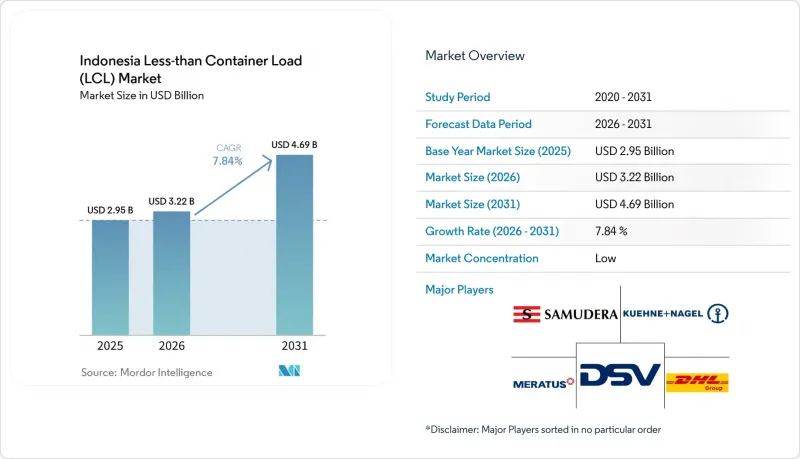
According to Mordor Intelligence, the Indonesia less-than container load (LCL) market was valued at USD 2.95 billion in 2025 and is estimated to grow from USD 3.22 billion in 2026 to reach USD 4.69 billion by 2031, at a CAGR of 7.84% during the forecast period (2026-2031).
Indonesia Less-than Container Load (LCL) Market Trends and Insights
E-Commerce Growth Increasing Cross-Border LCL Shipment Demand
Indonesia led Southeast Asia's cross-border e-commerce activity in 2025, which supported demand for consolidated cargo from smaller online orders. Retailers increasingly source from several suppliers and place more frequent orders, which raises the need for flexible shipment planning. Short booking windows at major container freight stations place greater value on prompt cargo acceptance and accurate documentation. The Indonesia less-than container load (LCL) market benefits when forwarders can combine these orders without slowing the release process. DHL identified e-commerce and retail as priorities in Indonesia's trade development, alongside the country's expected role in global trade growth. Providers that connect booking information with customs workflows can make frequent small shipments easier for shippers to manage.
Manufacturing Diversification Expanding Multi-Origin Consolidation Requirements
Mainland China and Hong Kong investment in Indonesia reached USD 11.5 billion in the first half of 2026, compared with USD 4.1 billion in the same period of 2025, as manufacturers considered Indonesia within China-plus-one supply-chain plans. New production sites in Cikarang, Batam, Kendal, and Sulawesi can generate cargo from several factory locations for the same overseas buyer. Electronics, automotive components, and textile assembly often need inbound components as well as export shipping, which can support two-way consolidation on a corridor. This pattern favors operators that can collect smaller lots, plan stuffing, and issue a single bill of lading for a combined shipment. In the Indonesia less-than container load (LCL) market, container freight station networks close to industrial estates can reduce handling steps before the cargo reaches a gateway port.
Port Congestion and Truck Delays Increasing Transit Times
Indonesia's customs rules can add uncertainty to clearance scheduling because dutiable values may be assessed using 90-day historical import price benchmarks instead of declared transaction values. Truck queues at container freight station gates also create idle time that consolidators need to absorb or pass on through their pricing. The problem is most visible at Tanjung Priok, Tanjung Perak, and Belawan, where a delay can affect several smaller consignments in one container. Road conditions and truck availability can widen the transit gap between Java and secondary ports. This is difficult for high-frequency online retail shipments that require dependable delivery timing. Better stuffing schedules and collection times can help providers limit the effect, but the Indonesian less-than container load (LCL) market remains exposed to congestion until landside improvements are completed.
Other drivers and restraints analyzed in the detailed report include:
- Port Infrastructure Expansion Supporting LCL Network Development
- Digital Freight Integration Improving LCL Shipment Coordination
- Fuel and Ocean Rate Volatility Pressuring LCL Costs
For complete list of drivers and restraints, kindly check the Table Of Contents.
Segment Analysis
Consolidation services held 64.59% of the Indonesia less-than container load (LCL) market share in 2025. The result reflects the importance of inbound cargo that arrives in mixed-shipper containers from Northeast and Southeast Asian origins. Co-loading at places such as Guangzhou, Yiwu, or Singapore means Indonesian importers depend on performance at origin container freight stations as well as local handling. Local providers earn much of their value from unstuffing, customs coordination, and delivery after discharge. This creates an advantage for operators with efficient links between container freight stations and customer locations across Java.
De-consolidation and distribution is projected to register a 9.87% CAGR from 2026 to 2031, the highest rate within this service segmentation. The Indonesia less-than container load (LCL) market size for this service is supported by cargo moving from port discharge to tier-2 and tier-3 cities. Healthcare supply chains, agricultural flows, and online fulfillment all create demand for sorting, inspection, repackaging, and storage after arrival. These services offer revenue beyond base freight charges when they are completed accurately and within the requested delivery window. The need is strongest where final customers are located far from the main port gateway.
International LCL accounted for 62.37% of the Indonesia less-than container load (LCL) market size in 2025. Trade-oriented manufacturing and demand for imported industrial inputs, consumer electronics, and fast-moving consumer goods supported that position. International shipments often move through container freight station networks near the principal gateways. Higher per-cubic-meter pricing on intra-Asia consolidation lanes also helps set the near-term pricing floor for this business. New industrial clusters in Sulawesi and Kalimantan are broadening the origin base for export cargo that once moved mainly through Java.
Domestic LCL is forecast to register a 10.97% CAGR from 2026 to 2031, the fastest destination segment. Inter-island consumer goods distribution, expanding Sea Toll routes, and online fulfillment needs outside Jakarta and Surabaya support this outlook. Government-backed route development can create cargo flows that operators can serve through scheduled consolidation. The segment also has room to grow because several areas have historically had less frequent logistics coverage. Domestic demand includes project cargo purchases and replenishment shipments that may not need a full container.
Complete Report Scope:
- By Service Type
- Consolidation Services
- De-consolidation and Distribution
- By Destination
- Domestic
- International
- By Nature of Business
- Freight Forwarding
- NVOCCs
- By End User
- Manufacturing and Automotive
- Retail and E-commerce
- Healthcare and Pharmaceuticals
- Agriculture and Forestry
- Other End Users
- By Cargo Type
- General Cargo
- Temperature-Controlled Cargo
- Hazardous Cargo
- High-Value and Sensitive Cargo
- By Region
- Java (Jakarta and BOD)
- Sumatra
- Kalimantan
- Sulawesi
- Bali and Nusa Tenggara
- Papua Region and Maluku Islands
List of Companies Covered in this Report:
- DHL Group
- Kuehne+Nagel International AG
- DSV A/S
- CEVA Logistics
- A.P. Moller - Maersk
- Expeditors International
- NX Group
- GEODIS
- Rhenus Group
- Yusen Logistics Co., Ltd.
- APL Logistics
- KLN Logistics Group Limited
- Sinotrans Limited
- Dimerco Express Group
- Hellmann Worldwide Logistics
- PT Samudera Indonesia Tbk
- Meratus Group
- PT Cipta Krida Bahari
- PT Kamadjaja Logistics
- PT Puninar Logistics
- Gateway Container Line (GCL)
- Waresix
Additional Benefits:
- The market estimate (ME) sheet in Excel format
- 3 months of analyst support
TABLE OF CONTENTS
1 Introduction
- 1.1 Study Assumptions and Market Definition
- 1.2 Scope of the Study
2 Research Methodology
3 Executive Summary
- 3.1 Market Size, Growth, and Forecast Outlook
- 3.2 Key Demand Drivers and LCL Shipping Trends
- 3.3 Major LCL Gateways and Cargo Concentration
- 3.4 Competitive Landscape and Leading LCL Providers
4 Market Landscape
- 4.1 Market Overview and Importance of Less Than Container Load Market
- 4.2 Market Drivers
- 4.2.1 E-commerce Growth Increasing Cross-Border LCL Shipment Demand
- 4.2.2 Manufacturing Diversification Expanding Multi-Origin Consolidation Requirements
- 4.2.3 Port Infrastructure Expansion Supporting LCL Network Development
- 4.2.4 Digital Freight Integration Improving LCL Shipment Coordination
- 4.2.5 Low Backhaul Utilization Increasing Cargo Consolidation Demand
- 4.2.6 Eastern Indonesia Distribution Gaps Creating LCL Opportunities
- 4.3 Market Restraints
- 4.3.1 Port Congestion and Truck Delays Increasing Transit Times
- 4.3.2 Fuel and Ocean Rate Volatility Pressuring LCL Costs
- 4.3.3 Fragmented CFS Regulations Increasing Customs Documentation Complexity
- 4.3.4 Container Imbalances Reducing Inter-Island Backhaul Efficiency
- 4.4 Value Chain Structure and LCL Cargo Flow Analysis
- 4.5 Regulatory Framework and LCL Shipping Compliance Analysis
- 4.6 Technology Adoption and LCL Digitalization Trend Analysis
- 4.7 Major Port and LCL Gateway Concentration Analysis
- 4.8 LCL Freight Rate and Surcharge Trend Analysis
- 4.9 Inter-Island LCL Connectivity and Backhaul Analysis
- 4.10 Porter's Five Forces Analysis
- 4.10.1 Threat of New Entrants
- 4.10.2 Bargaining Power of Buyers
- 4.10.3 Bargaining Power of Suppliers
- 4.10.4 Threat of Substitute Services
- 4.10.5 Intensity of Competitive Rivalry
- 4.11 Impact of Geo-Political Events on Supply Chain Shifts
5 Market Size and Growth Forecasts
- 5.1 By Service Type
- 5.1.1 Consolidation Services
- 5.1.2 De-consolidation and Distribution
- 5.2 By Destination
- 5.2.1 Domestic
- 5.2.2 International
- 5.3 By Nature of Business
- 5.3.1 Freight Forwarding
- 5.3.2 NVOCCs
- 5.4 By End User
- 5.4.1 Manufacturing and Automotive
- 5.4.2 Retail and E-commerce
- 5.4.3 Healthcare and Pharmaceuticals
- 5.4.4 Agriculture and Forestry
- 5.4.5 Other End Users
- 5.5 By Cargo Type
- 5.5.1 General Cargo
- 5.5.2 Temperature-Controlled Cargo
- 5.5.3 Hazardous Cargo
- 5.5.4 High-Value and Sensitive Cargo
- 5.6 By Region
- 5.6.1 Java (Jakarta and BOD)
- 5.6.2 Sumatra
- 5.6.3 Kalimantan
- 5.6.4 Sulawesi
- 5.6.5 Bali and Nusa Tenggara
- 5.6.6 Papua Region and Maluku Islands
6 Competitive Landscape
- 6.1 Market Concentration
- 6.2 Strategic Moves
- 6.3 Market Share Analysis
- 6.4 Company Profiles (includes Global Level Overview, Market Level Overview, Core Segments, Financials as available, Strategic Information, Geographic Coverage, Products and Services, Recent Developments)
- 6.4.1 DHL Group
- 6.4.2 Kuehne+Nagel International AG
- 6.4.3 DSV A/S
- 6.4.4 CEVA Logistics
- 6.4.5 A.P. Moller - Maersk
- 6.4.6 Expeditors International
- 6.4.7 NX Group
- 6.4.8 GEODIS
- 6.4.9 Rhenus Group
- 6.4.10 Yusen Logistics Co., Ltd.
- 6.4.11 APL Logistics
- 6.4.12 KLN Logistics Group Limited
- 6.4.13 Sinotrans Limited
- 6.4.14 Dimerco Express Group
- 6.4.15 Hellmann Worldwide Logistics
- 6.4.16 PT Samudera Indonesia Tbk
- 6.4.17 Meratus Group
- 6.4.18 PT Cipta Krida Bahari
- 6.4.19 PT Kamadjaja Logistics
- 6.4.20 PT Puninar Logistics
- 6.4.21 Gateway Container Line (GCL)
- 6.4.22 Waresix
7 Market Opportunities and Future Outlook
- 7.1 White-Space Opportunities and Unmet LCL Service Needs
- 7.2 High-Potential End-User Segments and Trade Opportunities
- 7.3 Strategic Growth Priorities Across LCL Shipping Ecosystem
- 7.4 Future Market Outlook and Emerging LCL Demand Pockets
8 Appendix

