PUBLISHER: Mordor Intelligence | PRODUCT CODE: 2187736

PUBLISHER: Mordor Intelligence | PRODUCT CODE: 2187736
India Container Shipping - Market Share Analysis, Industry Trends & Statistics, Growth Forecasts (2027 - 2032)
According to Mordor Intelligence, the India container shipping market size is expected to increase from USD 19.73 billion in 2026 to USD 21.4 billion in 2027 and reach USD 31.71 billion by 2032, growing at a CAGR of 8.18% over 2027-2032.
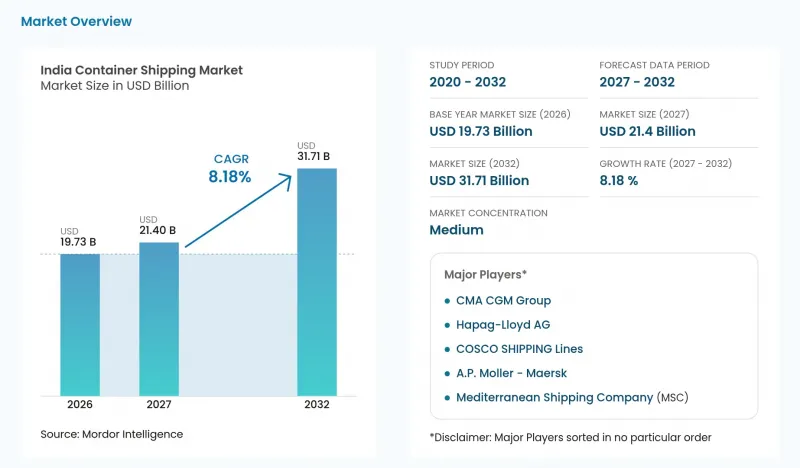
This report is segmented by Service Type (Deep-Sea/Ocean Container Shipping and more), Container Type (Dry Containers and more), Container Size (40-foot Containers and more), Load Type (Full-Container-Load and more), End-User Industry (FMCG and Retail and more), and Geography (West and more). The market forecasts are provided in terms of value (USD), based on availability.
India Container Shipping Market Trends and Insights
Rising EXIM Containerization Across Key Industrial Corridors
Indian export containerization gives logistics operators more value to capture when they can connect specific inland origins to overseas destinations. On July 9, 2026, Container Corporation of India Limited (CONCOR) inaugurated its first overseas export movement in CONCOR-owned containers from the CONCOR logistics park at MIHAN, Nagpur to Jebel Ali in the United Arab Emirates. Jawaharlal Nehru Port Authority (JNPA) handled a record 8.17 million 20-foot equivalent units (TEUs) in FY2025-26, with container throughput growing 11.94%. The near-term opportunity for carriers and inland operators is to originate additional overseas business in owned containers around gateways that already handle substantial volumes.
Western Dedicated Freight Corridor Commissioning and Port Rail Integration
Direct rail access to the port can widen the practical cargo base available to ocean carriers serving inland industrial shippers. On September 8, 2026, Japan International Cooperation Agency (JICA) reported completion and full operation of the 1,506-kilometer Western Dedicated Freight Corridor from Dadri, Uttar Pradesh, to Jawaharlal Nehru Port. Its 3 final sections cover 326 kilometers and provide direct rail connectivity to JNPA. JICA supplied financial and technical support, while Dedicated Freight Corridor Corporation of India Limited implemented the corridor under India's Ministry of Railways. For shippers considering maritime export routes, the direct connection can strengthen the case for using this gateway by linking inland movement with port access. The commercial gain depends on coordinating rail arrivals with vessel departures so that inland connectivity becomes usable ocean-service demand.
Strait of Hormuz, Red Sea, Panama Canal, and Geopolitical Route Disruptions
Middle East geopolitical shipping disruption affected JNPA's Middle East-bound vessel schedules and export cargo movement from March 2026. At JNPA, around 5,000 TEUs were stranded on March 1, 2026, and nearly 3,200 on March 8 as conditions improved. Unknown-projectile strikes on container ships transiting the Strait of Hormuz from October 2026 included hull damage to GFS Giselle. GFS Ship Management operated the vessel, while Global Feeder Shipping used it on a service linking Fujairah and Khor Fakkan with Mundra and Nhava Sheva. The March backlog concerned cargo evacuation at the port, while the October incident involved a vessel at sea. Physical vessel risk can therefore constrain dependable sailing commitments, leaving exporters on exposed routes facing the possibility of additional departure delays.
Other drivers and restraints analyzed in the detailed report include:
- Capacity Additions at Major West Coast and East Coast Ports
- Transshipment Share Gains Through Coastal and Hub Port Routing
- US Tariff Exposure on Containerized Export Sectors
For complete list of drivers and restraints, kindly check the Table Of Contents.
Segment Analysis
Deep-sea/ocean container shipping accounted for a 67.93% share of the India container shipping market size in 2026. Vizhinjam provided an operating example for this largest segment, having handled more than 70 ultra-large container vessels by June 2026, the highest number among Indian ports. That activity illustrates the importance of gateways capable of receiving ocean-going container vessels, giving carriers a concrete Indian port interface for their long-haul service propositions. Port infrastructure that can receive ultra-large vessels decides which deep-sea calls shippers can use on their overseas routes.
Feeder and coastal/domestic container shipping is forecast to be the fastest-growing segment, at a CAGR of 9.21% over 2027-2032. India's containerized coastal cargo reached 20.6 million metric tons in FY2024-25, with major ports handling nearly 90% of that volume. This concentration ties coastal service development to established container gateways, where operators can assemble cargo for shorter connecting or domestic maritime legs.
Dry containers (general purpose) were the largest segment, accounting for 81.3% of market revenue in 2026. Kolkata Dock System handled 814,529 metric tons of rice exports as containerized cargo in FY2024-25. This commodity flow illustrates an actual dry-cargo application around which carriers can assemble maritime bookings. On the equipment-supply side, Bhavnagar-based manufacturer APPL Containers Limited reported deliveries of 159 20-foot standard containers by December 24, 2025. Access to cargo at the loading gateway lets carriers sell space on overseas sailings to commodity exporters.
Reefer containers are forecast to be the fastest-growing segment, with an 11.78% CAGR over 2027-2032. By May 2026, Maersk had flagged off a dedicated weekly Hyderabad-Nhava Sheva service for pharmaceutical exporters, with CONCOR as its rail-logistics partner. The offering used 40-foot reefers and combined inland rail, ocean freight and shipment visibility under a single-window arrangement. Pre-trip inspection and quality-aligned container selection were incorporated into every shipment. A reefer booking can therefore compete on equipment readiness and inspection compliance as well as the availability of maritime space.
Complete Report Scope:
- By Service Type
- Deep-Sea/Ocean Container Shipping
- Short-Sea Container Shipping
- Feeder and Coastal/Domestic Container Shipping
- By Container Type
- Dry Containers (General Purpose)
- Reefer Containers
- By Container Size
- 20-foot Containers (20 ft)
- 40-foot Containers (40 ft)
- Other Specialized Sizes
- By Load Type
- Full-Container-Load (FCL)
- Less-Than-Container-Load (LCL)
- By End-User Industry
- FMCG and Retail
- Manufacturing and Automotive
- Healthcare and Pharmaceuticals
- Electronics and Electrical Equipment
- Industrial Chemicals and Raw Materials
- Others
- By Geography
- North
- Central
- West
- East
- South
List of Companies Covered in this Report:
- Mediterranean Shipping Company (MSC)
- A.P. Moller - Maersk
- CMA CGM Group
- COSCO SHIPPING Lines
- Hapag-Lloyd AG
- Ocean Network Express (ONE)
- Evergreen Marine Corporation
- HMM
- Yang Ming Marine Transport
- ZIM Integrated Shipping Services
- Wan Hai Lines
- Pacific International Lines (PIL)
- X-Press Feeders
- SITC International Holdings (SITC Container Lines)
- Unifeeder
- Korea Marine Transport Corporation (KMTC)
- Regional Container Lines (RCL)
- Emirates Shipping Line
- TS Lines
- Interasia Lines
- SM Line
- Shipping Corporation of India (SCI)
Additional Benefits:
- The market estimate (ME) sheet in Excel format
- 3 months of analyst support
TABLE OF CONTENTS
1 INTRODUCTION
- 1.1 Study Assumptions and Market Definition
- 1.2 Scope of the Study
2 RESEARCH METHODOLOGY
3 EXECUTIVE SUMMARY
4 MARKET LANDSCAPE
- 4.1 Market Overview
- 4.2 Market Drivers
- 4.2.1 Rising EXIM Containerization Across Key Industrial Corridors
- 4.2.2 Western Dedicated Freight Corridor Commissioning and Port Rail Integration
- 4.2.3 Capacity Additions at Major West Coast and East Coast Ports
- 4.2.4 Transshipment Share Gains Through Coastal and Hub Port Routing
- 4.2.5 Foreign Carrier Network Expansion and Service Frequency Uplift
- 4.2.6 Public Sector Push for Indigenous Container Shipping Capacity
- 4.3 Market Restraints
- 4.3.1 Strait of Hormuz, Red Sea, Panama Canal, and Geopolitical Route Disruptions
- 4.3.2 US Tariff Exposure on Containerized Export Sectors
- 4.3.3 Rail Haulage Cost Pressure and Inland Dwell Time Inefficiency
- 4.3.4 West Coast Terminal Congestion and Vessel Slot Constraints
- 4.4 Industry Value Chain Analysis
- 4.5 Regulatory Landscape
- 4.6 Technological Outlook
- 4.7 Porter's Five Forces Analysis
- 4.7.1 Threat of New Entrants
- 4.7.2 Bargaining Power of Suppliers
- 4.7.3 Bargaining Power of Buyers
- 4.7.4 Threat of Substitutes
- 4.7.5 Competitive Rivalry
- 4.8 Market Overview and Role of Container Shipping in Logistics
- 4.9 Technology Innovations Outlook
- 4.10 Evolution of Container Shipping Industry
- 4.11 Comparison: Container Shipping vs Other Freight Modes
- 4.12 Pricing Analysis
- 4.13 Nearshoring and Friend-Shoring Developments
- 4.14 Economic Indicators Influencing Container Demand
5 MARKET SIZE AND GROWTH FORECASTS (VALUE)
- 5.1 By Service Type
- 5.1.1 Deep-Sea/Ocean Container Shipping
- 5.1.2 Short-Sea Container Shipping
- 5.1.3 Feeder and Coastal/Domestic Container Shipping
- 5.2 By Container Type
- 5.2.1 Dry Containers (General Purpose)
- 5.2.2 Reefer Containers
- 5.3 By Container Size
- 5.3.1 20-foot Containers (20 ft)
- 5.3.2 40-foot Containers (40 ft)
- 5.3.3 Other Specialized Sizes
- 5.4 By Load Type
- 5.4.1 Full-Container-Load (FCL)
- 5.4.2 Less-Than-Container-Load (LCL)
- 5.5 By End-User Industry
- 5.5.1 FMCG and Retail
- 5.5.2 Manufacturing and Automotive
- 5.5.3 Healthcare and Pharmaceuticals
- 5.5.4 Electronics and Electrical Equipment
- 5.5.5 Industrial Chemicals and Raw Materials
- 5.5.6 Others
- 5.6 By Geography
- 5.6.1 North
- 5.6.2 Central
- 5.6.3 West
- 5.6.4 East
- 5.6.5 South
6 COMPETITIVE LANDSCAPE
- 6.1 Market Concentration
- 6.2 Strategic Moves
- 6.3 Market Share Analysis
- 6.4 Company Profiles (includes Global level Overview, Market level overview, Core Segments, Financials as available, Strategic Information, Market Rank/Share for key companies, Products and Services, and Recent Developments)
- 6.4.1 Mediterranean Shipping Company (MSC)
- 6.4.2 A.P. Moller - Maersk
- 6.4.3 CMA CGM Group
- 6.4.4 COSCO SHIPPING Lines
- 6.4.5 Hapag-Lloyd AG
- 6.4.6 Ocean Network Express (ONE)
- 6.4.7 Evergreen Marine Corporation
- 6.4.8 HMM
- 6.4.9 Yang Ming Marine Transport
- 6.4.10 ZIM Integrated Shipping Services
- 6.4.11 Wan Hai Lines
- 6.4.12 Pacific International Lines (PIL)
- 6.4.13 X-Press Feeders
- 6.4.14 SITC International Holdings (SITC Container Lines)
- 6.4.15 Unifeeder
- 6.4.16 Korea Marine Transport Corporation (KMTC)
- 6.4.17 Regional Container Lines (RCL)
- 6.4.18 Emirates Shipping Line
- 6.4.19 TS Lines
- 6.4.20 Interasia Lines
- 6.4.21 SM Line
- 6.4.22 Shipping Corporation of India (SCI)
7 MARKET OPPORTUNITIES AND FUTURE OUTLOOK
- 7.1 White-Space and Unmet-Need Assessment

