PUBLISHER: Mordor Intelligence | PRODUCT CODE: 2184609

PUBLISHER: Mordor Intelligence | PRODUCT CODE: 2184609
Japan Automotive Adaptive Lighting System - Market Share Analysis, Industry Trends & Statistics, Growth Forecasts (2027 - 2032)
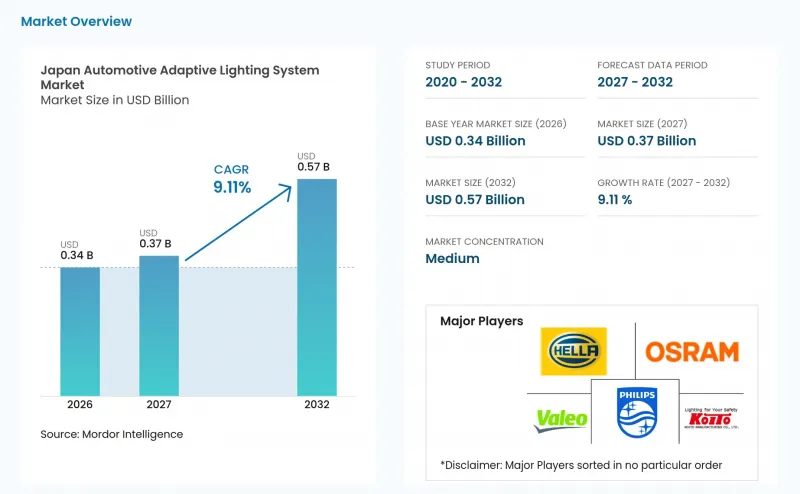
According to Mordor Intelligence, the Japan automotive adaptive lighting system market size was valued at USD 0.34 billion in 2026, is expected to reach USD 0.37 billion in 2027, and is projected to reach USD 0.57 billion by 2032, growing at a CAGR of 9.11% from 2027 to 2032.
Japan Automotive Adaptive Lighting System Market Trends and Insights
Stricter Japanese Vehicle-Lighting Safety Regulations
Japan's transposition of UN R149 and the National Agency for Automotive Safety & Victims' Aid (NASVA) JNCAP scoring rubric has raised the performance bar beyond simple auto-on headlights. Higher JNCAP points reward glare-free adaptive beams that dim individual pixels, prompting OEMs to embed sensor-fusion lighting into new models to secure superior safety ratings . Dual certification-device-level UN compliance and installation-level approval audited by the National Traffic Safety and Environment Laboratory (NTSEL)-extends lead times for suppliers unfamiliar with domestic procedures, fortifying incumbents with established MLIT relationships . As a result, adaptive lighting is bundled with broader ADAS suites such as Mazda's i-ACTIVSENSE, unlocking insurance discounts that sway fleet buyers.
Increasing ADAS & Autonomous-Driving Integration
Toyota's LED Array Adaptive High Beam System, Honda's Adaptive Driving Beam, and Nissan's Adaptive LED Headlights exemplify a decade-long shift from reactive beam switching to predictive illumination tethered to forward-camera, speed, and navigation data . The National Police Agency's Level 4 guidelines forbid nighttime autonomous operation unless pedestrian detection is assured, making high-resolution adaptive lighting a prerequisite for wider automated-driving domains. OEMs that harmonize beam patterns with collision-warning and lane-departure systems gain regulatory flexibility to extend automated service hours, enhancing vehicle utilization metrics for ride-hailing and logistics fleets.
High Module and Integration Cost
Complete adaptive lighting packages, including sensors, wiring, and calibration labor, cost significantly more than static LED headlamp systems. Koito has made substantial investments to expand capacity, highlighting the scale required to offset fixed costs. However, smaller OEMs face difficulties in distributing software validation costs across limited-volume models. Fleet operators, which prioritize total cost of ownership, are delaying LCV upgrades as they wait for retrofit prices to decline. This trend is dampening short-term demand.
Other drivers and restraints analyzed in the detailed report include:
- Growing Consumer Demand for Premium Safety & Nighttime Visibility
- LED/Laser Cost Decline Accelerating OEM Adoption
- Complex Electronics/Vehicle Homologation
For complete list of drivers and restraints, kindly check the Table Of Contents.
Segment Analysis
The passenger-car segment accounted for 71.26% of Japan's automotive adaptive lighting system market share in 2026, anchored by rigorous JNCAP testing that skews safety-feature rollouts toward personal vehicles. LCV demand is primed to grow at a 10.13% CAGR as e-commerce logistics fleets target nighttime accident reduction and lower insurance costs through Support Car S compliance.
Fleet retrofits benefit from ETC 2.0's 1,600 expressway ITS spots, which feed congestion and obstacle data into adaptive controllers that pre-shape beams for upcoming traffic clusters. Toyota's Smart Road Stud pilot in Kure City demonstrates how V2I cooperation extends visibility beyond the headlamp envelope, a synergy especially valuable to LCVs navigating urban delivery routes. OEM incentives, such as zero-interest safety loans, accelerate adoption among small-parcel operators, positioning LCVs as the fastest-growing vehicle class in the Japanese automotive adaptive lighting system market.
Front adaptive lighting dominated, accounting for 87.73% of installations in 2026, a direct reflection of JNCAP's forward-illumination test protocol. However, rear adaptive systems are projected to grow at a 10.16% CAGR through 2032, driven by smart-city pilots in Tokyo and Osaka that require V2I-capable tail-lamp modules for connected traffic management. These pilots support the development of intelligent transportation infrastructure by enabling real-time communication between vehicles and roadside systems.
Rear modules communicate lane-change intent through human-visible and machine-readable patterns, addressing the National Police Agency's concerns regarding ambiguous turn-signal cues in mixed-autonomy traffic. The Ministry of Internal Affairs and Communications' 5.9 GHz V2X roadmap positions tail-lamp controllers as low-latency broadcasters of vehicle status, enabling faster data exchange within connected traffic environments. This requirement increases the software content of each rear lighting unit, supports the integration of advanced communication capabilities, and diversifies revenue streams beyond front lighting assemblies.
Complete Report Scope:
- By Vehicle Type
- Passenger Cars
- Light Commercial Vehicles (LCVs)
- Medium & Heavy Commercial Vehicles (HCVs)
- By Lighting Type
- Front Adaptive Lighting (Headlamps)
- Rear Adaptive Lighting (Tail-lamps)
- By Component
- Lamp Assemblies
- Sensors & Cameras
- Controllers
- Others
- By Sales Channel
- OEM
- Aftermarket
List of Companies Covered in this Report:
- Koito Manufacturing Co. Ltd
- Stanley Electric Co. Ltd
- Valeo Group (Ichikoh Industries)
- Marelli Holdings Co., Ltd.
- HELLA GmbH & Co. KGaA
- Hyundai Mobis Co., Ltd.
- Denso Corporation
- ZKW Group GmbH
- ams-OSRAM AG
- Continental AG
- Robert Bosch GmbH
- Texas Instruments Inc.
- SL Corp.
- Mitsubishi Electric Mobility Corporation
- Varroc Lighting Systems
- Koninklijke Philips N.V.
- Nichia Corporation
- Sharp Corporation
- Panasonic Automotive Systems
- Aisin Corporation
- Ichikoh Industries, Ltd.
Additional Benefits:
- The market estimate (ME) sheet in Excel format
- 3 months of analyst support
TABLE OF CONTENTS
1 Introduction
- 1.1 Study Assumptions & Market Definition
- 1.2 Scope of the Study
2 Research Methodology
3 Executive Summary
4 Market Landscape
- 4.1 Market Overview
- 4.2 Market Drivers
- 4.2.1 Stricter Japanese Vehicle-Lighting Safety Regulations (UN R149, JNCAP)
- 4.2.2 Increasing ADAS & Autonomous-Driving Integration in Domestic OEM Line-Ups
- 4.2.3 Growing Consumer Demand for Premium Safety & Nighttime Visibility
- 4.2.4 LED/Laser Cost Decline Accelerating OEM Adoption
- 4.2.5 Aging-Driver Demographics Driving Regulatory Impetus for Enhanced Visibility
- 4.2.6 Smart-City Pilots (Tokyo/Osaka) Requiring V2I-Ready Lighting Modules
- 4.3 Market Restraints
- 4.3.1 High Module and Integration Cost
- 4.3.2 Complex Electronics/Vehicle Homologation Processes
- 4.3.3 Tight Domestic Semiconductor Supply for High-Resolution Led Matrices
- 4.3.4 Limited Aftermarket Technician Proficiency Causing Warranty Risk
- 4.4 Value / Supply-Chain Analysis
- 4.5 Regulatory Landscape
- 4.6 Technological Outlook
- 4.7 Porter's Five Forces Analysis
- 4.7.1 Bargaining Power of Suppliers
- 4.7.2 Bargaining Power of Buyers
- 4.7.3 Threat of New Entrants
- 4.7.4 Threat of Substitutes
- 4.7.5 Competitive Rivalry
5 Market Size & Growth Forecasts (Value (USD) and Volume (Units))
- 5.1 By Vehicle Type
- 5.1.1 Passenger Cars
- 5.1.2 Light Commercial Vehicles (LCVs)
- 5.1.3 Medium & Heavy Commercial Vehicles (HCVs)
- 5.2 By Lighting Type
- 5.2.1 Front Adaptive Lighting (Headlamps)
- 5.2.2 Rear Adaptive Lighting (Tail-lamps)
- 5.3 By Component
- 5.3.1 Lamp Assemblies
- 5.3.2 Sensors & Cameras
- 5.3.3 Controllers
- 5.3.4 Others
- 5.4 By Sales Channel
- 5.4.1 OEM
- 5.4.2 Aftermarket
6 Competitive Landscape
- 6.1 Market Concentration
- 6.2 Strategic Moves
- 6.3 Market Share Analysis
- 6.4 Company Profiles (includes Global Level Overview, Market Level Overview, Core Segments, Financials as Available, Strategic Information, Market Rank/Share for Key Companies, Products and Services, SWOT Analysis, and Recent Developments)
- 6.4.1 Koito Manufacturing Co. Ltd
- 6.4.2 Stanley Electric Co. Ltd
- 6.4.3 Valeo Group (Ichikoh Industries)
- 6.4.4 Marelli Holdings Co., Ltd.
- 6.4.5 HELLA GmbH & Co. KGaA
- 6.4.6 Hyundai Mobis Co., Ltd.
- 6.4.7 Denso Corporation
- 6.4.8 ZKW Group GmbH
- 6.4.9 ams-OSRAM AG
- 6.4.10 Continental AG
- 6.4.11 Robert Bosch GmbH
- 6.4.12 Texas Instruments Inc.
- 6.4.13 SL Corp.
- 6.4.14 Mitsubishi Electric Mobility Corporation
- 6.4.15 Varroc Lighting Systems
- 6.4.16 Koninklijke Philips N.V.
- 6.4.17 Nichia Corporation
- 6.4.18 Sharp Corporation
- 6.4.19 Panasonic Automotive Systems
- 6.4.20 Aisin Corporation
- 6.4.21 Ichikoh Industries, Ltd.
7 Market Opportunities & Future Outlook
- 7.1 White-Space & Unmet-Need Assessment

