PUBLISHER: Mordor Intelligence | PRODUCT CODE: 2184620

PUBLISHER: Mordor Intelligence | PRODUCT CODE: 2184620
North America Automotive Adaptive Lighting System - Market Share Analysis, Industry Trends & Statistics, Growth Forecasts (2026 - 2031)
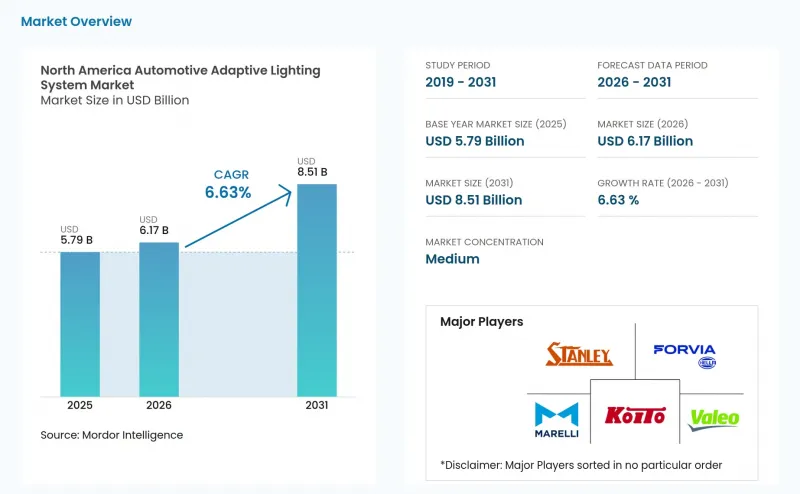
According to Mordor Intelligence, the North America automotive adaptive lighting system market size was valued at USD 5.79 billion in 2025 and is projected to expand from USD 6.17 billion in 2026 to USD 8.51 billion by 2031, registering a CAGR of 6.63% between 2026 and 2031.
North America Automotive Adaptive Lighting System Market Trends and Insights
NHTSA and CMVSS Enablement of Adaptive Driving Beams
NHTSA allowed certification of adaptive driving beam headlamps under Federal Motor Vehicle Safety Standard No. 108 in 2022. The agency denied petitions for reconsideration in December 2024, which confirmed the regulatory direction for U.S. vehicle programs. The settled framework gives automakers a clearer basis for planning compliant adaptive lighting systems. It also allows suppliers to prepare products for U.S. launches without relying on uncertain policy outcomes. The North America automotive adaptive lighting system market can therefore move from limited deployment toward more planned vehicle-program adoption.
ADAS and Camera Integration
Adaptive lighting increasingly uses camera, radar, and other vehicle inputs to adjust beam patterns while driving. This shifts attention from the lamp as a stand-alone part toward the coordination of sensors, controllers, and software. Suppliers that can support these connected functions may be more useful to automakers than suppliers focused only on hardware. Software also creates a path for qualified lighting features to be activated or adjusted after a vehicle is sold. The North America automotive adaptive lighting system market benefits as vehicle sensing systems become more common across new platforms.
High System and Repair Cost
Adaptive headlamp systems combine optics, electronics, actuators, and control software in a single assembly. That design can increase replacement costs when a component fails or is damaged. Repair providers also need vehicle-specific equipment and training to calibrate the system correctly. Availability of qualified service can be uneven outside major metropolitan areas. These factors may slow adoption in price-sensitive vehicle classes within the North America automotive adaptive lighting system market.
Other drivers and restraints analyzed in the detailed report include:
- Premium SUV and EV Feature Penetration
- LED Cost and Performance Improvement
- GaN and High-Power Semiconductor Supply Concentration
For complete list of drivers and restraints, kindly check the Table Of Contents.
Segment Analysis
Passenger cars held a 72.09% share in the North American automotive adaptive lighting system market in 2025. SUVs and crossovers support demand because automakers often introduce advanced lighting on higher-value vehicle lines. Their vehicle architectures can accommodate the sensors and control functions needed for adaptive operation. Sedans and hatchbacks have lower feature adoption rates, with buyers placing more emphasis on purchase price. Light commercial vehicles sit between consumer and heavy-duty use cases, as delivery fleets renew vehicles and add practical safety features.
Medium and heavy commercial vehicles are forecast to grow at a 10.57% CAGR through 2031. Fleet operators can value lighting that improves visibility on long and poorly lit routes. Safety policies and insurance requirements can make nighttime performance relevant to commercial procurement decisions. Suppliers that document reliable beam operation may be better placed in fleet discussions. The North America automotive adaptive lighting system industry, therefore, has a separate opportunity in working vehicles, not only in premium passenger models.
Exterior lighting accounted for 91.84% share in 2025 in the North America automotive adaptive lighting system market. Headlamps, cornering lights, and adaptive signaling remain closely connected to the safety purpose of these systems. Front lighting attracts much of the engineering and compliance work because it must manage road illumination and glare. Rear lighting can also evolve as vehicle systems use speed and navigation data more actively. The large exterior position reflects the current focus of automaker lighting programs.
Interior lighting is forecast to grow at a 9.12% CAGR through 2031. Automakers are using ambient lighting more often as part of the vehicle experience and software feature set. This use case can support functions that are updated or activated after delivery when the vehicle design allows it. Valeo announced an interior-lighting program using In-Mold Structural Electronics technology for a premium automaker. The North America automotive adaptive lighting system market may see interior lighting become more closely tied to user-interface and software decisions.
Complete Report Scope:
- By Vehicle Type
- Passenger Cars
- Sedans
- SUVs and Crossovers
- Hatchbacks
- Light Commercial Vehicles
- Medium and Heavy Commercial Vehicles
- Passenger Cars
- By Application
- Exterior Lighting
- Front Lighting
- Rear Lighting
- Interior Lighting
- Exterior Lighting
- By Component
- Controllers and ECUs
- Sensors and Cameras
- Lamp Assemblies
- Actuators and Motors
- Other Components
- By Technology and Light Source
- LED
- Xenon and HID
- Halogen
- Laser Lighting
- OLED and Micro-LED
- By Functionality
- Automatic High Beam
- Dynamic Bending Light
- Cornering Lights
- Adaptive Front Lighting
- Adaptive Driving Beam
- By Sales Channel
- Original Equipment Manufacturers
- Aftermarket
- By Country
- United States
- Canada
- Rest of North America
List of Companies Covered in this Report:
- ams-OSRAM AG
- Aptiv PLC
- Continental AG
- DENSO Corporation
- FORVIA HELLA
- Gentex Corporation
- Hyundai Mobis Co., Ltd.
- J.W. Speaker Corporation
- Johnson Electric Holdings Limited
- Koito Manufacturing Co., Ltd.
- Lear Corporation
- LG Electronics Inc. and ZKW Group
- Marelli Holdings Co., Ltd.
- Magna International Inc.
- North American Lighting, Inc.
- OPmobility SE
- Robert Bosch GmbH
- Stanley Electric Co., Ltd.
- Valeo SE
- Varroc Engineering Limited
Additional Benefits:
- The market estimate (ME) sheet in Excel format
- 3 months of analyst support
TABLE OF CONTENTS
1 INTRODUCTION
- 1.1 Study Assumptions and Market Definition
- 1.2 Scope of the Study
2 RESEARCH METHODOLOGY
3 EXECUTIVE SUMMARY
4 MARKET LANDSCAPE
- 4.1 Market Overview
- 4.2 Market Drivers
- 4.2.1 NHTSA and CMVSS Enablement of Adaptive Driving Beams
- 4.2.2 ADAS and Camera Integration
- 4.2.3 Premium SUV and EV Feature Penetration
- 4.2.4 LED Cost and Performance Improvement
- 4.2.5 OTA Beam-Pattern Upgrades and Software-Defined Lighting
- 4.2.6 Mexico-Based Lamp Module Localization Under USMCA
- 4.3 Market Restraints
- 4.3.1 High System and Repair Cost
- 4.3.2 GaN and High-Power Semiconductor Supply Concentration
- 4.3.3 Thermal Management in High-Lumen Modules
- 4.3.4 CAN-FD and OTA Cybersecurity Exposure
- 4.4 Value and Supply-Chain Analysis
- 4.5 Regulatory Landscape
- 4.6 Technological Outlook
- 4.7 Porter's Five Forces Analysis
- 4.7.1 Bargaining Power of Suppliers
- 4.7.2 Bargaining Power of Buyers
- 4.7.3 Threat of New Entrants
- 4.7.4 Threat of Substitutes
- 4.7.5 Intensity of Competitive Rivalry
5 MARKET SIZE AND GROWTH FORECASTS (VALUE AND VOLUME)
- 5.1 By Vehicle Type
- 5.1.1 Passenger Cars
- 5.1.1.1 Sedans
- 5.1.1.2 SUVs and Crossovers
- 5.1.1.3 Hatchbacks
- 5.1.2 Light Commercial Vehicles
- 5.1.3 Medium and Heavy Commercial Vehicles
- 5.1.1 Passenger Cars
- 5.2 By Application
- 5.2.1 Exterior Lighting
- 5.2.1.1 Front Lighting
- 5.2.1.2 Rear Lighting
- 5.2.2 Interior Lighting
- 5.2.1 Exterior Lighting
- 5.3 By Component
- 5.3.1 Controllers and ECUs
- 5.3.2 Sensors and Cameras
- 5.3.3 Lamp Assemblies
- 5.3.4 Actuators and Motors
- 5.3.5 Other Components
- 5.4 By Technology and Light Source
- 5.4.1 LED
- 5.4.2 Xenon and HID
- 5.4.3 Halogen
- 5.4.4 Laser Lighting
- 5.4.5 OLED and Micro-LED
- 5.5 By Functionality
- 5.5.1 Automatic High Beam
- 5.5.2 Dynamic Bending Light
- 5.5.3 Cornering Lights
- 5.5.4 Adaptive Front Lighting
- 5.5.5 Adaptive Driving Beam
- 5.6 By Sales Channel
- 5.6.1 Original Equipment Manufacturers
- 5.6.2 Aftermarket
- 5.7 By Country
- 5.7.1 United States
- 5.7.2 Canada
- 5.7.3 Rest of North America
6 COMPETITIVE LANDSCAPE
- 6.1 Market Concentration
- 6.2 Strategic Moves
- 6.3 Market Share Analysis
- 6.4 Company Profiles (Includes Global Level Overview, Market Level Overview, Core Segments, Financials as available, Strategic Information, Market Rank/Share, Products and Services, Recent Developments)
- 6.4.1 ams-OSRAM AG
- 6.4.2 Aptiv PLC
- 6.4.3 Continental AG
- 6.4.4 DENSO Corporation
- 6.4.5 FORVIA HELLA
- 6.4.6 Gentex Corporation
- 6.4.7 Hyundai Mobis Co., Ltd.
- 6.4.8 J.W. Speaker Corporation
- 6.4.9 Johnson Electric Holdings Limited
- 6.4.10 Koito Manufacturing Co., Ltd.
- 6.4.11 Lear Corporation
- 6.4.12 LG Electronics Inc. and ZKW Group
- 6.4.13 Marelli Holdings Co., Ltd.
- 6.4.14 Magna International Inc.
- 6.4.15 North American Lighting, Inc.
- 6.4.16 OPmobility SE
- 6.4.17 Robert Bosch GmbH
- 6.4.18 Stanley Electric Co., Ltd.
- 6.4.19 Valeo SE
- 6.4.20 Varroc Engineering Limited
7 MARKET OPPORTUNITIES AND FUTURE OUTLOOK
- 7.1 White-Space and Unmet-Need Assessment

