PUBLISHER: Mordor Intelligence | PRODUCT CODE: 2184625

PUBLISHER: Mordor Intelligence | PRODUCT CODE: 2184625
China Automotive Adaptive Lighting System - Market Share Analysis, Industry Trends & Statistics, Growth Forecasts (2027 - 2032)
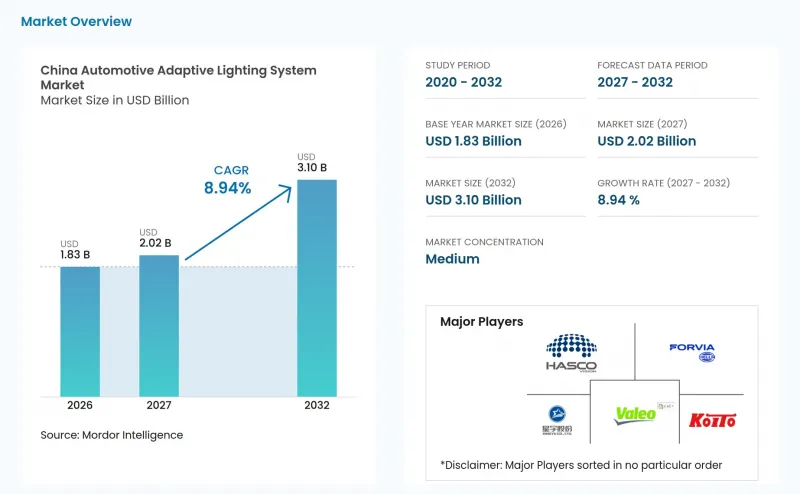
According to Mordor Intelligence, the China automotive adaptive lighting system market size was valued at USD 1.83 billion in 2026, is estimated at USD 2.02 billion in 2027, and is projected to reach USD 3.10 billion by 2032, growing at a CAGR of 8.94% from 2027 to 2032.
China Automotive Adaptive Lighting System Market Trends and Insights
New-Energy Vehicle and Premium-EV Penetration
China's new-energy vehicle expansion is supporting demand for adaptive lighting systems rather than only increasing vehicle output. Battery-electric and plug-in hybrid platforms often use centralized electronic architectures, which can reduce the integration burden of connected lighting functions. Premium electric-vehicle brands use lighting design and interactive features to distinguish their vehicles, making advanced lamps more visible to buyers. This helps shorten the decision cycle for pixel lighting and adaptive beam features in volume vehicle programs. The Chinese automotive adaptive lighting system market therefore benefits when new platforms are designed around software-connected electrical systems from the start.
Falling LED and Semiconductor Costs Through Localized Supply
Local supply development is lowering a cost barrier that once restricted adaptive lighting to luxury vehicles. Chinese suppliers are building capability in LED chips, driver integrated circuits, optical modules, and lamp integration. Xingyu has described strategic cooperation with Oritek and LatticePower that supports its lighting technology development. Broader local sourcing can narrow the gap between basic LED lamps and more capable matrix systems. The China automotive adaptive lighting system market may therefore see adaptive functions reach lower vehicle price bands when qualified local inputs are available at scale. This cost shift also increases pressure on suppliers that rely on imported high-flux LED dies or driver components.
High Integration, Validation, and Thermal-Management Costs
High-resolution adaptive lamps place more optical power and electronic content into a smaller package than conventional headlamps. This raises the need for thermal design, durable materials, and testing across the vehicle operating range. FORVIA HELLA localized its SSL|HD technology for a Zeekr program with 25,000 individually controllable pixels in each headlamp. Each configuration requires functional-safety work and environmental validation before it can be approved for production. These requirements can extend program timing when a single supplier supports multiple pixel formats across different OEM architectures. Consequently, the Chinese automotive adaptive lighting system market favors suppliers that have integrated optical, thermal, electronic, and validation capabilities.
Other drivers and restraints analyzed in the detailed report include:
- GB Lighting Standards and C-NCAP Safety Evaluation
- ADAS Sensor Fusion and Software-Defined Vehicle Architectures
- Price Erosion and Supplier Overcapacity
For complete list of drivers and restraints, kindly check the Table Of Contents.
Segment Analysis
Passenger vehicles held 79.15% of China's automotive adaptive lighting system market share in 2026. The segment benefits from its large production base and the high concentration of new-energy vehicle launches in the passenger-car segment. Passenger-car OEMs also have stronger incentives to specify higher-value lighting that supports safety ratings and visible design differentiation. Matrix LED and adaptive high-beam functions are reaching vehicle price bands where domestic brands compete most actively. FORVIA HELLA developed intelligent headlamps for NIO's ONVO L90, a mainstream-premium new-energy SUV launched in July 2025 . The company also created customized LED matrix headlamps for the smart#5 program. These programs show that adaptive specifications now extend across more than one premium vehicle position.
Light commercial vehicles are forecast to record an 11.36% CAGR through 2032, the fastest rate among vehicle types. Electrification of logistics and last-mile delivery fleets gives OEMs a reason to improve night-driving safety and vehicle identity. Fleet operators have a practical interest in systems that can improve forward visibility on repetitive urban and highway routes. Commercial vehicle buyers also value distinct lighting signatures that support fleet branding and vehicle recognition. Although medium- and heavy-duty commercial vehicles currently account for a smaller share, their long operating hours strengthen the case for adaptive high-beam and cornering lighting functions. Highway use increases the relevance of glare management and road illumination during overnight operations. The Chinese automotive adaptive lighting sector has an opportunity to tailor durable systems for trucks rather than relying on passenger-car designs.
Exterior lighting accounted for 94.22% of China's automotive adaptive lighting system market revenue in 2026 and is set to grow at a 10.45% CAGR. Headlamps and rear lamps are of greatest value because they must meet photometric requirements while remaining visible design elements. Their functions can also be evaluated by safety organizations and understood directly by vehicle buyers. This creates a close connection between lighting specification, vehicle positioning, and product appeal. FORVIA HELLA launched a Star-Diamond Rear Lamp for the Zeekr 9X with an integrated indicator that supports assisted-driving communication. The product demonstrates how exterior lamps are moving beyond basic illumination and signaling.
Interior lighting remains a small revenue area, but it is gaining functional depth in new-energy vehicles. OEMs are using ambient lighting that changes with vehicle modes, driver attention states, and occupant interactions. Marelli presented lighting technologies for the age of the software-defined vehicle at Auto China 2026 . Its presentation included flat lighting surfaces and MicroLED concepts that connect display, lighting, and signaling functions. These systems suggest that interior and exterior functions can share software and electronic building blocks. Shared platforms can reduce the incremental development burden of adding adaptive interior features. The Chinese automotive adaptive lighting system market may therefore benefit from common lighting architectures, even as interior lighting remains a smaller revenue stream.
Complete Report Scope:
- By Vehicle Type
- Passenger Vehicles
- Light Commercial Vehicles
- Medium and Heavy Commercial Vehicles
- By Application
- Exterior Lighting
- Interior Lighting
- By Component Type
- Controllers
- Sensors/Cameras
- Lamp Assemblies
- Actuators
- Others
- By Technology
- Light-Emitting Diode
- Xenon and High-Intensity Discharge
- Halogen
- Laser Lighting
- By Sales Channel
- Original Equipment Manufacturer
- Aftermarket
- By Functionality
- Automatic High Beam
- Dynamic Bending Light
- Cornering Light
- Adaptive Front Lighting
- Cross-Segmentation Analysis
- Vehicle Type by Application
- Vehicle Type by Component Type
List of Companies Covered in this Report:
- Hella GmbH & Co. KGaA (FORVIA HELLA)
- HASCO Vision Technology Co., Ltd.
- Changzhou Xingyu Automotive Lighting Systems Co., Ltd.
- Valeo SA
- Koito Manufacturing Co., Ltd.
- Marelli Holdings Co., Ltd.
- Stanley Electric Co., Ltd.
- ZKW Group GmbH
- Jingwei Hirain Technologies Co., Ltd.
- ams-OSRAM AG
- Jinye Lighting Holding Group
- Changzhou Xingyu Automotive Lighting Systems Co., Ltd.
- SL Corporation
- Zhejiang Jiali (Lishui) Industry Co., Ltd.
- OPmobility SE
Additional Benefits:
- The market estimate (ME) sheet in Excel format
- 3 months of analyst support
TABLE OF CONTENTS
1 Introduction
- 1.1 Study Assumptions and Market Definition
- 1.2 Scope of the Study
2 Research Methodology
3 Executive Summary
4 Market Landscape
- 4.1 Market Overview
- 4.2 Market Drivers
- 4.2.1 New-Energy Vehicle and Premium-EV Penetration
- 4.2.2 Falling LED and Semiconductor Costs Through Localized Supply
- 4.2.3 GB Lighting Standards and C-NCAP Safety Evaluation
- 4.2.4 ADAS Sensor Fusion and Software-Defined Vehicle Architectures
- 4.2.5 OTA-Updatable Lighting Functions and Digital Feature Monetization
- 4.2.6 Lighting as External Human-Machine Interface and Road Projection
- 4.3 Market Restraints
- 4.3.1 High Integration, Validation, and Thermal-Management Costs
- 4.3.2 Price Erosion and Supplier Overcapacity
- 4.3.3 Photometric Revalidation Across Software and OTA Releases
- 4.3.4 Fragmented Ownership of Perception, Lighting, and Vehicle E/E Architectures
- 4.4 Value and Supply-Chain Analysis
- 4.5 Regulatory Landscape
- 4.6 Technological Outlook
- 4.7 Porter's Five Forces Analysis
- 4.7.1 Bargaining Power of Suppliers
- 4.7.2 Bargaining Power of Buyers
- 4.7.3 Threat of New Entrants
- 4.7.4 Threat of Substitutes
- 4.7.5 Intensity of Competitive Rivalry
5 Market Size and Growth Forecasts (Value (USD) and Volume (Units))
- 5.1 By Vehicle Type
- 5.1.1 Passenger Vehicles
- 5.1.2 Light Commercial Vehicles
- 5.1.3 Medium and Heavy Commercial Vehicles
- 5.2 By Application
- 5.2.1 Exterior Lighting
- 5.2.2 Interior Lighting
- 5.3 By Component Type
- 5.3.1 Controllers
- 5.3.2 Sensors/Cameras
- 5.3.3 Lamp Assemblies
- 5.3.4 Actuators
- 5.3.5 Others
- 5.4 By Technology
- 5.4.1 Light-Emitting Diode
- 5.4.2 Xenon and High-Intensity Discharge
- 5.4.3 Halogen
- 5.4.4 Laser Lighting
- 5.5 By Sales Channel
- 5.5.1 Original Equipment Manufacturer
- 5.5.2 Aftermarket
- 5.6 By Functionality
- 5.6.1 Automatic High Beam
- 5.6.2 Dynamic Bending Light
- 5.6.3 Cornering Light
- 5.6.4 Adaptive Front Lighting
- 5.7 Cross-Segmentation Analysis
- 5.7.1 Vehicle Type by Application
- 5.7.2 Vehicle Type by Component Type
6 Competitive Landscape
- 6.1 Market Concentration
- 6.2 Strategic Moves
- 6.3 Market Share Analysis
- 6.4 Company Profiles (Includes Global Level Overview, Market Level Overview, Core Segments, Financials as Available, Strategic Information, Market Rank/Share for Key Companies, Products Offered, SWOT Analysis, and Recent Developments)
- 6.4.1 Hella GmbH & Co. KGaA (FORVIA HELLA)
- 6.4.2 HASCO Vision Technology Co., Ltd.
- 6.4.3 Changzhou Xingyu Automotive Lighting Systems Co., Ltd.
- 6.4.4 Valeo SA
- 6.4.5 Koito Manufacturing Co., Ltd.
- 6.4.6 Marelli Holdings Co., Ltd.
- 6.4.7 Stanley Electric Co., Ltd.
- 6.4.8 ZKW Group GmbH
- 6.4.9 Jingwei Hirain Technologies Co., Ltd.
- 6.4.10 ams-OSRAM AG
- 6.4.11 Jinye Lighting Holding Group
- 6.4.12 Changzhou Xingyu Automotive Lighting Systems Co., Ltd.
- 6.4.13 SL Corporation
- 6.4.14 Zhejiang Jiali (Lishui) Industry Co., Ltd.
- 6.4.15 OPmobility SE
7 Market Opportunities and Future Outlook
- 7.1 White-Space and Unmet-Need Assessment

