PUBLISHER: Mordor Intelligence | PRODUCT CODE: 2185148

PUBLISHER: Mordor Intelligence | PRODUCT CODE: 2185148
North America Pre-engineered Buildings (PEB) Construction - Market Share Analysis, Industry Trends & Statistics, Growth Forecasts (2027 - 2032)
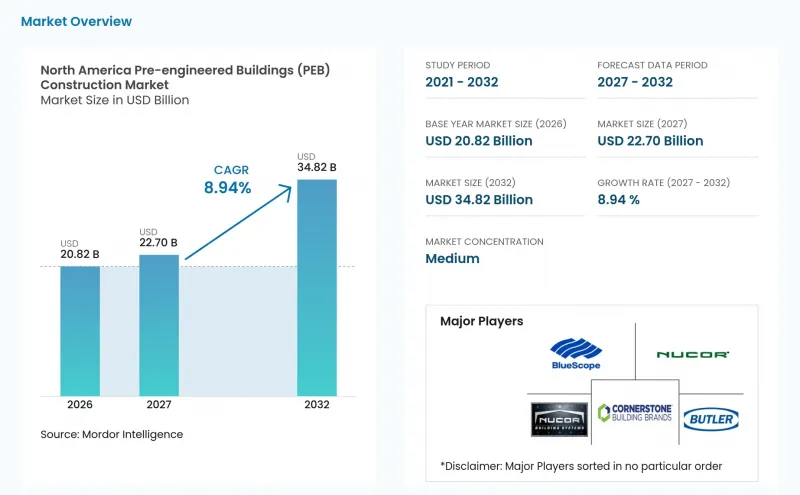
According to Mordor Intelligence, the North America pre-engineered buildings construction market size is expected to increase from USD 20.82 billion in 2026 to USD 22.70 billion in 2027 and reach USD 34.82 billion by 2032, growing at a CAGR of 8.94% over 2027-2032.
North America Pre-engineered Buildings (PEB) Construction Market Trends and Insights
E-Commerce Fulfillment and Cold-Chain Distribution-Center Expansion
The North America pre-engineered buildings (PEB) construction market gains from distribution projects that require clear spans, higher eaves, and refrigeration-ready envelopes. These needs fit steel systems designed around standardized frames and secondary members, allowing operators to plan refrigeration penetrations, insulated envelopes, and high eave heights without repeated field redesign, reducing coordination work during a stage when cold-chain users are managing demanding commissioning schedules. Bolt-up construction can dry in 30% to 50% faster than conventional approaches, helping operators protect tight delivery schedules for perishable goods. Star Building Systems documented the use of a 3D-scan-guided rigid-frame system at a UPS processing facility in Denver during 2025. Insulated metal panels also raise the value of a project because they are increasingly specified with the structural shell. Manufacturers that include these panels in their scope can retain work that would otherwise go to separate suppliers.
Hyperscale Data-Center and Semiconductor Fab Shell Construction
Data-center investment is increasing demand for large structures that can be delivered on compressed schedules. The North America pre-engineered buildings (PEB) construction market is well placed for this work because prefabricated structural components reduce site assembly time. Crusoe began the second phase of its Abilene, Texas, artificial intelligence campus in March 2025, with the site planned at 1.2 gigawatts across 4 million square feet. Vertiv introduced its OneCore prefabricated data-center platform in August 2025 and stated that it could compress schedules by up to 50% compared with traditional construction. Nucor reported 31.9 million square feet of domestic data-center development in 2025. These projects provide manufacturers with large contracts that are less tied to residential and smaller commercial construction cycles, which supports a steadier order pipeline for suppliers aligned with hyperscale owner-operators when residential or light-commercial activity is uneven.
Domestic Steel-Capacity Cycles and Zinc-Coated Coil Price Volatility
Zinc-coated coil remains a significant input for steel building manufacturers. Zinc ingot prices in the United States reached USD 3,445 per metric ton in June 2025, while galvanized plain sheet prices in Illinois reached USD 1,520 per metric ton. Manufacturers commonly price projects before material is procured and fabricate within 12 to 20 weeks. A rapid input-cost change during that period can reduce margins on a fixed-price contract. Price-escalation clauses can offer protection, but owners may resist terms that leave final costs open. The North America pre-engineered buildings (PEB) construction market, therefore, remains exposed to steel-price movements even when demand is firm, making material purchasing discipline and clear contract terms important for producers that commit to delivery dates before coil is procured.
Other drivers and restraints analyzed in the detailed report include:
- Automotive and Battery-Manufacturing Nearshoring in Mexico and the United States
- Hurricane, Tornado, and Seismic Wind-Load Compliance
- Unionized Erection Labor Availability and Wage Escalation
For complete list of drivers and restraints, kindly check the Table Of Contents.
Segment Analysis
Single-story buildings held 62% of the North America pre-engineered buildings (PEB) construction market size in 2026. Fulfillment centers, manufacturing shells, and agricultural storage buildings support this position because they need large floorplates and column-free internal space. Clear spans of up to 300 feet are common for these uses. E-commerce operators are also seeking eave heights above 40 feet to support automated storage and retrieval systems. This raises the engineering content and value per square foot of a typical single-story project. It also gives manufacturers an opportunity to supply structural components suited to automated equipment layouts, rather than a basic low-height warehouse shell. The format remains practical where land is available, and equipment circulation needs open floor space.
Multi-story buildings are forecast to grow at a 9.4% CAGR through 2032. Urban logistics hubs, multi-tenant industrial condominiums, and modular residential projects are supporting the faster pace. The Modular Building Institute reported year-over-year growth in completed multi-story permanent modular projects in the United States and Canada in 2026. Canada is prioritizing 4,000 factory-built units on federal sites in six cities through its Build Canada Homes initiative. Both structure types benefit when owners value certainty in schedules and labor use. The North America pre-engineered buildings (PEB) construction industry also gains when prefabricated frames reduce the time needed to establish a building skeleton.
Complete Report Scope:
- By Structure
- Single-Story
- Multi-Story
- By Product Type
- Modular Buildings
- Panelized and Componentized Systems
- Other Prefabricated Building Types
- By Application
- Residential
- Commercial
- Industrial
- Institutional
- Others
- By Country
- United States
- Canada
- Mexico
List of Companies Covered in this Report:
- BlueScope Steel Limited
- Nucor Corporation
- Cornerstone Building Brands, Inc.
- Butler Manufacturing Company
- Mueller, Inc.
- ATCO Ltd.
- Kingspan Group plc
- Panel Built, Inc.
- Star Building Systems
- Zamil Steel Holding Company
- Cornerstone Building Brands, Inc.
- Varco Pruden Buildings
- American Buildings Company
- RedBuilt LLC
- United Structures of America, Inc.
Additional Benefits:
- The market estimate (ME) sheet in Excel format
- 3 months of analyst support
TABLE OF CONTENTS
1 Introduction
- 1.1 Study Assumptions & Market Definition
- 1.2 Scope of the Study
2 Research Methodology
3 Executive Summary
4 Market Landscape
- 4.1 Market Overview
- 4.2 Market Drivers
- 4.2.1 E-Commerce Fulfillment and Cold-Chain Distribution-Center Expansion
- 4.2.2 Hyperscale Data-Center and Semiconductor Fab Shell Construction
- 4.2.3 Automotive and Battery-Manufacturing Nearshoring in Mexico and the United States
- 4.2.4 Hurricane, Tornado and Seismic Wind-Load Compliance
- 4.2.5 Dealer-Erector Consolidation and Automated Shop Fabrication
- 4.3 Market Restraints
- 4.3.1 Domestic Steel-Capacity Cycles and Zinc-Coated Coil Price Volatility
- 4.3.2 Unionized Erection Labor Availability and Wage Escalation
- 4.3.3 State-by-State Permitting, Zoning and Local Design Requirements
- 4.3.4 Oversized-Load Rules and Cross-Border USMCA Logistics Constraints
- 4.4 Value / Supply-Chain Analysis
- 4.5 Regulatory Landscape
- 4.6 Technological Outlook
- 4.7 Cost Structure Analysis
- 4.8 Replacement Market Dynamics
- 4.9 Porter's Five Forces
- 4.9.1 Threat of New Entrants
- 4.9.2 Bargaining Power of Suppliers
- 4.9.3 Bargaining Power of Buyers
- 4.9.4 Threat of Substitutes
- 4.9.5 Competitive Rivalry
5 Market Size & Growth Forecasts (Value, In USD Billion)
- 5.1 By Structure
- 5.1.1 Single-Story
- 5.1.2 Multi-Story
- 5.2 By Product Type
- 5.2.1 Modular Buildings
- 5.2.2 Panelized and Componentized Systems
- 5.2.3 Other Prefabricated Building Types
- 5.3 By Application
- 5.3.1 Residential
- 5.3.2 Commercial
- 5.3.3 Industrial
- 5.3.4 Institutional
- 5.3.5 Others
- 5.4 By Country
- 5.4.1 United States
- 5.4.2 Canada
- 5.4.3 Mexico
6 Competitive Landscape
- 6.1 Market Concentration
- 6.2 Strategic Moves
- 6.3 Company Profiles {(includes Global level Overview, Market level overview, Core Segments, Financials as available, Strategic Information, Market Rank/Share for key companies, Products & Services, and Recent Developments)}
- 6.3.1 BlueScope Steel Limited
- 6.3.2 Nucor Corporation
- 6.3.3 Cornerstone Building Brands, Inc.
- 6.3.4 Butler Manufacturing Company
- 6.3.5 Mueller, Inc.
- 6.3.6 ATCO Ltd.
- 6.3.7 Kingspan Group plc
- 6.3.8 Panel Built, Inc.
- 6.3.9 Star Building Systems
- 6.3.10 Zamil Steel Holding Company
- 6.3.11 Cornerstone Building Brands, Inc.
- 6.3.12 Varco Pruden Buildings
- 6.3.13 American Buildings Company
- 6.3.14 RedBuilt LLC
- 6.3.15 United Structures of America, Inc.
7 Market Opportunities & Future Outlook
- 7.1 White-space & unmet-need assessment

