PUBLISHER: Mordor Intelligence | PRODUCT CODE: 2186091

PUBLISHER: Mordor Intelligence | PRODUCT CODE: 2186091
Asia-Pacific Watch Components Manufacturing - Market Share Analysis, Industry Trends & Statistics, Growth Forecasts (2027 - 2032)
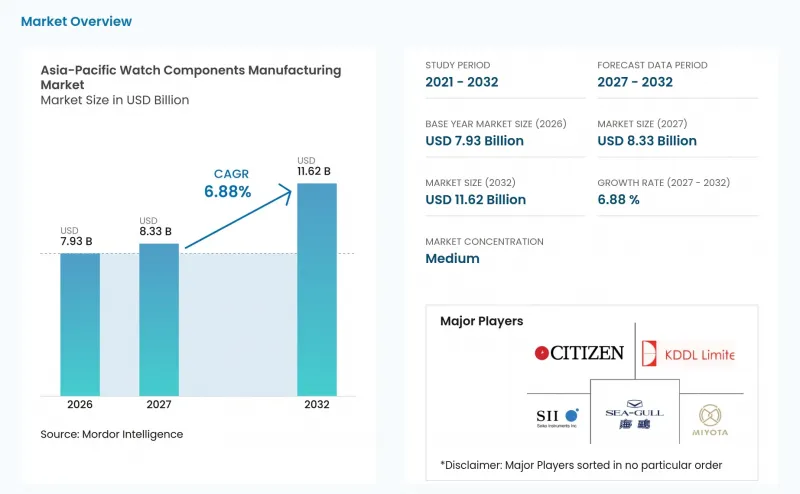
According to Mordor Intelligence, the Asia-Pacific watch components manufacturing market size is projected to expand from USD 7.93 billion in 2026 and USD 8.33 billion in 2027 to USD 11.62 billion by 2032, registering a CAGR of 6.88% between 2027 and 2032.
Asia-Pacific Watch Components Manufacturing Market Trends and Insights
Premiumization and Revival of Mechanical and Luxury Watchmaking
Premiumization allows component suppliers to grow revenue through higher-value inputs rather than through a simple increase in unit output. Demand for sapphire crystals, high-grade movement blanks, coated cases, detailed dials, and finished bracelets raises the value attached to each watch. This favors producers that can maintain consistent dimensions, cosmetic quality, and material performance across repeated production runs. Seagull Watch demonstrated this movement toward higher-value products when it debuted a split-seconds chronograph at Watches and Wonders 2025 and presented its vertically integrated capability across components. The Asia-Pacific watch components manufacturing market, therefore, benefits when premium brands require parts that are harder to substitute and more demanding to qualify. The result is greater importance for finishing, precision tooling, material validation, and dependable supply relationships that begin with design discussions, continue through pilot samples and testing, and remain important when a product enters regular production, because premium brands must protect consistency across models, colors, case sizes, and production batches.
Rising Asia-Pacific Watch Production and Regional Brand Development
China, Japan, India, and Southeast Asia provide production capacity across movements, exterior parts, dials, hands, crystals, bracelets, and final assembly. Regional brands increasingly create component demand closer to the place where products are designed and assembled. This gives suppliers a customer base that is not limited to export orders from established overseas houses. India's component sector has gained relevance through bracelets, dials, hands, and precision-engineering activity serving both domestic and international customers. The Asia-Pacific watch components manufacturing market gains resilience when local brand development adds another route to demand for qualified components. This development also makes speed, shorter production runs, and direct engineering coordination more important for suppliers, since new or growing regional brands often need to adjust designs, confirm samples, place repeat orders, and maintain product identity without the long planning cycles associated with large global collections.
Luxury Watch Demand and Export-Market Volatility
Component orders move with the demand outlook of the brands that buy finished parts, especially when a supplier serves export-oriented premium watch programs. A demand reduction can affect dials, hands, movement parts, cases, and bracelets before a final watch reaches the retail market. This leaves suppliers with less visibility on capacity planning and inventory purchases. The risk is greater for companies that have a narrow set of customers or heavy exposure to one export destination. The Asia-Pacific watch components manufacturing market needs broader customer portfolios and a balanced mix of mechanical, quartz, smart, and aftermarket work to manage this exposure. Domestic watch demand in India and other regional markets provides a partial counterweight. Still, it does not remove the need for flexible operations that can shift labor, tooling, material orders, and production schedules across different component programs when premium export orders change.
Other drivers and restraints analyzed in the detailed report include:
- Silicon, Ceramic, Sapphire, Titanium and Other Advanced Material Adoption
- Regionalization of Sourcing and ASEAN Capacity Diversification
- Skilled Micromechanics and Precision-Manufacturing Labor Shortages
For complete list of drivers and restraints, kindly check the Table Of Contents.
Segment Analysis
Movement Components held 30% of the Asia-Pacific watch components manufacturing market share in 2026, reflecting the high value carried by mainplates, bridges, gear trains, escapements, and regulating parts. These inputs form the operating core of mechanical watches and need close coordination between design, materials, tooling, and assembly. Their value is not based on size alone, because small parts can determine the accuracy, reliability, and serviceability of a finished watch. Extended customer qualifications also give established suppliers a stronger position once a movement design has been accepted. The Asia-Pacific watch components manufacturing market includes deep movement expertise in Tianjin, Japan, and other specialist locations. Seagull Watch reported 3 million movements of annual capacity in 2025, which shows the scale of movement manufacturing available in China. The company also reported 1,457 worldwide patents, including technical work related to high complications. This combination of scale and technical capability supports the continued revenue leadership of movement components.
Crystal Components are forecast to grow at a 7.6% CAGR through 2032, making them the fastest-growing component category. Sapphire demand is central to this growth because premium mechanical, hybrid, and smart watch designs need scratch-resistant transparent covers with consistent optical quality. Crystal suppliers must manage material processing, cutting, shaping, coating, and quality control while also serving different case designs. Thailand and China remain important to the regional crystal supply base, alongside related optics and wafer-processing capabilities. Exterior and habillage components, including cases, bezels, lugs, crowns, and casebacks, remain the next major group because they define the appearance and wearability of a watch. Dial and hand suppliers retain a practical role in product differentiation through color, texture, indices, print, and finishing. Sealing and authentication components are smaller categories, but they matter as brands seek reliable water resistance and clearer supply-chain documentation.
Complete Report Scope:
- By Component Type
- Movement Components
- Mainplates, Bridges, and Plates
- Gear Trains, Wheels, and Pinions
- Escapements, Anchors, and Regulating Components
- Springs, Barrels, and Shock-Protection Components
- Rotors, Oscillating Weights, Screws, Jewels, and Other Movement Components
- Watch Exterior / Habillage Components
- Cases, Case Middles, and Casebacks
- Bezels, Lugs, Flanges, and Casing Rings
- Crowns, Tubes, Pushers, and Correctors
- Dial and Hand Components
- Dial Plates, Indexes, Applied Markers, and Decorative Dial Elements
- Hour, Minute, Seconds, and Chronograph Hands
- Crystal Components
- Sapphire Crystals
- Mineral Glass Crystals
- Acrylic and Specialty Crystals
- Bracelet, Strap, and Clasp Components
- Metal Bracelets and Links
- Leather, Rubber, Textile, and Polymer Straps
- Buckles, Clasps, Spring Bars, and End Links
- Sealing and Other Watch-Specific Components
- Gaskets, Seals, and Water-Resistance Components
- Decorative, Authentication, and Specialty Components
- Movement Components
- By Watch Type / End Use
- Mechanical Watches
- Quartz Watches
- Smart and Hybrid Watches - Watch-Specific Mechanical and Exterior Components Only
- By Material
- Stainless Steel and Other Ferrous Alloys
- Gold, Platinum, and Precious-Metal Alloys
- Titanium, Aluminium, Magnesium, and Zirconium
- Brass, Nickel Alloys, and Copper Alloys
- Ceramic, Sapphire, Glass, and Carbon Composites
- Silicon, Nickel-Phosphorus, and Silicon-Based Materials
- Leather, Rubber, Textile, and Engineering Polymers
- By Geography
- China
- Japan
- India
- Thailand
- Taiwan
- South Korea
- Vietnam
- Cambodia
- Hong Kong
- Singapore
- Indonesia
- Malaysia
- Australia
- Rest of Asia-Pacific
List of Companies Covered in this Report:
- Seiko Instruments Inc.
- CITIZEN WATCH CO., LTD.
- MIYOTA Movement
- Tianjin Seagull Watch Group Co., Ltd.
- KDDL Limited
- Nihon Seimitsu Co., Ltd.
- NV Vision Group
- Ching Mei Optics Co., Ltd.
- Orbray Co., Ltd.
- Yu Hing Precision Technology (Shenzhen) Company Limited
- Baoruihua (Dongguan) Precision Technology Co., Ltd.
- Shenzhen Shijin Watch Co., Ltd.
- HHV Crystals
- Braloba AG
- Megaage Watchband Manufacturing Limited
- TAY I TANG INDUSTRIAL CO., LTD.
- NISSEY VIETNAM CO., LTD.
- Paragon Crystal Manufacturing Co., Ltd.
Additional Benefits:
- The market estimate (ME) sheet in Excel format
- 3 months of analyst support
TABLE OF CONTENTS
1 Introduction
- 1.1 Study Assumptions and Market Definition
- 1.2 Scope of the Study
2 Research Methodology
3 Executive Summary
4 Market Landscape
- 4.1 Market Overview
- 4.2 Market Drivers
- 4.2.1 Premiumization and Revival of Mechanical and Luxury Watchmaking
- 4.2.2 Rising Asia-Pacific Watch Production and Regional Brand Development
- 4.2.3 Silicon, Ceramic, Sapphire, Titanium, and Other Advanced Material Adoption
- 4.2.4 Regionalization of Sourcing and ASEAN Capacity Diversification
- 4.2.5 Low-Volume Flexible Supply for Microbrands and Independent Watchmakers
- 4.2.6 Repairability and Long-Tail Spare-Parts Demand
- 4.3 Market Restraints
- 4.3.1 Luxury Watch Demand and Export-Market Volatility
- 4.3.2 Skilled Micromechanics and Precision-Manufacturing Labor Shortages
- 4.3.3 Long Supplier Qualification Cycles and High Switching Costs
- 4.3.4 Fragmented Aftermarket Data, Traceability Gaps, and Counterfeit Risk
- 4.4 Value and Supply-Chain Analysis
- 4.4.1 Raw Materials and Specialty Inputs
- 4.4.2 Component Design, Engineering, and Tooling
- 4.4.3 Precision Manufacturing and Micromachining
- 4.4.4 Surface Finishing, Decoration, and Coating
- 4.4.5 Inspection, Testing, and Metrology
- 4.4.6 Movement and Watch Assembly
- 4.4.7 Aftermarket Service and Spare-Parts Supply
- 4.5 Regulatory Landscape
- 4.5.1 Product Safety, Chemical, and Hazardous-Substance Compliance
- 4.5.2 Precious-Metal Traceability and Responsible Sourcing
- 4.5.3 Sustainability and Supply-Chain Disclosure Requirements
- 4.5.4 Import, Export, Customs, and Rules-of-Origin Requirements
- 4.5.5 Intellectual Property, Design Protection, and Counterfeit Enforcement
- 4.6 Manufacturing Technology and Innovation Landscape
- 4.6.1 CNC Turning, Milling, and Micromachining
- 4.6.2 High-Precision Gear Cutting and Finishing
- 4.6.3 Stamping, Pressing, and Progressive Tooling
- 4.6.4 Grinding, Honing, Lapping, and Precision Finishing
- 4.6.5 Injection Molding, Casting, and Sintering
- 4.6.6 Silicon Etching and Microfabrication
- 4.6.7 UV-LIGA and Electroformed Microcomponents
- 4.6.8 Laser Processing and Additive Manufacturing
- 4.6.9 Plating, PVD, DLC, PEO and Advanced Coatings
- 4.6.10 Polishing, Decoration, Engraving and Gem Setting
- 4.6.11 Automated Assembly, Calibration and Testing
- 4.6.12 Machine Vision, Automated Inspection, and Integrated Metrology
- 4.7 Impact of Geopolitical Developments on the Market
- 4.7.1 China Plus One Manufacturing Strategies
- 4.7.2 Cross-Border Component Trade and Supply Continuity
- 4.7.3 RCEP-Linked Sourcing and ASEAN Production Networks
5 Market Size & Growth Forecasts
- 5.1 By Component Type
- 5.1.1 Movement Components
- 5.1.1.1 Mainplates, Bridges, and Plates
- 5.1.1.2 Gear Trains, Wheels, and Pinions
- 5.1.1.3 Escapements, Anchors, and Regulating Components
- 5.1.1.4 Springs, Barrels, and Shock-Protection Components
- 5.1.1.5 Rotors, Oscillating Weights, Screws, Jewels, and Other Movement Components
- 5.1.2 Watch Exterior / Habillage Components
- 5.1.2.1 Cases, Case Middles, and Casebacks
- 5.1.2.2 Bezels, Lugs, Flanges, and Casing Rings
- 5.1.2.3 Crowns, Tubes, Pushers, and Correctors
- 5.1.3 Dial and Hand Components
- 5.1.3.1 Dial Plates, Indexes, Applied Markers, and Decorative Dial Elements
- 5.1.3.2 Hour, Minute, Seconds, and Chronograph Hands
- 5.1.4 Crystal Components
- 5.1.4.1 Sapphire Crystals
- 5.1.4.2 Mineral Glass Crystals
- 5.1.4.3 Acrylic and Specialty Crystals
- 5.1.5 Bracelet, Strap, and Clasp Components
- 5.1.5.1 Metal Bracelets and Links
- 5.1.5.2 Leather, Rubber, Textile, and Polymer Straps
- 5.1.5.3 Buckles, Clasps, Spring Bars, and End Links
- 5.1.6 Sealing and Other Watch-Specific Components
- 5.1.6.1 Gaskets, Seals, and Water-Resistance Components
- 5.1.6.2 Decorative, Authentication, and Specialty Components
- 5.1.1 Movement Components
- 5.2 By Watch Type / End Use
- 5.2.1 Mechanical Watches
- 5.2.2 Quartz Watches
- 5.2.3 Smart and Hybrid Watches - Watch-Specific Mechanical and Exterior Components Only
- 5.3 By Material
- 5.3.1 Stainless Steel and Other Ferrous Alloys
- 5.3.2 Gold, Platinum, and Precious-Metal Alloys
- 5.3.3 Titanium, Aluminium, Magnesium, and Zirconium
- 5.3.4 Brass, Nickel Alloys, and Copper Alloys
- 5.3.5 Ceramic, Sapphire, Glass, and Carbon Composites
- 5.3.6 Silicon, Nickel-Phosphorus, and Silicon-Based Materials
- 5.3.7 Leather, Rubber, Textile, and Engineering Polymers
- 5.4 By Geography
- 5.4.1 China
- 5.4.2 Japan
- 5.4.3 India
- 5.4.4 Thailand
- 5.4.5 Taiwan
- 5.4.6 South Korea
- 5.4.7 Vietnam
- 5.4.8 Cambodia
- 5.4.9 Hong Kong
- 5.4.10 Singapore
- 5.4.11 Indonesia
- 5.4.12 Malaysia
- 5.4.13 Australia
- 5.4.14 Rest of Asia-Pacific
6 Competitive Landscape
- 6.1 Market Concentration
- 6.2 Market Share Analysis
- 6.3 Strategic Moves
- 6.4 Company Profiles (Includes Global Level Overview, Market Level Overview, Core Segments, Financials as available, Strategic Information, Products and Services, Recent Developments)
- 6.4.1 Seiko Instruments Inc.
- 6.4.2 CITIZEN WATCH CO., LTD.
- 6.4.3 MIYOTA Movement
- 6.4.4 Tianjin Seagull Watch Group Co., Ltd.
- 6.4.5 KDDL Limited
- 6.4.6 Nihon Seimitsu Co., Ltd.
- 6.4.7 NV Vision Group
- 6.4.8 Ching Mei Optics Co., Ltd.
- 6.4.9 Orbray Co., Ltd.
- 6.4.10 Yu Hing Precision Technology (Shenzhen) Company Limited
- 6.4.11 Baoruihua (Dongguan) Precision Technology Co., Ltd.
- 6.4.12 Shenzhen Shijin Watch Co., Ltd.
- 6.4.13 HHV Crystals
- 6.4.14 Braloba AG
- 6.4.15 Megaage Watchband Manufacturing Limited
- 6.4.16 TAY I TANG INDUSTRIAL CO., LTD.
- 6.4.17 NISSEY VIETNAM CO., LTD.
- 6.4.18 Paragon Crystal Manufacturing Co., Ltd.
7 Market Opportunities and Future Outlook
- 7.1 White-Space and Unmet-Need Assessment
- 7.1.1 Flexible and Low-Volume Component Supply for Microbrands
- 7.1.2 Sustainable, Traceable and Recycled Component Materials
- 7.1.3 Advanced Non-Magnetic and Micromechanical Component Platforms
- 7.1.4 Diversified and Resilient Component-Sourcing Hubs
- 7.1.5 Repairable Components and Long-Life Spare-Parts Ecosystems
- 7.2 Future Outlook
- 7.2.1 Increasing Complexity and Value of Premium Watch Components
- 7.2.2 Greater Automation and Digitalization in Precision Component Manufacturing
- 7.2.3 Evolving Balance Between Vertical Integration and Strategic Outsourcing
- 7.2.4 Growing Focus on Traceability, Repairability, and Supply-Chain Resilience
- 7.2.5 Advancements in Materials and Manufacturing Technologies

